Bougainvillea
Bougainvillea is one of the world’s most beloved ornamental plants, admired for its dazzling bracts that paint walls, fences, and gardens in vibrant shades of pink, purple, red, orange, and white. Native to South America but now thriving across tropical and subtropical regions, this hardy climber has a fascinating history that stretches from 18th-century exploration to modern landscaping. Beyond its beauty, bougainvillea is steeped in cultural symbolism, recognized as a national flower in several countries, and celebrated for its resilience in hot, dry climates. In this post, we’ll uncover 25 interesting facts about bougainvillea—from its discovery and naming to its hybrid varieties and global significance—that reveal why it continues to captivate gardeners, botanists, and admirers around the world.
1. Named after Louis Antoine de Bougainville
Bougainvillea owes its name to the French admiral and explorer Louis Antoine de Bougainville, who led a global expedition in the 1760s. During his voyage, the plant was first documented by botanist Philibert Commerson, who was fascinated by its vibrant bracts. Naming the genus after Bougainville immortalized the explorer’s contribution to botany, linking the plant forever to the age of discovery and European expansion into tropical regions.
2. First described by Philibert Commerson
Commerson, a naturalist accompanying Bougainville, was the first to describe the plant scientifically. His keen eye for detail and passion for cataloging exotic species brought bougainvillea into the scientific record. This discovery highlighted the importance of botanical exploration during the Enlightenment, when plants were not only admired for beauty but also studied for their ecological and economic potential.
3. Standardized spelling in the 1930s
The plant’s name went through several spelling variations—Bougainvillia, Bouganvillea, and others—before being standardized as Bougainvillea in the 1930s. This reflects the challenges of early taxonomy, where explorers and botanists often worked independently, leading to inconsistencies. The eventual standardization allowed for clearer scientific communication and global recognition of the genus.
4. Member of the Nyctaginaceae family
Bougainvillea belongs to the Nyctaginaceae family, commonly known as the “four o’clock family.” This family includes ornamental and medicinal plants, many of which thrive in tropical and subtropical climates. Bougainvillea’s membership in this family highlights its resilience and adaptability, traits shared by its relatives that often bloom in the late afternoon.
5. Between 4 and 22 recognized species
The exact number of bougainvillea species has long been debated, with estimates ranging from 4 to 22. This uncertainty arises from frequent hybridization and morphological similarities among species. Today, most botanists recognize around 16 species, but the blurred boundaries between them reflect the dynamic nature of plant evolution and human cultivation.
6. Common species: spectabilis, glabra, peruviana
Among the most widely cultivated species are Bougainvillea spectabilis, Bougainvillea glabra, and Bougainvillea peruviana. Each has distinct traits—spectabilis is robust and thorny, glabra is delicate with papery bracts, and peruviana is known for its hybrid potential. Together, they form the backbone of bougainvillea cultivation worldwide.
7. Nicknamed “paper flower”
Bougainvillea glabra earned the nickname “paper flower” because of its thin, papery bracts that resemble delicate sheets of colored paper. This nickname has become synonymous with bougainvillea in many cultures, emphasizing its ornamental appeal and lightweight beauty.
8. True flowers are small and white
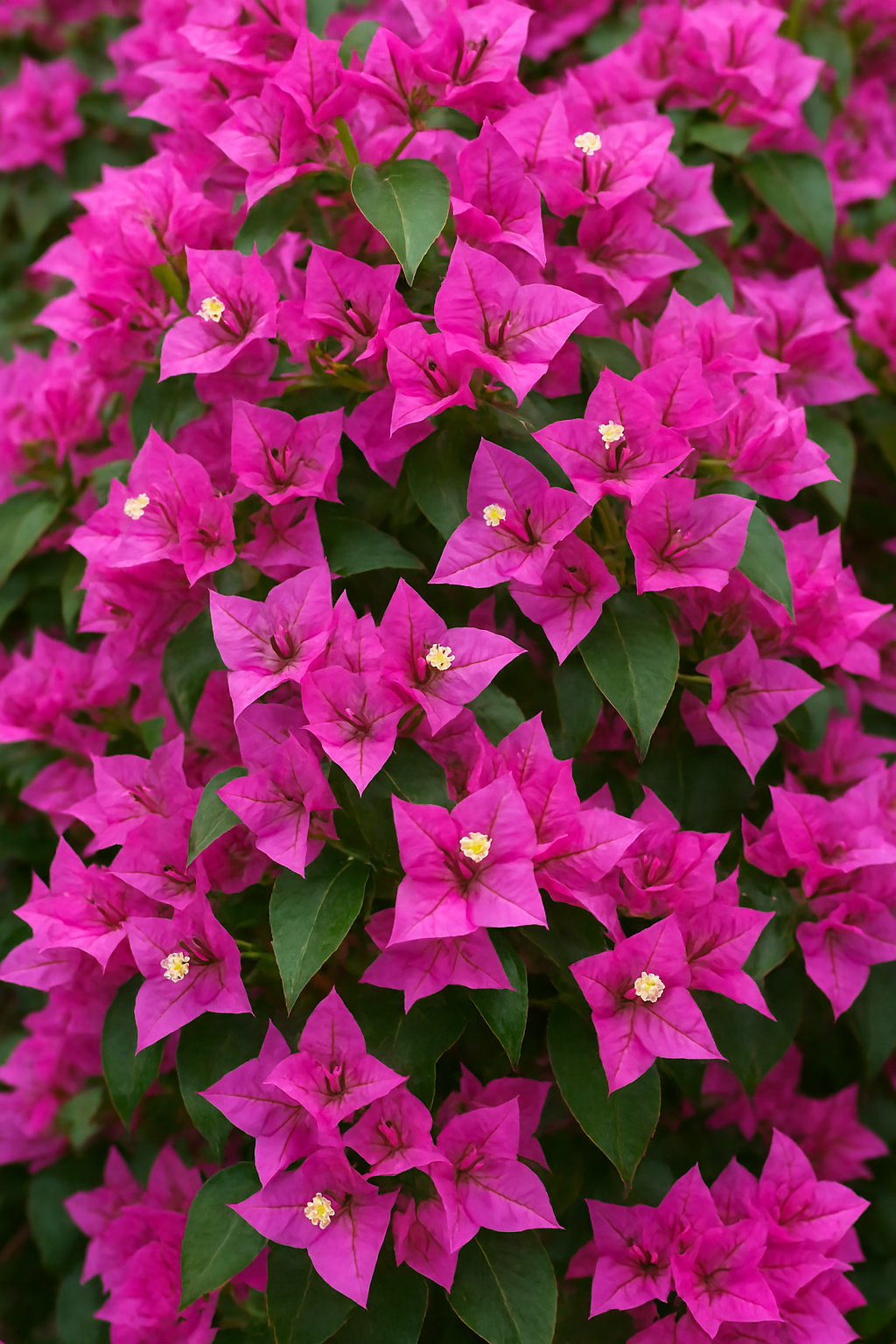
The showy colors of bougainvillea come not from its flowers but from its bracts. The actual flowers are small, tubular, and white, often overlooked by casual observers. This adaptation allows the plant to attract pollinators with bright bracts while protecting its reproductive structures within.
9. Growth height: 1 to 12 meters
Bougainvillea can grow as a sprawling shrub or climb up to 12 meters tall, depending on conditions. Its thorny branches enable it to scramble over fences, trellises, and walls, making it a favorite for covering large structures with vibrant color.
10. Evergreen in wet climates, deciduous in dry
Bougainvillea’s adaptability is evident in its seasonal behavior. In wet, tropical climates, it remains evergreen, while in dry regions it sheds leaves to conserve water. This dual nature makes it suitable for diverse environments, from humid rainforests to arid landscapes.
11. Leaves are ovate-acuminate
The leaves of bougainvillea are simple, ovate-acuminate in shape, meaning they taper to a pointed tip. Measuring 4–13 cm long, they provide a lush green backdrop to the colorful bracts, enhancing the plant’s ornamental appeal.
12. Bracts in multiple colors
Bougainvillea bracts come in a dazzling array of colors—pink, magenta, purple, red, orange, white, and yellow. This diversity results from selective breeding and hybridization, making bougainvillea one of the most versatile ornamental plants for landscaping.
13. Produces a five-lobed achene fruit
Though rarely noticed, bougainvillea produces a narrow, five-lobed achene fruit. These fruits are small and inconspicuous compared to the bracts, but they play a role in seed dispersal and reproduction in wild populations.
14. Introduced to Europe in the 19th century
Bougainvillea was introduced to Europe in the early 19th century, quickly becoming a favorite in botanical gardens. Its exotic appearance and adaptability made it a prized ornamental plant, spreading from Europe to colonies worldwide.
15. Spread through Kew Gardens
Kew Gardens in London played a pivotal role in distributing bougainvillea to British colonies. As a hub of botanical exchange, Kew ensured that bougainvillea reached Asia, Africa, and the Caribbean, embedding it in colonial landscapes.
16. Bougainvillea buttiana as a hybrid
Initially thought to be a distinct species, Bougainvillea buttiana was later identified as a natural hybrid of B. glabra and B. peruviana. This discovery highlighted the plant’s tendency to hybridize, creating new varieties with unique traits.
17. Hybridization across continents
Bougainvillea hybridization has occurred spontaneously in Africa, India, Australia, and the Philippines. These hybrids often display novel colors and growth habits, enriching the diversity of bougainvillea cultivars available today.
18. Thrives in hot, dry climates
Bougainvillea is highly drought-tolerant once established, making it ideal for hot, dry climates. Its ability to flourish with minimal water has made it a staple in Mediterranean and tropical landscaping.
19. Frost-sensitive plant
Despite its resilience, bougainvillea is frost-sensitive and cannot survive prolonged cold. It thrives only in USDA zones 9b–10, limiting its cultivation in temperate regions unless grown in containers and sheltered during winter.
20. Popular in Florida, California, South India, Mediterranean
Bougainvillea is especially popular in warm regions such as Florida, California, South India, and the Mediterranean Basin. In these areas, it adorns homes, public spaces, and gardens, becoming a symbol of tropical beauty.
21. Used in bonsai and hedges
Bougainvillea’s versatility extends to bonsai cultivation, where its thorny branches and colorful bracts create striking miniature trees. It is also used as hedges, hanging baskets, and climbing vines, showcasing its adaptability in ornamental design.
22. Over 300 cultivars exist
There are more than 300 bougainvillea cultivars, including double-flowered and variegated varieties. This vast diversity allows gardeners to choose plants suited to specific aesthetic preferences and environmental conditions.
23. Award-winning cultivars
Cultivars such as San Diego Red and Mary Palmer’s Enchantment have won the Royal Horticultural Society’s Award of Garden Merit. These awards recognize their exceptional beauty, resilience, and performance in gardens.
24. National and regional flower
Bougainvillea is the national flower of Grenada and the official flower of Guam, Ipoh (Malaysia), and several cities in Taiwan, China, and the Philippines. Its widespread adoption as a symbol reflects its cultural resonance and ornamental value.
25. Known by many local names
Bougainvillea is known by diverse local names: trinitaria in the Caribbean, santa-rita in Argentina, veranera in Colombia, and buganvilia in Portuguese-speaking countries. These names reflect its integration into local cultures and its role as a beloved ornamental plant worldwide.
🌿 Bougainvillea FAQs
1. What is bougainvillea?
Bougainvillea is a woody, fast-growing vine native to South America, belonging to the Nyctaginaceae family. It is famous for its colorful bracts (modified leaves) that surround small, white flowers. These bracts come in shades of pink, purple, red, orange, yellow, and white, making bougainvillea one of the most vibrant ornamental plants worldwide.
2. How do you grow bougainvillea?
Bougainvillea thrives in hot, dry climates with full sun exposure. It prefers well-drained soil and minimal watering once established. Overwatering can reduce blooming, while stressing the plant slightly often encourages more bracts. It grows best in USDA zones 9b–10, but in cooler climates, it can be grown in containers and sheltered indoors during winter.
3. How often does bougainvillea bloom?
Bougainvillea can bloom year-round in tropical climates, but in seasonal regions, it typically flowers during warm months. Its blooming cycle is influenced by sunlight, water stress, and pruning. Limiting fertilizer and water often stimulates more vibrant bracts.
4. Is bougainvillea easy to care for?
Yes, bougainvillea is considered low-maintenance once established. It is drought-tolerant, resistant to most pests, and grows quickly. However, it requires regular pruning to control its size and shape, as it can become invasive if left unchecked.
5. Does bougainvillea have thorns?
Bougainvillea vines are covered in sharp thorns, which can make handling difficult. Gardeners often plant them away from walkways or areas where children play. Gloves and protective clothing are recommended when pruning.
6. Can bougainvillea be grown indoors?
Bougainvillea can be grown indoors in containers, but it requires direct sunlight for at least 5–6 hours daily. Without sufficient light, it will produce fewer bracts. Indoor bougainvillea also needs careful watering to avoid root rot.
7. What are popular bougainvillea varieties?
Some popular cultivars include:
- San Diego Red – Large, deep red bracts.
- Mary Palmer’s Enchantment – Double-flowered variety.
- Torch Glow – Compact shrub-like form.
- Orange King – Bright orange bracts.
8. Is bougainvillea used symbolically?
Yes, bougainvillea is the national flower of Grenada and the official flower of Guam, Ipoh (Malaysia), and several cities in Taiwan, China, and the Philippines. It symbolizes passion, resilience, and beauty, often associated with tropical landscapes.
9. What are the risks of growing bougainvillea?
- Thorns can cause injury.
- Sap may irritate skin, similar to poison ivy.
- It can become invasive if not pruned regularly.
- Sensitive to frost, limiting its growth in colder regions.
10. How long does bougainvillea live?
Bougainvillea is a long-lived plant, often surviving for decades if properly cared for. Its resilience in harsh climates makes it a staple in tropical and subtropical gardens.