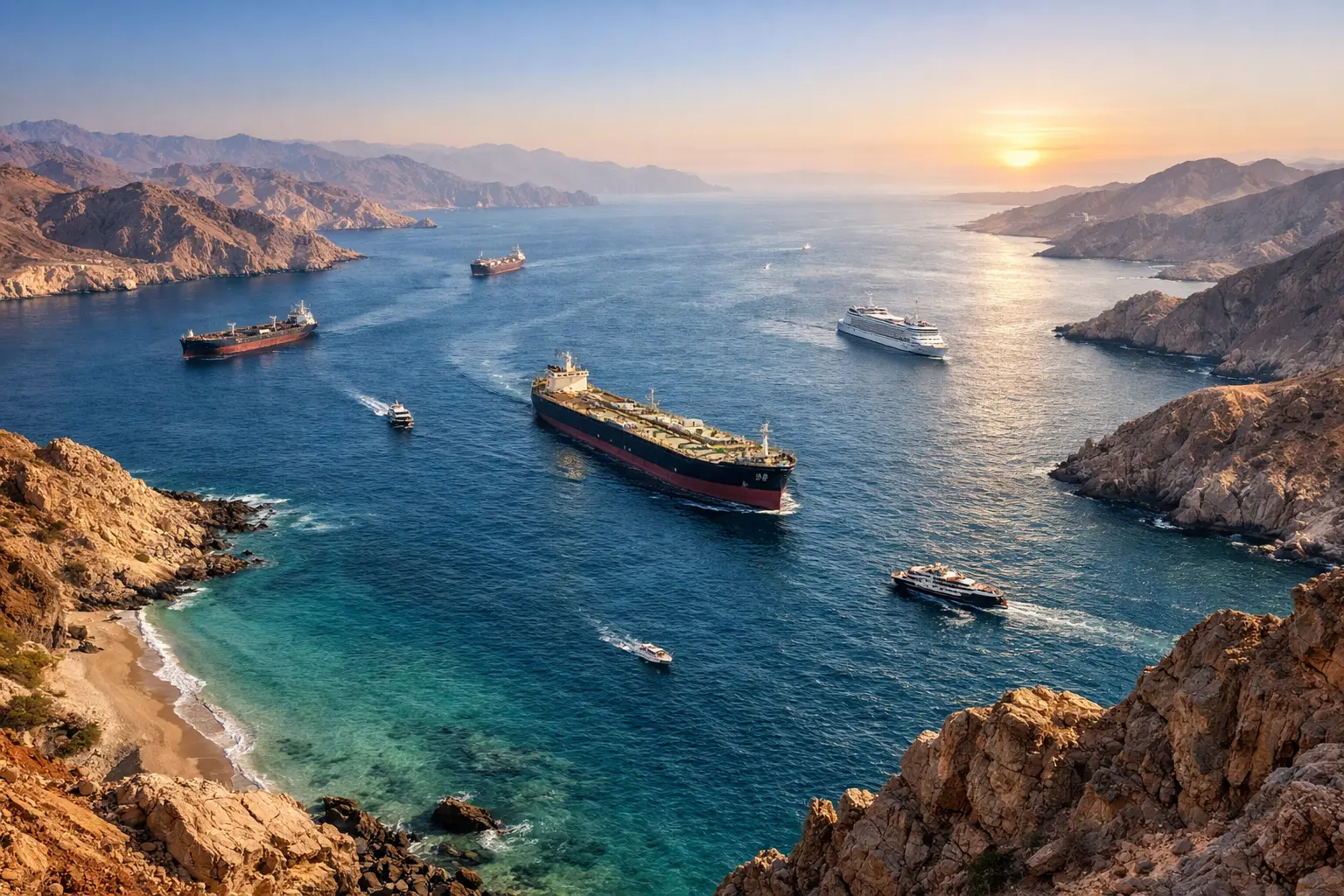
The Strait of Hormuz is far more than a narrow stretch of water—it is a lifeline of global trade, a stage for centuries of conflict, and a symbol of how geography can shape history. Nestled between Iran to the north and Oman and the UAE to the south, this 104‑mile passage funnels nearly a quarter of the world’s oil and a fifth of its liquefied natural gas, making it one of the most strategically important waterways on Earth. Its islands, settlements, and traffic lanes have witnessed empires rise and fall, colonial powers clash, and modern navies patrol in tense standoffs. From its ancient mentions in Greek maritime guides to its role in today’s energy security and international law disputes, the Strait of Hormuz is a place where commerce, culture, and conflict converge. In this post, we’ll explore 25 fascinating facts that reveal why this narrow corridor continues to command global attention.
1. Location
The Strait of Hormuz sits at the crossroads of the Persian Gulf and the Gulf of Oman, making it the only maritime gateway from the oil-rich Gulf states to the Arabian Sea and beyond. This geographic positioning has elevated it from a mere waterway to a global strategic chokepoint. Its location means that any disruption—whether political, military, or environmental—can ripple across continents, affecting energy markets in Asia, Europe, and North America. For centuries, empires and modern states alike have recognized its importance, from the Portuguese in the 16th century to today’s U.S. Navy patrols.
2. Length
Stretching about 104 miles (167 km), the Strait of Hormuz is not particularly long compared to other global waterways, but its length is deceptive. Within this relatively short span lies a corridor through which a staggering volume of global trade flows. Its compactness makes it easier to monitor and control, but also more vulnerable to blockades or military confrontations. The length also means that ships passing through are exposed for hours, not minutes, to potential threats from coastal batteries, fast attack craft, or even drones.
3. Width
The strait narrows to just 24 miles (39 km) at its tightest point, a feature that magnifies its vulnerability. While 60 miles wide at its broadest, the navigable shipping lanes are far narrower, forcing massive oil tankers and LNG carriers into predictable paths. This bottleneck effect is why naval strategists often describe the Strait of Hormuz as a “pressure point” in global trade. A single incident—such as a grounded tanker or a deliberate blockade—could halt traffic entirely, with catastrophic consequences for energy markets.
4. Borders
Iran dominates the northern shore, while Oman’s Musandam Peninsula and the UAE line the southern coast. This geopolitical geography creates a delicate balance: Iran, with its history of tension with Western powers, has the ability to threaten closure, while Oman has traditionally played the role of mediator and stabilizer. The UAE, meanwhile, has invested heavily in alternative pipelines to bypass the strait, underscoring how geography dictates national policy. The proximity of these states means that any naval incident could quickly escalate into a regional crisis.
5. Islands
Hormuz, Qeshm, and Larak Islands dot the strait, each with strategic and historical significance. Hormuz Island once hosted the Kingdom of Ormus, a medieval trading hub. Qeshm, the largest island in the Persian Gulf, is heavily fortified and used by Iran for military purposes. Larak, though smaller, is strategically positioned near the shipping lanes. These islands are not just geographic features—they are military assets, staging grounds, and symbols of sovereignty, often used by Iran to assert control over the strait.
6. Settlements Nearby
Bandar Abbas in Iran and Khasab in Oman are the two most prominent settlements near the strait. Bandar Abbas is Iran’s principal naval base, housing warships, submarines, and missile batteries. It is also a bustling commercial port, blending civilian trade with military readiness. Khasab, by contrast, is a quieter Omani town known for its fishing and tourism, but its location makes it a listening post for monitoring traffic. Together, these settlements embody the dual nature of the strait: commerce and conflict intertwined.
7. Only Sea Passage
The Strait of Hormuz is the sole maritime exit from the Persian Gulf, meaning that countries like Kuwait, Qatar, Bahrain, and Iraq have no alternative route for their exports. This exclusivity magnifies its importance: pipelines can provide partial relief, but they cannot match the scale of seaborne trade. The strait’s monopoly on Gulf access makes it a perpetual bargaining chip in international diplomacy, with Iran often threatening closure during periods of tension.
8. Oil Trade
Roughly 25% of the world’s seaborne oil trade flows through the strait, amounting to millions of barrels per day. This figure underscores how dependent global markets are on this narrow waterway. Any disruption—whether from conflict, piracy, or even natural disaster—would send oil prices skyrocketing. The strait is thus not just a regional asset but a global lifeline, tying the economies of Asia, Europe, and North America to its stability.
9. LNG Trade
The strait also carries about 20% of global liquefied natural gas (LNG), much of it from Qatar, the world’s largest LNG exporter. LNG is critical for countries like Japan, South Korea, and India, which rely on imports for electricity generation. The LNG trade adds another layer of vulnerability: unlike oil, LNG requires specialized carriers and terminals, making rerouting more difficult. This dependence makes the strait a focal point not only for oil markets but also for global energy diversification strategies.
10. Critical for Gulf States
For Gulf states, the strait is both a blessing and a curse. It enables them to export their vast energy resources, but it also exposes them to geopolitical risks. Qatar, for instance, has invested in pipelines to reduce reliance, while the UAE built the Habshan–Fujairah pipeline to bypass the strait. Yet, complete independence is impossible, meaning that Gulf states must constantly balance economic reliance with security concerns.
11. Europe’s Energy Security
Europe imports significant volumes of oil and LNG through the strait, making its stability a cornerstone of European energy policy. The EU has invested in diversification—such as pipelines from Russia and North Africa—but the Strait of Hormuz remains irreplaceable. This dependence explains why European navies often join U.S.-led patrols in the region, ensuring freedom of navigation. The strait thus ties European prosperity to Middle Eastern stability in a way few other regions do.
12. Fertilizer Exports
Beyond oil and gas, the strait is vital for global agriculture. About 30% of the world’s urea and 20–30% of ammonia exports pass through, both essential for fertilizers. This means that disruptions in the strait could affect food security worldwide, raising prices and threatening harvests. The fertilizer trade highlights how the strait’s importance extends beyond energy, touching the very foundations of global food supply chains.
13. Name from Ahura Mazda
One theory suggests the name “Hormuz” derives from Ahura Mazda, the supreme god in Zoroastrianism. This etymology reflects the deep cultural and religious roots of the region, linking geography to spirituality. The association with a divine figure underscores the reverence ancient peoples may have held for the strait, seeing it not just as a passage but as a sacred threshold.
14. Place of Dates
Another theory traces the name to “Hur-Mogh,” meaning “Place of Dates.” This reflects the agricultural richness of the region, where date palms have long been a staple crop. The name emphasizes the strait’s role not only as a maritime hub but also as a center of trade in everyday commodities, connecting local livelihoods to global commerce.
15. Ifra Hormizd
Some scholars argue the strait was named after Ifra Hormizd, mother of King Shapur II of the Sassanian Empire. This interpretation ties the strait to dynastic history, embedding it in the lineage of Persian royalty. Naming such a critical waterway after a queen mother highlights the cultural importance of maternal figures in Persian tradition.
16. Greek Origin
The Greek word “Hormos,” meaning cove or bay, offers another possible origin. This reflects the strait’s role in ancient navigation, where Greek sailors and geographers documented its geography. The Greek connection underscores the strait’s place in classical antiquity, linking it to broader Mediterranean trade networks.
17. Periplus of the Erythraean Sea
The strait is mentioned in the 1st-century Periplus of the Erythraean Sea, a Greek maritime guide. This reference proves its importance in ancient trade, connecting Roman, Indian, and Arabian markets. The Periplus highlights how the strait was already a global hub two millennia ago, long before oil made it famous.
18. Kingdom of Ormus
From the 10th to 17th centuries, the Kingdom of Ormus controlled the strait, turning it into a thriving trading hub. Ormus was renowned for its wealth, cosmopolitanism, and strategic diplomacy. Its dominance illustrates how control of the strait has always equated to economic and political power.
19. Portuguese Control
The Portuguese seized the strait in 1507, holding it until 1750. Their control marked the beginning of European colonial involvement in the region. The Portuguese fortified Hormuz Island, using it as a base to dominate trade routes. This period highlights how the strait’s importance attracted global powers long before modern geopolitics.
20. Traffic Separation Scheme
Modern shipping follows a Traffic Separation Scheme (TSS), with inbound and outbound lanes to prevent collisions. This system is critical given the size of oil tankers and LNG carriers, which require precise navigation. The TSS reflects how technology and regulation have evolved to manage the strait’s immense traffic safely.
21. Territorial Seas
In the 1970s, both Iran and Oman extended their territorial seas to 12 nautical miles, effectively splitting control of the strait. This expansion gave them greater authority over navigation, but also sparked disputes with the U.S. and other powers. The territorial claims highlight the tension between sovereignty and international law.
22. Iran’s Restrictions
Iran requires foreign warships and nuclear-powered vessels to seek permission before transiting. ThisGreat, let’s expand each of the 25 trivia points into long, detailed paragraphs that really unpack their significance. I’ll continue from where I left off at #22 and carry through to #25, so you’ll have a full set of extended explanations.
22. Iran’s Restrictions
Iran requires foreign warships and nuclear-powered vessels to seek permission before transiting the Strait of Hormuz, a policy that reflects its assertion of sovereignty and its desire to control military activity in its immediate waters. This restriction is controversial because international maritime law, particularly the United Nations Convention on the Law of the Sea (UNCLOS), generally recognizes the right of “innocent passage” through straits used for international navigation. Iran’s stance is therefore seen by many Western powers as an attempt to challenge global norms and assert regional dominance. By demanding prior permission, Iran effectively signals that it has the authority to regulate military traffic, which is especially significant given the heavy presence of U.S. and allied naval forces in the area. This policy has led to repeated confrontations, with the U.S. insisting that its vessels do not need Iranian approval, thereby creating a recurring flashpoint in international relations.
23. U.S. Freedom of Navigation
The United States contests Iran and Oman’s restrictions, citing freedom of navigation as a fundamental principle of international law. The U.S. Navy regularly conducts “freedom of navigation operations” (FONOPs) to demonstrate its refusal to recognize excessive maritime claims. In the Strait of Hormuz, this means that U.S. warships often transit without seeking permission, directly challenging Iran’s regulations. These operations are not just symbolic—they are intended to reinforce the idea that no single nation can control such a vital global artery. However, they also heighten tensions, as Iran views them as provocations and violations of its sovereignty. This clash of legal interpretations—sovereignty versus international passage rights—has made the strait a recurring stage for geopolitical theater, where law, power, and military presence intersect.
24. Tanker War (1980s)
During the Iran–Iraq War, the Strait of Hormuz became the focal point of what is known as the “Tanker War.” Iraq, seeking to cripple Iran’s economy, began attacking Iranian oil tankers and facilities. Iran retaliated by targeting Kuwaiti and Saudi tankers that supported Iraq. The result was a dangerous escalation in which neutral shipping became a target, threatening global energy supplies. The U.S. and other Western nations intervened, reflagging Kuwaiti tankers under American flags and escorting them through the strait. This period demonstrated how quickly the strait could become militarized and how vulnerable global trade was to regional conflicts. Despite the attacks, Iran never fully closed the strait, recognizing that doing so would alienate even its allies. The Tanker War remains a vivid example of how localized conflict can have global repercussions when it involves the Strait of Hormuz.
25. Iran Air Flight 655 (1988)
One of the most tragic incidents in the history of the Strait of Hormuz occurred in July 1988, when the U.S. Navy cruiser USS Vincennes shot down Iran Air Flight 655, a civilian Airbus A300, killing all 290 people on board. The Vincennes mistook the airliner for an attacking Iranian fighter jet during a tense naval engagement in the strait. The incident shocked the world and remains a deeply painful memory in Iran, fueling anti-American sentiment for decades. It highlighted the dangers of operating military forces in such a congested and high-stakes environment, where misidentifications can lead to catastrophic consequences. The tragedy also underscored the strait’s volatility: a single mistake in its narrow waters can escalate into international crisis. Even today, Flight 655 is invoked in discussions about U.S.–Iran relations, serving as a reminder of the human cost of geopolitical tension in the Strait of Hormuz.
FAQs about the Strait of Harmuz:
❓ Who owns the Strait of Hormuz?
The Strait of Hormuz is bordered by Iran to the north and Oman’s Musandam Peninsula to the south, with the United Arab Emirates nearby. The shipping lanes themselves lie mostly in Omani territorial waters and partly in Iranian waters, but they are governed by international maritime law under UNCLOS (United Nations Convention on the Law of the Sea). This means no single country “owns” the strait outright, though Iran and Oman exert significant control over navigation.
❓ Why is the Strait of Hormuz so important?
It is the only sea passage from the Persian Gulf to the open ocean, making it critical for global energy supply. Roughly 20 million barrels of oil per day—about 25% of global seaborne oil trade—and one-fifth of global LNG shipments pass through. Countries like Qatar, Kuwait, Bahrain, and Iraq rely entirely on this route for exports. Any disruption here can spike global energy prices and destabilize economies worldwide.
❓ Can Iran close the Strait of Hormuz?
Iran has repeatedly threatened to close the strait during times of tension, but in practice, a full closure would be extremely difficult and self-defeating. Iran itself exports oil and gas through the strait, so shutting it down would harm its own economy. Moreover, the U.S. and allied navies maintain a strong presence to ensure freedom of navigation. While Iran could disrupt traffic with harassment, mines, or missile attacks, a sustained closure would likely trigger international military intervention.
❓ What environmental risks exist in the Strait of Hormuz?
The strait is a potential environmental time bomb. With hundreds of giant oil and gas tankers passing daily, the risk of a major spill is high. Conservationists warn that fragile marine ecosystems—home to coral reefs, fish nurseries, and migratory species—could be devastated by even a single large spill. Recent conflicts have heightened this risk, as damaged tankers and military strikes increase the chance of accidents. An oil spill here would not only harm local biodiversity but also affect fisheries and coastal communities across the Gulf.
❓ What islands are strategically important in the Strait of Hormuz?
Several islands play key roles:
- Hormuz Island: Historically the seat of the medieval Kingdom of Ormus.
- Qeshm Island: The largest island in the Persian Gulf, heavily fortified by Iran.
- Larak Island: Positioned near shipping lanes, often used for military staging.
- Abu Musa: Disputed between Iran and the UAE, adding to regional tensions. These islands are not just geographic features—they are military assets that can influence control of the strait.
❓ How safe is shipping through the Strait of Hormuz today?
Despite tensions, shipping continues, but vessels often face verification checks by Iran and must navigate under the watch of multiple navies. For example, Indian-flagged LPG tankers recently crossed the strait after undergoing Iranian inspections, highlighting the delicate balance between commerce and security. While most ships pass safely, the risk of confrontation remains high, especially during regional conflicts.
❓ Are there alternatives to bypass the Strait of Hormuz?
Yes, but they are limited. The UAE built the Habshan–Fujairah pipeline, allowing oil exports directly to the Gulf of Oman, bypassing the strait. Saudi Arabia also has pipelines to the Red Sea. However, these alternatives cannot match the scale of tanker traffic through Hormuz. For LNG, especially from Qatar, there is no viable bypass route, making the strait irreplaceable for global energy flows.