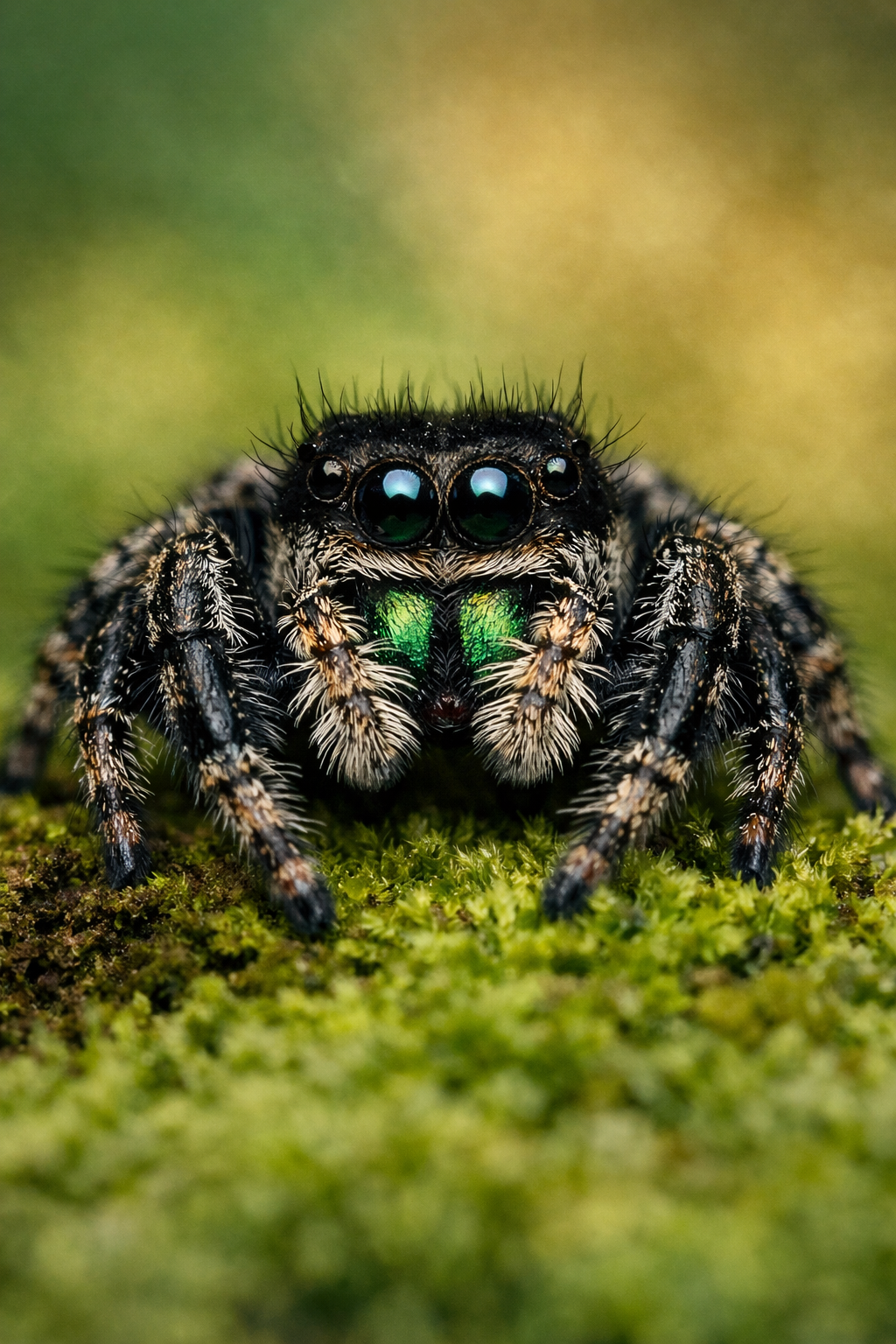
Jumping Spider
Jumping spiders may be tiny, but they are among the most fascinating creatures in the animal kingdom, combining extraordinary vision, acrobatic hunting skills, and surprisingly complex social behaviors. With nearly 7,000 species spread across the globe, these agile predators thrive in environments ranging from tropical forests to deserts and even the slopes of Mount Everest. Their ability to leap many times their body length, communicate through elaborate dances, and even display ultraviolet signals makes them a marvel of evolution. In this post, we’ll explore 25 captivating facts that reveal why jumping spiders are not only the largest spider family but also one of the most remarkable examples of nature’s ingenuity.
1. Family Salticidae is the largest spider family, comprising ~13% of all spider species.
The Salticidae family dominates the spider world in terms of diversity, accounting for approximately 13% of all known spider species. This makes them the single largest family within the order Araneae, surpassing many other groups in sheer numbers. Their success is attributed to their adaptability, advanced vision, and active hunting strategies, which allow them to thrive in environments ranging from tropical forests to deserts and even mountainous regions.
2. There are 695 genera and ~7,000 described species worldwide.
Jumping spiders are astonishingly diverse, with around 695 recognized genera and nearly 7,000 species formally described by arachnologists. This immense variety means they occupy ecological niches across nearly every continent, except Antarctica. The true number of species is likely higher, as new discoveries continue to emerge, especially in underexplored tropical regions where biodiversity is richest.
3. The family was established by Blackwall in 1841.
The formal recognition of Salticidae as a distinct family dates back to 1841, when the British arachnologist John Blackwall classified them based on their unique morphology and behavior. His work laid the foundation for modern taxonomy, distinguishing jumping spiders from other visually oriented hunters. Since then, the family has undergone numerous revisions, reflecting advances in molecular phylogenetics and evolutionary biology.
4. Closest relatives: Philodromidae (running crab spiders).
Salticidae’s closest relatives are the Philodromidae, commonly known as running crab spiders. While both families share certain traits, such as agile hunting, Philodromidae rely more on speed and ambush rather than the precision leaps and advanced vision of Salticidae. Comparative studies of their evolutionary lineage highlight how jumping spiders developed specialized eyes and hydraulic jumping mechanisms that set them apart.
5. A 2015 revision divided Salticidae into seven subfamilies.
In 2015, a major taxonomic revision reorganized Salticidae into seven subfamilies, reflecting evolutionary relationships uncovered through genetic analysis. Among these, Salticinae is by far the largest, containing about 540 genera, while others like Spartaeinae and Lyssomaninae represent smaller but distinct lineages. This classification helps researchers better understand the evolutionary pathways and ecological specializations within the family.
6. Jumping spiders are easily recognized by their rectangular “flat faces” and forward-facing eyes.
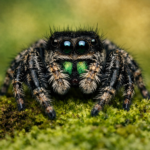
One of the most distinctive features of jumping spiders is their rectangular cephalothorax, which gives them a “flat-faced” appearance. Their forward-facing eyes resemble binoculars, lending them an almost mammalian look compared to other arachnids. This facial structure is not just cosmetic—it supports their extraordinary vision and contributes to their reputation as the most visually advanced spiders.
7. They have eight eyes, with the anterior median pair being especially large.
Jumping spiders possess eight eyes arranged in a unique pattern, with the anterior median pair dominating their facial structure. These large eyes provide high-resolution vision, enabling them to detect fine details and judge distances with remarkable accuracy. The other eyes serve complementary roles, such as motion detection and peripheral awareness, creating a nearly panoramic field of view.
8. Body length ranges from 1–25 mm; the largest species is Hyllus giganteus.
Jumping spiders vary greatly in size, from tiny species measuring just 1 mm to giants like Hyllus giganteus, which can reach 25 mm in body length. Despite their small stature, even the tiniest species exhibit the same advanced hunting behaviors and visual capabilities. The larger species, often found in tropical regions, are particularly striking due to their bold coloration and impressive leaps.
9. Their front legs are larger, used for prey grasping and signaling, while rear legs power jumps.
The morphology of jumping spiders reflects their dual reliance on hunting and communication. Their front legs are often enlarged and used both for capturing prey and for visual displays during courtship rituals. Meanwhile, their rear legs are muscular and specialized for launching powerful jumps, allowing them to cover distances many times their body length with precision.
10. They lack the prominent spines found in crab or lynx spiders.
Unlike crab spiders (Thomisidae) or lynx spiders (Oxyopidae), jumping spiders do not rely on spiny legs for capturing prey. Instead, they depend on stealth, vision, and agility to stalk and leap onto their targets. This evolutionary trade-off highlights their reliance on active hunting strategies rather than brute force or ambush tactics.
11. They have stereoscopic color vision and possibly tetrachromatic vision.
Jumping spiders are among the few arthropods capable of stereoscopic color vision, meaning they can perceive depth and color simultaneously. Research suggests they may even possess tetrachromatic vision, with sensitivity to ultraviolet, green, and red wavelengths. This ability allows them to detect prey, mates, and predators with extraordinary precision, even in complex environments.
12. The anterior median eyes are telescopic, with a four-layered retina.
The anterior median eyes function like telescopes, with a retina composed of four distinct layers. Each layer is sensitive to different wavelengths, enabling the spider to process a wide spectrum of visual information. This layered retina design is unique among arachnids and contributes to their ability to perceive fine details and subtle movements.
13. Secondary eyes provide motion detection and wide-angle vision.
While the anterior median eyes handle high-resolution detail, the secondary eyes are specialized for detecting motion and providing a wide-angle view. Together, these eyes give jumping spiders nearly 360° coverage, ensuring they can spot threats or prey from almost any direction. This combination of acute detail and broad awareness makes them formidable hunters.
14. Some species use UV markings for sexual signaling.
Species such as Cosmophasis umbratica exhibit ultraviolet markings that are invisible to predators but highly visible to potential mates. These UV signals play a crucial role in courtship, allowing males to attract females while minimizing predation risk. The use of UV light demonstrates the sophistication of their communication systems, which extend beyond human visual perception.
15. Their visual acuity is extremely high (11 minutes of arc).
Jumping spiders’ visual acuity measures at 11 minutes of arc, a level comparable to some vertebrates and far superior to most other arthropods. This means they can distinguish fine details at relatively long distances, an ability essential for stalking prey and recognizing mates. Their vision is so advanced that it rivals that of animals many times their size.
16. They use hydraulic pressure to extend limbs for powerful jumps.
Jumping spiders rely on hydraulic pressure, rather than large muscles, to power their leaps. By rapidly increasing hemolymph pressure in their legs, they can extend them explosively, launching themselves into the air. This mechanism allows them to achieve remarkable jumping distances without requiring bulky musculature.
17. Some species can jump up to 38× their body length.
Certain jumping spiders are capable of leaps up to 38 times their body length, a feat that would be equivalent to a human jumping over a skyscraper. This extraordinary ability is not only used for hunting but also for evading predators. Their precision in landing is aided by silk draglines, which act as safety ropes in case of miscalculation.
18. They tether silk draglines for safety, braking, and stabilization.
Before leaping, jumping spiders anchor a silk dragline to the surface, ensuring they remain tethered during their jump. This silk serves multiple purposes: it prevents falls, acts as a braking mechanism, and stabilizes their trajectory. The dragline is a critical adaptation that enhances their survival during risky maneuvers.
19. Hunting is diurnal, visually guided, and often involves complex detours.
Jumping spiders are primarily diurnal hunters, relying on their vision to stalk prey during daylight hours. Some species, such as Portia, demonstrate remarkable problem-solving abilities, taking detours to ambush prey from unexpected angles. This level of cognitive complexity is rare among spiders and suggests advanced neural processing.
20. Some species specialize in ant predation or spider hunting.
Several jumping spiders have evolved to specialize in hunting ants or other spiders, often using deceptive tactics. For example, some mimic ant behavior to infiltrate colonies, while others invade webs and produce vibrations that mimic trapped prey. These specialized strategies highlight their adaptability and intelligence in exploiting ecological niches.
21. Most are carnivorous, feeding on insects and other spiders.
The majority of jumping spiders are carnivorous, preying on insects such as flies, moths, and beetles, as well as other spiders. Their hunting style is active and precise, relying on stealth and sudden leaps rather than webs. This makes them important regulators of insect populations in many ecosystems.
22. Some consume nectar, such as Bagheera kiplingi.
The Central American species Bagheera kiplingi is unique among spiders for its primarily herbivorous diet, feeding on nectar and plant material. This dietary adaptation demonstrates the flexibility of Salticidae in exploiting available resources. It also challenges traditional assumptions about spiders being strictly carnivorous.
23. The Southeast Asian Toxeus magnus produces “milk” to feed offspring.
In a remarkable display of parental care, Toxeus magnus produces a nutritious fluid akin to “milk” to feed its offspring. This secretion ensures the survival of spiderlings during their vulnerable early stages. Such behavior is rare among arachnids and underscores the evolutionary innovation within Salticidae.
24. Males perform elaborate dances, displaying iridescent hairs, leg fringes, and UV markings.
Male jumping spiders are renowned for their complex and visually striking courtship rituals, which often involve rhythmic dances, leg waves, and body vibrations. These displays are enhanced by iridescent scales, fringed legs, and ultraviolet markings that females can perceive but predators often cannot. The dances serve a dual purpose: they demonstrate the male’s fitness and genetic quality while also reducing the risk of being mistaken for prey by the female, who is often larger and capable of killing him if unimpressed.
25. Courtship involves visual, vibrational, and auditory signals, with females responding by crouching or vibrating palps.
Courtship in jumping spiders is multimodal, combining visual signals with vibrational and even auditory cues transmitted through substrates. Males may drum their legs, vibrate their abdomens, or produce sounds that travel through leaves or silk, while females respond with subtle gestures such as crouching, palp vibrations, or reciprocal movements. This intricate communication system ensures species recognition, reduces aggression, and facilitates successful mating, highlighting the evolutionary sophistication of Salticidae compared to many other spider families.
🕷️ Frequently Asked Questions About Jumping Spiders
1. Are jumping spiders dangerous to humans?
Jumping spiders are not dangerous to humans. While they do possess venom glands used to subdue prey, their venom is harmless to people and far weaker than that of medically significant spiders like black widows. Bites are extremely rare and usually occur only if the spider feels threatened, resulting in mild irritation similar to a mosquito bite.
2. Do jumping spiders bite?
Yes, they can bite, but it is very uncommon. Most jumping spiders prefer to flee rather than attack, and their small fangs are not designed to penetrate human skin effectively. If a bite does occur, it is typically defensive and causes only minor discomfort.
3. Can jumping spiders recognize humans?
Surprisingly, many enthusiasts believe jumping spiders can recognize and respond to human presence. Their advanced vision allows them to track movements and even turn their heads to follow observers. While scientific evidence is limited, anecdotal reports suggest they can distinguish familiar caretakers from strangers.
4. Are jumping spiders friendly?
Jumping spiders are often described as curious and bold, showing less fear of humans compared to other spiders. They may approach people out of interest, and some keepers report that their spiders seem to “interact” with them. While friendliness is a human interpretation, their behavior is undeniably engaging.
5. Do jumping spiders make good pets?
Yes, jumping spiders are considered excellent beginner pets. They are small, easy to care for, and require minimal space in a well-ventilated enclosure. Their active hunting, inquisitive nature, and visible behaviors make them more entertaining than web-building spiders.
6. What do jumping spiders eat?
Jumping spiders are carnivorous, feeding primarily on small insects such as flies, moths, and ants. In captivity, they thrive on a diet of fruit flies, crickets, or other appropriately sized feeder insects. Some species, like Bagheera kiplingi, are unusual in consuming nectar and plant matter.
7. How far can jumping spiders jump?
Jumping spiders can leap 10–40 times their body length, an extraordinary feat powered by hydraulic pressure in their legs. This ability allows them to ambush prey with precision and escape predators quickly. Their jumps are stabilized by silk draglines that act as safety ropes.
8. How many species of jumping spiders exist?
There are over 6,000–7,000 species of jumping spiders described worldwide, making them the largest spider family. They are most abundant in tropical regions but can also be found in deserts, mountains, and even Arctic zones.
9. Where are jumping spiders commonly found?
Jumping spiders are distributed globally, with high diversity in tropical forests. In North America, species like Phidippus audax (the bold jumper) are widespread, ranging from Canada to Mexico. They can also inhabit urban gardens, walls, and windowsills, making them familiar to many people.
10. Are jumping spiders intelligent?
Jumping spiders demonstrate remarkable problem-solving abilities, especially species like Portia, which can plan detours to ambush prey. Their ability to learn from experience and adapt hunting strategies suggests a level of cognitive complexity unusual for arachnids. This intelligence contributes to their reputation as “thinking” spiders.