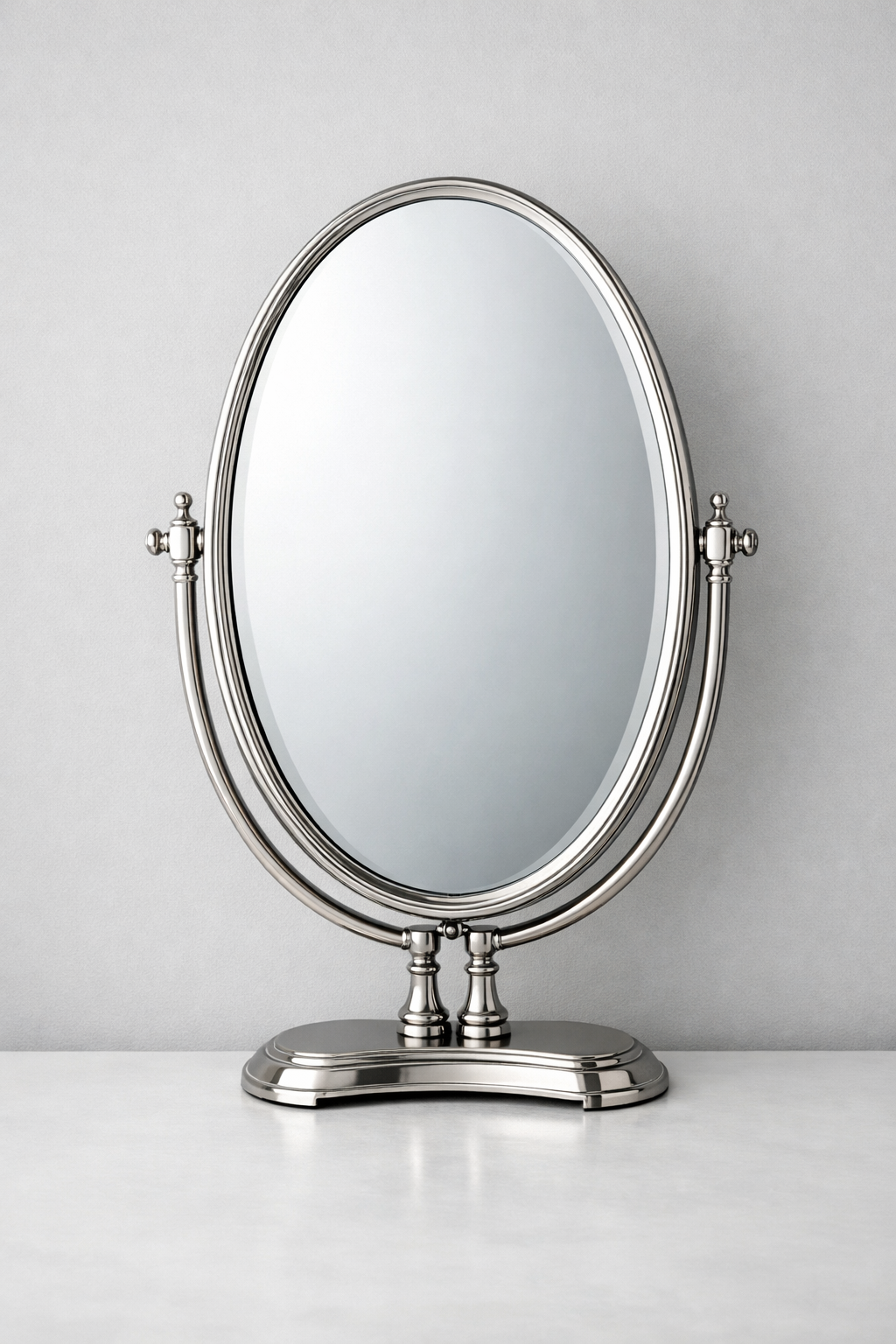
Mirror
Mirrors have fascinated humanity for thousands of years, serving as both practical tools and powerful symbols across cultures. From the shimmering pools of water used by prehistoric people to the massive parabolic mirrors that power solar furnaces and telescopes today, these reflective surfaces tell a story of innovation, science, and superstition. In this article, we’ll explore 25 interesting facts about mirrors—spanning their ancient origins, technological breakthroughs, cultural meanings, and modern applications—that reveal why these everyday objects are far more extraordinary than they first appear.
Fact 1: The Earliest Mirrors Were Pools of Water
Long before humans learned to shape metals or glass, nature itself provided the first reflective surfaces. A calm pool of water acted as a primitive mirror, allowing early humans to glimpse their own faces. This simple phenomenon was more than vanity—it likely played a role in self-awareness and identity formation. Anthropologists suggest that seeing one’s reflection may have influenced early concepts of the “self,” a cornerstone of human consciousness. These natural mirrors were fleeting, dependent on weather and environment, but they set the stage for humanity’s fascination with reflection and the pursuit of more permanent reflective tools.
Fact 2: Obsidian Mirrors in Anatolia (6000 BCE)
By around 6000 BCE, people in Anatolia (modern-day Turkey) began crafting mirrors from polished obsidian, a volcanic glass formed from rapidly cooled lava. These mirrors were not only functional but also symbolic, often associated with ritual and status. Archaeological finds suggest they were used in burial practices, hinting at a spiritual dimension—perhaps as portals to the soul or tools for divination. The craftsmanship required to polish obsidian to a reflective sheen demonstrates remarkable technological skill for the time, and these artifacts remain some of the earliest evidence of human ingenuity in manipulating natural materials for symbolic and practical purposes.
Fact 3: Bronze Age Copper and Bronze Mirrors
As metallurgy advanced, civilizations in Mesopotamia and Egypt began producing mirrors from polished copper and bronze around 3000–4000 BCE. These mirrors were durable, portable, and often beautifully decorated, reflecting both faces and cultural values. In Egypt, mirrors were linked to Hathor, the goddess of beauty and love, and were frequently included in tombs as grave goods. Their reflective quality was less perfect than modern glass mirrors, but they were prized possessions, often reserved for the elite. The transition from stone to metal mirrors marked a leap in technological sophistication and broadened their role from ritual objects to everyday tools of grooming and adornment.
Fact 4: Roman Glass Mirrors Backed with Lead or Gold
The Romans introduced a significant innovation by combining glass with reflective backing materials like lead or gold leaf. This technique produced clearer reflections than polished metal alone, though the mirrors were small and expensive. Roman mirrors were luxury items, often framed in ornate designs, and they symbolized wealth and refinement. The use of glass also foreshadowed the eventual dominance of glass-based mirrors in later centuries. These artifacts reveal the Roman mastery of glassmaking and their desire to integrate beauty with practicality, laying the groundwork for the Venetian and modern mirrors that would follow.
Fact 5: Venetian Tin–Mercury Amalgam Mirrors
During the Middle Ages, Venetian artisans perfected the art of mirror-making using a tin–mercury amalgam applied to glass. These mirrors were dazzlingly clear compared to earlier versions and became highly sought after across Europe. Venice guarded the secret of their production fiercely, making mirrors a luxury commodity that only the wealthy could afford. Their brilliance transformed interior design, allowing rooms to appear larger and more luminous. However, the process was hazardous, as mercury exposure posed serious health risks to the craftsmen. Despite this, Venetian mirrors became symbols of opulence and artistic achievement, influencing both fashion and architecture.
Fact 6: The Silvered-Glass Mirror Revolution of 1835
In 1835, German chemist Justus von Liebig introduced a groundbreaking method of coating glass with a thin layer of metallic silver, creating what we now recognize as the modern mirror. This innovation transformed mirrors from luxury items into everyday household objects. Unlike earlier tin–mercury amalgam mirrors, Liebig’s silvered-glass mirrors were clearer, safer to produce, and far more affordable. The invention coincided with the Industrial Revolution, a period of mass production and technological progress, which allowed mirrors to be manufactured on a large scale. This democratization of mirrors changed society—suddenly, ordinary people could afford to see themselves clearly, influencing fashion, grooming, and even psychology by reinforcing self-awareness and identity.
Fact 7: Aluminum Mirrors and Their Durability
While silver offered excellent reflectivity, it tarnished quickly when exposed to air. Aluminum, introduced later, became a popular alternative due to its resistance to oxidation and corrosion. Though slightly less reflective than silver, aluminum mirrors proved more practical for everyday use, particularly in humid or outdoor environments. Today, aluminum coatings dominate in applications like automotive mirrors, telescopes, and scientific instruments, where durability is more important than perfect reflectivity. The shift from silver to aluminum illustrates how material science adapts to practical needs, balancing performance with longevity.
Fact 8: Plane Mirrors and Their Unique Image
Plane mirrors, the simplest type, produce images that are undistorted but laterally inverted—meaning left and right are reversed. This inversion has fascinated philosophers and scientists alike, as it highlights the difference between physical reality and perception. While the image appears identical to the object, it is virtual, existing only in the mind’s interpretation of reflected light. Plane mirrors are ubiquitous in homes, vehicles, and public spaces, serving both functional and decorative roles. Their simplicity belies their profound impact on human culture, from grooming rituals to artistic symbolism.
Fact 9: Concave Mirrors and Magnification
Concave mirrors curve inward, focusing light to a single point. This property allows them to magnify objects when positioned close, making them invaluable in applications like shaving mirrors, makeup mirrors, and dental tools. At greater distances, concave mirrors can concentrate light beams, a principle harnessed in telescopes, headlights, and solar furnaces. Their ability to manipulate light demonstrates the interplay between geometry and optics, showing how simple curvature can unlock powerful scientific and practical uses.
Fact 10: Convex Mirrors and Wide-Angle Views
Convex mirrors curve outward, spreading reflected light and providing a wider field of view. This makes them essential for safety, particularly in vehicle rear-view mirrors and security installations. Though they distort images by shrinking them, the trade-off is increased visibility, reducing blind spots and enhancing awareness. Convex mirrors embody the principle that distortion can be useful, prioritizing situational awareness over accuracy. Their widespread use underscores how optics can be tailored to human needs in everyday life.
Fact 11: Parabolic Mirrors and Concentrated Rays
Parabolic mirrors are shaped to concentrate parallel rays of light into a single focal point. This design is critical in telescopes, where capturing faint starlight requires maximum efficiency, and in solar furnaces, where sunlight is focused to generate extreme heat. Parabolic mirrors also underpin satellite dishes and radio telescopes, extending their utility beyond visible light into other parts of the electromagnetic spectrum. Their precision demonstrates how geometry can amplify natural forces, turning weak signals or diffuse light into powerful tools for science and industry.
Fact 12: Dielectric Mirrors and Thin-Film Interference
Dielectric mirrors rely on thin-film interference, layering materials with different refractive indices to reflect specific wavelengths with extraordinary efficiency. Unlike metallic mirrors, which reflect broadly, dielectric mirrors can achieve reflectivity above 99.99% in narrow ranges, making them indispensable in lasers and optical instruments. Their design reflects the sophistication of modern optics, where control over light at the microscopic level enables technologies ranging from fiber optics to quantum computing. These mirrors represent the cutting edge of reflection science, far beyond the simple glass-and-metal designs of earlier centuries.
Fact 13: Acoustic Mirrors and Early Aircraft Detection
Before radar, nations experimented with acoustic mirrors—large concrete structures designed to reflect and concentrate sound waves. In Britain during the early 20th century, these devices were used to detect the distant hum of approaching aircraft engines. Though eventually replaced by radar, acoustic mirrors remain as historical monuments to human ingenuity in defense technology. They highlight the versatility of reflection, showing that mirrors need not be limited to light but can manipulate sound waves as well. Their legacy is a reminder of how necessity drives innovation, even in unexpected directions.
Fact 14: Atomic Mirrors and Quantum Experiments
Atomic mirrors reflect matter waves rather than light, a concept rooted in quantum mechanics. These devices use electromagnetic fields or specially structured surfaces to redirect atoms, enabling experiments in atomic interferometry and quantum optics. Atomic mirrors are crucial in studying fundamental physics, such as wave-particle duality and precision measurements of gravitational forces. Their existence expands the definition of a mirror, proving that reflection is a universal principle applicable to both classical and quantum realms. They represent the frontier of science, where mirrors are tools not just for vision but for probing the deepest laws of nature.
Fact 15: Nonlinear Optical Mirrors in Laser Technology
Nonlinear optical mirrors, also known as phase-conjugate mirrors, can reverse the direction and phase of incoming light waves. This property allows them to correct distortions in laser beams, making them invaluable in high-precision applications. By essentially “undoing” the effects of turbulence or imperfections in optical systems, these mirrors ensure that lasers remain coherent and focused. Their development showcases the marriage of physics and engineering, where abstract principles of wave behavior translate into practical tools for medicine, communication, and defense.
Fact 16: Silver Reflects Up to 99% of Visible Light
Silver is renowned for its exceptional ability to reflect visible light, with reflectivity reaching as high as 99%. This makes silver-coated mirrors ideal for applications requiring maximum clarity and brightness, such as high-end decorative mirrors or scientific instruments. However, silver’s tendency to tarnish when exposed to air and moisture limits its practicality in everyday use. Historically, silver mirrors were prized possessions, often reserved for the wealthy, and their brilliance symbolized purity and perfection. Even today, silver remains the gold standard for optical quality, used in specialized contexts where performance outweighs maintenance concerns.
Fact 17: Gold Mirrors for Infrared Reflection
Gold may not be the best choice for visible light, but it excels in reflecting infrared radiation, with efficiency above 96%. This property makes gold mirrors indispensable in infrared optics, astronomy, and thermal imaging technologies. Their ability to handle heat and infrared wavelengths allows scientists to study celestial bodies and thermal phenomena with precision. The softness of gold, however, means these mirrors require careful handling and are often used in controlled environments. Their specialized role highlights how different metals serve unique purposes in the vast spectrum of light.
Fact 18: Mirrors in Telescopes
Telescopes rely on mirrors to gather and focus faint light from distant stars and galaxies. Large concave or parabolic mirrors act as light collectors, amplifying signals that would otherwise be invisible to the human eye. The largest astronomical mirrors, spanning several meters in diameter, are marvels of engineering, requiring extreme precision to avoid distortions. These mirrors have expanded humanity’s understanding of the universe, enabling discoveries from planetary systems to the cosmic microwave background. Without mirrors, modern astronomy would be impossible, underscoring their central role in science.
Fact 19: Mirrors in Lasers
Lasers depend on mirrors to amplify and direct light beams. Within a laser cavity, mirrors bounce photons back and forth, stimulating emission and producing coherent, focused light. This principle, known as “light amplification by stimulated emission of radiation,” would not function without mirrors. Their role is so critical that even slight imperfections can disrupt laser performance. From medical surgery to telecommunications, lasers powered by mirrors have revolutionized technology, proving that reflection is not just about vision but about harnessing energy itself.
Fact 20: Mirrors in Periscopes
Periscopes, used in submarines and military observation, rely on mirrors to redirect light around obstacles. By placing mirrors at precise angles, periscopes allow users to see above water or over barriers without exposing themselves. This simple yet ingenious application demonstrates how mirrors extend human vision beyond natural limits. Periscopes have been vital in warfare, exploration, and even children’s toys, showing how a basic principle of reflection can be adapted for diverse purposes.
Fact 21: Solar Furnaces and Giant Mirrors
Solar furnaces use massive arrays of mirrors to concentrate sunlight into a single focal point, generating temperatures high enough to melt metals or power turbines. These installations, often spanning entire hillsides, showcase the potential of mirrors in renewable energy. By harnessing the sun’s rays, solar furnaces provide a sustainable alternative to fossil fuels, highlighting the role of reflection in addressing global energy challenges. The sheer scale of these projects demonstrates how mirrors can move beyond personal use to reshape industries and societies.
Fact 22: The Superstition of Seven Years’ Bad Luck
The belief that breaking a mirror brings seven years of bad luck dates back to ancient Rome, where mirrors were thought to reflect not just physical appearance but the soul itself. Damaging a mirror was seen as harming one’s spirit, with misfortune lasting until the soul renewed after seven years. This superstition spread across cultures and persists today, influencing behavior and folklore. While scientifically unfounded, it illustrates the deep cultural symbolism attached to mirrors, which often transcend their physical function to embody mystical and psychological meanings.
Fact 23: Socrates and Moral Self-Reflection
Greek philosopher Socrates encouraged the use of mirrors not merely for grooming but for moral introspection. He believed that seeing one’s reflection could inspire self-improvement, reminding individuals of their responsibilities and virtues. This philosophical perspective elevated mirrors from tools of vanity to instruments of wisdom. By linking physical reflection with ethical reflection, Socrates highlighted the mirror’s role in shaping character and conscience, a theme that continues in literature and psychology.
Fact 24: Mirrors in Architecture and Decoration
Architects and designers use mirrors to manipulate space and light, creating illusions of depth and openness. A strategically placed mirror can make a small room appear larger or brighten a dim interior by reflecting natural light. Beyond functionality, mirrors serve as aesthetic elements, adding elegance and drama to interiors. From Versailles’ Hall of Mirrors to modern skyscrapers clad in reflective glass, mirrors have transformed architecture into a dialogue between light, space, and perception.
Fact 25: The Largest Mirrors in Observatories
The largest mirrors in the world are found in astronomical observatories, some exceeding 8 meters in diameter. These colossal structures are painstakingly engineered to capture faint cosmic signals with unparalleled precision. Constructing such mirrors involves advanced techniques like adaptive optics, which adjust for atmospheric distortions in real time. These mirrors are gateways to the universe, enabling discoveries about black holes, exoplanets, and the origins of galaxies. They represent the pinnacle of human craftsmanship and curiosity, turning reflection into a bridge between Earth and the cosmos.
🔍FAQs About Mirrors
1. What is a mirror and how does it work?
A mirror is a reflective surface, usually glass coated with a thin layer of metal such as silver or aluminum. It works on the law of reflection, which states that the angle of incidence equals the angle of reflection. When light rays strike the smooth surface, they bounce back predictably, forming a clear image. The smoothness of the surface is crucial—any irregularities scatter light, producing a blurred reflection. Modern mirrors are made by depositing reflective coatings on glass, ensuring durability and clarity.
2. What are the main types of mirrors?
- Plane mirrors: Flat surfaces that produce upright, laterally inverted images of the same size.
- Concave mirrors: Curved inward; they magnify objects when close and focus light when distant, used in telescopes and headlights.
- Convex mirrors: Curved outward; they shrink images but provide a wide field of view, common in vehicle rear-view mirrors.
- Specialized mirrors: Dielectric mirrors (high reflectivity for specific wavelengths), acoustic mirrors (reflect sound), and atomic mirrors (reflect matter waves in quantum experiments).
3. Why do mirrors reverse left and right but not up and down?
Mirrors don’t actually reverse left and right; they reverse front and back. When you raise your right hand, the mirror shows it on the opposite side because the image is flipped along the axis perpendicular to the mirror’s surface. This creates the illusion of left-right reversal, but in reality, the mirror preserves orientation while inverting depth.
4. Who invented the modern mirror?
The modern silvered-glass mirror was invented in 1835 by Justus von Liebig, who developed a chemical process to deposit a thin layer of silver onto glass. This innovation made mirrors affordable and widely available, replacing earlier costly Venetian tin–mercury mirrors.
5. Why are mirrors important in science and technology?
Mirrors are essential in:
- Astronomy: Large parabolic mirrors in telescopes capture faint starlight.
- Lasers: Mirrors amplify and direct coherent light beams.
- Safety: Convex mirrors reduce blind spots in vehicles.
- Energy: Solar furnaces use giant mirrors to concentrate sunlight.
- Medicine: Dental and surgical mirrors provide magnified views.
6. What materials are used to make mirrors?
- Silver: Reflects up to 99% of visible light but tarnishes easily.
- Aluminum: Reflects 85–90%, more durable and widely used today.
- Gold: Excellent for infrared reflection, used in specialized optics.
- Dielectric coatings: Provide extremely high reflectivity for lasers and scientific instruments.
7. Is it true that breaking a mirror brings bad luck?
Yes, this superstition dates back to ancient Rome, where mirrors were believed to reflect the soul. Breaking one was thought to damage the spirit, with misfortune lasting seven years—the time it supposedly took for the soul to renew. Though scientifically baseless, the belief persists in many cultures.
8. Why do some mirrors look distorted?
Distortion occurs when the mirror surface isn’t perfectly smooth or when it’s intentionally curved (like convex or funhouse mirrors). Manufacturing defects, warping, or uneven coatings can also cause irregular reflections. High-quality mirrors minimize distortion by using precision glass and uniform coatings.
9. What is the difference between reflection and refraction in mirrors?
- Reflection: Light bounces back from the mirror surface, forming an image.
- Refraction: Light bends when passing through different media (like glass or water). Mirrors rely on reflection, while lenses rely on refraction.
10. Can mirrors reflect sound or other waves?
Yes. Acoustic mirrors reflect sound waves, historically used to detect aircraft before radar. Atomic mirrors reflect matter waves in quantum experiments. These examples show that the principle of reflection applies beyond visible light.