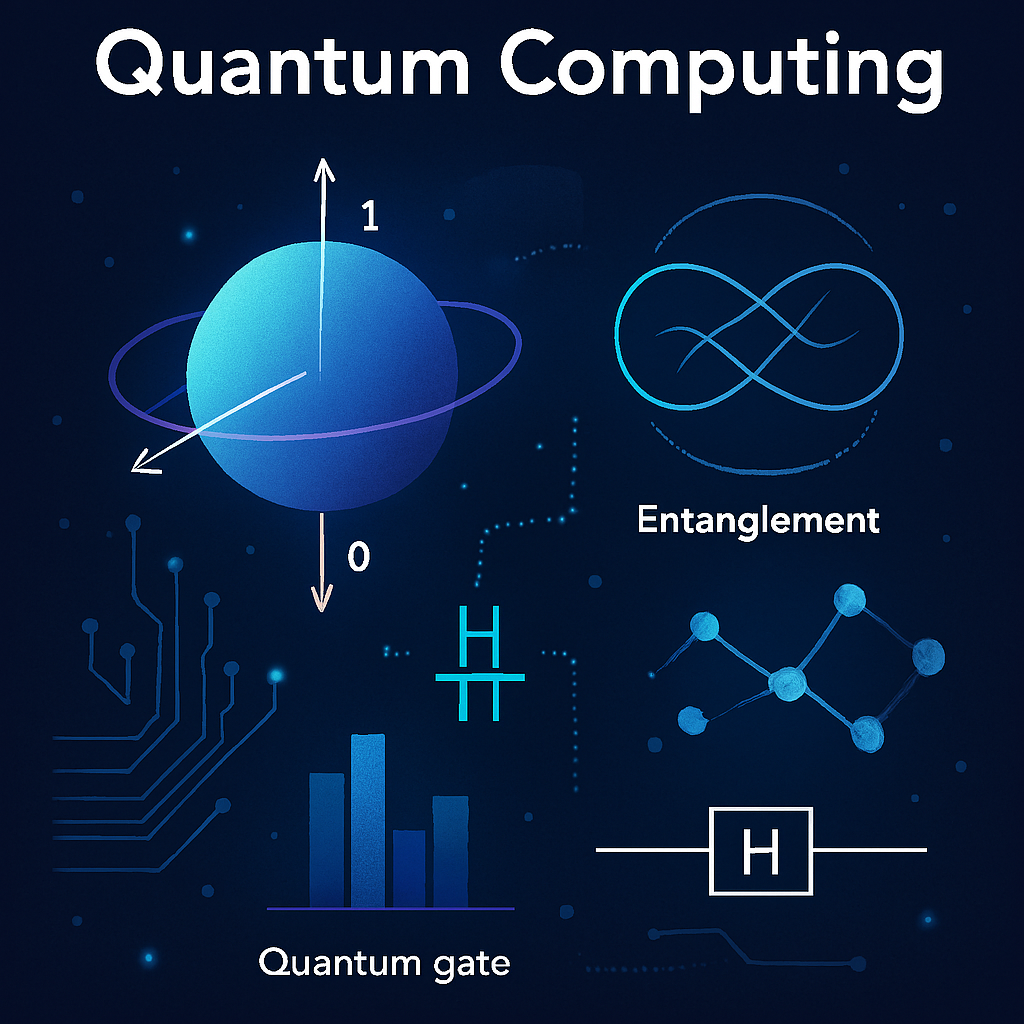
Quantum Computing
Quantum computing is reshaping the way we think about information and problem‑solving, offering possibilities far beyond the reach of classical machines. By harnessing the strange principles of quantum mechanics—like superposition and entanglement—quantum computers can process data in ways that defy everyday intuition, opening doors to breakthroughs in cryptography, drug discovery, logistics, and more. While the technology is still in its early stages and faces challenges such as error correction and decoherence, researchers and governments worldwide are investing heavily in its future. In this post, we’ll dive into 25 fascinating facts that highlight the science, milestones, and potential of quantum computing, giving you a clear picture of why it’s considered one of the most exciting frontiers in technology today.
1. Qubits and Superposition
Unlike classical bits, which can only be 0 or 1, qubits can exist in a superposition of states, meaning they can represent both 0 and 1 simultaneously. This property allows quantum computers to process vast amounts of information in parallel, giving them a potential edge in solving problems that would take classical computers an impractical amount of time. Superposition is one of the fundamental pillars of quantum mechanics, and its application in computing is what makes quantum systems so powerful.
2. Entanglement
Qubits can also be entangled, a phenomenon where the state of one qubit is directly linked to another, even across large distances. This correlation enables quantum computers to perform coordinated operations that classical systems cannot replicate. Entanglement is not only crucial for computation but also for quantum communication, where it underpins protocols like quantum teleportation and secure key distribution.
3. Bloch Sphere Representation
The Bloch sphere is a geometric representation of a qubit’s state. It allows researchers to visualize superposition and entanglement as points on a sphere, with pure states at the poles and mixed states elsewhere. This visualization is essential for understanding how qubits behave and how quantum gates manipulate them.
4. Probabilistic Nature of Qubits
Qubits don’t hold fixed values until measured; instead, they exist in probabilistic combinations of states. Measurement collapses the qubit into a definite 0 or 1, but until then, it encodes probabilities. This probabilistic nature is what allows quantum algorithms to explore multiple solutions simultaneously, though it also introduces challenges in ensuring reliable outcomes.
5. Parallelism in Quantum Algorithms
Quantum algorithms exploit superposition to evaluate many possibilities at once. For example, in optimization problems, a quantum computer can explore multiple candidate solutions simultaneously, dramatically reducing the time needed compared to classical brute-force approaches. This parallelism is one of the most promising aspects of quantum computing.
6. Shor’s Algorithm
Developed in 1994, Shor’s algorithm demonstrated that quantum computers could factor large integers exponentially faster than classical computers. This breakthrough has profound implications for cryptography, as it threatens RSA encryption, which relies on the difficulty of factoring large numbers.
7. Grover’s Algorithm
Grover’s algorithm, introduced in 1996, provides a quadratic speedup for searching unsorted databases. While not as dramatic as Shor’s exponential improvement, it still represents a significant advantage in problems where classical search would be prohibitively slow.
8. Specialized Speedups
Quantum computers are not universally faster than classical ones. Their advantage lies in specific problem domains, such as factoring, searching, and simulating quantum systems. For many everyday tasks, classical computers remain more efficient.
9. Quantum Supremacy
Quantum supremacy refers to the milestone where a quantum computer performs a task infeasible for classical computers. It doesn’t necessarily mean practical usefulness but serves as proof that quantum machines can outperform classical ones in certain domains.
10. Google’s Sycamore Processor
In 2019, Google announced that its 54-qubit Sycamore processor had achieved quantum supremacy by performing a calculation in 200 seconds that would take classical supercomputers thousands of years. This claim marked a turning point in quantum research.
11. IBM’s Dispute
IBM challenged Google’s claim, arguing that classical computers could simulate the task in a reasonable timeframe. This debate highlighted the complexity of defining quantum supremacy and the importance of benchmarking against realistic classical methods.
12. Decoherence
Decoherence occurs when qubits lose their quantum state due to environmental interference. It is one of the biggest obstacles in building reliable quantum computers, as even slight disturbances can cause errors in computation.
13. Quantum Error Correction
To combat decoherence, quantum error correction encodes logical qubits across many physical qubits. This redundancy allows errors to be detected and corrected, but it requires enormous resources, making scalable quantum computers difficult to achieve.
14. NISQ Devices
Current quantum computers are known as NISQ (Noisy Intermediate-Scale Quantum) devices. They are experimental, prone to errors, and not yet capable of fault-tolerant computation, but they provide valuable platforms for testing algorithms and applications.
15. Limitations of NISQ
NISQ devices cannot yet solve large-scale practical problems. Their usefulness lies in exploring quantum algorithms, developing error correction techniques, and preparing for future fault-tolerant machines.
16. Physical Implementations
Quantum computers can be built using superconducting circuits, trapped ions, or topological qubits. Each approach has strengths and weaknesses, from scalability to stability, and researchers are still exploring which will prove most viable.
17. Threat to RSA Encryption
Quantum computers could break RSA encryption by factoring large numbers efficiently. This poses a major security risk, as RSA underpins much of today’s secure communication.
18. Post-Quantum Cryptography
To counter this threat, researchers are developing post-quantum cryptography—algorithms resistant to quantum attacks. These new methods aim to secure data even in a future where quantum computers are widespread.
19. Drug Discovery
Quantum computers could simulate molecular interactions at a level of detail impossible for classical machines. This capability could revolutionize drug discovery by predicting how molecules behave, speeding up the development of new medicines.
20. Logistics Optimization
Quantum computing could optimize complex supply chains by evaluating countless variables simultaneously. This would allow companies to streamline operations, reduce costs, and respond more effectively to disruptions.
21. Quantum Key Distribution (QKD)
QKD uses quantum mechanics to securely distribute encryption keys. Any attempt to intercept the key alters its quantum state, alerting the parties to potential eavesdropping.
22. China’s Quantum Satellite
In 2017, China demonstrated satellite-based quantum communication, sending entangled photons between ground stations. This achievement showcased the potential for global-scale quantum-secure communication.
23. Quantum Turing Machines
Theoretical models like quantum Turing machines extend classical computation theory into the quantum realm. They provide a framework for understanding what quantum computers can and cannot do.
24. Global Investment
Governments and corporations worldwide are investing billions in quantum research. The US, EU, and China are leading efforts, recognizing quantum computing’s potential to reshape industries and national security.
25. Future Outlook
Despite progress, experts caution that fully fault-tolerant quantum computers are still decades away. Current research focuses on incremental advances, with practical applications likely to emerge gradually rather than suddenly.
FAQs about Quantum Computing
1. What is quantum computing, and how does it differ from classical computing?
Quantum computing is a new paradigm that uses quantum mechanics to process information. Classical computers rely on bits (0 or 1), while quantum computers use qubits, which can exist in superpositions of states (both 0 and 1 at once). This allows quantum computers to explore many possibilities simultaneously. The difference is not just speed—it’s a fundamentally different way of computation, enabling solutions to problems classical machines cannot feasibly tackle.
2. What is a qubit, and why is it important?
A qubit is the basic unit of quantum information. Unlike a classical bit, which is binary, a qubit can exist in multiple states due to superposition. Additionally, qubits can be entangled, meaning their states are linked. These properties give quantum computers their unique power, allowing them to perform complex calculations in parallel.
3. What problems can quantum computers solve better than classical ones?
Quantum computers excel in problems involving factorization, optimization, and simulation of quantum systems. For example, Shor’s algorithm can factor large numbers exponentially faster than classical algorithms, threatening RSA encryption. They can also simulate molecules for drug discovery or optimize logistics networks far more efficiently than classical methods.
4. What are the main challenges in building quantum computers?
The biggest challenges are decoherence (loss of quantum state due to environmental noise), error correction, and scalability. Qubits are extremely fragile, and maintaining their state long enough to perform useful computations is difficult. Quantum error correction requires many physical qubits to create one reliable logical qubit, making large-scale systems resource-intensive.
5. When will quantum computers be practically useful?
Experts predict that quantum advantage—where quantum computers outperform classical ones on real-world problems—may emerge between 2030 and 2040. Current devices, known as NISQ (Noisy Intermediate-Scale Quantum) computers, are experimental and not yet fault-tolerant, but they are valuable for testing algorithms and preparing for future breakthroughs.
6. Will quantum computers replace classical computers?
No. Quantum computers are not general-purpose replacements. They are specialized tools that will complement classical systems. For everyday tasks like browsing the web or running spreadsheets, classical computers remain more efficient. Quantum machines will be used for specific domains where they offer clear advantages.
7. How does quantum computing affect cybersecurity?
Quantum computers could break widely used encryption methods like RSA by factoring large numbers efficiently. This has led to the development of post-quantum cryptography, which uses algorithms resistant to quantum attacks. Governments and organizations are already working to transition to these new standards to secure data against future quantum threats.
8. What industries will benefit most from quantum computing?
Industries such as pharmaceuticals, materials science, finance, logistics, and cybersecurity stand to gain the most. Quantum simulations could accelerate drug discovery, financial institutions could optimize risk models, and logistics companies could streamline supply chains.
9. What is quantum supremacy?
Quantum supremacy is the milestone where a quantum computer performs a task infeasible for classical computers. In 2019, Google claimed quantum supremacy with its Sycamore processor, which completed a calculation in 200 seconds that would take classical supercomputers thousands of years. IBM disputed the claim, showing the complexity of defining supremacy.
10. How can beginners start learning quantum computing?
Beginners can start by learning the basics of quantum mechanics, linear algebra, and computer science. Platforms like IBM’s Quantum Experience and Microsoft’s Azure Quantum provide free access to quantum simulators and real devices. Online courses and beginner-friendly guides explain concepts like qubits, superposition, and entanglement in simple terms.