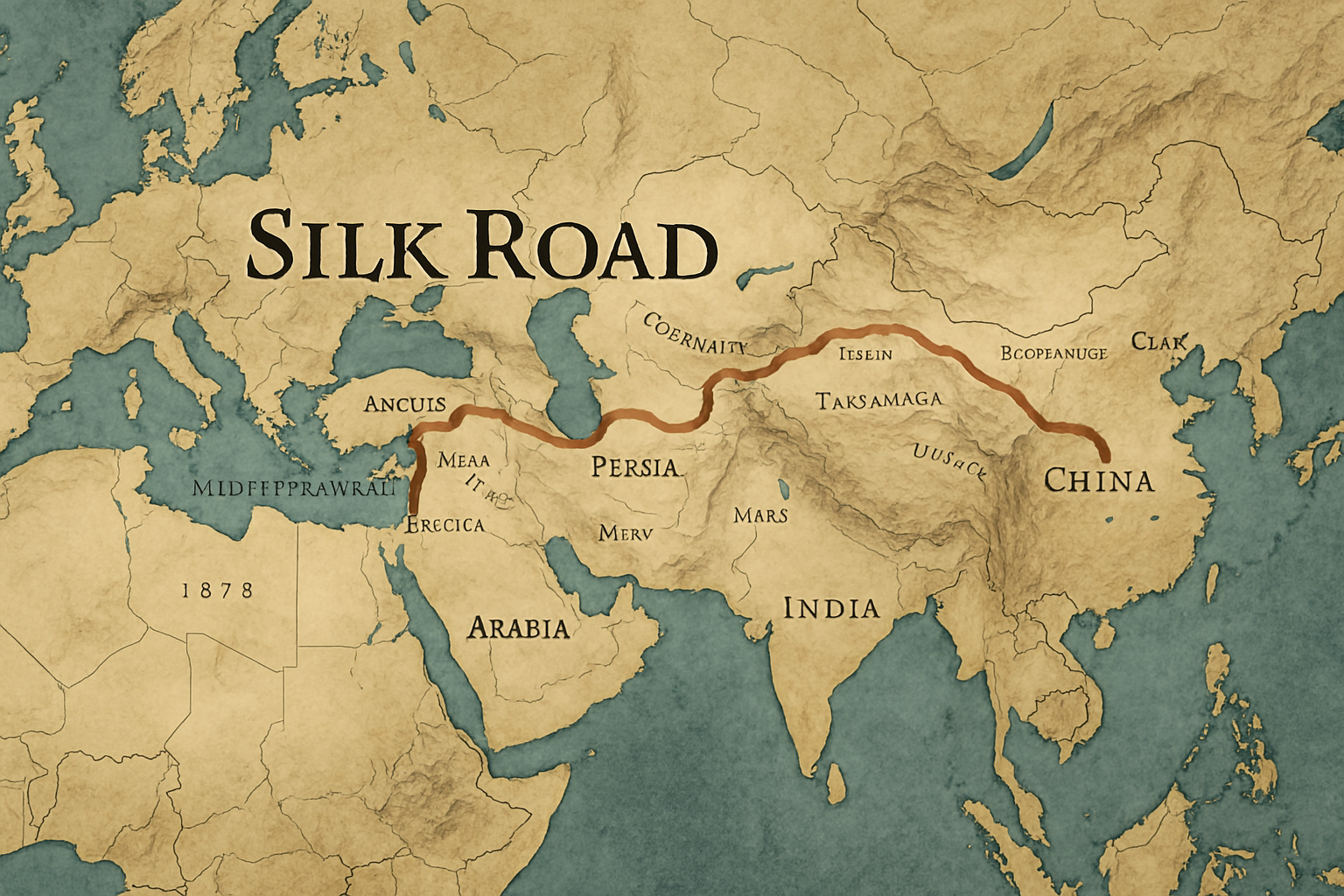
Silk Road
The Silk Road was far more than a trade route—it was a sprawling network of land and sea paths that connected civilizations across Eurasia for over 2,000 years, shaping the course of history. Stretching more than 6,400 kilometers (4,000 miles), it carried silk, spices, porcelain, and paper from China to the Mediterranean, while bringing back horses, glassware, and precious metals from the West. Alongside goods, it spread religions like Buddhism, artistic styles, scientific knowledge, and even diseases, profoundly influencing cultures from Rome to India to China. From its origins in the Han dynasty to its golden age under the Mongols, and even its modern revival through China’s Belt and Road Initiative, the Silk Road remains a symbol of global exchange, innovation, and interconnectedness. In this post, we’ll explore 25 fascinating facts that reveal how this legendary route shaped the world we know today.
1. The Silk Road was active from around 114 BCE to 1450 CE.
Spanning over two millennia, the Silk Road operated from approximately 114 BCE—during the Han dynasty—until around 1450 CE, when maritime trade began to dominate. This vast timeframe reflects the enduring importance of overland trade across Eurasia, connecting empires, cultures, and economies. Despite periods of decline due to war or disease, the Silk Road remained a vital artery for exchange for over 2,000 years.
2. It stretched over 6,400 km (4,000 miles) of land routes.
The Silk Road’s terrestrial routes covered more than 6,400 kilometers (about 4,000 miles), traversing deserts, mountains, and steppes. These paths linked China to the Mediterranean, passing through Central Asia, Persia, and the Levant. The sheer scale of the network underscores the logistical complexity and the determination of traders who braved harsh terrain to move goods and ideas.
3. The term “Silk Road” was coined in 1877 by Ferdinand von Richthofen.
Although the routes had existed for centuries, the name “Silk Road” was only introduced in 1877 by German geographer Ferdinand von Richthofen. He used the term “Seidenstraße” to describe the trade routes that carried silk and other goods between East and West. This modern naming helped popularize the concept in academic and public discourse, giving a unified identity to a diverse network.
4. “Silk Routes” is often preferred to reflect the network’s complexity.
Historians increasingly use “Silk Routes” instead of “Silk Road” to emphasize the multiplicity of paths—both land and sea—that facilitated trade. These included northern, central, and southern land corridors, as well as maritime routes across the Indian Ocean. The plural form better captures the decentralized and adaptive nature of ancient trade systems.
5. Zhang Qian’s explorations around 114 BCE helped open the Silk Road.
Han dynasty envoy Zhang Qian was dispatched around 114 BCE to explore Central Asia and establish diplomatic ties. His journeys revealed new trade opportunities and laid the groundwork for sustained exchange between China and the West. Zhang’s reports on the cultures and goods of Central Asia were instrumental in formalizing the Silk Road’s eastern segments.
6. The Silk Road traded more than silk—tea, porcelain, gunpowder, and paper were key exports.
While silk was the most iconic commodity, China also exported tea, porcelain, gunpowder, and paper along the Silk Road. These goods revolutionized societies: paper transformed record-keeping, gunpowder altered warfare, and porcelain became a luxury item in Europe. In return, China imported horses, wine, glassware, and precious metals from the West.
7. The Great Wall of China was extended to protect Silk Road routes.
To safeguard trade caravans from nomadic raids, the Han dynasty extended the Great Wall of China westward. These fortifications helped secure key segments of the Silk Road, especially in vulnerable desert and steppe regions. The wall’s expansion reflects the strategic importance of trade to imperial stability and prosperity.
8. The Parthian Empire served as a bridge between China and the Mediterranean.
The Parthians, who ruled much of Iran and Mesopotamia, played a crucial intermediary role in Silk Road commerce. They controlled key trade hubs and facilitated the movement of goods between China and Rome. Their diplomatic and commercial networks helped maintain the flow of silk, spices, and other luxuries across continents.
9. Roman demand for Chinese silk was so high it became a luxury item.
By the 1st century CE, Chinese silk had become a coveted luxury in Rome, Egypt, and Greece. Roman elites wore silk garments despite criticism from moralists who viewed it as decadent. The high demand led to a steady flow of silk westward, often exchanged for gold and silver, enriching Chinese merchants and fueling cross-cultural fascination.
10. Buddhism spread from India to China via the Silk Road.
The Silk Road was a major conduit for religious exchange, especially the spread of Buddhism from India to China and East Asia. Monks traveled along trade routes, carrying scriptures and establishing monasteries in oasis towns. This spiritual transmission profoundly shaped Chinese philosophy, art, and architecture.
11. Scientific, philosophical, and artistic ideas traveled along the Silk Road.
Beyond goods, the Silk Road facilitated the exchange of knowledge, including astronomy, medicine, mathematics, and artistic styles. Greek and Persian ideas influenced Chinese thought, while Chinese inventions like paper and printing reached the Islamic world and Europe. This intellectual cross-pollination enriched civilizations and laid foundations for future innovations.
12. Diseases like the plague traveled along the Silk Road.
The Silk Road’s connectivity also enabled the spread of infectious diseases, including the bubonic plague. Trade caravans and travelers inadvertently carried pathogens across continents, contributing to pandemics like the Black Death. These outbreaks had devastating demographic and economic consequences, highlighting the risks of global exchange.
13. The Silk Road was highly decentralized, relying on middlemen.
Rather than direct long-distance travel, Silk Road trade was conducted through a chain of middlemen who specialized in regional segments. Goods changed hands multiple times, with each trader adding markup and local expertise. This decentralized model allowed the network to adapt to political changes and geographic challenges.
14. The Mongol Empire boosted Silk Road trade in the 13th century.
Under the Mongol Empire, especially during the reign of Genghis Khan and his successors, the Silk Road experienced a golden age of stability. The Pax Mongolica ensured safe passage for merchants, diplomats, and missionaries across vast territories. This period saw increased trade volume and cultural exchange between East and West.
15. The Maritime Silk Road connected Southeast Asia, India, Arabia, and East Africa.
Complementing the land routes, the Maritime Silk Road enabled sea-based trade across the Indian Ocean. Chinese, Indian, Arab, and African merchants exchanged spices, textiles, and ceramics via coastal ports. These maritime routes were often more efficient for bulk goods and played a vital role in global commerce.
16. Austronesian sailors used advanced ships centuries before China’s naval expansion.
Austronesian navigators from Southeast Asia operated sophisticated ocean-going vessels long before China’s maritime dominance. Their ships reached as far as Madagascar and the Arabian Peninsula, facilitating early trade and cultural contact. These sailors laid the groundwork for the Maritime Silk Road’s development.
17. Roman glassware reached China via the Silk Road.
Archaeological finds, including Roman glass bowls in Han dynasty tombs, confirm that luxury items traveled eastward along the Silk Road. These artifacts demonstrate the appeal of Roman craftsmanship in China and the reach of Mediterranean trade. Such exchanges enriched elite lifestyles and artistic traditions.
18. The southern Silk Road route persists today as the Karakoram Highway.
The southern branch of the Silk Road passed through the Karakoram mountains, linking China with South Asia. Today, this ancient path is mirrored by the Karakoram Highway, a modern road connecting Pakistan and China. It serves as a living legacy of Silk Road infrastructure and geopolitical importance.
19. The southwestern route through Bangladesh and Burma shipped gold and silver from Yunnan.
Another Silk Road corridor ran through present-day Bangladesh and Burma, facilitating trade in precious metals from Yunnan province. This route highlights the diversity of Silk Road paths and the regional specialization of goods. It also underscores Southeast Asia’s role in ancient commerce.
20. The Silk Road was designated a UNESCO World Heritage Site in 2014 and 2023.
In recognition of its historical significance, UNESCO designated the Chang’an–Tianshan Corridor as a World Heritage Site in 2014 and the Zarafshan–Karakum Corridor in 2023. These designations preserve key archaeological sites and promote cultural tourism. They affirm the Silk Road’s enduring legacy as a bridge between civilizations.
21. Marco Polo never used the term “Silk Road.”
Although Marco Polo traveled extensively along Silk Road routes during the Mongol era, he never used the term “Silk Road.” The name was coined centuries later, and Polo’s writings focused more on the people and places he encountered. His accounts nonetheless provide valuable insights into Silk Road life and logistics.
22. Tarim mummies suggest East-West contact as early as 1600 BCE.
The Tarim Basin mummies found in Xinjiang, China, date back to around 1600 BCE and exhibit European features. Their presence suggests early migration and contact between East and West long before the Silk Road’s formal establishment. These findings challenge conventional timelines and expand our understanding of prehistoric exchange.
23. The Sogdians were key traders, and their language became a lingua franca.
The Sogdians, an Iranian people from Central Asia, dominated Silk Road trade during the early medieval period. Their language became the commercial lingua franca across the region, facilitating communication among diverse groups. Sogdian merchants also played a role in spreading Buddhism and other cultural influences.
24. Scythian animal motifs spread from Mongolia to Germany via the Silk Road.
Artistic styles, such as Scythian animal motifs, traveled along the Silk Road, appearing in artifacts from Mongolia to Germany. These designs reflect deep cultural exchange and the movement of artisans and ideas. The diffusion of motifs illustrates how aesthetics evolved through interaction across vast distances.
25. The “New Silk Road” refers to China’s Belt and Road Initiative (BRI).
In the 21st century, the term “New Silk Road” has been revived to describe China’s ambitious Belt and Road Initiative (BRI). This modern project, launched in 2013, aims to build infrastructure and trade networks across Asia, Africa, and Europe, echoing the ancient Silk Road’s role as a connector of civilizations. With investments in railways, highways, ports, and pipelines, the BRI seeks to strengthen China’s global economic influence, while also drawing symbolic parallels to the Silk Road’s legacy of cultural and commercial exchange. The initiative has sparked both enthusiasm and criticism, as it promises economic growth but also raises concerns about debt dependency and geopolitical power shifts.
🏺 Silk Road FAQs
1. What was the Silk Road?
The Silk Road was an ancient network of trade routes that connected China with the Mediterranean, spanning over 6,400 km (4,000 miles) of land paths and additional maritime routes. It operated from around 114 BCE to 1450 CE, facilitating the exchange of goods, ideas, religions, and technologies across Eurasia. It wasn’t a single road but a vast web of interconnected routes linking East and West.
2. Why is it called the Silk Road?
The name “Silk Road” was coined in 1877 by German geographer Ferdinand von Richthofen. It reflects the importance of silk as one of China’s most valuable exports, highly prized in Rome and other parts of the West. However, many historians prefer “Silk Routes” to emphasize the multiple land and sea paths involved.
3. What goods were traded along the Silk Road?
China exported silk, tea, porcelain, paper, and gunpowder, while importing horses, wool, glassware, gold, and silver from the West. Spices, textiles, and precious stones also traveled along the routes. These exchanges transformed economies and introduced new luxuries to distant societies.
4. What traveled along the Silk Road besides goods?
Beyond commodities, the Silk Road carried religions like Buddhism, Christianity, and Islam, as well as scientific knowledge, art styles, and even diseases. For example, Buddhism spread from India into China and East Asia, while the bubonic plague traveled westward, contributing to pandemics. This cultural and biological exchange profoundly shaped civilizations.
5. Where did the Silk Road start and end?
The Silk Road began in Chang’an (modern Xi’an, China) and extended westward through Central Asia, Persia, and the Middle East, eventually reaching the Mediterranean ports. Maritime routes connected Southeast Asia, India, Arabia, and East Africa. Together, these paths created a global trade network long before modern globalization.
6. How long did the Silk Road last?
The Silk Road lasted for over 2,000 years, from the Han dynasty’s expansion around 114 BCE until the mid-15th century CE. It declined as maritime trade routes became more efficient and safer, especially after the rise of European naval powers. The fall of the Mongol Empire and regional instability also contributed to its decline.
7. Who were the key players in Silk Road trade?
Several empires and peoples played vital roles, including the Han dynasty, the Parthians, the Romans, and later the Mongols. The Sogdians, an Iranian people, were especially influential as traders and cultural intermediaries, with their language serving as a commercial lingua franca. The Mongol Empire’s Pax Mongolica in the 13th century created a rare period of stability that boosted trade.
8. Was Marco Polo connected to the Silk Road?
Yes, Marco Polo traveled extensively along Silk Road routes during the 13th century under the Mongol Empire. His accounts introduced Europeans to the wealth and sophistication of China, though he never used the term “Silk Road” (coined centuries later). His writings remain a key source of information about Silk Road life.
9. Is the Silk Road still used today?
While the ancient routes are no longer active in their original form, many paths have modern equivalents, such as the Karakoram Highway linking Pakistan and China. In the 21st century, China’s Belt and Road Initiative (BRI) has revived the Silk Road concept, building new infrastructure to connect Asia, Africa, and Europe. This “New Silk Road” echoes the ancient network’s legacy of global exchange.
10. What is the cultural legacy of the Silk Road?
The Silk Road left a lasting impact on art, architecture, religion, and cuisine across Eurasia. Artistic motifs like Scythian animal designs spread widely, while Buddhist monasteries flourished along trade routes. Its legacy continues today as a symbol of interconnectedness, inspiring modern projects and cultural tourism.