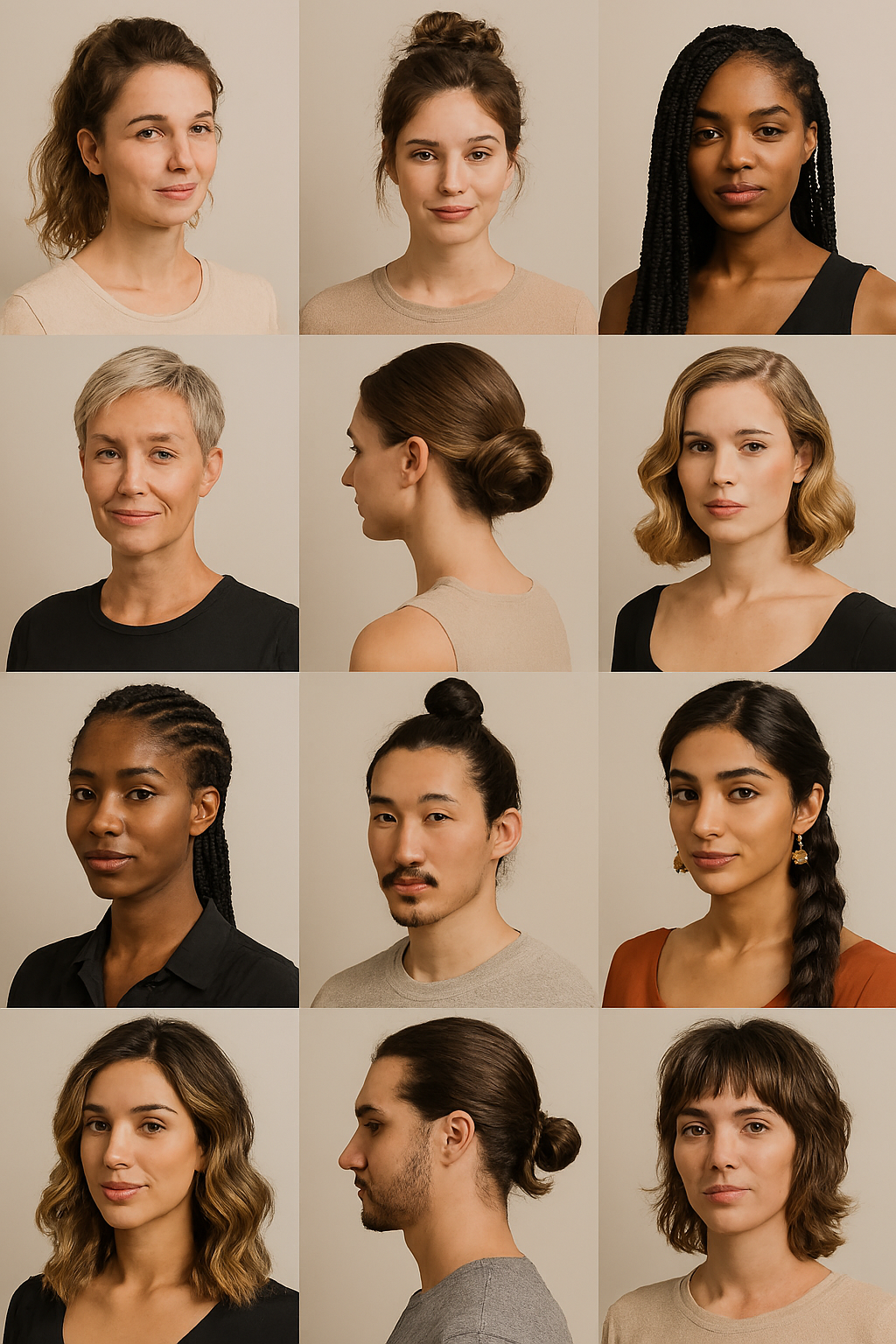
Various Hairstyles
Hair is far more than something we cut, comb, or style every day—it’s a powerful form of human expression that has shaped identity, culture, and history for thousands of years. From prehistoric braids etched into ancient figurines to modern styles that signal fashion trends, beliefs, and individuality, hairstyles tell stories long before words are spoken. Across civilizations, hair has reflected social status, spirituality, politics, gender norms, and even rebellion, making it one of the most visible and meaningful parts of personal appearance.
In this post, we’ll explore 25 fascinating facts about hairstyles that reveal how deeply hair is woven into human history and culture. Some of these facts may surprise you, others may change the way you look at your own hair—but all of them show that hairstyles are far more than a finishing touch. Let’s take a journey through time, tradition, and creativity, one strand at a time.
1) Hairstyle, hairdo, haircut, or coiffure
The word “hairstyle” encompasses several overlapping terms—hairdo, haircut, and coiffure—that collectively describe the many ways people shape the hair on their head. While “haircut” emphasizes the act or result of cutting hair to a particular length or shape, “hairdo” and “coiffure” point more to arrangement and styling, including techniques like setting, curling, braiding, and accessorizing. In everyday use, these words are often interchangeable, but the article underscores that all of them sit within the broader practice of hair fashioning and care, which can be transient (a style) or semi‑permanent (the cut that forms the base).
2) Not only scalp hair—also facial or body hair
Although most discussion focuses on hair atop the head, the article notes that “hairstyle” can extend to facial or even body hair, acknowledging cultural traditions around mustaches, beards, sideburns, and other regions where hair is styled or groomed. This broader definition reminds us that hair expression is not restricted to scalp hair alone; throughout history and across cultures, grooming practices have included shaving patterns, trimming, and shaping beyond the crown, all of which contribute to one’s visual identity and social signaling.
3) Part of grooming, fashion, and cosmetics
Hair styling is framed as part of personal grooming and situated squarely within fashion and cosmetics, showing how it intersects with clothing, makeup, and adornment to create a coherent look. From a social standpoint, the way a person styles their hair is often read alongside other aesthetic choices, which is why salons and barbershops occupy a space at the crossroads of beauty services and everyday hygiene. The article highlights this integration explicitly, positioning hairstyles as a visible, curated component of how people present themselves to the world.
4) Influenced by practical, cultural, and popular considerations
While trends and aesthetics are important, the article emphasizes that practical, cultural, and popular forces also shape hairstyle choices. Practical concerns might include climate (keeping hair off the neck in heat), occupation (styles compatible with helmets or hats), or maintenance time; cultural considerations include norms of modesty, rites of passage, or community standards; and popular influences range from celebrities to social media. This mix of drivers explains why certain styles persist in some contexts while others spread rapidly or fade, reflecting both utility and the zeitgeist.
5) The oldest known hairstyling: braiding ~30,000 years ago
One of the article’s most striking facts is that the oldest known depiction of hairstyling is braiding dating to approximately 30,000 years ago. This dramatically pushes hairstyling into deep prehistory and suggests that even early human communities invested time and skill into manipulating hair for aesthetic or social reasons. Braiding, with its technical complexity and durability, would have been a practical yet expressive way to manage hair, signaling that styling is not a modern luxury but an ancient human behavior.
6) The Venus of Willendorf and braided hair
The Venus of Willendorf—a Paleolithic figurine—has often been interpreted as showing braided or patterned hair, and the article specifically presents it as evidence for ancient braiding practices. Whether read as a stylized cap, hair, or headdress, the figurine indicates intentional patterning that aligns with hairstyling, placing deliberate hair arrangement at the dawn of human artistic representation and cultural expression.
7) The Venus of Brassempouy shows clear hairstyling
Similarly, the Venus of Brassempouy—another Paleolithic artifact—“indisputably shows hairstyling,” according to the article, reinforcing that early humans depicted head hair with intention and structure. The explicitness of this representation bolsters the claim that hairstyling is not just inferred but visually documented in prehistoric art, revealing pattern, texture, and arrangement well beyond incidental depiction.
8) Hairstyles as markers of social class
The article explains that hairstyles often operate as markers of social class, signaling status through complexity, adornment, or the very ability to devote time and resources to maintenance. Elaborate court styles, expensive wigs, and ornate accessories have historically communicated wealth and rank, while regulations or practical constraints might have limited lower‑status groups to simpler forms. Hair thus becomes a visible index of social stratification, read instantly in many societies.
9) Indicators of age and marital status
Hairstyles can also encode age and marital status, with communities historically reserving certain styles for children, adolescents, or married individuals. The article notes this signaling function explicitly, and you can see it in practices where girls might wear hair loose until a coming‑of‑age ceremony or where married women cover or bind hair differently than unmarried women. These conventions make hair a shorthand for life stage and relationship status within a cultural framework.
10) Expressions of racial identification
Beyond class and age, hairstyles can communicate racial identification, as the article states, aligning hair textures and styling traditions with community identity and heritage. This includes protective styles, braiding patterns, and textures that carry deep cultural meaning and historical continuity. The recognition of hair as a site of racial identity helps explain why certain styles become central to cultural pride and why debates over hair in schools or workplaces can take on larger social significance.
11) Signals of political beliefs and gender attitudes
The article further points out that hairstyles can reflect political beliefs and attitudes about gender, functioning as a visual manifesto when people adopt styles that challenge or affirm norms. From cutting hair short to reject traditional expectations, to embracing natural textures as an assertion of autonomy, hair has been a tool for political expression across eras. In this way, styling is both personal and public, a choice that can align a person with a movement or ideology at a glance.
12) Historically elaborate women’s hairstyling
Throughout ancient and historical contexts, the article notes that women often wore hair that was elaborately and carefully dressed, involving curling, pinning, and the use of ornaments. Such styles demanded skill and time, sometimes the services of attendants, and were often associated with ceremonial or public appearances, reflecting ideals of beauty and social expectations. The elaboration itself—waves, coils, structured arrangements—testifies to hair’s importance in public identity.
13) Yet frequently covered outside the home—especially for married women
Counterbalancing the elaborate styling, the article emphasizes that women’s hair was frequently kept covered outside the home, with covering especially common for married women in many societies. Covering can serve practical ends (protection from the elements) but often carries social or moral meanings related to modesty, propriety, or marital status, so the very act of covering becomes part of the “style” in cultural terms.
14) Hair covering for religious or cultural reasons
Not all covering stems from fashion; the article explicitly says some people cover their hair totally or partially for cultural or religious reasons. In these cases, the head covering is integral to religious observance or communal identity, and styles of wrapping or veiling are themselves traditional, learned, and aesthetically nuanced practices—another form of hairstyling, even when hair is concealed.
15) Muslim women and the hijab
A prominent example the article gives is Muslim women who wear the hijab, a practice with varied regional forms and personal interpretations but grounded in religious and cultural frameworks. Whether a simple headscarf or a more enveloping style, hijab practices intersect with hair directly: the act of covering shapes how hair is managed, secured, and maintained daily, integrating faith, modesty, and personal expression.
16) Married Haredi Jewish women—sheitel or tichel
The article also cites married women in Haredi Judaism who cover hair with a sheitel (wig) or tichel (scarf), underscoring a codified relationship between marital status and hair visibility. These coverings are themselves diverse in style and material, and the choice between wig and scarf can reflect community norms, personal comfort, and aesthetics—demonstrating how even “covering” becomes a curated aspect of personal presentation.
17) Sikh men and women—dastar (turban)
In Sikhism, men and women wear the dastar (turban) as a symbol of faith and cultural identity, a practice the article highlights among global examples of hair covering. The dastar both protects uncut hair and signifies commitment to religious principles, so turban‑tying itself is a practiced skill and an important part of appearance, integrating spiritual values directly with daily grooming.
18) Prehistory already shows intentional design
The article’s prehistoric examples make clear that hair was not merely left to chance; even in the Paleolithic, people intentionally designed hairstyles or head coverings that read as patterned, organized, and purposeful. This pushes back on any assumption that complex hairstyling is a late cultural development and suggests that the impulse to shape hair—whether for beauty, identity, or utility—has been a longstanding human trait.
19) Bronze Age razors in use (not daily)
By the Bronze Age, the article notes, razors were known and used by some men, though daily shaving was uncommon because the tools could be uncomfortable and required resharpening. This detail situates hair removal technologies within early metallurgy and shows how tool limitations shaped grooming habits; even when the desire to shave existed, practical constraints affected frequency and style outcomes.
20) Frequent resharpening limited daily shaving
Because those early razors needed frequent resharpening, their endurance was reduced, which the article links to the rarity of daily shaving in that era. This technical limitation provides a concrete reason behind historical facial‑hair norms and helps explain why certain beard styles or stubble might prevail when maintenance tools were labor‑intensive to keep sharp.
21) Ancient practices: coloring, curling, pinning
In ancient civilizations, the article describes women coloring, curling, and pinning their hair into a variety of forms, indicating a sophisticated toolkit of methods well before modern salons. The use of pigments, heat‑free setting techniques, and mechanical fastening (pins, combs) reveals a mature aesthetic culture of hair that paralleled developments in clothing and jewelry.
22) Creating waves/curls with wet clay and sun
A particularly vivid ancient technique the article mentions involved applying wet clay to create waves and curls, drying in the sun, and then combing out the set. This method is a clever exploitation of clay’s temporary rigidity and the sun’s drying power—an early analog to setting lotions and heat styling that demonstrates ingenuity with available materials and environment.
23) Quince‑seed jelly as a curling aid
Another ancient curling aid was jelly made from quince seeds soaked in water, which the article notes as a styling medium to help form and hold shape. Plant‑based gels like this foreshadow modern hair products by providing viscosity, slip, and light hold—evidence that cosmetic chemistry has deep roots in natural gums and mucilages used creatively for hairstyling effects.
24) A continuous story from prehistory to modernity
Stepping back, the article presents hairstyling as a continuous thread from Paleolithic figurines to contemporary fashion, with each era layering new tools, meanings, and conventions onto the universal act of managing hair. This continuity helps explain why hair remains a potent site of identity: it is a daily canvas shaped by tradition, technology, and taste, all evolving yet recognizable through time.
25) Both functional grooming and symbolic communication
Finally, the article underscores that hairstyles operate on two intertwined levels: functional grooming (cleanliness, comfort, manageability) and symbolic communication (status, faith, politics, gender, culture). Because hair is so visible and malleable, it carries messages even when practicality is the main driver—and, conversely, even highly symbolic styles must still be worn and maintained. This dual nature is what makes hair such a powerful and enduring medium of personal and social expression. [en.wikipedia.org]
Frequently Asked Questions (FAQs) About Hairstyles
1) How do I choose the right hairstyle for my face shape?
Choosing the right hairstyle starts with identifying your face shape—commonly oval, round, square, heart, or diamond. Oval faces are considered the most versatile and suit most hairstyles, while round faces benefit from styles that add height and length, such as long layers or side‑swept bangs. Square faces often look best with soft layers that balance strong jawlines, and heart‑shaped faces are complemented by styles that add volume around the chin. Professional hairstylists frequently recommend considering face shape as a foundational step because it helps enhance natural features rather than working against them. [flawlesshair.com], [upjourney.com]
2) What hairstyle works best for my hair type?
Hair type—such as straight, wavy, curly, or coily—plays a crucial role in determining which hairstyles will look and perform best. For example, layered cuts can prevent thick hair from appearing bulky, while blunt cuts often work better on fine hair by creating the illusion of fullness. Curly and coily hair benefit from cuts designed to maintain shape and reduce frizz rather than thin the hair excessively. Stylists emphasize matching the cut to natural texture to minimize daily styling effort and improve long‑term hair health. [upjourney.com], [latest-hai…styles.com]
3) How often should I get a haircut?
The recommended frequency for haircuts depends on style and hair goals. Precision cuts such as bobs or fades typically require maintenance every 4–6 weeks, while longer or layered hairstyles can last 8–12 weeks between trims. Regular trimming helps remove split ends, maintain shape, and promote healthier‑looking hair, even if you are growing it out. Hairstylists generally encourage consistency rather than waiting until hair becomes visibly damaged. [flawlesshair.com], [holleewoodhair.com]
4) Should I wash my hair every day?
Washing hair daily is not necessary for most people and may strip natural oils if harsh shampoos are used. Many experts advise washing every 2–3 days, allowing natural scalp oils to nourish the hair. However, individuals with fine hair, oily scalps, or active lifestyles may prefer more frequent washing using gentle, sulfate‑free products. Ultimately, washing frequency should be guided by scalp condition and lifestyle rather than rigid rules. [holleewoodhair.com], [latest-hai…styles.com]
5) How can I make my hairstyle last longer?
To prolong a hairstyle, proper preparation and maintenance are essential. This includes using products suited to your hair type, avoiding excessive heat styling, and applying heat protectants. Sleeping on satin or silk pillowcases reduces friction, helping prevent frizz and flattening. Many hairstylists also recommend light touch‑ups rather than complete restyling to extend the life of a look. [latest-hai…styles.com], [upjourney.com]
6) What is a low‑maintenance hairstyle?
A low‑maintenance hairstyle requires minimal daily styling and grows out gracefully. Examples include long layers, subtle balayage, textured shags, and natural‑texture cuts. These styles are especially popular among busy professionals and parents because they rely more on natural texture than frequent salon visits. Stylists often recommend considering lifestyle and styling time before committing to a new look. [upjourney.com], [flawlesshair.com]
7) Can hairstyles affect hair health?
Yes, certain hairstyles can significantly affect hair health. Tight styles such as braids, ponytails, or buns worn consistently can lead to traction alopecia, a form of hair loss caused by tension on the scalp. Heat‑heavy or chemically treated styles can also weaken hair over time. Rotating styles and allowing rest periods helps maintain scalp and strand integrity. [latest-hai…styles.com], [thehairstyler.com]
8) How do I prevent hair color from fading?
Hair color fades due to washing frequency, sun exposure, and heat styling. To prevent fading, experts recommend using cool water, color‑safe shampoos, and minimizing heat use. Red and vibrant shades fade faster because pigment molecules escape the hair shaft more easily. Color‑depositing products can help maintain vibrancy between salon visits. [holleewoodhair.com]
9) Are trending hairstyles suitable for everyone?
Not all trends suit every person. A hairstyle that looks great on social media may not align with your face shape, hair texture, or maintenance tolerance. Professional stylists often adapt trends—rather than copying them exactly—to ensure the style works realistically for the client. This personalization is key to avoiding disappointment and damage. [flawlesshair.com], [enlightio.com]
10) Why do hairstylists recommend consultations before big changes?
Hair consultations allow stylists to assess hair condition, texture, history, and lifestyle before making major changes. This reduces the risk of damage and miscommunication while setting realistic expectations for results and upkeep. Most professional salons consider consultations essential for successful transformations and long‑term client satisfaction. [scottfsalon.com], [glossgenius.com]
11) Can a hairstyle change how my face looks?
Yes—hairstyles can visually alter facial proportions. Volume placement, length, and parting can make faces appear longer, narrower, or more balanced. That’s why subtle changes, such as switching a hair part or adding face‑framing layers, can dramatically shift overall appearance without a major cut. [flawlesshair.com]
12) What should I consider before changing my hairstyle?
Before making a change, experts suggest considering daily routine, maintenance ability, hair history, and long‑term goals. Drastic changes may require more frequent salon visits or styling time. Thinking beyond aesthetics ensures satisfaction well after the initial transformation fades. [enlightio.com], [scottfsalon.com]