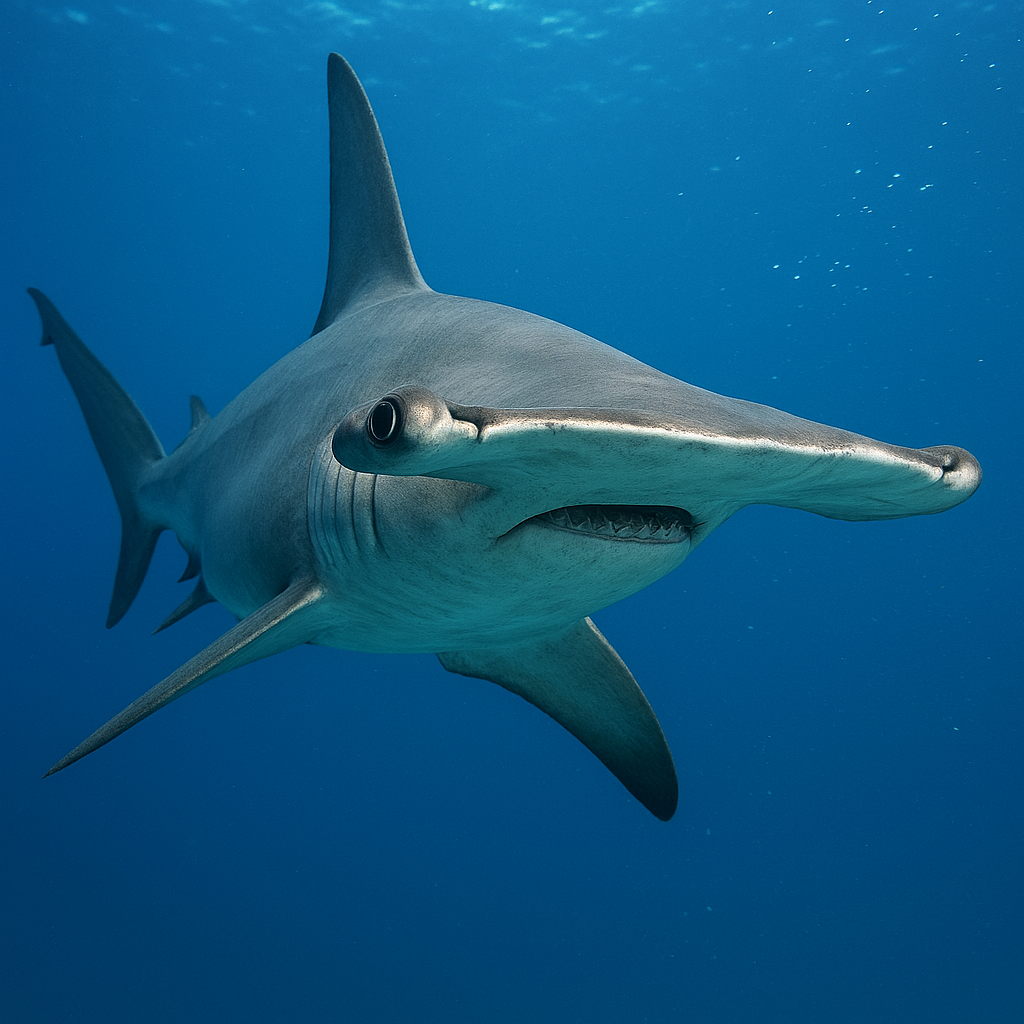
Hammerhead shark
Hammerhead sharks are among the most fascinating creatures in the ocean, instantly recognizable by their unique, hammer-shaped heads. These remarkable predators are not only visually striking but also possess extraordinary adaptations that make them masters of their environment. From record-breaking sizes and impressive hunting techniques to their critical role in marine ecosystems, hammerheads have captivated scientists and ocean enthusiasts alike. In this article, we’ll dive into 25 well-verified and measurable facts about hammerhead sharks, exploring their biology, behavior, and conservation status. Whether you’re a marine life lover or simply curious about these iconic sharks, prepare to discover why hammerheads are truly one of nature’s marvels.
1. Largest Hammerhead Species
The Great Hammerhead (Sphyrna mokarran) holds the record as the largest species among hammerhead sharks, reaching an impressive length of up to 6.1 meters (20 feet). This size makes it one of the most formidable predators in tropical and subtropical waters. Its massive body and distinctive hammer-shaped head give it a unique advantage in hunting and navigation.
2. Heaviest Recorded Individual
The heaviest documented Great Hammerhead weighed 1,280 pounds (580 kg), showcasing the species’ remarkable bulk. This weight is comparable to a small car, emphasizing the shark’s dominance in its ecosystem. Such large specimens are rare, as most individuals do not reach this extreme size.
3. Common Size Range
While some hammerheads grow exceptionally large, most individuals encountered by divers measure between 10 and 14 feet (3–4.3 m). This size range is typical for mature adults and allows them to efficiently hunt stingrays, fish, and other prey. Their streamlined bodies make them agile despite their considerable length.
4. Sexual Dimorphism in Size
Female Great Hammerheads mature at lengths of 8.2–9.8 feet (2.5–3 m), while males reach maturity at 7.7–8.8 feet (2.3–2.7 m). This size difference is common among sharks, with females generally larger to accommodate reproduction. Larger females can carry more pups, which is critical for species survival.
5. Size at Birth
Hammerhead pups are surprisingly large at birth, measuring 20–28 inches (50–70 cm) long. This size gives them a better chance of survival in the open ocean, where predators abound. Newborns are fully independent and must fend for themselves immediately after birth.
6. Average Adult Weight
Adult Great Hammerheads typically weigh between 900 and 1,280 pounds (410–580 kg). This substantial weight supports their powerful swimming ability and predatory lifestyle. Their muscular build enables them to chase fast-moving prey like stingrays and small sharks.
7. Historical Weight Record
One of the largest hammerheads ever recorded was caught off Florida in 1906, weighing an astonishing 1,500 pounds (680 kg). This historical catch remains a benchmark for shark researchers and anglers alike. It highlights the species’ potential for extraordinary growth under favorable conditions.
8. Swimming Speed
Great Hammerheads are swift swimmers, capable of reaching speeds up to 25 mph (40 km/h). This speed is essential for ambushing prey and escaping threats in the ocean. Their streamlined bodies and powerful tails make them efficient hunters in open water.
9. Migration Distance
These sharks are known for long-distance migrations, sometimes traveling over 3,000 km (1,864 miles). Such journeys often occur between feeding grounds and breeding areas, ensuring genetic diversity and resource availability. Their ability to cover vast distances demonstrates their adaptability to changing ocean conditions.
10. Habitat Depth
Hammerheads inhabit depths ranging from 1 to 80 meters (3–262 feet), favoring continental shelves and coral reefs. This range allows them to exploit diverse ecosystems, from shallow coastal waters to deeper offshore zones. Their preference for warm waters makes them common in tropical regions worldwide.
11. Preferred Depth
Although capable of diving deeper, Great Hammerheads typically prefer 30–80 feet of water. These depths provide abundant prey and suitable conditions for hunting. Divers often encounter them in these zones, especially near reef systems.
12. Reproductive Method
Great Hammerheads are viviparous, meaning they give birth to live young after an 11-month gestation period. This lengthy pregnancy ensures that pups are well-developed at birth. Unlike egg-laying species, viviparity offers better survival chances for offspring.
13. Litter Size
Females can give birth to litters ranging from 6 to 42 pups, with an average of 20–40 pups per cycle. Such large litters help offset high juvenile mortality rates in the wild. However, producing so many pups requires significant energy investment from the mother.
14. Breeding Frequency
Hammerheads reproduce only every two years, making population recovery slow. This low reproductive rate, combined with overfishing, contributes to their endangered status. Conservation efforts must account for this biological limitation.
15. Lifespan
The estimated lifespan of a Great Hammerhead is 20–30 years in the wild. This longevity allows them to play a sustained role as apex predators in marine ecosystems. However, few individuals reach this age due to human threats and natural predation.
16. Age of Maturity
Sexual maturity occurs at 6–9 years, depending on gender and environmental conditions. Reaching maturity later in life further slows population growth. This trait makes hammerheads particularly vulnerable to overfishing.
17. Favorite Prey
Stingrays are the hammerhead’s favorite prey, and they use their wide, hammer-shaped head to pin rays to the seabed before biting. This hunting technique is highly effective and unique among sharks. It demonstrates the evolutionary advantage of their distinctive head shape.
18. Diet Diversity
Their diet includes squid, crabs, small sharks, groupers, and lobsters, making them versatile predators. This variety ensures survival even when preferred prey is scarce. Hammerheads help maintain balance in marine ecosystems by controlling multiple species.
19. Immunity to Stingray Venom
Hammerheads have been observed immune to stingray venom, often found with stingers protruding from their mouths. This adaptation allows them to hunt stingrays without suffering fatal injuries. It is a remarkable example of evolutionary specialization.
20. Electroreception
The cephalofoil enhances electroreception, enabling detection of prey buried under sand via Ampullae of Lorenzini. These sensory organs pick up weak electrical signals emitted by living organisms. This ability makes hammerheads exceptional hunters in murky waters.
21. Vision Advantage
Their eye placement provides a 360-degree field of vision, a rare adaptation among sharks. This panoramic view helps them spot predators and prey simultaneously. It is one of the most striking benefits of their hammer-shaped head.
22. Solitary Behavior
Great Hammerheads are solitary and nomadic, often migrating seasonally toward cooler waters. Unlike schooling species, they prefer to hunt alone, reducing competition for food. This behavior influences their distribution and population dynamics.
23. Role as Apex Predator
As apex predators, hammerheads regulate marine ecosystems by controlling prey populations. Their presence ensures ecological balance, preventing overpopulation of certain species. Removing them from the food chain can lead to cascading effects on ocean health.
24. Conservation Status
The Great Hammerhead is classified as Critically Endangered by the IUCN due to overfishing and the global shark fin trade. Their fins are highly valued, driving unsustainable hunting practices. Conservation measures are urgently needed to prevent extinction.
25. Human Interaction
According to the International Shark Attack File, there have been 17 unprovoked attacks by hammerhead species, with no recorded fatalities. This statistic shows that hammerheads pose minimal threat to humans compared to other sharks. Most encounters occur when humans enter their natural habitat.
Frequently Asked Questions (FAQs) about Hammerhead Sharks
1. What do hammerhead sharks eat?
Hammerhead sharks have a diverse diet that includes crustaceans, octopuses, squid, and smaller fish. The Great Hammerhead, the largest species, is known for hunting stingrays and even other sharks, including smaller hammerheads. Interestingly, one species—the bonnethead shark—is omnivorous, consuming seagrass along with animal prey. [blog.padi.com]
2. How many species of hammerhead sharks are there?
There are nine recognized species in the genus Sphyrna, plus one species—the Winghead Shark (Eusphyra blochii)—in its own genus. These include the Great Hammerhead (Sphyrna mokarran), Scalloped Hammerhead (Sphyrna lewini), Smooth Hammerhead (Sphyrna zygaena), Bonnethead (Sphyrna tiburo), and others. Each species varies in size, habitat, and head shape. [a-z-animals.com]
3. What is the largest hammerhead shark?
The Great Hammerhead Shark (Sphyrna mokarran) is the largest species, reaching lengths of up to 6.1 meters (20 feet) and weights exceeding 1,280 pounds (580 kg). This species dominates tropical and subtropical waters and is considered an apex predator. [blog.padi.com]
4. What is the smallest hammerhead shark?
The smallest species is the Scalloped Bonnethead, which grows to an average maximum size of 90 cm (35 inches). Other small species, like the Bonnethead (Sphyrna tiburo), typically measure around 1 meter in length. [blog.padi.com]
5. Where do hammerhead sharks live?
Hammerhead sharks inhabit temperate and tropical waters worldwide, often near continental shelves, coastlines, and coral reefs. They can also be found near the surface of deep waters and migrate seasonally to maintain optimal temperatures. [blog.padi.com]
6. Why do hammerhead sharks have hammer-shaped heads?
The hammer-shaped head, called a cephalofoil, provides several advantages: enhanced electroreception for detecting prey, improved binocular vision, and better maneuverability in the water. This adaptation allows hammerheads to locate prey buried in sand and navigate efficiently. [a-z-animals.com]
7. Can hammerhead sharks see in front of them?
Yes, hammerhead sharks can see objects directly in front of them. Their wide-set eyes give them a visual field of 308–340 degrees, compared to about 190 degrees for humans. This nearly panoramic vision helps them detect predators and prey simultaneously. [blog.padi.com]
8. Are hammerhead sharks dangerous to humans?
Hammerhead sharks are generally not aggressive toward humans. There have been only 17 recorded unprovoked attacks worldwide, with no fatalities. Most encounters occur when humans enter their habitat, and attacks usually happen if the shark feels threatened. [blog.padi.com]
9. How do hammerhead sharks reproduce?
Hammerheads are viviparous, meaning they give birth to live young after an 11-month gestation period. Litters can range from 6 to 42 pups, and females typically reproduce every two years, which slows population recovery. [a-z-animals.com]
10. Are hammerhead sharks endangered?
Yes, several species, including the Great Hammerhead, are classified as Critically Endangered by the IUCN. Overfishing and the shark fin trade are the primary threats, making conservation efforts essential for their survival. [blog.padi.com]
11. How many teeth does a hammerhead shark have?
Hammerhead sharks have multiple rows of triangular, serrated teeth, with the exact number varying by species and size. These teeth are designed for gripping and tearing prey, making them effective hunters of stingrays and fish. [dutchshark…ociety.org]
12. How big can hammerhead sharks get?
Depending on the species, hammerheads range from 90 cm (35 inches) for the smallest to 6.1 meters (20 feet) for the Great Hammerhead. Their weight can vary from 10 kg (22 lbs) for small species to over 580 kg (1,280 lbs) for the largest individuals. [wheredosha…kslive.com]
13. Do hammerhead sharks migrate?
Yes, hammerheads are known for long-distance migrations, sometimes traveling thousands of kilometers to find food or suitable breeding grounds. These migrations often follow seasonal temperature changes in the ocean. [blog.padi.com]
14. How long do hammerhead sharks live?
Hammerhead sharks have an estimated lifespan of 20–30 years in the wild. However, many do not reach this age due to fishing pressures and natural predation. [a-z-animals.com]
15. Do hammerhead sharks hunt in groups?
Some species, like the Scalloped Hammerhead, are known to form large schools, sometimes numbering in the hundreds. This social behavior is thought to aid in protection and possibly hunting efficiency. [wheredosha…kslive.com]