The Gulf War, often remembered as the “Video Game War” for its unprecedented live coverage, was one of the most defining conflicts of the late 20th century. Fought between Iraq and a massive coalition of 42 nations led by the United States, this war was not only a military showdown but also a turning point in global geopolitics, technology, and media. From precision-guided bombs and stealth aircraft to the largest tank battles in U.S. history, the Gulf War showcased innovations that changed modern warfare forever. It was short, intense, and full of fascinating details—from environmental catastrophes to diplomatic maneuvers that kept a fragile coalition intact.
In this post, we’ll dive into 25 intriguing facts about the Gulf War that reveal its complexity, its human and environmental impact, and its lasting influence on world affairs. Whether you’re a history buff, a military enthusiast, or just curious about how this conflict shaped the modern era, these insights will give you a deeper appreciation of one of history’s most remarkable wars.
1) Duration and overall timeline
The Gulf War unfolded over a compact yet intense span of six months, three weeks, and five days, beginning on August 2, 1990, when Iraq invaded and occupied Kuwait in a matter of hours, and concluding on February 28, 1991 with a coalition-declared ceasefire after the rapid 100‑hour ground offensive that liberated Kuwait; this compressed chronology is often divided by historians into an initial diplomatic and military buildup—where the United Nations passed a series of resolutions condemning the invasion and imposing sanctions, regional partners assessed their security posture, and the United States coordinated deployment to Saudi Arabia—and the subsequent combat phase in January–February 1991, during which a massive air campaign degraded Iraqi command-and-control, air defenses, and fielded forces, culminating in a brief, decisive ground campaign that ended major hostilities, after which follow-on arrangements such as demilitarized zones and border security mechanisms were put in place along the Iraq–Kuwait frontier to stabilize the postwar environment and facilitate the return of Kuwaiti governance from exile; the dates, phasing, and operational tempo together make the Gulf War a distinct episode in late 20th‑century conflict, notable for how quickly multinational military power was assembled and applied to produce strategic effects in a constrained timeframe.
2) Operation Desert Shield and Operation Desert Storm
The war’s structure is commonly described in terms of two titled U.S.-led phases: Operation Desert Shield, which began in August 1990 and focused on deterring further Iraqi expansion by rushing air, ground, and naval assets to Saudi Arabia, building up coalition combat power, integrating allied contingents, and conducting diplomatic pressure under UN authority; and Operation Desert Storm, launched on January 17, 1991, which opened with a carefully orchestrated air campaign against Iraqi military and strategic targets, transitioned to a ground assault on February 24, 1991, and concluded in a matter of days with the liberation of Kuwait; the operational names anchor the narrative in military planning cycles, highlighting how prepositioning, logistics, and coalition command structures established during Desert Shield directly enabled the stunning tempo of Desert Storm’s air and land phases, each step reflecting broader multinational coordination under UN resolutions, a public communications strategy with real‑time media, and a culminating “100‑hour war” that demonstrated striking efficiency coupled with overwhelming technological superiority.
3) A 42‑country coalition—the largest since WWII
The Gulf War mobilized an extraordinary 42‑country coalition, a scale of multinational alignment not seen since World War II, encompassing major powers (the United States, United Kingdom, France) and a broad spectrum of regional and global contributors from Saudi Arabia and Egypt to Canada, Italy, Turkey, Syria, and many others; this alignment emerged from UN Security Council mandates (notably Resolution 678) authorizing “all necessary means” to restore Kuwait’s sovereignty, and was organized into operational commands distributed across maritime, air, and land components, reflecting complex diplomatic engineering in which states contributed troops, aircraft, ships, or logistical support in varying proportions; the coalition’s very breadth was strategically significant, compressing the political space for Iraqi maneuver, reducing the burden on any single contributor, and symbolically affirming a post–Cold War international order willing to collectively act against overt aggression in the Middle East.
4) The “Video Game War” and real‑time media coverage
The conflict gained the moniker “Video Game War” because of unprecedented live broadcasts, particularly by CNN, that delivered aerial footage and cockpit camera views to global audiences, conveying the conflict’s precision and technological sophistication while shaping public perception of modern warfare; the daily release of gun‑camera imagery of smart munitions striking targets, coupled with satellite communications and continuous news cycles, blurred lines between operational reporting and strategic messaging, demonstrating an early form of information dominance where media access and visuals amplified psychological and political effects, helped maintain coalition cohesion domestically, and simultaneously projected deterrence and competence to adversaries—an enduring lesson in the interplay between warfare, technology, and media that has influenced every subsequent major operation.
5) Iraq’s name for the war: “Umm al‑Maʿārik”—Mother of All Battles
In Iraqi official rhetoric, the Gulf War was framed as “Umm al‑Maʿārik”—the “Mother of All Battles”—a phrase intended to galvanize domestic support, elevate the conflict’s historic stakes, and project defiance against a vast coalition; this naming served internal propaganda purposes, recasting a fundamentally defensive struggle and a diplomatically isolated position into a narrative of epic confrontation, while internationally the war was referred to by multiple names—Gulf War, Persian Gulf War, Kuwait War, sometimes even First Iraq War post-2003—to distinguish it from later conflicts, each label reflecting the perspective and political framing of the speaker, the evolving historiography, and the need to differentiate among successive Middle Eastern wars in global discourse.
6) Force levels: over 950,000 coalition troops vs. over 1,000,000 Iraqi troops
At peak deployment, the coalition massed over 950,000 soldiers, supported by thousands of tanks, aircraft, and artillery systems, while Iraq fielded over 1,000,000 troops (with roughly 600,000 positioned in Kuwait and southern Iraq), creating what appeared, on paper, to be a formidable numerical challenge; however, the coalition’s qualitative advantages—in air superiority, precision strike capability, intelligence, surveillance, and reconnaissance (ISR), training, logistical sustainment, and combined‑arms doctrine—combined with Iraqi vulnerabilities such as degraded command networks, poor morale among conscripts, and exposure of armored formations, allowed coalition operations to dismantle Iraqi capacity rapidly in the air and then on the ground, illustrating how technology, doctrine, and alliance coordination can outweigh raw troop counts in modern conventional warfare.
7) Lead contributors: U.S., Saudi Arabia, U.K., and Egypt
While the coalition was broad, the United States provided the bulk of high‑end capabilities and combat power, Saudi Arabia offered crucial basing, funding, and sizable forces defending its territory, the United Kingdom contributed ground and air units under Operation Granby, and Egypt reinforced the Arab legitimacy of the campaign with substantial troop deployments, ensuring the operation was not perceived solely as Western intervention but as a regional consensus to reverse aggression; this distribution of roles reflected complementary strengths, domestic political imperatives, and strategic messaging, with other partners—from France under Opération Daguet to Canada under Operation Friction—adding to a coalition architecture that integrated widely disparate military cultures and capabilities into a unified operational plan.
8) The 100‑hour ground war
The ground offensive—sometimes described simply as the “100‑hour war”—was remarkable for its brevity and decisiveness: beginning on February 24, 1991, after five weeks of air strikes, coalition ground forces executed a left‑hook maneuver through the desert, bypassing prepared defenses, severing Iraqi lines of communication, enveloping fielded units, and liberating Kuwait City, after which the coalition advanced into southern Iraq to shatter remaining formations; by February 28, the offensive had achieved its core objectives, and a ceasefire was declared, underscoring how meticulous air preparation, deception, mobility, and overwhelming firepower can compress the time needed for land operations in a theater where terrain, logistics, and the adversary’s degraded readiness converge to produce operational shock.
9) Scud strikes on Israel and coalition cohesion
Iraq’s strategy included firing Scud ballistic missiles at Israel in hopes of provoking Israeli retaliation that might fracture the coalition by compelling Arab states to withdraw; however, intense diplomatic engagement and Israeli restraint prevented this outcome, while coalition air defenses and counter‑scud operations attempted to mitigate the threat and reassure populations in Saudi Arabia and elsewhere, illustrating how political discipline and alliance management can be as decisive as battlefield success, and how adversaries may use long‑range fires for strategic aims beyond purely military effects, especially when they seek to manipulate coalition fault lines and regional sensitivities.
10) Massive armored engagements: 73 Easting, Medina Ridge, Norfolk
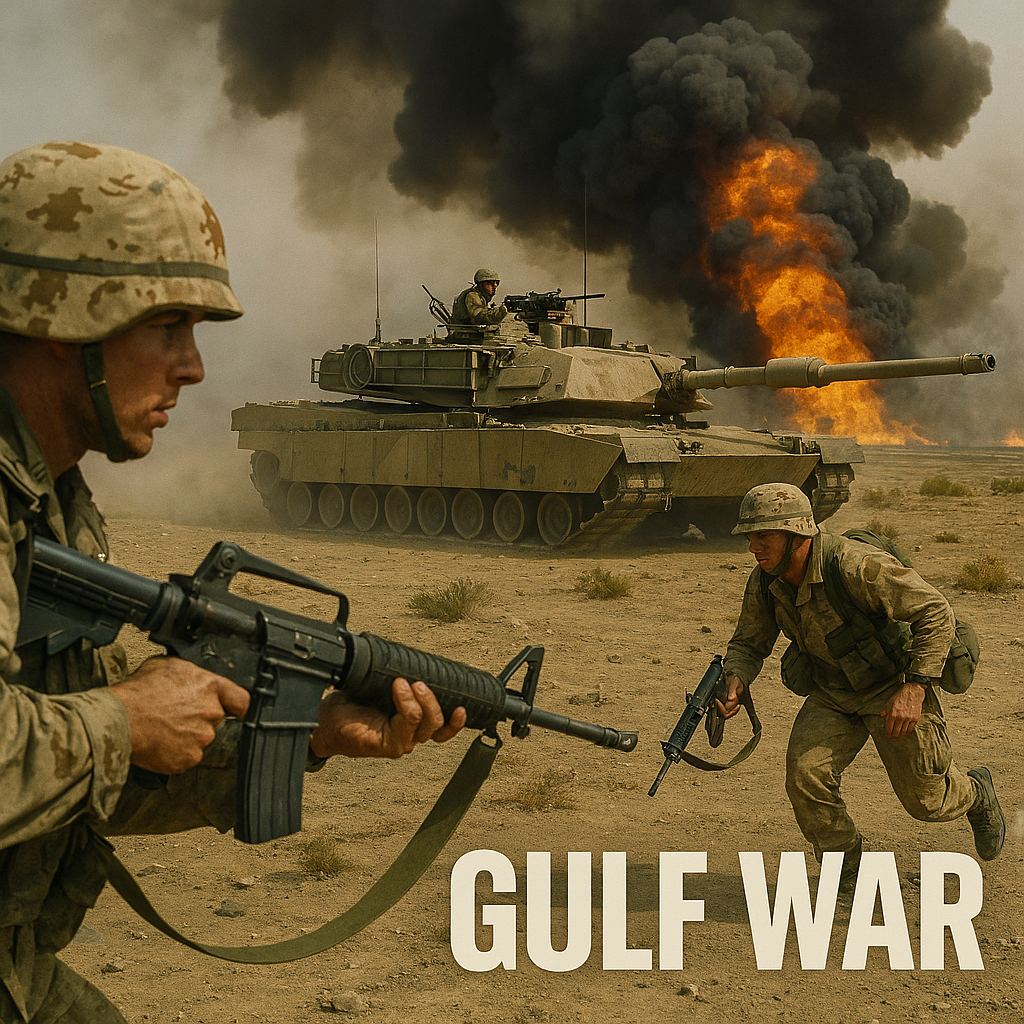
The Gulf War included several of the largest tank battles in U.S. military history, notably the Battle of 73 Easting, Medina Ridge, and Norfolk, where coalition armored units—benefiting from superior training, night‑fighting optics, thermal imaging, and combined‑arms integration with close air support—destroyed Iraqi armored formations at range and in adverse visibility, often before Iraqi crews knew they were under effective fire; these engagements validated the doctrinal emphasis on maneuver warfare and the technological investments in platforms like the M1A1 Abrams and Bradley IFVs, while exposing the limits of Iraqi Soviet‑era armor and defensive posture in the face of Western reconnaissance and fire‑control superiority.
11) First large‑scale use of precision‑guided munitions and stealth
The air campaign showcased the first large‑scale employment of precision‑guided munitions (PGMs) and stealth aircraft such as the F‑117 Nighthawk, enabling strikes against hardened, well-defended targets with minimal collateral damage and reduced pilot risk; initial waves used Tomahawk and AGM‑86 cruise missiles, Wild Weasel suppression of enemy air defenses (SEAD), and precision bombing to rapidly degrade Iraqi air defenses and command nodes, paving the way for control of the skies within a week and changing expectations of air power in joint campaigns, particularly in urban and integrated air defense environments; this technological leap is one reason the Gulf War is remembered as a watershed in modern warfare.
12) Over 100,000 sorties and 88,500 tons of bombs
Coalition air forces flew over 100,000 sorties, dropping roughly 88,500 tons of ordnance, numbers that capture both the scale and sustained tempo of aerial operations across strategic, operational, and tactical targets; this level of air activity required intricate coordination of tanker tracks, airborne command posts, suppression of enemy air defenses, and targeting cycles, while ISR platforms fed a constantly updated picture of Iraqi order of battle and battlefield effects, allowing dynamic retasking to exploit emerging opportunities and ensure ground forces would later encounter a debilitated adversary with disrupted logistics and shattered morale.
13) CNN and the first real‑time global war coverage
The Gulf War is widely considered the first war experienced in real time by a global audience, with CNN and other outlets broadcasting live from Baghdad and coalition capitals, an innovation enabled by satellite uplinks and 24‑hour news cycles that placed viewers inside command narratives and political decision‑making rhythms; this visibility influenced domestic politics, international diplomacy, and military public affairs, prompting armed forces to adapt media strategies and recognize that strategic communication was no longer an adjunct but a core component of modern operations, with effects on adversary perceptions, allied reassurance, and global legitimacy.
14) Coalition casualties: 292 dead
Despite the intensity of operations, coalition fatalities were relatively low—approximately 292 killed—reflecting the effectiveness of air dominance, the brevity of ground combat, force protection measures, and the asymmetry between coalition capabilities and Iraqi vulnerabilities; casualty figures remain a sober measure of war’s human cost, and the distribution of hostile versus non‑hostile deaths (including accidents and illnesses) underscores the risks inherent in large deployments even when active combat duration is short, while the wider context includes hundreds wounded and equipment losses that, though limited compared to Iraqi attrition, demonstrate that even overwhelming technological advantage does not render modern war bloodless.
15) Iraqi civilian deaths and total mortality estimates
Civilian suffering in Iraq was significant, with direct civilian deaths estimated at 3,664 during the conflict and broader postwar mortality—when including the 1991 uprisings and related turmoil—estimated by Medact at 142,500–206,000; these figures highlight the indirect pathways by which war harms populations, including infrastructure damage affecting water, electricity, and health services, displacement, and the social dislocation associated with rapid military defeat and subsequent internal repression, reminding analysts that battlefield metrics alone cannot capture the full human toll of a conflict whose consequences extend beyond ceasefires into complex humanitarian and political aftermaths.
16) Kuwait’s civilian losses: over 1,000 dead and 600 missing
Kuwait suffered over 1,000 civilian deaths and recorded approximately 600 missing persons, reflecting the harsh realities of occupation, resistance, and collateral damage within a small country subjected to rapid invasion and months of control by Iraqi forces; after liberation, efforts to document abuses, locate missing individuals, and restore normal life proceeded alongside massive reconstruction, environmental remediation, and reestablishment of government services, illustrating the complex, long‑term societal repair required after even a short war and the importance of international support in helping a small state recover its institutions and population wellbeing.
17) Over 600 Kuwaiti oil wells set ablaze
In a scorched‑earth tactic during withdrawal, Iraqi forces set more than 600 Kuwaiti oil wells on fire, creating towering smoke plumes that darkened skies, lowered local temperatures, and deposited soot across vast areas, while spillover effects contaminated soil and water; extinguishing the fires required international teams using specialized methods and equipment, and the environmental ramifications—ranging from air quality crises to long‑term ecological damage—became emblematic of the war’s environmental cost, reinforcing global concern about the intersection of armed conflict and environmental security.
18) The largest oil spill in history at the time
The Gulf War oil spill of early 1991—caused by massive releases from facilities like the Sea Island Oil Terminal and additional sources—was at the time the largest oil spill in history, with estimates often cited in the millions of barrels; whether framed as deliberate environmental warfare or contested as the unintended consequence of strikes, the spill devastated Saudi and Kuwaiti coastal ecosystems, harmed marine life, and demanded complex cleanup strategies, while subsequent studies questioned early optimistic assessments and documented persistent ecological impacts, making the event a case study in environmental terrorism, crisis response, and the need for robust environmental protections even amid military planning.
19) Oil disputes and post–Iran‑Iraq War debt as causes
Iraq’s decision to invade Kuwait cannot be separated from contentious oil politics and crushing post–Iran‑Iraq War debt, including claims that Kuwait exceeded OPEC quotas and depressed prices, as well as Baghdad’s frustration that loans from Gulf neighbors—especially Kuwait—were not forgiven; Iraq also revived border and historical claims, underscoring how fiscal pressures, energy markets, and unresolved territorial disputes can combine to produce strategic miscalculations, particularly when a regime seeks quick financial relief or political distraction through coercion against a smaller neighbor perceived to be undermining its economic recovery.
20) Accusations of Kuwaiti slant‑drilling in the Rumaila field
Among Iraq’s justifications was the allegation that Kuwait engaged in slant‑drilling into the Rumaila oil field, effectively siphoning Iraqi hydrocarbons across the border; while this claim is disputed and often cited as a pretext, its prominence in Iraqi rhetoric reveals how technical oil‑field operations can become weaponized politically in a region where resource lines closely coincide with national boundaries, and where perceptions of economic warfare—real or imagined—feed into broader narratives of grievance, sovereignty, and the legitimacy of using force to redress alleged economic harms, even as international law and external observers challenge the factual basis of such accusations.
21) UN Security Council Resolution 678’s ultimatum
UNSCR 678, adopted on November 29, 1990, gave Iraq an unmistakable ultimatum—withdraw from Kuwait by January 15, 1991, or face member states using “all necessary means” to compel compliance—thus anchoring the coalition’s legal authority and shaping a clear diplomatic narrative of collective security against aggression; the resolution’s timing allowed Desert Shield to mature, created a fixed political horizon for both sides, and ensured that when Desert Storm commenced, it did so under a widely recognized international mandate that helped maintain Arab participation and global support, demonstrating the power of Security Council consensus to underpin large multinational military actions.
22) Gulf War Syndrome and veterans’ health
A controversial and enduring legacy is Gulf War Syndrome (GWI), a constellation of chronic symptoms reported by a significant share of veterans—over 40% of U.S. veterans by some assessments—including fatigue, musculoskeletal pain, cognitive issues, and gastrointestinal disorders; while causal factors have been debated (ranging from exposure to chemical agents, destroyed munitions facilities, pesticides, vaccines, and environmental toxins), studies and official inquiries have sought to disentangle complex exposures from stress and other confounders, and the U.S. government has recognized GWI for treatment and benefits purposes, underscoring that even short conflicts can have long‑term health consequences that challenge medical science and policy frameworks decades after the shooting stops.
23) Iraqi aircraft flown to Iran to avoid destruction
In the chaos of the air campaign and impending ground assault, Iraq flew approximately 137 aircraft to Iran to avoid their destruction, an extraordinary move given the countries’ enmity after the Iran‑Iraq War; the transfer removed valuable assets from immediate coalition targeting but paradoxically left Iraq’s own air capabilities diminished, and the episode highlights how states under acute military pressure may make desperate decisions that appear strategically rational in the moment yet complicate future force regeneration and regional politics—particularly when assets are not returned or become bargaining chips in subsequent diplomatic relations.
24) Reshaping Middle East politics and U.S. presence
The Gulf War reshaped regional politics, reinforcing U.S. partnerships with Gulf monarchies, prompting long‑term U.S. military presence and basing arrangements, and influencing debates on sanctions, containment, and regime durability in Iraq; the war also affected relations among Arab states, the Palestinian issue (including Kuwait’s postwar stance toward the PLO), and perceptions of international norms around sovereignty and collective action, while domestically in the U.S. it contributed to narratives of post–Cold War leadership and military professionalism, setting precedents for later interventions and policy frameworks that would echo into the 2003 Iraq War and beyond.
25) A first major post–Cold War conflict and U.S. dominance
As the first major international conflict after the Cold War, the Gulf War signaled a new era in which the United States could assemble broad coalitions under UN auspices, leverage overwhelming technological advantages, and execute joint operations with minimal casualties relative to the scale of objectives; this demonstration of capability and political will shaped global perceptions of U.S. power, influenced adversary calculations, and underpinned doctrinal evolution in precision warfare, networked command, and integrated air‑land operations—features that would define much of the military conduct in the 1990s and early 2000s, even as subsequent conflicts probed the limits of such dominance in irregular warfare contexts.
FAQs about the Gulf War
1. What was the Gulf War and when did it happen?
The Gulf War, also known as the Persian Gulf War or Operation Desert Storm, was a conflict that took place from August 2, 1990, to February 28, 1991. It began when Iraq, led by Saddam Hussein, invaded Kuwait over oil disputes and territorial claims. In response, a U.S.-led coalition of 42 nations intervened under United Nations authority to liberate Kuwait. The war consisted of two main phases: Operation Desert Shield (defensive buildup) and Operation Desert Storm (combat operations). [history.com]
2. Why did Iraq invade Kuwait?
Iraq invaded Kuwait primarily due to economic and territorial disputes. Saddam Hussein accused Kuwait of slant-drilling into Iraq’s Rumaila oil field and overproducing oil, which lowered global prices and hurt Iraq’s economy. Iraq also demanded that Kuwait forgive billions in debt from the Iran-Iraq War. Additionally, Hussein claimed Kuwait was historically part of Iraq, framing the invasion as a correction of colonial-era borders. [history.com]
3. Who were the main countries involved in the Gulf War?
The coalition was led by the United States and included major contributors like Saudi Arabia, the United Kingdom, France, Egypt, and Canada, among others. In total, 42 nations participated, making it the largest military alliance since World War II. Iraq stood alone, with limited support from Jordan and the PLO, but no major allies. [history.com]
4. What were Operation Desert Shield and Operation Desert Storm?
- Operation Desert Shield (August 1990 – January 1991): The defensive phase where U.S. and coalition forces deployed to Saudi Arabia to prevent further Iraqi aggression.
- Operation Desert Storm (January 17 – February 28, 1991): The offensive phase, starting with a massive air campaign followed by a 100-hour ground assault that liberated Kuwait. [history.com]
5. How long did the ground war last?
The ground offensive lasted only 100 hours (February 24–28, 1991). After weeks of air strikes, coalition forces launched a swift maneuver that overwhelmed Iraqi defenses, liberated Kuwait, and forced Iraqi troops to retreat. [history.com]
6. How many casualties occurred during the Gulf War?
Coalition forces suffered around 292 fatalities, while Iraqi military deaths are estimated between 20,000 and 50,000. Civilian casualties in Iraq were significant, with thousands killed directly and many more affected by postwar uprisings and infrastructure collapse. [history.com]
7. What role did technology play in the Gulf War?
The Gulf War marked the first large-scale use of precision-guided munitions and stealth aircraft like the F-117 Nighthawk. Coalition forces also used advanced tanks (M1A1 Abrams), GPS navigation, and real-time satellite communications. These innovations contributed to rapid victory and minimal coalition casualties. [history.com]
8. Why is the Gulf War called the “Video Game War”?
The Gulf War earned this nickname because of extensive live TV coverage, especially by CNN, and the broadcast of gun-camera footage showing precision strikes. This was the first war experienced globally in real time, changing how conflicts were perceived by the public. [history.com]
9. Did Iraq use chemical or biological weapons during the Gulf War?
Although Iraq possessed chemical and biological weapons, it did not use them during the Gulf War, likely due to fear of massive retaliation by coalition forces. However, concerns about exposure to chemical agents contributed to long-term health issues among veterans. [history.com]
10. What was Gulf War Syndrome?
Gulf War Syndrome (GWI) refers to chronic health problems reported by veterans, including fatigue, joint pain, memory issues, and respiratory conditions. Causes remain debated, with theories pointing to chemical exposure, vaccines, and environmental hazards during deployment. [reddit.com]
11. Why didn’t the coalition remove Saddam Hussein from power?
The coalition’s mandate was limited to liberating Kuwait, not regime change. U.S. leaders feared that toppling Saddam would destabilize Iraq and the region, create a power vacuum, and require prolonged occupation—concerns that later proved prescient after the 2003 Iraq War. [reddit.com]
12. What environmental damage did the Gulf War cause?
Iraqi forces set over 600 Kuwaiti oil wells on fire during their retreat, causing massive air pollution and ecological devastation. Additionally, the Gulf War oil spill was the largest in history at the time, severely damaging marine ecosystems in the Persian Gulf. [history.com]
13. How did the Gulf War affect Middle East politics?
The war strengthened U.S. ties with Gulf states, led to a long-term American military presence in the region, and influenced future conflicts like the Iraq War in 2003. It also strained relations between Kuwait and the PLO, as Palestinian leadership supported Iraq during the war. [history.com]
14. What was Iraq’s strategy during the war?
Iraq tried to break coalition unity by launching Scud missiles at Israel, hoping to provoke Israeli retaliation and alienate Arab coalition members. Israel refrained from responding, thanks to U.S. diplomatic pressure, preserving coalition cohesion. [history.com]
15. How did tanks influence the outcome of the Gulf War?
Coalition tanks, especially the M1A1 Abrams, dominated Iraqi armor in battles like 73 Easting and Medina Ridge. Superior firepower, night vision, and maneuverability allowed coalition forces to destroy Iraqi formations with minimal losses, proving the effectiveness of modern armored warfare. [history.com]