Villa Savoye
Villa Savoye is more than just a house—it’s a manifesto of modernist architecture and a living symbol of Le Corbusier’s revolutionary vision. Built between 1928 and 1931 in Poissy, France, this sleek concrete structure embodies the architect’s famous “Five Points of Architecture,” from pilotis that lift the building off the ground to ribbon windows that flood the interior with light. Though plagued by leaks and structural flaws, the villa has endured war damage, near-demolition, and decades of neglect to become a celebrated UNESCO World Heritage Site in 2016. Today, it stands as both a museum and a timeless reminder of how bold design can challenge tradition, inspire generations, and spark debate about the balance between architectural ideals and everyday living.
1. Location in Poissy, France
Villa Savoye is located at 82 Rue de Villiers, 78300 Poissy, France, about 30 kilometers northwest of Paris. The site was chosen to provide the Savoye family with a retreat from the city while remaining accessible by car. Its rural setting allowed Le Corbusier to experiment with his architectural ideals in a natural landscape, emphasizing the harmony between modern design and open surroundings.
2. Coordinates
The villa’s exact coordinates are 48°55′28″N 2°1′42″E, situating it firmly within the Île-de-France region. These coordinates highlight its proximity to Paris while still being surrounded by countryside. The location reflects Le Corbusier’s vision of integrating modern architecture into both urban and rural contexts.
3. Designed by Le Corbusier and Pierre Jeanneret
The villa was designed by Le Corbusier and Pierre Jeanneret, cousins and frequent collaborators. Le Corbusier provided the visionary concepts, while Jeanneret contributed technical expertise. Together, they created a building that became a manifesto of modernist architecture, embodying radical ideas that shaped the future of design.
4. Construction Timeline
Construction took place between 1928 and 1931, a period when modernist architecture was gaining momentum. The use of reinforced concrete was cutting-edge at the time, allowing for structural freedom and innovation. Despite delays and technical challenges, the villa emerged as a bold statement of architectural modernity.
5. Reinforced Concrete
Villa Savoye was built using reinforced concrete, a material that enabled Le Corbusier’s “Five Points of Architecture.” Concrete allowed for pilotis, ribbon windows, and free façades, all of which were impossible with traditional stone or brick. This material choice was both innovative and problematic, as it contributed to structural issues like cracks and leaks.
6. Five Points of Architecture
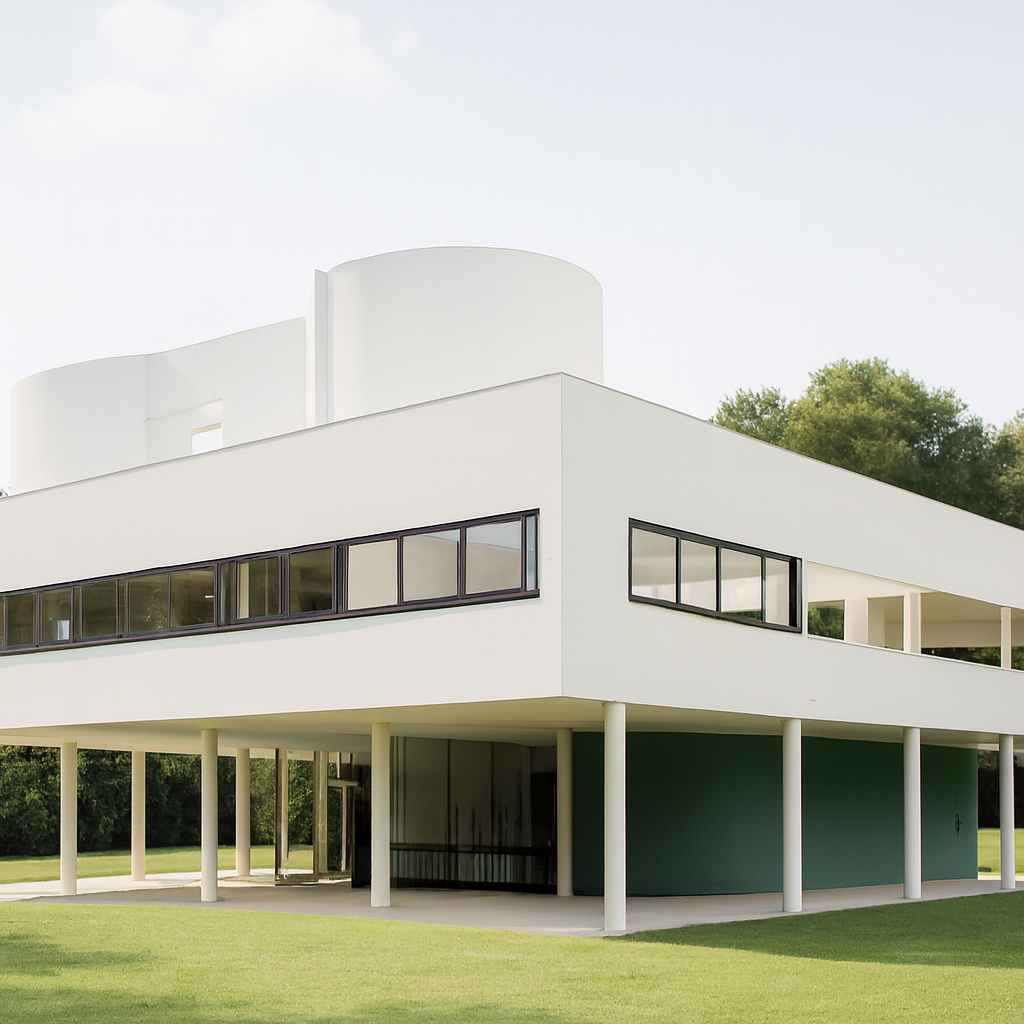
The villa exemplifies Le Corbusier’s “Five Points of Architecture”: pilotis, roof garden, free plan, ribbon windows, and free façade. These principles were revolutionary, breaking away from traditional load-bearing walls and pitched roofs. Villa Savoye became the textbook example of these ideas, demonstrating how modern architecture could liberate design from historical constraints.
7. Pilotis
The house is elevated on slender pilotis (columns), lifting it above the ground. This design freed the landscape below, allowing nature to flow uninterrupted. It also created a sense of lightness and modernity, symbolizing the detachment of architecture from the earth.
8. Roof Terrace
The villa’s roof is a flat terrace garden, intended as a leisure space. Le Corbusier believed rooftops should be reclaimed for human use, integrating nature into architecture. This feature reflected his vision of urban living where green spaces could coexist with modern structures.
9. Ribbon Windows
Long horizontal ribbon windows stretch across the façade, flooding the interior with light. These windows provided panoramic views of the surrounding countryside. They also emphasized the villa’s modernist aesthetic, breaking away from traditional vertical openings.
10. Free Façade
The façade of Villa Savoye is free from structural constraints, thanks to reinforced concrete. This allowed Le Corbusier to design the exterior purely for aesthetic and functional purposes. The result was a sleek, minimalist look that became iconic in modernist architecture.
11. Free Floor Plan
Inside, the villa features a free floor plan, where walls are not load-bearing. This flexibility allowed for open, flowing spaces rather than rigid compartments. It demonstrated how modern materials could liberate interior design from structural limitations.
12. Rarely Used
Despite its innovative design, the villa was rarely used by the Savoye family. Structural problems, including leaks and cracks, made it uncomfortable. The family eventually abandoned the house, highlighting the tension between architectural ideals and practical living.
13. Construction Defects
The villa suffered from roof leaks and structural cracks, common issues in early reinforced concrete buildings. These defects undermined its functionality as a home. While architecturally groundbreaking, the villa revealed the challenges of experimental design in real-world conditions.
14. World War II Occupation
During World War II, Villa Savoye was occupied by both German and American forces. The house endured neglect, vandalism, and damage during this period. Its wartime history added another layer to its complex legacy, showing how architecture can be caught in the tides of history.
15. Wartime Damage
The villa suffered significant damage during the war, including broken windows, structural deterioration, and neglect. Its condition worsened, and by the postwar years, it was nearly uninhabitable. This period marked the lowest point in its history before restoration efforts began.
16. Near Demolition
In the 1950s, Villa Savoye faced the threat of demolition to make way for urban development. Its deteriorated state made it seem expendable. However, architects and preservationists rallied to save it, recognizing its importance as a cultural and architectural landmark.
17. Protests
Protests from architects, historians, and preservationists played a crucial role in saving Villa Savoye. They argued that the villa was a masterpiece of modern architecture that deserved protection. Their efforts highlighted the growing movement to preserve 20th-century heritage.
18. Le Corbusier’s Intervention
Le Corbusier himself intervened to prevent the demolition of Villa Savoye. His advocacy underscored the villa’s significance as a representation of his architectural philosophy. His involvement helped secure its survival and eventual restoration.
19. Historical Monument Status
In 1965, Villa Savoye was officially declared a French historical monument. This recognition ensured its preservation for future generations. It was one of the first modernist buildings to receive such status, marking a turning point in heritage conservation.
20. Recognition During Le Corbusier’s Lifetime
Remarkably, the villa was declared a historical monument while Le Corbusier was still alive. This rare honor allowed him to witness the recognition of his work as part of France’s cultural heritage. It validated his vision and cemented his legacy.
21. Museum
Today, Villa Savoye is open to the public as a museum. Visitors can explore its spaces and experience firsthand the principles of modernist architecture. It serves as both an educational site and a pilgrimage destination for architecture enthusiasts.
22. UNESCO World Heritage Site
In 2016, Villa Savoye was inscribed as part of the UNESCO World Heritage Site The Architectural Work of Le Corbusier. This designation recognized its global significance. It joined a collection of Le Corbusier’s works celebrated for their impact on modern architecture.
23. Comparison to Villa Rotunda
Architectural critic Colin Rowe famously compared Villa Savoye to Palladio’s Villa Rotunda. He argued that both buildings represent idealized forms of architecture in their respective eras. This comparison highlighted the timeless pursuit of harmony and proportion in design.
24. Villa Savoye Shadow
A black replica called the “Villa Savoye Shadow” exists in Canberra, Australia. This reinterpretation pays homage to the original while exploring its symbolic presence. It demonstrates how Villa Savoye continues to inspire reinterpretations across the globe.
25. Clash of Ideals and Practicality
Despite its iconic status, Villa Savoye is often cited as an example of modernist ideals clashing with practical living needs. Its leaks and discomfort made it unsuitable as a family home. Yet, its architectural brilliance ensured its place as a symbol of modernism’s aspirations and limitations.
FAQs about Villa Savoye
1. Where is Villa Savoye located?
Villa Savoye is located at 82 Rue de Villiers, 78300 Poissy, France, about 30 kilometers northwest of Paris. Its rural setting was chosen to give the Savoye family a countryside retreat while remaining accessible to the city. Today, it is part of the Île-de-France region and is open to the public as a museum.
2. Who designed Villa Savoye?
The villa was designed by Le Corbusier and Pierre Jeanneret, cousins and collaborators. Le Corbusier provided the visionary concepts, while Jeanneret contributed technical expertise. Together, they created a building that became a manifesto of modernist architecture.
3. When was Villa Savoye built?
Construction took place between 1928 and 1931, during a period when modernist architecture was gaining momentum. The villa’s use of reinforced concrete was cutting-edge at the time. Despite construction challenges, it emerged as a bold statement of architectural modernity.
4. What is the architectural style of Villa Savoye?
Villa Savoye is considered a masterpiece of the International Style, characterized by simplicity, functionality, and geometric clarity. Its clean lines, open spaces, and lack of ornamentation exemplify this style. It influenced countless modernist buildings worldwide.
5. What are Le Corbusier’s “Five Points of Architecture” seen in Villa Savoye?
The villa embodies Le Corbusier’s Five Points of Architecture:
- Pilotis (columns) lifting the building off the ground.
- Flat roof terrace functioning as a garden.
- Free floor plan with non-load-bearing walls.
- Ribbon windows for continuous light.
- Free façade design unconstrained by structure.
6. What are the opening hours of Villa Savoye?
From May 2 to August 31, the villa is open 10 am – 6 pm (closed Mondays). From September 1 to April 30, it is open 10 am – 5 pm (closed Mondays). It closes at 4 pm on December 24 and is closed on May 1, December 25, and January 1.
7. How much is the entrance fee?
As of January 2024, the individual ticket price is €9. A special partnership rate is €7.50, and there are free admissions for under 18s, EU residents aged 18–25, and disabled visitors with companions. Eurostar travelers can also benefit from a “2FOR1” offer.
8. Who owns Villa Savoye today?
The villa is owned by the French government. Its preservation is managed as part of France’s cultural heritage, ensuring that it remains open to the public and maintained as a historical monument.
9. Why was Villa Savoye rarely used by the Savoye family?
Although commissioned as a weekend retreat, the Savoye family rarely used the villa due to construction defects such as roof leaks and cracks. These issues made the house uncomfortable and impractical for regular living.
10. What happened to Villa Savoye during World War II?
During World War II, Villa Savoye was occupied by both German and American forces. It suffered neglect, vandalism, and damage, leaving it in poor condition after the war.
11. Was Villa Savoye ever threatened with demolition?
Yes, in the 1950s, Villa Savoye was nearly demolished to make way for development. Protests from architects and preservationists, along with Le Corbusier’s intervention, saved the villa from destruction.
12. When did Villa Savoye become a historical monument?
In 1965, Villa Savoye was declared a French historical monument. This recognition ensured its preservation and marked one of the first times a modernist building received such status.
13. Is Villa Savoye a UNESCO World Heritage Site?
Yes, in 2016, Villa Savoye was inscribed as part of the UNESCO World Heritage Site The Architectural Work of Le Corbusier. It was recognized under cultural criteria i, ii, and vi for its outstanding contribution to modern architecture.
14. What facilities does Villa Savoye include?
The villa includes a garage for three automobiles, a caretaker’s lodge, and living spaces such as a living room, kitchen, bedrooms, and bathrooms. These features reflected the Savoye family’s lifestyle and Le Corbusier’s vision of a “machine for living.”
15. Why is Villa Savoye considered iconic?
Villa Savoye is iconic because it perfectly demonstrates Le Corbusier’s architectural philosophy. It represents the shift from traditional design to modernist ideals, influencing generations of architects worldwide.