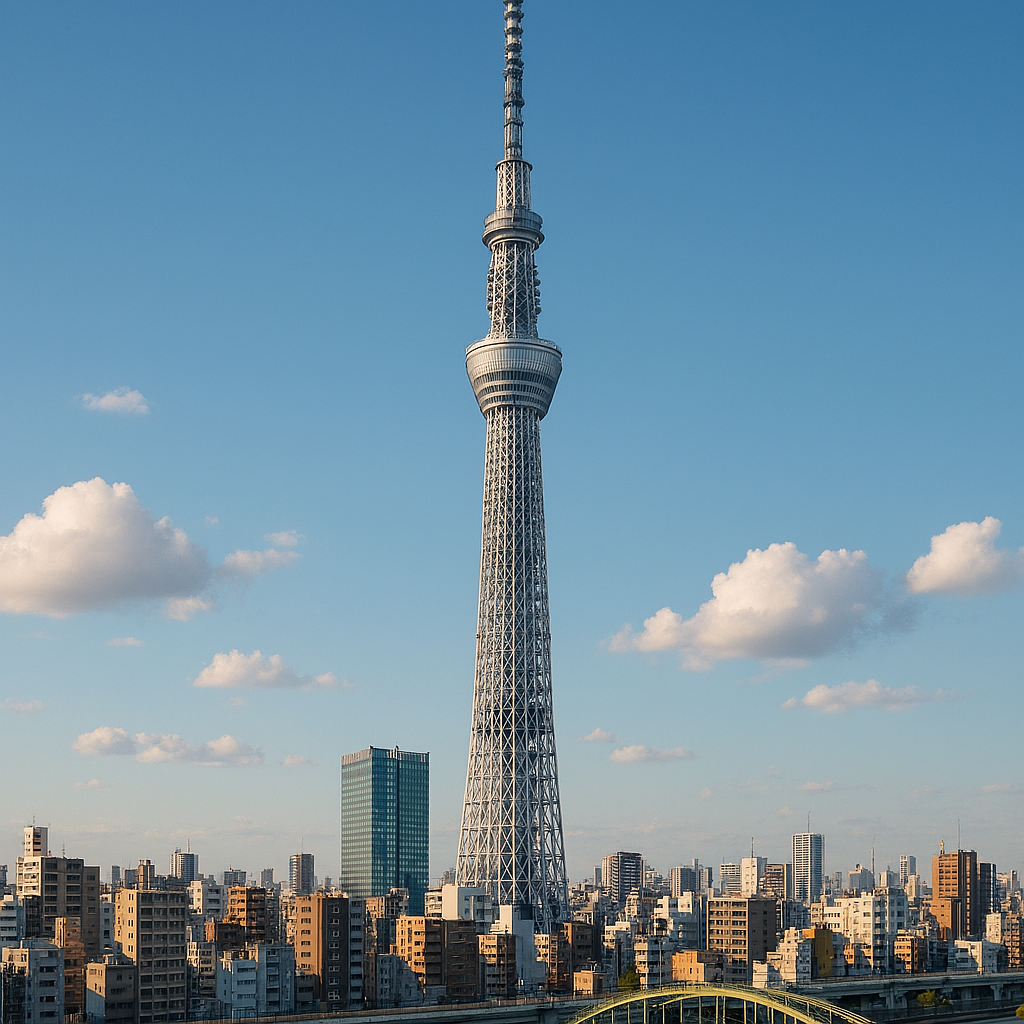
Tokyo Skytree
Tokyo Skytree isn’t just a broadcasting tower—it’s a modern icon that defines the skyline of Japan’s capital. Standing at an incredible 634 meters, this architectural marvel combines cutting-edge engineering with cultural symbolism, making it one of the most fascinating structures in the world. From its record-breaking height and earthquake-resistant design to its breathtaking observation decks and unique lighting themes, Tokyo Skytree offers more than just a view—it tells a story of innovation, resilience, and tradition. In this post, we’ll explore 25 verified numerical facts that reveal why Tokyo Skytree is not only a technological triumph but also a cultural landmark worth knowing.
1. Height – 634 meters
Tokyo Skytree reaches an astonishing height of 634 meters (2,080 feet), making it the tallest tower in the world and the tallest structure in Japan. This height surpasses other famous towers like the Canton Tower in China, which stands at 600 meters, and Tokyo Tower, which is only 333 meters tall. Its immense size was designed to ensure clear broadcasting signals across the Tokyo metropolitan area, which is densely packed with skyscrapers that interfere with transmission.
2. Meaning of 634
The number 634 was not chosen arbitrarily; it carries cultural significance in Japan. When pronounced in Japanese, the digits can be read as “Mu-Sa-Shi,” which refers to the historical Musashi Province, an area that once encompassed modern-day Tokyo. This clever linguistic connection makes the tower not only a technological marvel but also a tribute to Japan’s heritage.
3. Construction Timeline
Construction began on July 14, 2008, and was completed on February 29, 2012, taking nearly 3 years and 10 months to finish. This timeline is impressive considering the complexity of building a structure that would become the tallest of its kind. The project involved thousands of workers and cutting-edge engineering techniques to ensure safety and stability in a region prone to earthquakes.
4. Topping Out
The tower reached its full height on March 18, 2011, marking a major milestone in its construction. This achievement came just days after the devastating Great East Japan Earthquake on March 11, 2011, which tested the resilience of the structure during its final stages. Despite the disaster, the tower remained unharmed, proving the effectiveness of its earthquake-resistant design.
5. Construction Cost
The total cost of building Tokyo Skytree was approximately ¥65 billion JPY, which is about $500 million USD. This massive investment reflects the scale and ambition of the project, which aimed to create not just a broadcasting tower but a landmark symbol for Tokyo. The cost also included advanced seismic technology and luxurious observation decks to attract millions of visitors annually.
6. Tembo Deck
The Tembo Deck, located at 350 meters (1,150 feet), is one of the main observation areas and can accommodate up to 2,000 people at a time. Visitors enjoy panoramic views of Tokyo, and on clear days, Mount Fuji can be seen in the distance. The deck also features interactive displays and a café, making it a popular destination for both tourists and locals.
7. Tembo Galleria
Above the Tembo Deck lies the Tembo Galleria, situated at 450 meters (1,480 feet), which can hold 900 people. This area is often called the “skywalk” because of its spiraling glass corridor that gives visitors the sensation of walking in the sky. It is one of the highest observation points in the world, offering breathtaking views of Tokyo’s sprawling cityscape.
8. Highest Accessible Point
The highest point accessible to visitors is 451.3 meters (1,481 feet), located at the top of the Tembo Galleria. Standing here provides a unique perspective of Tokyo, especially at night when the city lights create a dazzling spectacle. Few observation decks globally reach this altitude, making it a bucket-list experience for travelers.
9. Elevators
Tokyo Skytree is equipped with 13 elevators, including high-speed lifts that can reach the observation decks in about 50 seconds. These elevators are among the fastest in Japan and are designed to minimize vibration for passenger comfort. The interiors are themed to represent the four seasons, adding an artistic touch to the ride.
10. Tripod Base
The tower’s base is shaped like a tripod, which transitions into a cylindrical structure above 350 meters. This design was chosen for stability and aesthetics, ensuring the tower could withstand strong winds and earthquakes. The tripod base also creates a visually striking silhouette that distinguishes Tokyo Skytree from other towers worldwide.
11. Roof and Antenna Heights
The roof of Tokyo Skytree reaches 495.2 meters (1,625 feet), while the antenna spire extends to the full 634 meters. This spire is essential for broadcasting signals across the Kanto region, which includes Tokyo and surrounding prefectures. The additional height ensures uninterrupted transmission even in Japan’s densely built urban environment.
12. Earthquake Resistance
The tower’s earthquake resistance is achieved through a central reinforced concrete shaft that acts as a counterweight, reducing seismic vibrations by up to 50%. This design was inspired by traditional Japanese pagodas, which have survived centuries of earthquakes. The engineering innovation makes Tokyo Skytree one of the safest tall structures in the world.
13. First-Year Visitors
In its first year, Tokyo Skytree welcomed 6.34 million visitors, while the surrounding Solamachi shopping complex attracted 50 million people. These numbers highlight the tower’s immediate success as a tourist destination. The influx of visitors also boosted local businesses and reinforced Tokyo Skytree’s status as a cultural and economic landmark.
14. Annual Visitors
Today, the tower attracts over 2.5 million tourists annually, making it one of Japan’s most visited attractions. This steady flow of visitors contributes significantly to Tokyo’s tourism industry. The tower’s popularity is sustained by seasonal events, light shows, and its reputation as a must-see destination.
15. Solamachi Shopping Complex
At the base of Tokyo Skytree lies the Solamachi complex, which boasts over 300 stores. This makes it one of Tokyo’s largest shopping hubs, offering everything from traditional crafts to international brands. The complex also includes an aquarium and planetarium, turning the area into a full-day entertainment destination.
16. Broadcasting Role
Tokyo Skytree serves as the primary TV and radio broadcast tower for the entire Kanto region. Its height eliminates interference caused by Tokyo’s numerous skyscrapers, which was a problem for the older Tokyo Tower. This role ensures that millions of households receive clear digital signals daily.
17. Lighting Themes
The tower features two main lighting themes—“Iki” (blue) and “Miyabi” (purple)—which alternate nightly. Special color schemes are used for holidays and events, such as pink for cherry blossom season or green for environmental campaigns. These illuminations make Tokyo Skytree a dynamic part of the city’s skyline.
18. Location
Tokyo Skytree is located 7 km (4.3 miles) northeast of Tokyo Station and is accessible via two major train stations: Tokyo Skytree Station and Oshiage Station. This convenient location makes it easy for visitors to reach from anywhere in Tokyo. The surrounding area also offers scenic riverside views and cultural attractions.
19. Guinness World Record
In 2012, Tokyo Skytree was officially recognized by Guinness World Records as the tallest free-standing broadcasting tower. This accolade cemented its place among the world’s most iconic structures. The recognition also boosted its global profile, attracting international tourists and media attention.
20. Design Inspiration
The tower’s design draws inspiration from the curvature of a Japanese sword and traditional pagoda architecture. This blend of modern engineering and cultural symbolism creates a structure that is both functional and aesthetically pleasing. The design reflects Japan’s ability to harmonize tradition with innovation.
21. Glass Floor
The Tembo Deck includes a glass floor section that allows visitors to look straight down from 350 meters above ground. This thrilling feature offers a unique perspective and is popular among adventurous tourists. The glass is reinforced for safety, ensuring visitors can enjoy the experience without fear.
22. Lightning Detection
Tokyo Skytree is equipped with advanced cloud and lightning detection systems for research purposes. These instruments help scientists study atmospheric conditions and improve weather forecasting. The tower thus serves not only as a tourist attraction but also as a hub for scientific innovation.
23. Ticket Demand
During its opening year, ticket demand was so high that some visitors waited up to 6 hours without success. This overwhelming popularity led to the implementation of an online reservation system. The initial rush demonstrated the tower’s status as a highly anticipated landmark.
24. Construction Safety
Special safety measures were taken during construction to prevent falling tools, as an object dropped from 400 meters could cause severe injury. Workers used nets and harnesses to minimize risks. These precautions ensured that the project maintained an excellent safety record despite its scale.
25. Height Adjustment
The tower’s height was originally planned to be 610 meters but was increased by 20 meters to reach 634 meters, surpassing China’s Canton Tower. This strategic decision ensured Tokyo Skytree would hold the title of the world’s tallest tower. The adjustment reflects Japan’s ambition to lead in architectural achievements.
Frequently Asked Questions (FAQ) about Tokyo Skytree
1. What is Tokyo Skytree?
Tokyo Skytree is a broadcasting and observation tower located in Sumida, Tokyo, Japan. It stands at 634 meters (2,080 feet), making it the tallest structure in Japan and the tallest free-standing broadcasting tower in the world. Completed in 2012, it serves as a hub for television and radio transmission while also being a major tourist attraction with observation decks, shopping, and dining facilities. [travelsetu.com]
2. How tall is Tokyo Skytree?
The tower measures 634 meters (2,080 feet) from base to tip, a height chosen for cultural significance because “634” can be read as “Musashi,” an old name for the region. This height surpasses Tokyo Tower (333 meters) and ensures clear broadcasting signals across the Kanto region. [travelsetu.com]
3. Why was Tokyo Skytree built?
Tokyo Skytree was constructed primarily to improve television and radio broadcasting coverage in Tokyo. The older Tokyo Tower could no longer provide complete digital terrestrial broadcasting due to interference from surrounding skyscrapers. The new tower also aimed to become a landmark and tourist destination, blending modern engineering with traditional Japanese aesthetics. [travelsetu.com]
4. When was Tokyo Skytree completed and opened?
Construction began in July 2008 and was completed on February 29, 2012. The tower officially opened to the public in May 2012, marking a new era for Tokyo’s skyline and broadcasting infrastructure. [solosophie.com]
5. Where is Tokyo Skytree located?
Tokyo Skytree is situated in Sumida City, northeast of central Tokyo. It is easily accessible via Tokyo Skytree Station on the Tobu Skytree Line and Oshiage Station, which connects to multiple subway lines including the Hanzomon and Asakusa Lines. [triptojapan.com]
6. How do I get to Tokyo Skytree?
Visitors can reach Tokyo Skytree by train, bus, or car. The most convenient stations are Tokyo Skytree Station and Oshiage Station, both just a short walk from the tower. Parking is available but limited, so public transportation is recommended. [triptojapan.com]
7. What are the observation decks at Tokyo Skytree?
There are two main observation decks:
- Tembo Deck at 350 meters (1,148 ft) offers 360-degree views and interactive exhibits.
- Tembo Galleria at 450 meters (1,476 ft) features a spiraling glass walkway for a “walk in the sky” experience. [travelsetu.com]
8. What are the operating hours of Tokyo Skytree?
The observation decks are open daily from 10:00 AM to 10:00 PM, with last admission at 9:00 PM. Hours may vary during special events or holidays, so checking the official website before visiting is recommended. [tokyo-skytree.jp]
9. How much time can I spend on the observation deck?
There is no official time limit for staying on the observation decks. However, during peak hours or operational constraints, staff may request visitors to limit their time to manage crowd flow. [tokyo-skytree.jp]
10. Can I buy tickets online?
Yes, tickets can be purchased online through the official Tokyo Skytree website or authorized platforms. Online booking is highly recommended to avoid long queues, especially during weekends and holidays. [tripadvisor.com]
11. How much do tickets cost?
Ticket prices vary depending on the observation deck:
- Tembo Deck (350m): Around ¥2,100 for adults.
- Tembo Galleria (450m): Additional fee of about ¥1,000. Combo tickets and fast-access options are also available. [travelsetu.com]
12. Are there restaurants or shops at Tokyo Skytree?
Yes, the base of the tower features Tokyo Solamachi, a shopping complex with over 300 stores and restaurants. Visitors can enjoy Japanese cuisine, international dishes, and purchase souvenirs, including exclusive Skytree merchandise. [travelsetu.com]
13. Is Tokyo Skytree accessible for people with disabilities?
Absolutely. The tower is fully wheelchair-accessible, with elevators, ramps, and accessible restrooms. Wheelchairs are available for loan, though in limited numbers. [tokyo-skytree.jp]
14. Can I bring pets inside Tokyo Skytree?
No, pets are not allowed inside the tower. However, service animals such as guide dogs are permitted. [tokyo-skytree.jp]
15. Are there any prohibited items?
For safety reasons, items such as drones, large luggage, and hazardous materials are prohibited. Visitors should check the official guidelines before arrival. [tokyo-skytree.jp]
16. Does Tokyo Skytree accept credit cards?
Yes, major credit cards including VISA, MasterCard, JCB, AMEX, and UnionPay are accepted throughout the facility. [tokyo-skytree.jp]
17. What is the best time to visit Tokyo Skytree?
The best time is on a clear day for views of Mount Fuji. Early mornings on weekdays are less crowded, while evenings offer stunning night views of Tokyo’s illuminated skyline. [travelsetu.com]
18. Can I leave and re-enter with the same ticket?
No, tickets are valid for one entry only. Once you exit, you cannot re-enter without purchasing a new ticket. [tokyo-skytree.jp]
19. Are there lockers available?
Yes, lockers are available for storing personal belongings. However, space is limited, so visitors should plan accordingly. [tripadvisor.com]
20. Does Tokyo Skytree host special events?
Yes, the tower frequently hosts seasonal light-ups, cultural exhibitions, and themed events. These enhance the visitor experience and often coincide with Japanese festivals. [travelsetu.com]