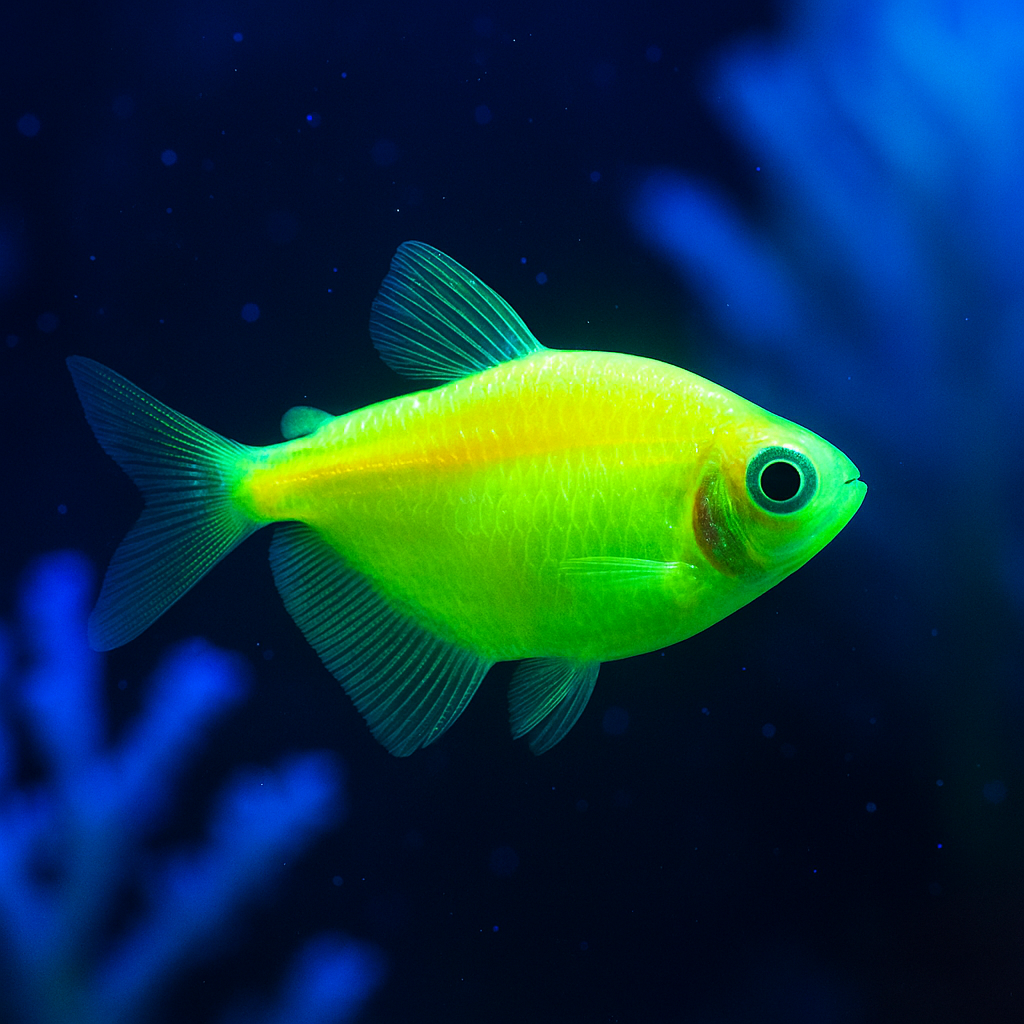
Electric Green GloFish Tetra
If you’ve ever walked past an aquarium glowing like a neon light show, chances are you’ve encountered GloFish Tetras. These dazzling fish aren’t just eye candy—they’re the result of fascinating science, clever innovation, and a splash of controversy. From their jellyfish-inspired glow to their journey from research labs to home aquariums, GloFish Tetras have a story that’s as colorful as they are. In this post, we’ll dive into 25 intriguing facts that reveal how these fluorescent wonders came to be, why they’re so popular, and what makes them unique in the world of ornamental fish. Whether you’re an aquarist, a science enthusiast, or just curious about glowing pets, you’re in for a bright read!
1) GloFish are genetically modified aquarium fish designed to fluoresce in bright colors.
GloFish are a line of ornamental fish whose defining trait is visible fluorescence—an eye‑catching glow produced by transgenic insertion of fluorescent protein genes into otherwise familiar freshwater species. The brand emerged as one of the first widely available genetically modified animals in the consumer pet market, transforming long‑kept community fish into luminous showpieces that glow vividly under certain lighting while still behaving like their non‑modified counterparts. Importantly, the fluorescence is not paint or dye; it is encoded in the fish’s genome and expressed naturally in tissues, making the color a stable, lifelong characteristic that can be passed to offspring. The commercial program behind GloFish consolidated the science of fluorescent proteins (initially developed for research) with aquaculture practices and retail distribution, leading to a product suite spanning multiple species and trademarked color lines that collectively define “GloFish” in the aquarium trade.
2) They were originally developed from zebrafish (Danio rerio).
The zebrafish is the foundational species for GloFish, chosen because it is a robust, fast‑breeding model organism in biology and a long‑established aquarium staple. In 1999, Dr. Zhiyuan Gong and colleagues at the National University of Singapore inserted genes encoding fluorescent proteins—such as GFP—into zebrafish embryos, first to create continuously fluorescing fish as a step toward environmental biosensors capable of detecting toxins in water. This proof‑of‑concept not only demonstrated that fluorescence could be stably integrated and inherited but also made zebrafish the practical platform for later transgenic lines used in science and, ultimately, commerce. The widespread use of zebrafish in biomedical research further accelerated techniques for tissue‑specific fluorescent expression and germline transmission, laying the groundwork for the ornamental strains that would later be marketed as GloFish.
3) Their fluorescent trait comes from genes of jellyfish or coral.
The “glow” in GloFish arises from transgenes encoding fluorescent proteins sourced from marine organisms: green fluorescent protein (GFP) from jellyfish, and other variants (including red/orange proteins such as DsRed) from corals and sea anemones. When these genes are inserted into the fish’s DNA at the embryonic stage, they produce proteins that absorb certain wavelengths (often in the blue/UV range) and re‑emit light as distinct colors visible to the human eye. Unlike externally applied dyes (which fade and can harm fish), fluorescent proteins are non‑topical, physiologically expressed, and maintained throughout life, making the luminance both biologically integrated and inheritable. The genetic approach also allows for a palette of colors by swapping or combining protein variants, which is why GloFish lines span reds, oranges, greens, blues, purples, and pinks tied to different fluorescent protein constructs.
4) “GloFish” is a registered trademark in the U.S. (with Spectrum Brands owning the rights today).
Beyond the science, GloFish is protected as a branded product: the name “GloFish” and the distinct color lines (e.g., Starfire Red®, Electric Green®, Cosmic Blue®) are registered trademarks, and the fish themselves are produced and sold under an intellectual‑property framework that includes patents, trade dress, and copyright protections on unique color configurations. Yorktown Technologies originally marketed GloFish, but the brand and its IP were acquired in May 2017 by Spectrum Brands (whose pet segment includes Tetra and Marineland), aligning GloFish with a larger portfolio of consumer aquatics goods and distribution. As part of this framework, the company maintains licensing terms that restrict intentional breeding and commercial sale of offspring outside authorized channels, reinforcing brand integrity and regulatory stewardship.
5) The first GloFish were introduced to the U.S. market in late 2003.
After early development and biosensor aspirations, fluorescent zebrafish entered U.S. pet stores in 2003, marking a milestone in the commercialization of genetically modified animals as household pets. Regulatory review at the time fell under the U.S. Food and Drug Administration’s jurisdiction for GM animals; the FDA evaluated environmental and public health risks and concluded that the fish posed no more risk than traditional tropical aquarium species, enabling market entry without additional constraints. The rollout triggered debate and litigation—most notably a 2004 lawsuit by advocacy groups seeking broader federal regulatory oversight—which the courts ultimately dismissed in 2005, clearing the path for continued sales.
6) The first tetra variant (derived from the Black Skirt Tetra, Gymnocorymbus ternetzi) arrived in 2012.
Following zebrafish, the portfolio expanded to other species, with a pivotal step in 2012 when Yorktown Technologies introduced the Electric Green® tetra based on the Black Skirt Tetra. This adaptation broadened GloFish beyond danios into characins popular for community tanks, reinforcing the brand’s strategy to translate fluorescence across species that hobbyists already enjoy. The tetra launches also heightened public scrutiny about ecological suitability in temperate regions, but risk screenings and later studies continued to find low invasion potential in U.S. contexts, especially relative to the ecological constraints and predation risks these fluorescent fish face.
7) The initial tetra color was Electric Green®.
The debut tetra color line was Electric Green®, signaling the use of a green fluorescent protein expressed broadly in the fish’s body and fins, producing a neon sheen most dramatic under actinic or blue LEDs. Retail listings and husbandry guidance emphasized normal care comparable to standard Black Skirt Tetras—schooling behavior, peaceful temperament, and typical tropical water parameters—with the fluorescence treated as a visual enhancement rather than a change to basic husbandry. The introduction also foregrounded how lighting choices influence perceived brightness, sparking a niche for GloFish‑branded lighting and accessories tailored to maximize the green glow.
8) By 2013, orange, pink, and purple tetras were added.
Within a year of the tetra launch, Yorktown introduced additional color lines—Sunburst Orange®, Moonrise Pink®, and Galactic Purple®—expanding aesthetic options and reinforcing the brand’s color taxonomy. Each color corresponds to a distinct fluorescent protein variant expressed in the fish’s tissues, tuned to absorb ambient or LED wavelengths and emit a specific hue. The multi‑color expansion also allowed aquarists to curate chromatic schools, combining different tetras (and later other species) to create multicolored displays that remained compatible in terms of care and behavior.
9) Red and blue tetras followed in 2014.
The palette grew to include Starfire Red® and Cosmic Blue® tetras in 2014, completing a spectrum that made fluorescent characins among the most visually varied lines in the brand. Red fluorescence typically leverages coral‑derived proteins, while blue lines depend on variants tuned to emit in the blue range; together with pinks, purples, and oranges, they enable striking contrasts—especially against dark substrates and under blue LED illumination. Retailers highlighted that these colors are not transient or topically applied but genetically encoded traits that do not fade, making the tetras long‑term visual anchors in display aquariums.
10) GloFish color names are trademarked (e.g., Starfire Red®, Moonrise Pink®, Sunburst Orange®, Electric Green®, Cosmic Blue®, Galactic Purple®).
The brand formalizes its palette as trademarked color families; this nomenclature appears consistently across product pages, packaging, and care FAQs, helping consumers recognize and purchase specific hues. Such trademarking prevents misuse of branding and distinguishes genuine GloFish from any non‑authorized fluorescent or dyed fish, a critical distinction for ethical husbandry and for maintaining consistent expectations about heritability and care. The consistent naming also aids educational messaging and customer support, as color families often correspond to recommended lighting and accessory bundles designed to accentuate particular wavelengths.
11) They were originally conceived as biological sensors for environmental monitoring.
The earliest fluorescent zebrafish were envisioned not for ornamentation but as living indicators of environmental toxins—fish that could selectively fluoresce when exposed to harmful substances, providing a visual readout useful to researchers and potentially to regulators. Creating lines that fluoresced constantly was a necessary first step in proving stable gene integration and expression. Although the biosensor objective did not become the dominant commercial use, the research legacy remains fluorescent zebrafish lines revolutionized in vivo visualization across developmental biology, neuroscience, hematopoiesis, and oncology, demonstrating how a tool from the lab can also catalyze a consumer product.
12) They are legal in the U.S., with California’s prohibition lifted in 2015.
While GloFish have generally been permitted nationwide, California initially restricted the sale of genetically modified ornamental fish on precautionary and ethical grounds, as reflected in debates following their 2003 launch. Over time, accumulating evidence and agency assessments led to California’s reversal, and by 2015 the state lifted its restriction on importation and commercial sale, aligning with broader U.S. practice that treats these fish like other tropical aquarium species under FDA’s risk‑based oversight of genetically engineered animals. The shift underscores how policy can evolve as data accumulate, environmental risk appears minimal, and practical husbandry remains contained within home aquariums.
13) They remain prohibited in the European Union.
In contrast to the U.S., the EU’s GMO framework imposes stricter controls on placing genetically modified organisms on the market, with deliberate environmental release and consumer availability governed by specific directives and regulations that, to date, have not authorized transgenic ornamental fish for private aquaria. EU regulators treat the keeping, breeding, and distribution of genetically modified animals as genetic‑engineering work requiring containment and authorization, which effectively bans consumer sales of fluorescent ornamental fish. Occasional enforcement actions and public advisories reiterate this position, illustrating the patchwork global regulatory landscape surrounding GMO pets.
14) In the U.S., the FDA oversees GM animals (including GloFish) using a risk‑based approach.
The FDA’s Center for Veterinary Medicine treats heritable intentional genomic alterations (IGAs) in animals under a drug‑like review paradigm because the inserted DNA is considered to confer a “drug” effect, assessing environmental risk, food safety (where relevant), and animal health. For ornamental fish such as GloFish, the FDA concluded early on that these tropical species—kept in home aquariums and not part of the human food supply—pose no greater environmental threat than their non‑modified counterparts. More recently, FDA guidance has clarified a tiered, risk‑based approach to heritable IGAs, providing developers and the public with transparent expectations about oversight, data needs, and pathways to market.
15) GloFish can reproduce in captivity, but intentional breeding and sale of offspring are prohibited by license.
Despite persistent hobbyist rumors of sterility, many GloFish lines are fertile and will spawn under typical conditions for their species (e.g., egg‑scattering for danios and tetras). However, the brand’s licensing terms explicitly forbid intentional breeding and any commercial disposition (sale, barter, trade) of offspring, limiting reproduction to incidental events within consumer tanks and preventing unauthorized propagation. These terms coexist with broader regulatory aims—limiting dissemination outside controlled channels and discouraging releases to the wild—while still acknowledging that heritable fluorescence is integral to the product’s biology.
16) Purchasers are subject to an IP and use license when they buy GloFish.
GloFish’s “International Use and License Notice” sets expectations for end users: the fish are intended solely for visual enjoyment; breeding and resale are prohibited; and the brand retains IP rights across trademarks, trade dress, and associated patents. This framework reflects how GM ornamental animals sit at the intersection of biotechnology and consumer goods, where responsible stewardship includes not only care but also respecting restrictions designed to prevent uncontrolled spread, improper marketing, or misrepresentation of fluorescent fish lines. The licensing notice also references review by government agencies (e.g., FDA in the U.S.), emphasizing compliance with applicable laws.
17) The fluorescent trait is heritable; offspring inherit the glow when the transgene is passed.
Because fluorescence is encoded in the fish’s genome, it behaves like other genetic traits: if the transgene is present and properly expressed, the offspring will exhibit the same fluorescent coloration as the parents. This is why retailers and the brand emphasize that GloFish are “born brilliant,” not dyed—fluorescence persists through growth, maturation, and natural turnover of tissues, and it can be accentuated by lighting that excites the fluorescent proteins. Heritability is both the scientific basis for sustained color and the practical reason for licensing restrictions on intentional breeding outside authorized production.
18) Studies find GloFish present low invasion risk compared with wild‑type fish in the U.S. context.
Transparent, peer‑reviewed risk screenings using the Fish Invasiveness Screening Kit (FISK) have evaluated zebrafish, Black Skirt Tetra, and Tiger Barb GloFish lines and concluded that their overall risk of invasiveness in the conterminous United States is low—particularly given their small size, lack of traits linked to persistence, limited hybridization potential with natives, and fluorescence that enhances predation vulnerability. These findings accord with prior qualitative agency assessments and support the position that, under typical conditions and consumer usage, the ecological risks posed by GloFish are not elevated relative to non‑modified counterparts.
19) Fluorescent coloration can increase vulnerability to predators in natural settings.
Experimental work designed to mimic ecologically realistic conditions found that red fluorescent zebrafish were about twice as likely to be taken by native predators (largemouth bass and eastern mosquitofish) than wild‑type fish, implying that bright coloration may reduce survival and, by extension, establishment potential if released. This heightened predation risk is a key factor in environmental assessments, as it offsets concerns about fluorescence conferring any advantage; rather, conspicuous visibility appears to make these fish easier targets, decreasing the likelihood of persistent feral populations.
20) The brand now spans multiple species (danios, tetras, barbs, “sharks,” bettas, corydoras, etc.).
From its zebrafish origins, the portfolio has diversified to include several community fish species and even “GloFish sharks” (based on albino rainbow sharks), with new introductions (e.g., bettas and bronze corydoras) over time. This multispecies strategy lets hobbyists assemble coherent, glowing communities across top‑, mid‑, and bottom‑dwelling niches, while retailers and manufacturers bundle compatible lighting, décor, and foods to highlight fluorescence. Availability of colors varies by species, but the overall spread ensures that aquarists can find fluorescent options matching their tank size and stocking plans.
21) Their glow is most dramatic under blue LED or blacklight (actinic) illumination.
Fluorescent proteins are excited by specific wavelengths—commonly in the blue/UV range—and re‑emit light as vivid colors, which is why blue LED bars, actinic lighting, and blacklight modes make GloFish “pop.” Brand care pages and veterinary resources alike recommend blue lighting to accentuate the glow, while reminding owners not to exceed typical photoperiods to prevent algae growth and stress. Under such lighting, even modest community tanks can take on a neon, otherworldly ambiance, especially with dark substrates and contrasting décor that help reflect and frame the emitted light.
22) They remain attractive under normal aquarium lighting as well.
While blue/UV’s excitation yields the strongest fluorescence, GloFish are also visible and attractive under standard white LEDs and daylight—several retailers explicitly note that the fish impress under white light and dazzle under blue. The distinction matters for mixed setups where plants and other fish benefit from full‑spectrum lighting; aquarists can still enjoy the colors day‑to‑day and switch to blue modes for peak glow during display periods. This flexibility is part of the appeal: GloFish can inhabit typical community tanks without specialized gear while still delivering a “showtime” effect when desired.
23) They are popular for home aquariums and educational use.
GloFish’s combination of familiar care profiles and vivid coloration makes them a frequent choice for introductory aquariums, children’s rooms, classroom displays, and office tanks. Retail and brand materials frame them as compatible with many standard community fish—provided size and temperament match—and promote accessory bundles and educational kits that demonstrate fluorescence principles. The company’s license even references permitted educational production within bona fide institutions (with restrictions on sale), underscoring the role GloFish can play in teaching genetics, fluorescence, and responsible animal care.
24) Environmental safety assessments and U.S. regulatory oversight have consistently indicated low risk when properly kept.
Across formal FDA oversight of GM animals and peer‑reviewed risk screenings (FISK), the consensus is that fluorescent ornamental fish, when kept as intended in aquaria, present limited environmental risk—not being food animals, lacking traits that favor establishment, and facing enhanced predation if released. The FDA’s risk‑based guidance clarifies how heritable genomic alterations are evaluated, helping ensure that commercial lines meet safety expectations before reaching consumers. These findings, echoed by state assessments, support responsible availability while discouraging releases or unauthorized breeding.
25) Their arrival sparked sustained ethical and policy debates about GM pets.
From the outset, GloFish fueled discussions that go beyond risk metrics—touching on values about the appropriate uses of genetic engineering, consumer rights, environmental stewardship, and the symbolism of “designer” animals. California’s early ban explicitly reflected ethical reservations about deploying transgenic technology for novelty, while advocacy organizations litigated for broader federal regulation, arguing that unregulated commercialization of GM pets sets precedent for other animals. Even as courts dismissed some challenges and science found low ecological risk, the debates persist, illustrating how innovation in biotechnology interacts with public sentiment, law, and culture.
Frequently Asked Questions about GloFish Tetra
❓ What exactly is a GloFish Tetra?
GloFish Tetras are genetically modified Black Skirt Tetras (Gymnocorymbus ternetzi) that fluoresce in vibrant hues. Their glow comes from jellyfish or coral genes integrated into their DNA—not from dye or paint. They’re fully natural at birth, pass on their fluorescent trait to offspring, and grow/behave the same as standard tetras. [indooraqua.com], [smartaquar…mguide.com]
🏠 What tank size and water parameters do they need?
- Tank Size: Minimum 15–20 gallons for a small school; larger is better. [tetraguide.com], [iere.org]
- Water Conditions:
- Temperature: 72–82 °F (22–28 °C) [switchtank.blog], [tetraguide.com]
- pH: 6.0–7.5 [tetraguide.com], [tetraguide.com]
- Hardness: Soft to moderate (4–15 dGH) [tetraguide.com], [tetraguide.com]
- A mix of open areas and hiding spots with live or artificial plants, and weekly water changes of ~20–25%, optimizes their health. [tetraguide.com], [switchtank.blog]
🍽️ What do GloFish Tetras eat and how often?
They are omnivores and thrive on a diverse diet:
- Daily feeding of high-quality flake or pellet food (including specially-formulated GloFish Flake/Pellets). [shop.glofish.com], [fishkeepin…ecrets.com]
- Treats like live or frozen brine shrimp, bloodworms, or daphnia help maintain health and enhance color. [fishelly.com], [tetraguide.com]
- Feed small amounts 1–2 times daily, ensuring they consume all offered food within a few minutes to prevent water quality issues. [switchtank.blog], [tetraguide.com]
🌟 Do you need special lighting for them to glow?
Yes—blue LED, actinic, or blacklight lighting makes their fluorescence pop dramatically.
However, they remain brightly visible under normal aquarium lighting, just less vividly.
A 12-hour lighting schedule with a “moonlight” mode is recommended to enhance their glow without compromising plant health or encouraging algae blooms. [shop.glofish.com], [modestfish.com]
👥 How many GloFish Tetras should be kept together?
They are schooling and social fish; keeping at least 5–6 in a properly sized tank is essential for their stress-free behavior.
Straying from a school may result in hiding, lethargy, or diminished color intensity. [switchtank.blog], [tetraguide.com]
🧪 Are special precautions needed for water quality?
Yes. Consistent filtration, regular water changes (~25% weekly), and maintaining ammonia/nitrite at zero are crucial. Testing water parameters regularly ensures stability, supports fish health, and keeps their fluorescent coloration bright. [tetraguide.com], [switchtank.blog]
🐟 What are suitable tank mates for GloFish Tetras?
Ideal companions are peaceful, small schooling fish, such as:
- Other tetras, rasboras, guppies
- Corydoras or similar bottom-dwellers
Avoid aggressive or large fish that could stress or prey on them. [iere.org], [articles.hepper.com], [shop.glofish.com]
🐣 Can you breed GloFish Tetras at home?
Yes—GloFish Tetras can successfully spawn in a separate breeding tank with soft acidic water.
However, sale or commercial distribution of offspring is prohibited, per licensing terms.
Legal to breed for personal use only. [tetra-fish-care.com], [theaquariumguide.com]
🕰️ What is their average lifespan?
Typically, GloFish Tetras live 3–5 years under good care; with optimal tank conditions and diet, some even reach 7+ years.
Their lifespan is comparable to that of regular Black Skirt Tetras when properly maintained. [aquifarm.com], [urbanfishkeeping.com], [tetra-fish-care.com]
🏥 Do they require specific health care or medications?
They’re generally hardy, but ensure:
- Quarantining new fish
- Monitoring for signs of stress (color dullness, hiding, lack of appetite)
- Maintaining stable water chemistry to prevent common freshwater diseases
No unique illness risk from their fluorescent genes. [switchtank.blog], [tetraguide.com]