African Violet
With their velvety leaves and stunning, jewel-toned blooms, African Violets have been a beloved staple on windowsills around the world for over a century. Yet, despite their ubiquitous presence in homes and gardens, these delicate beauties are shrouded in fascinating botanical history and surprising scientific quirks—from the surprising revelation that they aren’t actually true violets to their dramatic taxonomic reclassification and perilous conservation status in their native Tanzanian cloud forests. Whether you are a seasoned plant parent, a history buff, or simply someone who appreciates a good botanical mystery, get ready to look at your favorite houseplant in a whole new light as we dive into 25 interesting facts about the African Violet that will completely change the way you see these fuzzy-leaved wonders.
Fact Number 1
Despite their popular common name, African violets are not actually related to true violets. True violets belong to the genus Viola in the family Violaceae, whereas African violets belong to the family Gesneriaceae. The shared name is purely a result of superficial physical similarities; both produce small, delicate, five-petaled flowers that grow on fuzzy leaves. However, botanically speaking, their genetic lineage, floral structures, and growth habits are entirely distinct, making them more closely related to plants like the gloxinia or the jade plant than to the common garden violet.
Fact Number 2
The taxonomic reclassification of this plant highlights how modern science continually updates our understanding of the natural world. For over a century, they were classified under their own distinct genus, Saintpaulia. However, with the advent of advanced DNA sequencing and molecular phylogenetics in the late 20th and early 21st centuries, botanists discovered that these plants did not form a separate evolutionary branch. Instead, they were found to be deeply nested within the existing genus Streptocarpus (Cape primrose), leading to their formal reclassification as Streptocarpus sect. Saintpaulia.
Fact Number 3
While the wild section consists of only about ten recognized species, this small number belies their massive impact on the horticultural world. From these few wild progenitors, breeders have developed tens of thousands of cultivated hybrids and varieties. The genetic diversity contained within these ten wild species has proven incredibly malleable, allowing horticulturists to manipulate leaf shapes, flower forms, and color patterns to create a massive commercial industry, despite the narrow genetic bottleneck of their wild origins.
Fact Number 4
In evolutionary biology, a “monophyletic group” refers to a group of organisms that form a single branch on the tree of life, meaning they all share one unique common ancestor and include all of that ancestor’s descendants. The former Saintpaulia species form exactly this type of group within the subgenus Streptocarpella. This means that while they are now officially part of the larger Streptocarpus genus, they remain a distinct, tightly-knit evolutionary family that separated from their closest cousins millions of years ago and evolved their unique characteristics in isolation.
Fact Number 5
The fluctuating species count of African violets is a classic example of the ongoing debate in taxonomy between “lumpers” and “splitters.” In the mid-20th century, botanist B.L. Burtt acted as a “splitter,” expanding the recognized species to around 20 by classifying minor geographical variations as distinct species. Later, in 2006, “lumpers” used molecular data to reduce the count to just 6 species, arguing that many of these variations were merely environmental adaptations rather than genetic differences. By 2009, a compromise of 9 species, 8 subspecies, and 2 varieties was established, reflecting the nuanced and ever-evolving nature of botanical classification.
Fact Number 6
The Eastern Arc Mountains in Tanzania, where these plants originate, are globally recognized as one of the planet’s most critical biodiversity hotspots. These mountains are ancient, having remained relatively stable and unglaciated for millions of years, unlike many other mountain ranges. This deep-time stability allowed flora and fauna to evolve in isolated “sky islands” created by the mountain peaks. As a result, the Eastern Arc Mountains harbor thousands of endemic species—plants and animals found nowhere else on Earth—including the unique microclimates that allowed the ancestors of the African violet to thrive.
Fact Number 7
Long before Western botanists gave the plant a Latin binomial, the indigenous Wasambaa people living in the Usambara Mountains knew it intimately. In their native Kisambaa language, the plant is called “Dughulushi.” This local name reflects a deep, historical ecological knowledge of the plant’s habitat and uses. Recognizing indigenous names and knowledge is increasingly important in modern botany, as it acknowledges that the discovery of these plants was not a singular event by a European explorer, but rather the formalization of a botanical reality that local populations had understood and interacted with for generations.
Fact Number 8
The “discovery” of the African violet by the Western world is credited to Baron Walter von Saint Paul-Illaire, who was serving as the district commissioner for the Tanga province of German East Africa (now Tanzania) in the late 19th century. While taking a walk through the dense, humid rainforest of the Usambara Mountains, he noticed a cluster of striking little purple flowers growing among the rocky outcrops and tree roots. Intrigued by their beauty, he collected seeds from the plants, an act that would inadvertently launch a global horticultural phenomenon.
Fact Number 9
When the Baron observed the plants in the African rainforest, they evoked a strong sense of nostalgia for his native Europe. He noted that the delicate purple blooms reminded him of the alpine and forest violets he had known back home in Germany. Because of this emotional connection, he referred to them locally as “Usambaraveilchen,” which translates to “Usambara violets.” This poetic naming choice bridged his exotic colonial posting with his European roots, and while the common name “African Violet” eventually took over in English, the German name still reflects that initial moment of discovery and homesickness.
Fact Number 10
The journey of the African violet from an African rainforest to a global houseplant began with a simple mailing in 1892. Baron Walter von Saint Paul-Illaire sent the seeds he had collected to his father, Ulrich von Saint Paul-Illaire, who was a prominent figure in the German Dendrology Society. Recognizing that the seeds were of significant botanical interest, the elder von Saint Paul passed them along to Hermann Wendland, a professional botanist and director of the Herrenhausen Gardens in Hanover, Germany, setting the stage for the plant’s scientific introduction to the world.
Fact Number 11
Upon receiving the seeds in 1892, Hermann Wendland carefully germinated them and cultivated the plants to maturity in the greenhouses at Herrenhausen. By observing the fully developed plants, particularly their unique floral structures and leaf arrangements, he was able to formally describe the plant for the scientific community. In 1893, he published his findings in a botanical journal, officially introducing the new genus to the world and establishing the foundational scientific literature that would allow horticulturists globally to begin studying and cultivating the plant.
Fact Number 12
When Hermann Wendland established the new genus in 1893, he chose the name Saintpaulia as a unique double-honor. He named it to recognize both Baron Walter von Saint Paul-Illaire, the son who actually discovered the plant in the wild and collected the initial seeds, and Ulrich von Saint Paul-Illaire, the father who recognized the seeds’ importance and ensured they reached the scientific community. It is somewhat rare in botanical nomenclature for a genus name to honor two individuals simultaneously, making the name a lasting tribute to their collaborative role in the plant’s discovery.
Fact Number 13
While Baron von Saint Paul-Illaire gets the official credit for the plant’s scientific introduction, British collectors had actually encountered the plant years earlier. Sir John Kirk collected a specimen in 1884, and Reverend W.E. Taylor collected another in 1887. However, neither of these early collectors sent back complete enough specimens for a formal scientific description; their samples were missing crucial flowering parts or proper root structures. This highlights the strict, sometimes frustrating requirements of 19th-century botanical taxonomy, where a plant could not be officially described without a perfectly complete physical specimen.
Fact Number 14
In their natural habitat and as cultivated houseplants, African violets are notably compact, typically growing only 6 to 15 centimeters (2.4 to 6 inches) in height. This dwarf, low-growing stature is a direct evolutionary adaptation to the forest floor environment. By staying close to the ground, the plants are protected from the harsh, drying winds of the higher canopy and can take advantage of the slightly warmer, more humid microclimate that exists near the soil surface, where decaying organic matter provides both warmth and nutrients.
Fact Number 15
While their height is relatively uniform, the width of an African violet can vary drastically, ranging from a mere 6 centimeters to a sprawling 30 centimeters (12 inches) across. This variation is influenced by the specific wild species, the age of the plant, and environmental conditions like light and nutrient availability. In the horticultural trade, this variation in width is highly structured; growers categorize them into specific size classes—micro-mini, mini, semi-mini, and standard—which helps collectors manage their space and display the plants appropriately.
Fact Number 16
African violets exhibit a classic “rosette” growth habit, meaning their leaves radiate outward from a single, central crown in a circular, symmetrical pattern. This morphology is highly efficient for survival in the dimly lit understory of a cloud forest. The rosette shape ensures that every leaf is positioned to capture maximum sunlight without excessively shading the leaves below it. Additionally, this funnel-like shape helps channel scarce rainwater and dew directly down the petioles to the plant’s shallow root system at the base.
Fact Number 17
The leaves of the African violet are distinctly fleshy and covered in fine hairs, giving them a soft, velvety texture. The fleshy, somewhat succulent nature of the leaves is an adaptation that allows the plant to store water, helping it survive during brief dry spells in its environment. The fine hairs, known botanically as trichomes, serve multiple purposes: they help trap moisture from the humid air, reduce water loss through transpiration, and create a physical barrier that deters small insects and pests from feeding on the foliage.
Fact Number 18
The leaves of an African violet are attached to the central crown by long, fleshy stalks called petioles, which can measure anywhere from 2 to 10 centimeters in length. These elongated petioles act as biological levers, providing the plant with a high degree of flexibility. This allows the plant to exhibit phototropism—the ability to adjust the angle and position of its leaf blades to track the sun or reach toward gaps in the canopy, ensuring it can optimize its light absorption in the dappled, shifting shadows of the dense forest.
Fact Number 19
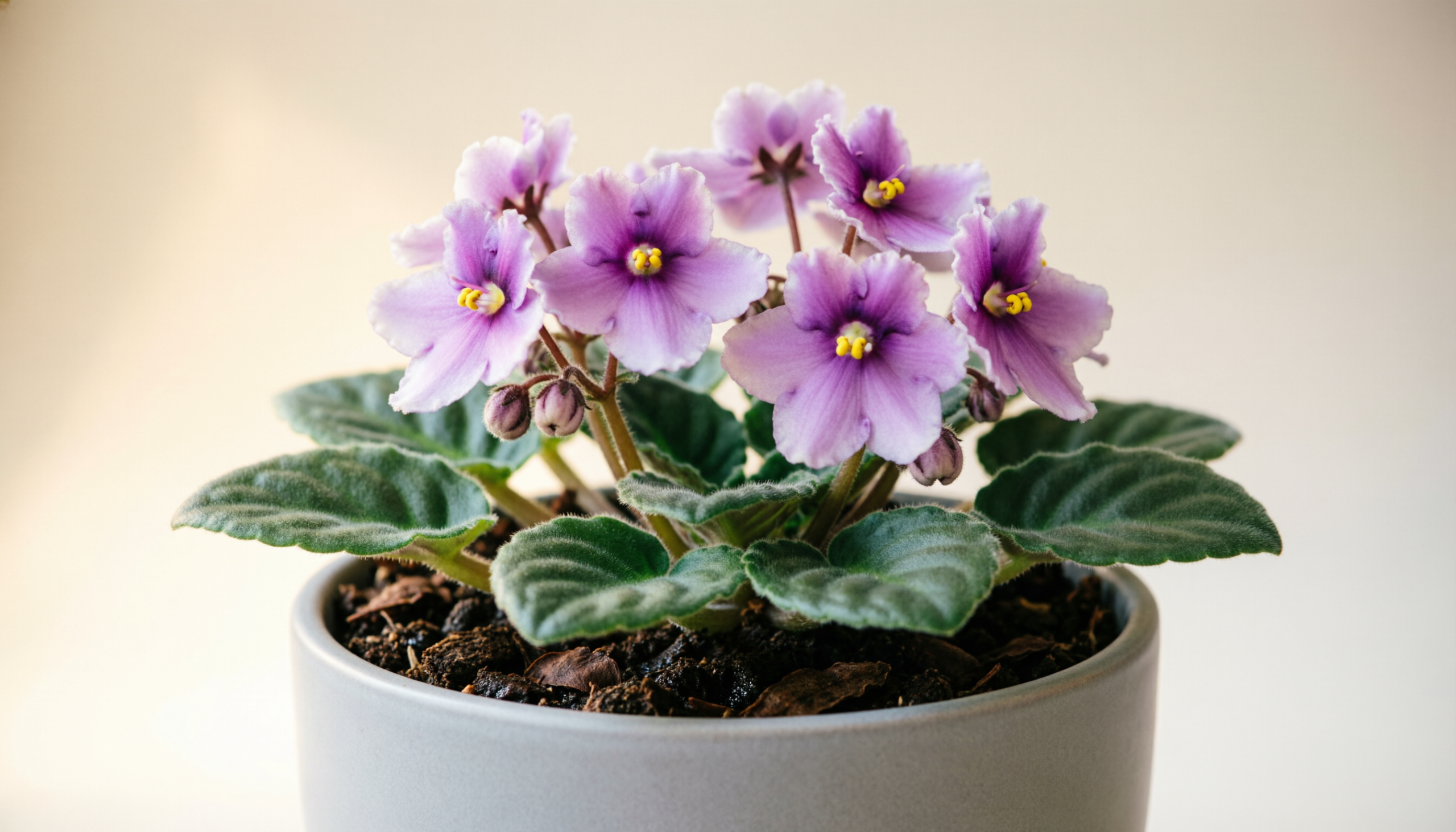
The flowers of the African violet are characterized by their distinct five-lobed structure, a classic morphological trait of the Gesneriaceae family. The corolla (the collective term for the petals) is divided into five distinct lobes, which are often slightly asymmetrical or bi-lobed. This specific floral geometry is not random; it is an evolutionary adaptation designed to accommodate the specific anatomy of their native pollinators, providing a precise landing pad and guiding structures that ensure pollen is effectively transferred when an insect or small bird visits the bloom.
Fact Number 20
One of the most visually striking features of the African violet is the velvety texture of its flower petals, known as the corolla. This velvety appearance is caused by microscopic, cone-shaped cells called papillae on the surface of the petals. These cells scatter light in a way that creates a deep, rich, matte finish that absorbs rather than reflects light. This unique optical effect not only makes the flowers highly visible to pollinators in the dim forest understory but may also help to slightly warm the flower’s reproductive organs by absorbing solar radiation.
Fact Number 21
While the individual flowers of an African violet are quite small, measuring only 2 to 3 centimeters in diameter, the plant compensates for their size by producing them in profuse numbers. The blooms grow in clusters called cymes, with each cluster typically holding anywhere from 3 to 10 or more flowers at a time. This strategy of producing numerous small blooms rather than a few large ones is highly effective for attracting pollinators from a distance, creating a large, colorful visual target in the dark green environment of the forest floor.
Fact Number 22
While modern cultivation has produced African violets in almost every color imaginable—including pinks, reds, and complex bicolors—the wild species possess a much more restricted and specific color palette. In their natural habitat, the flowers are strictly found in shades of violet, deep purple, pale blue, and white. These specific colors are highly tuned to the visual spectrum of their native pollinators, such as certain bees and sunbirds, which are particularly sensitive to blue and ultraviolet light, making the wild flowers highly conspicuous to the insects that ensure their reproduction.
Fact Number 23
Despite their massive popularity as indestructible houseplants worldwide, African violets are facing a severe conservation crisis in their native habitat. The cloud forests of the Eastern Arc Mountains are being rapidly degraded and cleared for subsistence agriculture, logging, and human settlement. Because these plants are highly endemic—meaning specific species or subspecies exist only in very small, isolated geographic pockets—the destruction of even a small patch of forest can result in the total extinction of a specific wild population, making them highly vulnerable to habitat loss.
Fact Number 24
The conservation status of the most widespread wild ancestor of the commercial African violet, Streptocarpus ionanthus, is currently classified as “Near-Threatened” on the IUCN Red List. This designation serves as a critical warning; it means that while the species is not yet officially endangered, it is perilously close to qualifying for that status due to ongoing population declines and habitat fragmentation. It highlights the irony that while millions of these plants thrive on windowsills globally, their wild genetic ancestors are slipping toward extinction in their native Tanzanian mountains.
Fact Number 25
African violets are notoriously sensitive to temperature fluctuations, particularly when it comes to cold water. If a grower accidentally spills cold water on the leaves, or waters the plant with chilled water, the plant suffers a physiological stress response. The sudden drop in temperature causes the cells in the palisade mesophyll layer of the leaf to lose their turgor pressure and their internal vacuoles to collapse. This cellular damage manifests days later as unsightly white or brown necrotic rings and spots on the foliage, a permanent reminder of the plant’s tropical origins and its intolerance for cold shock.
FAQs about African Violet
The Short Answer: Water when the top inch of soil feels dry to the touch, but the method of watering is just as important as the frequency.
The Detailed Answer: African violets are notoriously sensitive to both overwatering and getting their leaves wet. The most highly recommended method is bottom watering. To do this, place the plant’s nursery pot (which must have drainage holes) into a shallow bowl of room-temperature water for about 30 minutes. The soil will wick the moisture up through the drainage holes. Remove the pot once the top of the soil feels slightly moist and let any excess water drain away completely before putting it back in its decorative cache pot. If you prefer top watering, use a watering can with a long, narrow spout to carefully pour room-temperature water directly onto the soil, avoiding the crown and leaves entirely. Never use cold water, as it can cause the fuzzy leaves to develop permanent, unsightly brown rings (a condition known as ring spot, caused by cellular collapse).
The Short Answer: The most common culprits for a lack of blooms are insufficient light, incorrect fertilization, or a pot that is too large.
The Detailed Answer: African violets need bright, indirect light to produce flowers. If your plant is in a dark corner or a north-facing window without supplemental light, it will survive but will refuse to bloom. Move it to an east- or south-facing window (with a sheer curtain to diffuse the light) or use a grow light for 10–12 hours a day. Secondly, check your fertilizer. African violets are heavy feeders when in bloom, but they need the right nutrients. Use a fertilizer specifically formulated for African violets. Many experts recommend the “weakly, weekly” method: dilute a balanced, water-soluble fertilizer to 1/4 of the recommended strength and use it every time you water. Finally, African violets actually prefer to be slightly root-bound. If you’ve potted a small plant in a massive pot, it will focus all its energy on growing roots and leaves to fill the space rather than producing flowers.
The Short Answer: They thrive in bright, indirect light. Direct sunlight will burn and destroy their delicate leaves.
The Detailed Answer: In their natural habitat, African violets grow on the shaded, rocky forest floors of Tanzanian cloud forests, sheltered by the canopy above. Therefore, they are adapted to bright but filtered light. An east-facing window is usually perfect, providing gentle morning sun. A west- or south-facing window can work, but the plant must be placed a few feet back or shielded by a sheer curtain to prevent the harsh afternoon rays from hitting it. If an African violet gets too much direct sun, the leaves will look bleached, washed out, or develop crispy, brown, scorched patches. Conversely, if the light is too low, the leaves will stretch upward (become “leggy”), the leaf stems will grow unusually long, and the plant will grow upward rather than maintaining its tight, symmetrical rosette shape.
The Short Answer: You can easily grow a whole new plant by rooting a single healthy leaf in soil or water, though soil is generally preferred for stronger root development.
The Detailed Answer: Propagation is incredibly rewarding and highly successful with African violets.
Select a leaf: Choose a healthy, firm, medium-sized leaf from the middle ring of the plant (not the very center baby leaves, and not the old, outer leaves).
Cut the stem: Using a clean, sharp knife or scissors, cut the leaf stem (petiole) at an angle, leaving about 1 to 1.5 inches of stem attached to the leaf blade.
Plant it: Dip the cut end in rooting hormone (optional but helpful) and insert it into a small pot filled with moist, sterile African violet potting mix or a 50/50 mix of peat and perlite. The leaf blade should rest just above the soil surface.
Create a greenhouse: Place the pot inside a clear plastic bag or cover it with a plastic dome to trap humidity. Keep it in warm, bright, indirect light.
Wait: In about 4 to 6 weeks, the leaf will root. In a few more weeks, you will see tiny “plantlets” (baby leaves) sprouting from the base of the mother leaf. Once the plantlets are about 1-2 inches tall, you can gently separate them and pot them in their own containers.
The Short Answer: Leaf issues are almost always tied to watering habits, temperature stress, or lighting problems.
The Detailed Answer:
Yellow, mushy leaves at the base: This is the classic sign of overwatering and root rot. The soil is staying too soggy, suffocating the roots. Stop watering immediately, let the plant dry out, and if the rot is severe, you may need to cut away the mushy parts and reroot the healthy top crown in fresh soil.
Crispy, brown leaf edges: This usually indicates low humidity, underwatering, or exposure to cold drafts (like sitting directly against a cold windowpane in winter).
Brown spots in the center of the leaves: If you water from the top and water sits in the crown of the plant, it will cause crown rot. If the spots look like rings, you likely used cold water.
Drooping, soft leaves: While this can mean the plant is severely thirsty, it is more often a sign of root rot. If the roots are dead from overwatering, they can no longer uptake water, causing the plant to wilt even if the soil is wet. Check the soil moisture before watering!
The Short Answer: No, African violets are completely non-toxic to cats, dogs, and horses.
The Detailed Answer: According to the ASPCA, Streptocarpus sect. Saintpaulia is not listed as a toxic plant. If your curious cat takes a nibble of an African violet, it will not suffer from poisoning. However, it is still not recommended to let pets eat them. The leaves are covered in tiny, fuzzy hairs (trichomes) which can be irritating to a pet’s mouth and throat. Furthermore, ingesting any plant material in large quantities can cause mild gastrointestinal upset, such as vomiting or diarrhea, simply because a pet’s digestive system isn’t designed to break down large amounts of fibrous leaves.
The Short Answer: They require a very specific, lightweight, and fast-draining soil mix, and they should be repotted every 6 to 12 months.
The Detailed Answer: Never use standard outdoor garden soil or heavy, standard indoor potting soil for an African violet; it will hold too much water and suffocate their shallow root system. You must use a soil mix specifically labeled for African Violets. These mixes are usually peat-based and contain a high amount of perlite or vermiculite to ensure excellent drainage and aeration. Even though they like to be slightly root-bound, the soil eventually breaks down and loses its aeration, and salts from fertilizers can build up. You should repot your African violet every 6 to 12 months. When repotting, choose a pot that is only about 1/3 the diameter of the plant’s leaf span. Gently scrape away the old soil, trim any dead or rotting lower leaves, and plant the violet slightly deeper in fresh soil to cover the “neck” (the bare stem that forms as the plant grows upward).
The Short Answer: A balanced, water-soluble fertilizer specifically formulated for African violets, ideally without urea.
The Detailed Answer: African violets have specific nutritional needs. Look for a fertilizer labeled specifically for them. A common NPK (Nitrogen-Phosphorus-Potassium) ratio for general health and blooming is 14-12-14 or 20-20-20. A crucial detail to look for on the label is that the nitrogen should not be in the form of urea. African violets struggle to process urea, and it can cause a toxic buildup of salts in the soil that burns their delicate roots. As mentioned in the blooming FAQ, the most effective way to fertilize is the “weakly, weekly” approach. Instead of giving the plant a massive dose of fertilizer once a month (which can burn the roots), dilute the fertilizer to 1/4 or 1/2 of the strength recommended on the package, and use that diluted solution every time you water. This mimics the steady, gentle nutrient supply they would receive in nature.