The Great Emu War
In the annals of military history, there are countless tales of epic battles, but few are as delightfully absurd as the Great Emu War of 1932. Fought in the rugged Wheatbelt of Western Australia, this bizarre conflict pitted a heavily armed detachment of Royal Australian Artillery veterans against a formidable, 20,000-strong army of flightless birds. Armed with Lewis machine guns and thousands of rounds of ammunition, the soldiers expected a swift, decisive victory over the crop-destroying pests. Instead, they encountered an enemy that utilized natural “guerrilla tactics,” incredible speed, and sheer resilience to outmaneuver modern military might, ultimately turning a serious agricultural crisis into a global punchline. More than just a quirky historical footnote, this humbling episode highlights the unpredictable power of nature and the limits of human engineering. Whether you are a history buff, a wildlife enthusiast, or simply someone who appreciates a good underdog story, these 25 fascinating facts will reveal exactly how a flock of emus managed to defeat the Australian military and win the most unlikely war in history.
1. Date and Location
The so-called “Emu War” officially unfolded between 2 November and 10 December 1932, primarily centered in the Campion district of Western Australia’s Wheatbelt region. This area, characterized by its semi-arid climate and vast, open scrubland, became the unlikely battleground for one of the most bizarre military engagements in modern history. The specific timing is crucial, as it coincided with the post-breeding migration patterns of the emu, turning a quiet agricultural region into the epicenter of a highly publicized, albeit absurd, conflict between man and nature.
2. Official Purpose
While popularly remembered as a “war,” the Australian government formally classified the operation as a “nuisance wildlife management military operation.” This bureaucratic phrasing was an attempt to legitimize the deployment of armed forces against an animal population. The primary objective was not conquest, but rather the protection of vital agricultural assets, as the massive influx of emus was actively devastating the wheat crops that the local economy desperately relied upon for survival.
3. The Scale of the “Enemy”
The sheer number of birds involved was staggering. Following their breeding season in the inland regions, an estimated 20,000 emus migrated toward the coast. The newly cleared farmlands of the Wheatbelt, complete with cultivated wheat and newly established water supplies from farm dams, presented an irresistible ecological trap. What was once native scrubland had been transformed into an all-you-can-eat buffet for the massive, flightless birds, drawing them in unprecedented numbers.
4. Veteran Farmers
There is a profound and tragic irony in the identity of the affected farmers. Many of them were discharged soldiers from World War I who had been granted parcels of land by the Australian government under soldier settlement schemes. Promised a “land fit for heroes,” these men were instead given agriculturally marginal, difficult-to-farm soil. Having survived the trenches of Europe, they now found themselves fighting a new, absurd battle for their livelihoods on the harsh Australian frontier.
5. Great Depression Context
The emu incursion cannot be understood without the backdrop of the Great Depression. Global wheat prices had plummeted, leaving farmers operating on razor-thin margins. To make matters worse, the Western Australian government had failed to deliver promised financial subsidies to these struggling veterans. The emus were not merely a nuisance; they were an existential threat that pushed already desperate men to the absolute brink of financial ruin, fueling their demand for extreme measures.
6. Collateral Damage
The destruction caused by the emus extended far beyond the mere consumption of wheat. Emus are large, powerful birds, and as they pushed through the boundaries of the farms, they routinely smashed through the wire fences. These breaches created massive gaps in the state’s infamous “rabbit-proof fences,” inadvertently allowing hordes of invasive European rabbits to flood into the cultivated areas, compounding the agricultural devastation and creating a secondary ecological nightmare.
7. Request for Firepower
Drawing directly on their recent, traumatic experiences in World War I, the veteran farmers logically (if absurdly) applied military doctrine to their agricultural pest problem. A deputation of these ex-soldiers personally petitioned the Minister of Defence, Sir George Pearce, requesting the deployment of machine guns. They believed that the same overwhelming firepower that had been used on the battlefields of Europe could be efficiently repurposed to cull the emu population.
8. Strict Conditions
The federal government agreed to the deployment, but not without attaching stringent, cost-shifting conditions. The guns had to be operated exclusively by military personnel to maintain a veneer of official control. Furthermore, the Western Australian state government was forced to finance the transportation of the troops, while the struggling farmers themselves were required to provide food, accommodation, and even pay for the ammunition, turning the operation into a logistical and financial headache for all parties involved.
- “Good Target Practice”
Sir George Pearce’s justification for the deployment revealed a stark disconnect between the political elite in Canberra and the desperate reality on the ground. He reportedly supported the mission on the somewhat callous and dismissive grounds that the emus would make “good target practice” for the soldiers. This remark framed a serious livelihood crisis for the farmers as a mere recreational shooting exercise for the military, a tone that would later backfire spectacularly.
10. Political Motives
Beyond the immediate agricultural crisis, historians note that the operation was heavily driven by political expediency. In the early 1930s, Western Australia was deeply disgruntled with the federal government, and a secession movement was gaining serious, legitimate traction (culminating in the 1933 secession referendum). Pearce and the federal government viewed the deployment as a crucial public relations move to demonstrate that Canberra was actively listening to and supporting Western Australian constituents, hoping to stave off the breakaway movement.
11. Media Documentation
Eager to capture the event for posterity and to showcase the triumph of modern technology over nature, the government enlisted a cinematographer from Fox Movietone to film the military operation. However, this attempt at propaganda backfired. The resulting newsreel footage, which showed chaotic, unsuccessful chases and frustrated soldiers, was leaked to the press and quickly turned the operation into a source of national embarrassment and international comedy.
12. The Military Unit
The operation was commanded by Major Gwynydd Purves Wynne-Aubrey Meredith of the Royal Australian Artillery’s 7th Heavy Artillery. He was accompanied by Sergeant S. McMurray and Gunner J. O’Halloran. While Major Meredith was a seasoned and decorated military officer, his expertise lay in coordinating artillery against human armies, not in coordinating tactical strikes against fast-moving, erratic flightless birds in the dense Australian bush.
13. The Arsenal
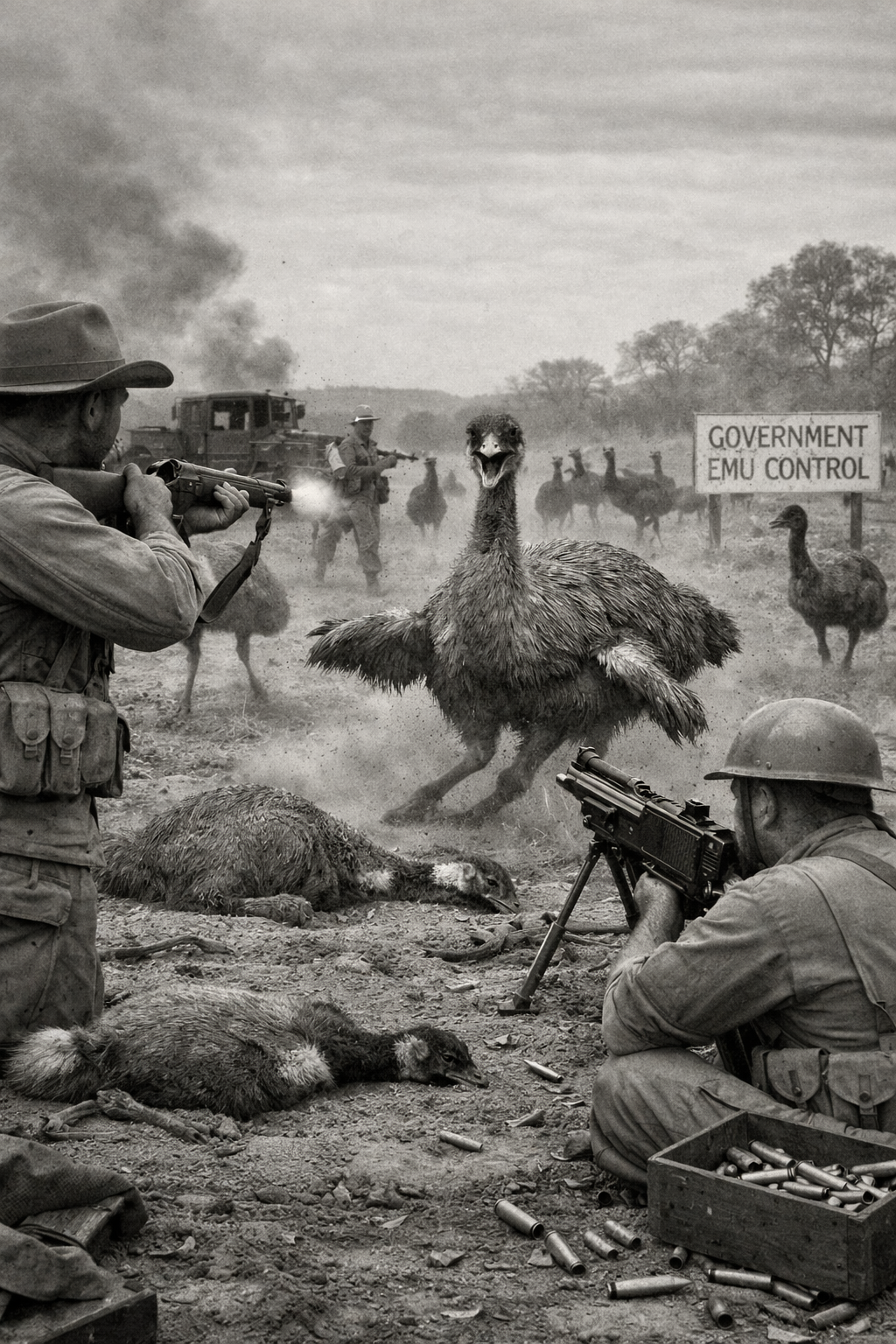
The three-man military detachment was armed with exactly two Lewis machine guns and 10,000 rounds of ammunition. The Lewis gun was a reliable, air-cooled light machine gun that had seen extensive service in World War I. However, it was designed for sustained, suppressive fire against stationary or predictably moving human targets, making it a clumsy and highly ineffective tool for hunting scattered wildlife in rugged, uneven terrain.
14. Weather Delays
The initial military deployment, originally planned for October 1932, was delayed by unexpected rainfall. While rain might seem beneficial for crops, it proved disastrous for the military operation. The water caused the emus to disperse over a vastly wider area of the Wheatbelt rather than congregating at predictable waterholes. This scattering transformed a concentrated, easy target into a widespread, elusive force, severely complicating the soldiers’ efforts.
15. The Jammed Gun Ambush
On 4 November, the soldiers attempted a classic military ambush, setting up their Lewis gun near a local dam to intercept a flock of over 1,000 emus. The plan was flawless on paper, but in execution, it was a farce. The machine gun jammed after only a dozen birds were killed. In the time it took to clear the malfunction, the massive flock scattered in every direction, vanishing into the scrub and rendering the ambush a total failure.
16. The Truck Chase Failure
Desperate to adapt, Major Meredith attempted to mount one of the Lewis guns on the back of a truck to chase the birds down. This proved to be a catastrophic tactical error. The primitive trucks of the era lacked proper suspension, and the bumpy, uneven outback terrain made it physically impossible for the gunner to aim or fire accurately. Furthermore, the emus, which can sustain speeds of up to 50 km/h (31 mph) over long distances, easily outran the vehicles, leaving the soldiers bouncing around in the back of the truck in utter frustration.
17. Emu “Guerrilla Tactics”
The absurdity of the situation was perfectly captured by renowned ornithologist Dominic Serventy, who later famously noted that the “Emu command had evidently ordered guerrilla tactics.” While the birds obviously did not have a formal military command, their natural flocking behavior perfectly mimicked human guerrilla warfare. When threatened, the large flocks would instantly splinter into innumerable small, fast-moving units, making the use of heavy, centralized military equipment highly uneconomical and utterly ineffective.
18. Emu Lookouts
By the fourth day of the campaign, astute army observers noted a fascinating behavioral trait: each emu pack seemed to have its own designated “sentry.” This was typically a large, black-plumed male standing fully six feet (1.8 meters) high. These lookouts possessed excellent eyesight and would stand tall to scan the horizon. Upon spotting the approaching soldiers, the sentry would emit a low-frequency, drum-like booming call, warning the rest of the flock to scatter and vanish into the dense brush long before the soldiers could get within firing range.
19. Meredith’s Grudging Respect
Despite the humiliation of the campaign, Major Meredith developed a grudging, almost awe-struck respect for his avian adversaries. In his official reports, he famously compared the emus to the fierce Zulu warriors of history, remarking that they could face machine-gun fire with the “invulnerability of tanks.” He noted that their thick feathers, incredible speed, and erratic zigzag running patterns meant that “even dum-dum (expanding) bullets could not stop” them, a striking admission of defeat from a seasoned military commander.
20. First Withdrawal
The combination of mechanical failures, tactical blunders, and the sheer resilience of the birds led to a swift and embarrassing conclusion to the first phase of the operation. Due to mounting negative media coverage that relentlessly mocked the military’s inability to defeat a flock of birds, the government abruptly ordered the withdrawal of the military personnel and their guns on 8 November 1932, after just six days of active engagement.
21. Second Attempt
The withdrawal did not solve the underlying problem. As the Australian summer intensified, bringing hot weather and severe drought, the emus were once again driven by desperation back to the farms in search of water and food. The crop destruction resumed with a vengeance. Feeling abandoned by the federal government, the farmers successfully lobbied for a resumption of military efforts, and a second, equally doomed deployment began on 12 November 1932.
22. The Final Tally
In his final, highly scrutinized report, Major Meredith claimed a total of 986 confirmed kills, achieved by expending 9,860 rounds of ammunition. This equated to a rate of exactly 10 rounds per confirmed kill. He also estimated that an additional 2,500 birds had been wounded and subsequently died from their injuries in the bush. On paper, this was presented as a moderate success, but the numbers were immediately met with skepticism.
23. Disputed Numbers
Modern historians, such as Greg Beyer, have thoroughly analyzed Meredith’s final report and conclude that the claimed kill count is highly disputed and likely vastly inflated. Given the well-documented mechanical failures of the Lewis guns, the chaotic nature of the terrain, and the evasive behavior of the birds, experts argue that the actual number of emus killed by the military was likely only a small fraction of the official report, padded to save face and justify the expenditure of government ammunition.
24. The Bounty Solution
Following the humiliating failure of the military intervention, the government was forced to admit defeat and revert to a civilian-led solution. They expanded a bounty system that had originally been instigated in 1923, paying local farmers and hunters a small cash reward for each emu scalp they produced. This decentralized approach proved exponentially more effective than the military’s heavy-handed tactics; in a single six-month period in 1934, a staggering 57,034 bounties were claimed, successfully managing the population without the need for machine guns.
25. Pop Culture Legacy
Over the decades, the sheer absurdity of the Emu War has transcended its obscure historical origins to become a beloved global internet meme and a enduring symbol of humanity’s hubris when attempting to wage war on nature. This cultural resonance has even caught the attention of Hollywood. The bizarre historical footnote has inspired modern pop culture projects, including a 2023 action-comedy film titled The Emu War, and another planned feature film being developed by comedy legends like John Cleese and Jim Jefferies, ensuring that the emus ultimately won the war for posterity.
Frequently Asked Questions (FAQs) About the Great Emu War
Yes, in a highly practical and historical sense, the emus won. The primary objective of the military operation was to significantly reduce the emu population and halt the destruction of wheat crops. After less than a month of chaotic, largely ineffective engagements marked by jammed weapons and elusive targets, the Australian military was forced to withdraw in embarrassment. The government ultimately admitted that military force was not a viable solution and abandoned the campaign, leaving the emus to continue roaming the Wheatbelt until a different strategy was implemented.
The decision was born out of a perfect storm of economic desperation and political maneuvering. In 1932, Western Australian farmers—many of whom were struggling World War I veterans given marginal land—were facing ruin due to the Great Depression and plummeting wheat prices. When 20,000 emus migrated into the area, devouring crops and breaking fences (which let invasive rabbits in), the veterans logically requested the same tool they knew from the war: machine guns. The federal Minister of Defence, Sir George Pearce, agreed to the deployment partly to help the farmers, but also as a public relations stunt to appease growing Western Australian resentment and stave off a serious state secession movement.
In his official final report, Major G.P.W. Meredith claimed a total of 986 confirmed kills, achieved by expending exactly 9,860 rounds of ammunition (a rate of 10 rounds per confirmed kill). He also estimated that another 2,500 birds were wounded and later died in the bush. However, modern historians and wildlife experts widely dispute these numbers as heavily inflated. Given the well-documented mechanical failures of the Lewis guns, the chaotic terrain, and the birds’ evasive behavior, experts believe the actual number of emus killed by the military was likely only a small fraction of the official report, padded to save face and justify the expenditure of government resources.
The three-man military detachment was armed with two Lewis light machine guns and 10,000 rounds of ammunition. The Lewis gun was a reliable, air-cooled weapon that had seen extensive use in World War I, but it was designed for sustained fire against human infantry, not fast-moving wildlife. In a desperate attempt to adapt, Major Meredith even tried mounting one of the machine guns on the back of a truck to chase the birds. This proved to be a disastrous tactical failure; the bumpy outback terrain made it impossible for the gunner to aim, and the emus easily outran the primitive vehicles.
It is a 100% real, documented historical event. While it sounds like a satirical internet meme today, it was an official, government-sanctioned “nuisance wildlife management military operation” authorized by the Australian Cabinet in 1932. The government even went so far as to send a cinematographer from Fox Movietone to film the operation for newsreels. However, the footage captured the chaotic, unsuccessful reality of the chases, and when the press got hold of the story, it quickly became a source of national embarrassment and international ridicule.
Emus possess a unique combination of physical traits and natural behaviors that make them surprisingly formidable targets. They can sustain running speeds of up to 50 km/h (31 mph) over long distances and are highly agile. When threatened, large flocks instinctively splinter into dozens of small, erratic groups, mimicking human guerrilla warfare tactics and making machine-gun fire highly inefficient. Furthermore, they have thick, shaggy feathers that can absorb or deflect light gunfire, and flocks often utilize tall, black-plumed males as “sentries” to watch for danger and warn the rest of the group to scatter long before humans get within range.
After the humiliating failure of the military intervention, the government was forced to pivot to a decentralized, civilian-led approach. They expanded a pre-existing bounty system that had been quietly instigated in 1923, offering a small cash reward to local farmers and hunters for every emu scalp they turned in. This method proved vastly more effective, cost-efficient, and sustainable than deploying heavy artillery. In a single six-month period in 1934, a staggering 57,034 bounties were claimed, successfully managing the population without the need for machine guns or military personnel.
While the Emu War was a comedic failure for the military, it is important to remember that emus are large, wild animals and can be dangerous if provoked. Standing up to 1.9 meters (6.2 feet) tall and weighing up to 60 kilograms (130 lbs), they possess incredibly powerful legs and sharp, three-toed claws designed for defense against predators like dingoes. While they generally prefer to flee from humans, a cornered or protective emu (especially a male guarding a nest) can deliver a powerful, forward-kicking strike capable of causing serious injury or even death to humans and livestock.