Darvaza Gas Crater
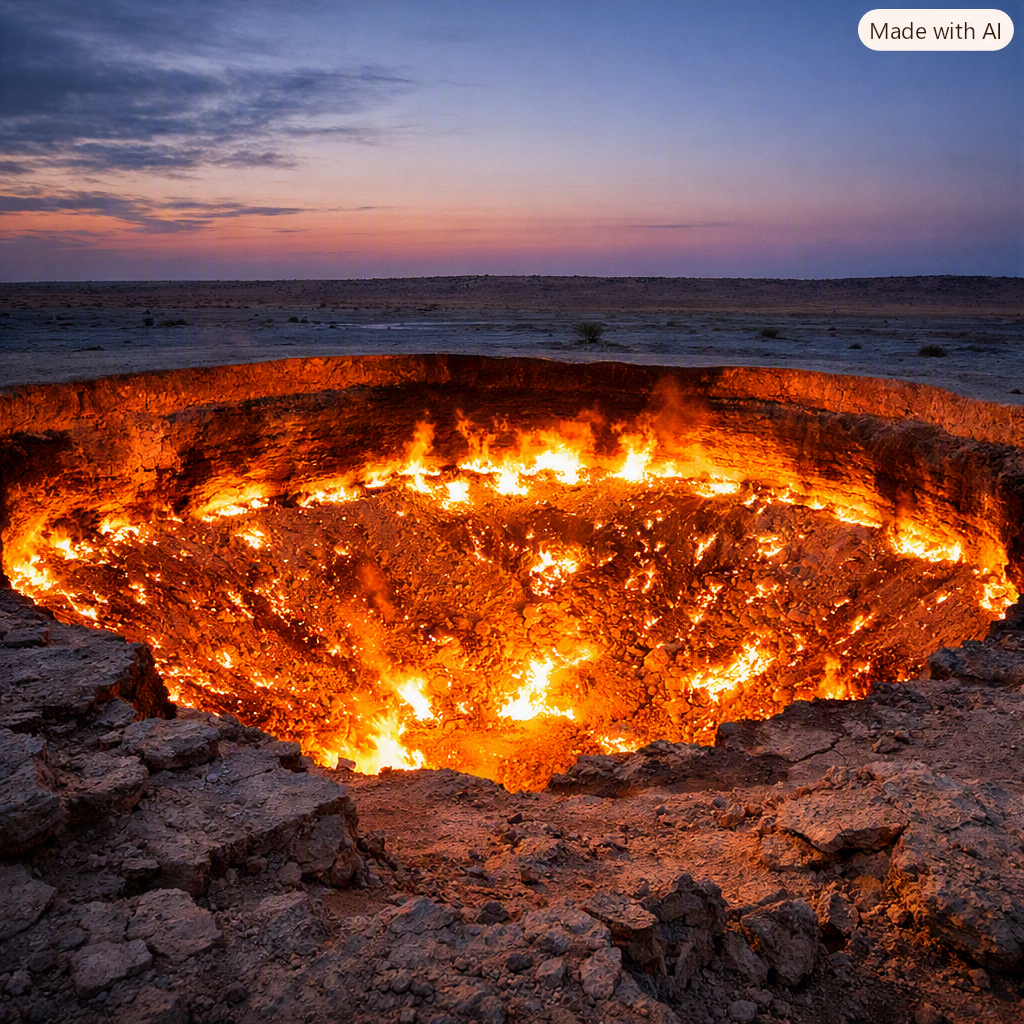
Deep in the heart of Turkmenistan’s vast Karakum Desert lies a surreal, glowing anomaly that looks like it was ripped straight from the pages of mythology: the Darvaza Gas Crater, famously known to the world as the “Door to Hell.” What began as a catastrophic Soviet drilling mishap in 1971 has transformed into a mesmerizing, perpetual inferno that has burned for over half a century, defying both time and conventional expectations. Far from being just a fiery pit, this 200-foot-wide abyss is a complex marvel of geology, a hidden haven for extreme microbial life, and Turkmenistan’s most captivating tourist attraction. Whether you are a seasoned traveler, a science enthusiast, or simply a lover of the world’s most bizarre phenomena, prepare to have your curiosity ignited as we dive into 25 mind-blowing facts about the Darvaza Gas Crater that will leave you absolutely spellbound.
1. Famous Nicknames: “Door to Hell” or “Gates of Hell” The crater earned its ominous and globally recognized monikers, the “Door to Hell” and “Gates of Hell,” due to the sheer psychological and visual impact it has on observers. Standing at the edge of a massive, fiery abyss in the middle of a desolate landscape naturally evokes mythological imagery. The constant, roaring flames and the intense, hellish glow that illuminates the desert night sky have cemented this dramatic nickname in popular culture, making it one of the most evocatively named geographical anomalies in the world.
2. Official Name: “Shining of Karakum” In an effort to rebrand the site and shift its narrative from a terrifying anomaly to a beacon of national pride, the Turkmen government officially designated the site as the “Shining of Karakum.” This rebranding is part of a broader strategy to promote the site as a majestic natural wonder rather than a disastrous industrial accident. By giving it a poetic and positive official name, authorities hope to attract more international tourism and frame the crater as a unique, shining jewel of the nation.
3. Local Name: Garagum ýalkymy In the native Turkmen language, the crater is known as Garagum ýalkymy, which directly translates to the “Shining of Karakum” or the “Glow of the Black Sand.” This name reflects the local population’s long-standing familiarity with the site. Rather than viewing it purely through a lens of fear, the local nomenclature acknowledges the crater as a persistent, luminous landmark that has become an inseparable part of the regional identity and the desert’s nocturnal landscape.
4. Geological Nature: A Collapsed Burning Natural Gas Field Geologically, the Darvaza crater is not a volcanic feature or a meteorite impact site, but rather a sinkhole formed over a subterranean natural gas pocket. The Karakum Desert sits atop vast hydrocarbon reserves. When the ground collapsed, it exposed this pressurized cavern to the surface. The continuous combustion is sustained by the steady seepage of methane and other natural gases from the earth, turning a simple geological depression into a perpetual, subterranean furnace.
5. Location: Near Darvaza Village, Ahal Province, Turkmenistan The crater is situated near the small, remote settlement of Darvaza in the Ahal Province of Turkmenistan. This region is the heartland of the country’s energy sector, rich in oil and natural gas deposits. The proximity to Darvaza village means that local residents have lived with the sight, sound, and occasional smell of the crater for decades, making it a deeply ingrained part of their daily environment and local folklore.
6. Desert Setting: The Karakum Desert The Karakum Desert is one of the largest sandy deserts in the world, covering approximately 70% of Turkmenistan’s landmass. The name “Karakum” translates to “Black Sand,” referring to the dark, scrub-covered dunes that characterize the terrain. The crater provides a stark, surreal contrast to this environment: during the day, it is a scar on the barren, sun-baked earth, but at night, it becomes the only source of light and warmth for miles in an otherwise freezing, pitch-black desert.
7. Distance from Capital: 260 Kilometers (160 Miles) North of Ashgabat Located about 260 kilometers north of Ashgabat, the crater is relatively isolated from the country’s modern, marble-clad capital. The journey from the city to the crater is a transition from highly developed urban infrastructure to rugged, unpaved desert tracks. This four-hour drive adds to the site’s allure, functioning as a pilgrimage for adventurous travelers who must traverse the remote, unforgiving landscape to witness the phenomenon.
8. Diameter: 60 to 70 Meters (200 to 230 Feet) The sheer width of the crater is difficult to grasp without a frame of reference. Spanning 60 to 70 meters across, the opening is roughly the size of a standard soccer field or a large city block. This massive diameter means that the fiery pit is not a small, localized burn, but a vast, open amphitheater of flame, allowing multiple tour groups to stand safely along the rim while still taking in the entirety of the spectacle.
9. Depth: About 30 Meters (98 Feet) Plunging approximately 30 meters deep, the crater is equivalent to the height of a 10-story building. This significant depth creates a natural bowl that traps and concentrates the heat and sound of the burning gas. It also adds a layer of physical danger, as the edges can be unstable, and the drop to the burning floor is severe, making unauthorized or unprepared descents incredibly hazardous.
10. Visual Spectacle: Hundreds of Fires Illuminating the Floor and Rim The crater is not a single, uniform lake of fire, but rather a complex network of hundreds of individual flames. These fires dance across the uneven, rocky floor and lick up the sides of the crater’s rim. At night, the visual effect is mesmerizing; the intense orange and yellow hues cast long, dramatic shadows against the crater walls, creating a dynamic, living landscape of fire that is constantly shifting with the wind and gas pressure.
11. Duration of Burn: Continuously Since 1971 (with Historical Debate) The widely accepted timeline states that the crater has been burning continuously since 1971. However, the exact history is shrouded in some debate. Some local geologists and historians argue that the initial ground collapse may have occurred in the 1960s, and that the ignition did not happen until the 1980s. This discrepancy highlights the lack of transparent record-keeping during the Soviet era, leaving a small but intriguing mystery regarding the crater’s true age.
12. Origin Story: Soviet Drilling Punctured a Cavern, Causing a Collapse The crater’s creation is a direct result of mid-20th-century industrial ambition. During the 1970s, Soviet geologists were actively exploring the Karakum Desert for oil and natural gas. While operating a drilling rig in the area, the machinery punctured the roof of a massive, gas-filled subterranean cavern. The ground beneath the rig could not support the sudden void, leading to a catastrophic collapse that swallowed the drilling equipment and created the massive sinkhole seen today.
13. Reason for Ignition: Preventing the Spread of Poisonous Gases Following the collapse, the exposed cavern began leaking large volumes of raw natural gas, which often contains toxic and asphyxiating compounds like hydrogen sulfide and carbon dioxide. Fearing that these poisonous gases would drift into nearby settlements and harm local populations or livestock, the Soviet engineers made the calculated decision to intentionally ignite the gas. Burning the methane converted it into less harmful carbon dioxide and water vapor, serving as an emergency public health measure.
14. Miscalculation: Engineers Underestimated the Volume of Gas The decision to ignite the crater was predicated on a fatal miscalculation. The engineers assumed that the trapped pocket of gas was finite and that the fire would burn itself out within a matter of weeks. Instead, they had tapped into a vast, interconnected natural gas field with immense pressure and volume. What was intended as a temporary, controlled burn inadvertently became a perpetual fire that has raged for over half a century.
15. Historical Ambiguity: Records are Absent, Classified, or Inaccessible Pinpointing the exact details of the crater’s creation is hindered by the bureaucratic secrecy of the former Soviet Union. Industrial accidents, especially those involving resource extraction failures, were often downplayed, buried, or classified. As a result, modern researchers and historians struggle to find definitive, declassified documents detailing the specific dates, the names of the engineering teams involved, or the exact deliberations that led to the ignition.
16. First Descent: George Kourounis Became the First to Reach the Bottom in 2013 For over four decades, the crater was only viewed from the safety of its rim. This changed in 2013 when Lebanese-Canadian adventurer, storm chaser, and explorer George Kourounis became the first documented person to rappel to the very bottom of the crater. His daring descent transformed the site from a distant, untouchable spectacle into a tangible environment that could be physically explored and scientifically studied.
17. Scientific Mission: Gathering Samples for the Extreme Microbiome Project Kourounis’s descent was not merely a stunt; it was a legitimate scientific expedition sponsored by National Geographic. His primary objective was to collect soil and microbial samples from the crater’s floor for the Extreme Microbiome Project. Scientists are intensely interested in “extremophiles”—microorganisms that can survive in extreme heat, toxicity, and low-oxygen environments—as studying them can provide clues about the limits of life on Earth and the potential for life on other planets.
18. Firsthand Account: A “Coliseum of Fire” with the Sound of a Jet Engine Describing his experience at the bottom, Kourounis famously likened the crater to a “coliseum of fire.” He noted that the sound was overwhelmingly loud, resembling the roaring, high-pressure rush of a jet engine. Remarkably, because methane burns very cleanly, there was virtually no smoke. This lack of obscurant allowed for a crystal-clear, panoramic view of thousands of individual licks of flame dancing across the rock, creating a surreal and awe-inspiring sensory experience.
19. Government Intervention: 2010 Recommendation to Limit Influence The crater’s perpetual burn represents a massive waste of valuable natural resources. Recognizing this, President Gurbanguly Berdimuhamedow first publicly recommended in April 2010 that measures be taken to control or extinguish the fire. The primary motivation was economic and strategic: the continuous flare was not only wasting marketable natural gas but also potentially complicating the development and safety of newer, adjacent natural gas extraction projects in the region.
20. Extinguishment Plans: 2022 Announcement Citing Health and Environmental Effects The push to close the crater intensified in January 2022, when President Berdimuhamedow formally announced plans to extinguish the fire. This announcement was accompanied by specific justifications, citing the deleterious effects the continuous emissions were having on local public health, the broader desert environment, and the efficiency of the national natural gas industry. This marked the most serious and high-profile political commitment to date to finally seal the “Gates of Hell.”
21. Ongoing Efforts: A Commission Established, but the Crater Remains Open Despite high-level declarations, actually extinguishing the Darvaza crater is a monumental engineering challenge. A special government commission was established to research and develop the optimal technique for closure. Simply dumping dirt or water on the crater is ineffective and dangerous due to the high pressure of the escaping gas. The gas supply must be carefully capped, diverted, or depleted, a complex process that requires extensive drilling and infrastructure, which is why the crater remains open and burning today.
22. Recent Reduction: 2025 Declaration of a Three-Fold Size Reduction Significant progress was reported in 2025, when Turkmen authorities declared that the active burning area of the crater had been reduced by a factor of three. This reduction was achieved by strategically drilling several new capture wells in the perimeter surrounding the crater. These wells successfully intercept and siphon off the natural gas before it can reach the main cavern, effectively starving the fire and shrinking the visible flames to just a few small pockets.
23. Heat Decline: 2026 Infrared Images Show a 75% Drop in Heat Intensity The physical reality of the mitigation efforts has been confirmed by modern technology. Infrared satellite imagery and thermal analysis conducted in 2026 by Capterio, a company that monitors global natural gas flares, revealed a dramatic change. The data showed that the heat intensity emanating from the Darvaza crater has diminished by more than 75% over the preceding three years, proving that the fire is genuinely on the decline and losing its former ferocity.
24. Methane Emissions: A Major Point Source Monitored by Carbon Mapper Despite the shrinking flames, the site remains a significant environmental concern. Data from Carbon Mapper, a Pasadena-based nonprofit, revealed that between 2022 and 2025, the crater emitted an average of 1,300 kilograms of methane per hour, with a recorded spike to 1,960 kilograms per hour in October 2025. Because methane is a potent greenhouse gas, this continuous leakage draws scrutiny from the International Energy Agency, highlighting the tension between local mitigation efforts and global climate monitoring.
25. Tourism & Culture: A Major Attraction with Yurts, Rallies, and Natural Reserve Status Today, the Darvaza gas crater is Turkmenistan’s top tourist attraction, drawing adventurers despite the hurdles of obtaining a visa and enduring a four-hour drive on a crude, unmarked road. To accommodate visitors, the region was declared a natural reserve in 2013, and traditional yurts have been set up nearby to offer overnight stays, allowing tourists to experience the crater’s full nocturnal glory. The site’s cultural footprint even extends to motorsports, having served as a dramatic overnight checkpoint in the 2018 Amul-Hazar desert automobile rally.
FAQs about Darvaza Gas Crater
The crater was the result of an industrial accident during the Soviet era. In 1971, Soviet geologists were drilling in the Karakum Desert in search of oil and natural gas. Their drilling rig accidentally punctured the roof of a massive, gas-filled subterranean cavern, causing the ground beneath the equipment to collapse and form a massive sinkhole. Fearing that the exposed cavern would leak poisonous gases (such as methane and hydrogen sulfide) into nearby villages, the engineers made the calculated decision to intentionally ignite the gas. They assumed the trapped pocket of gas was finite and would burn out within a few weeks. Instead, they had tapped into a vast, high-pressure natural gas reservoir, creating a perpetual fire that has burned for over half a century.
Yes, it has become Turkmenistan’s top tourist attraction. However, visiting requires careful planning. All foreign visitors must obtain a visa to enter Turkmenistan, which often requires booking through an approved, state-licensed tour operator. The crater is located approximately 260 kilometers (160 miles) north of the capital city, Ashgabat. The journey typically involves a four-hour drive through the desert on a crude, unmarked road. To accommodate visitors, traditional yurts (nomadic tents) have been set up near the rim, allowing tourists to stay overnight and experience the full, mesmerizing glow of the flames against the pitch-black desert sky.
Visiting the rim of the crater with a licensed guide is generally considered safe, but it is not without risks. The edges can be unstable, and the intense radiant heat can be uncomfortable. Furthermore, while the methane burns cleanly, heavier, unburned gases can occasionally pool in low-lying areas. Going inside the crater is highly dangerous and strictly prohibited for regular tourists. When explorer George Kourounis descended in 2013, he required specialized, life-saving equipment, including a custom-made Kevlar harness, multiple Technora ropes, a full-body aluminized heat-resistant suit, and a self-contained breathing apparatus to survive the extreme conditions.
Extinguishing the Darvaza crater is a monumental engineering challenge. It is not a simple surface fire; it is a continuous, high-pressure vent from a massive underground gas reservoir. Traditional firefighting methods, such as dumping dirt, sand, or water, are entirely ineffective and could even trigger dangerous pressure buildups or explosions. To safely close it, the gas supply must be capped, diverted, or depleted. While President Gurbanguly Berdimuhamedow announced formal plans to extinguish it in 2022 due to environmental and economic concerns, developing the optimal technique has taken time. Recently, authorities have shifted strategy to drilling capture wells around the crater’s perimeter to siphon the gas before it reaches the cavern, slowly starving the fire.
The temperatures inside the crater are extreme. The heat within the fiery hole can reach up to 1,000°C (1,832°F), which is comparable to the heat used in industrial metal smelting furnaces (www.advantour.com). The flames themselves can reach heights of 10 to 15 meters (greenly.earth). However, the ambient air temperature at the rim is dictated by the harsh desert climate. While winter nights can be freezing, summer daytime temperatures in the region can soar to 50°C (122°F) (www.orexca.com).
The environmental impact is a subject of global scientific scrutiny. On one hand, burning methane converts it into carbon dioxide and water vapor, which is less immediately harmful to the local atmosphere than raw, unburned methane (which is highly toxic and asphyxiating). On the other hand, the crater remains a massive point source of greenhouse gas emissions. Data from the nonprofit organization Carbon Mapper showed that between 2022 and 2025, the crater emitted an average of about 1,300 kilograms of methane per hour, with recorded spikes up to 1,960 kilograms per hour. This continuous leakage contributes to Turkmenistan having one of the highest levels of global methane emissions, according to the International Energy Agency.
In 2013, Lebanese-Canadian adventurer and storm chaser George Kourounis became the first documented person to rappel to the very bottom of the crater. His descent was sponsored by National Geographic and was conducted as part of the Extreme Microbiome Project (XMP). Kourounis famously described the experience as standing in a “coliseum of fire,” noting that the sound was like a roaring jet engine, but the gas burned so cleanly that there was no smoke to obscure the view of the thousands of individual flames.
Yes, and their discovery was the primary goal of the Extreme Microbiome Project. Scientists hypothesized that the crater’s unique environment could harbor “extremophiles”—microorganisms capable of surviving in extreme heat, toxicity, and low-oxygen conditions. Soil samples collected from the crater’s floor and edges successfully revealed novel strains of bacteria that do not exist anywhere else on Earth. Studying these microbes helps scientists understand the absolute limits of life on our planet and provides valuable analogues for what microbial life might look like in extreme extraterrestrial environments, such as on Mars or Venus.
Originally, engineers believed it would burn out in a few weeks. Today, the timeline depends entirely on human intervention and reservoir management. Recent reports indicate that the fire is actively and successfully being suppressed. In 2025, authorities declared that the size of the active fire had been reduced three-fold due to the new methane-capture wells. Furthermore, infrared imagery analyzed in 2026 showed that the heat intensity from the flames has diminished by more than 75% over the preceding three years. If these diversion efforts continue at their current pace, the crater could be fully extinguished or reduced to a small, controlled, and safe vent in the near future.
While it is globally and colloquially known as the “Door to Hell” or “Gates of Hell,” its official designation by the Turkmen government is the “Shining of Karakum.” In the native Turkmen language, it is called Garagum ýalkymy, which translates to the same. This official naming is a deliberate public relations and cultural strategy by the government to reframe the site. Rather than being viewed as a terrifying industrial disaster, the state promotes it as a majestic, shining natural wonder and a beacon of national pride to boost tourism and investment.