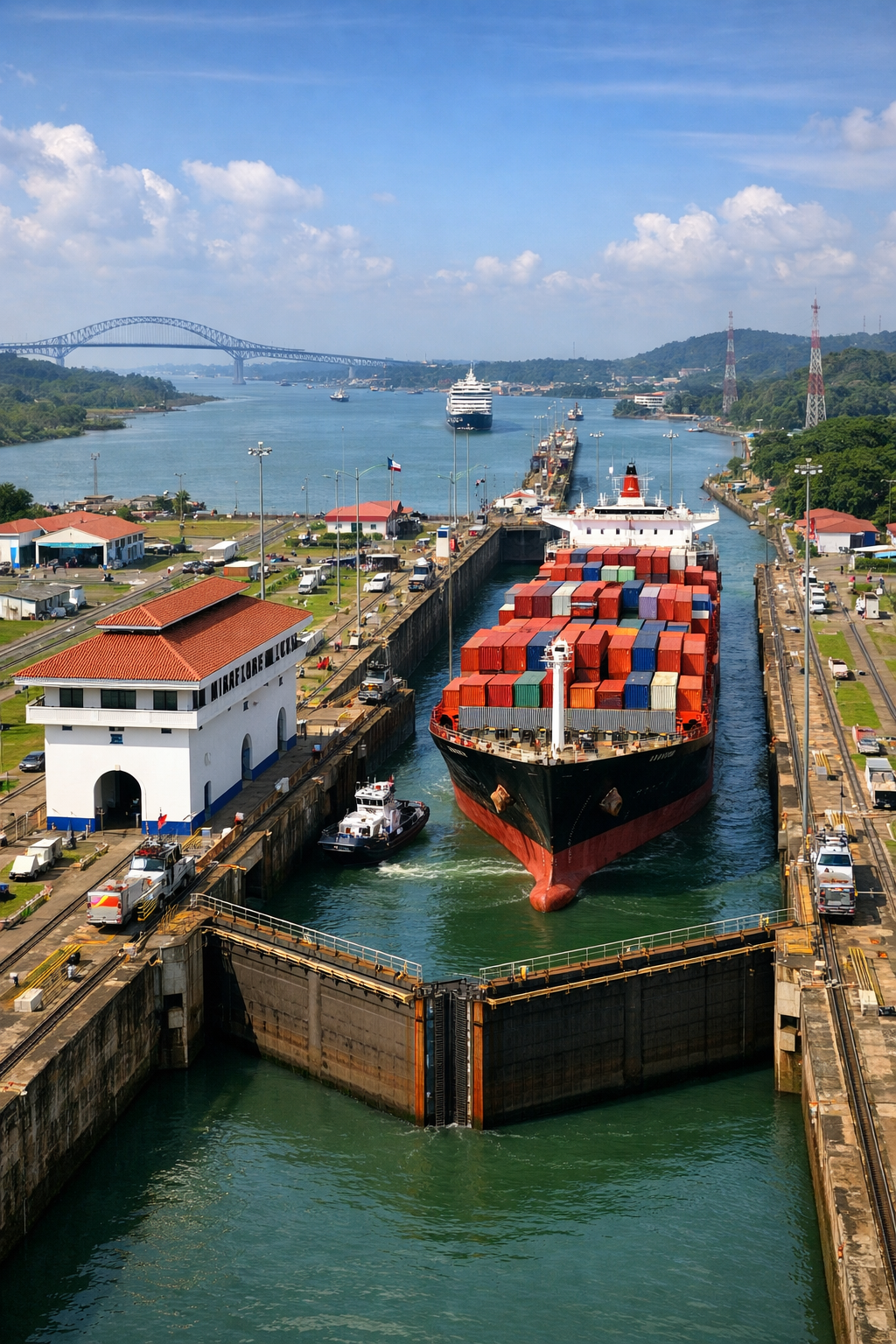
Panama Canal
Carved through the heart of a rugged tropical isthmus, the Panama Canal is far more than just a waterway; it is a towering testament to human ambition, engineering brilliance, and sheer perseverance. What began as a fleeting 16th-century dream evolved into one of history’s most grueling construction projects, overcoming devastating disease outbreaks, financial ruin, and seemingly impossible geography to forever alter the course of global maritime trade. Today, this gravity-fed marvel of locks and artificial lakes continues to shave thousands of miles off global shipping routes, seamlessly connecting the Atlantic and Pacific Oceans. Whether you’re a history buff, an engineering enthusiast, or simply curious about the hidden mechanics of modern commerce, these 25 fascinating facts will completely change the way you view one of the modern world’s greatest wonders.
1. Massive Water Usage
A single ship passing through the Panama Canal uses an average of 200 million liters (52 million US gallons) of fresh water per transit. This staggering amount is required because the canal’s original lock system is entirely gravity-fed; no massive pumps are used to fill the chambers. Instead, water is drawn from Gatun Lake and the surrounding watershed, flowing downhill to push the ships upward and then flushing out to the ocean when the ship descends. Because this water is lost to the sea with every transit, the canal is highly vulnerable to seasonal droughts and climate change, prompting ongoing discussions about building new reservoirs to secure the water supply for future global trade.
2. Not Sea-Level
Unlike the Suez Canal, which is a sea-level waterway, the Panama Canal is an intricate lock-and-lake system. Because the Isthmus of Panama features a rugged, mountainous spine known as the Continental Divide, digging a sea-level trench was deemed geologically and financially impossible. Instead, engineers designed a system of locks at both the Atlantic and Pacific ends to lift ships up to Gatun Lake, an artificial freshwater lake situated 26 meters (85 feet) above sea level. Ships travel across this lake, effectively crossing the continental divide, before being lowered back down to sea level on the opposite side, a process that requires immense precision and hydraulic engineering.
3. 16th-Century Vision
The conceptual origins of the Panama Canal date back to 1513, when Spanish conquistador Vasco Núñez de Balboa became the first European to lead an expedition across the Isthmus of Panama to the Pacific Ocean. Upon realizing how narrow the land bridge was at this point, Balboa noted in his journal the potential for a waterway that could connect the two great oceans. For the Spanish Empire, which was transporting vast amounts of silver and gold from Peru and Chile back to Europe, a canal would have eliminated the need for the treacherous, months-long voyage around the southern tip of South America.
4. Royal Decree
The earliest formal, official proposal for a canal was issued in 1534, when Holy Roman Emperor Charles V ordered a survey of the Isthmus of Panama to find a viable route to ease voyages between Spain and its South American territories. Surveyors explored the Chagres River and other potential paths, but the technology of the 16th century was entirely inadequate for the task. Without gunpowder for large-scale excavation, steam power, or any understanding of tropical medicine, the idea was shelved, remaining a mere cartographer’s dream for over three centuries.
5. The French Failure
France, flush with pride after Ferdinand de Lesseps successfully completed the sea-level Suez Canal in 1869, attempted to replicate that triumph in Panama. Construction began in 1881 under de Lesseps’s direction, but the endeavor was doomed from the start. De Lesseps stubbornly insisted on a sea-level canal, ignoring the warnings of engineers who knew the mountainous terrain and heavy rainfall of Panama would cause catastrophic landslides. The project was plagued by engineering miscalculations, financial mismanagement, and a horrific worker mortality rate, ultimately forcing the French to abandon the effort in 1889.
6. Deadly French Attempt
During the French construction effort, an estimated 22,000 workers died, making it one of the deadliest engineering projects in history. The primary killers were not accidents, but tropical diseases, specifically yellow fever and malaria. At the time, the medical establishment largely believed in the “miasma theory,” which held that diseases were caused by bad air or rotting organic matter. Because the role of the Aedes aegypti and Anopheles mosquitoes as disease vectors was unknown or actively dismissed by French medical officers, no effective preventative measures were taken, leading to devastating epidemics in the worker camps.
7. Bankruptcy
The collapse of the French canal effort triggered one of the most significant financial and political scandals in 19th-century Europe, known as the “Panama Scandals.” The Compagnie Universelle du Canal Interocéanique went bankrupt after reportedly squandering US$287 million (equivalent to over $10 billion today). The fallout was immense: the life savings of roughly 800,000 French investors were wiped out, and it was later revealed that company executives had bribed French politicians and journalists to maintain a facade of solvency. This financial ruin eventually paved the way for the company’s assets to be sold at a fraction of their cost to the United States.
8. US Acquisition
After the French failure, the United States began seriously evaluating a canal route, initially favoring Nicaragua due to its large natural lake and lower elevation. However, aggressive lobbying by the French-backed New Panama Canal Company, coupled with the sudden eruption of the Mount Pelée volcano in Martinique (which was used as propaganda to highlight Nicaragua’s volcanic risks), shifted American opinion. In 1902, the US Congress passed the Spooner Act, authorizing President Theodore Roosevelt to purchase the French company’s excavations, equipment, and the crucial Panama Railroad for $40 million, officially committing the US to the Panama route.
9. Gunboat Diplomacy
At the time, Panama was a province of Colombia, and the Colombian Senate rejected the Hay-Herrán Treaty, which would have granted the US rights to build the canal. In response, the US actively supported a Panamanian separatist movement. In November 1903, the US dispatched the gunboat USS Nashville to prevent Colombian troops from landing and suppressing the rebellion. Panama declared independence, and within weeks, the US negotiated the highly controversial Hay–Bunau-Varilla Treaty with the new Panamanian government, granting the United States perpetual control over a 10-mile-wide Canal Zone in exchange for financial compensation.
10. Teddy Roosevelt’s Quote
President Theodore Roosevelt was unapologetic about his aggressive, realpolitik approach to securing the canal route, viewing it as essential for American naval and economic power. When criticized by political opponents for violating Colombian sovereignty, Roosevelt famously defended his actions by stating, “I took the Isthmus, started the canal and then left Congress not to debate the canal, but to debate me.” This quote perfectly encapsulates his “Big Stick” diplomacy, reflecting his belief that the strategic necessity of the canal justified heavy-handed geopolitical maneuvering.
11. Sanitation Revolution
The US effort succeeded where the French failed largely due to a revolutionary public health campaign led by US Army Colonel William C. Gorgas. Armed with the newly accepted theories of Dr. Carlos Finlay and Dr. Walter Reed that mosquitoes transmitted yellow fever and malaria, Gorgas implemented aggressive, sweeping sanitation measures. His teams fumigated buildings with sulfur and pyrethrum, installed window screens, paved streets to eliminate muddy puddles, drained swamps, and applied oil to standing water to kill mosquito larvae. Within two years, yellow fever was virtually eradicated from the isthmus, making large-scale construction possible.
12. US Death Toll
Despite the monumental success of Gorgas’s sanitation revolution, the US construction phase was still perilous, resulting in approximately 5,600 deaths from disease and industrial accidents. There was also a stark demographic disparity in these casualties. White American engineers and skilled workers were provided with superior housing, medical care, and paid sick leave, resulting in a very low mortality rate. In contrast, the tens of thousands of West Indian laborers (primarily from Barbados and Jamaica) who performed the grueling manual excavation faced harsher living conditions, segregated facilities, and a significantly higher risk of death and injury.
13. Change of Plans
A pivotal turning point in the US effort came with the arrival of Chief Engineer John Frank Stevens in 1905. After thoroughly assessing the site, Stevens forcefully argued that attempting a sea-level canal would be a disastrous, endless excavation prone to constant, unmanageable landslides. He successfully lobbied President Roosevelt and Congress to abandon the sea-level concept in favor of a lock-and-lake system. This pragmatic decision leveraged the natural topography of the isthmus, saving years of labor and billions of dollars, and ultimately defined the canal’s enduring design.
14. Record-Breaking Engineering
The lock-and-lake system required the construction of the Gatun Dam across the Chagres River, which was a monumental feat of early 20th-century civil engineering. At the time of its completion, it was the largest earth-fill dam in the world. The dam’s creation resulted in the flooding of the Chagres River valley, forming Gatun Lake, which was then the largest human-made lake on Earth. This lake not only provided the massive volume of water needed to operate the locks but also allowed ships to travel 33 kilometers (21 miles) through the heart of the isthmus, drastically reducing the amount of excavation required.
15. Industrial Might
The American approach to building the canal was characterized by overwhelming industrial might and logistical innovation, starkly contrasting with the French reliance on manual labor. The US imported over 100 massive, railroad-mounted Bucyrus steam shovels, giant hydraulic rock crushers, and state-of-the-art concrete mixers. They also completely rebuilt and doubled the tracks of the Panama Railroad, turning it into a highly efficient conveyor belt system that continuously removed excavated spoil and delivered fresh supplies and workers to the front lines of the dig.
16. Military Leadership
After John Frank Stevens unexpectedly resigned in 1907, President Roosevelt turned to the US Army Corps of Engineers, appointing Major George Washington Goethals as the new chief engineer. Goethals brought strict military discipline, meticulous planning, and an unwavering focus on efficiency to the project. By establishing a clear chain of command and insulating the project from the political meddling and corporate profiteering that had doomed the French effort, Goethals stabilized the workforce and drove the massive logistical operation steadily toward completion.
17. Early Completion
Under Goethals’s resolute leadership, the workforce maintained high morale and extraordinary productivity. Despite the immense challenges of the terrain, weather, and logistical scale, Goethals finished the canal in 1914. This was a remarkable achievement, as it was two years ahead of the original target completion date of June 10, 1916. The early completion allowed the United States to assert its new global maritime dominance just as the outbreak of World War I was about to drastically reshape international shipping routes and naval strategy.
18. The Culebra Cut
The most difficult and dangerous engineering challenge of the entire project was the excavation of the Culebra Cut (later renamed the Gaillard Cut in honor of a fallen engineer). This 14-kilometer (8.7-mile) trench had to be carved directly through the unstable rock and clay of the Continental Divide. The excavation was plagued by relentless, massive landslides that would frequently swallow tracks, equipment, and months of progress. Major David du Bose Gaillard led this grueling effort with relentless dedication, working tirelessly until his untimely death in 1913, just a year before the canal opened.
19. Presidential Telegram
A highly symbolic moment in the canal’s history occurred on October 10, 1913, when the final barrier between the Atlantic and Pacific waters was removed. President Woodrow Wilson sat in the Oval Office in Washington, D.C., and pressed a telegraph key. This signal traveled thousands of miles to the isthmus, where it triggered a controlled explosion that destroyed the Gamboa Dike. The resulting rush of water flooded the remaining dry section of the Culebra Cut, officially uniting the two oceans and marking the functional completion of the waterway.
20. Official Opening
The Panama Canal was officially inaugurated and opened for commercial business on August 15, 1914. The first ship to make a complete, official transit was the American cargo and passenger vessel SS Ancon. Ironically, this monumental achievement in peacetime engineering was almost entirely overshadowed in the global press by the outbreak of World War I in Europe, which had begun just weeks earlier. Nevertheless, the canal immediately began altering global trade dynamics, proving its immense strategic and economic value.
21. Modern Expansion
By the early 21st century, global shipping had evolved, and the original canal was becoming a bottleneck for modern, massive vessels. To address this, Panama embarked on a historic $5.25 billion expansion project, which was approved by a national referendum in 2006 and constructed between 2007 and 2016. This project added a third, wider lane of traffic featuring the new Agua Clara and Cocoli locks. The expansion, which officially began commercial operations on June 26, 2016, allows the canal to accommodate “Neopanamax” vessels, including massive container ships, bulk carriers, and liquefied natural gas (LNG) tankers.
22. Original Dimensions
The original locks of the Panama Canal are 33.5 meters (110 feet) wide and 320 meters (1,050 feet) long. These specific dimensions were not arbitrary; they were meticulously calculated to accommodate the maximum size of ships that could safely navigate the system, giving birth to the maritime classification known as “Panamax.” For nearly a century, naval architects and commercial shipbuilders worldwide designed their vessels to maximize cargo capacity while strictly adhering to these exact dimensions, fundamentally shaping the design of global maritime fleets.
23. Avoiding a Hazardous Route
The primary economic and strategic value of the Panama Canal lies in the vast distances and dangers it allows ships to avoid. Before the canal, a vessel traveling from New York to San Francisco had to navigate approximately 8,000 nautical miles around the southernmost tip of South America via the Drake Passage, the Strait of Magellan, or the Beagle Channel. This route was notorious for treacherous weather, fierce storms, and hazardous ice. The canal shortens this journey to about 5,200 nautical miles, saving weeks of travel time, massive amounts of fuel, and countless lives.
24. Speed of Transit
Despite the complexity of moving massive, multi-thousand-ton vessels through a series of narrow, water-filled chambers and across a man-made lake, the canal operates with remarkable efficiency. As of 2017, it takes ships an average of just 11.38 hours to pass between the canal’s two outermost locks. This swift transit is a marvel of modern logistical coordination, relying on highly trained local pilots who board each ship, electric locomotives (known as “mules”) that guide the vessels through the locks, and a tightly scheduled convoy system to maximize daily throughput.
25. Modern Wonder
The enduring legacy of the Panama Canal as a triumph of human ingenuity over extreme geographic, climatic, and biological barriers has been formally recognized on the global stage. The American Society of Civil Engineers (ASCE) has officially ranked the Panama Canal as one of the Seven Wonders of the Modern World, placing it alongside monumental achievements like the Channel Tunnel, the Golden Gate Bridge, and the Itaipu Dam. This designation reflects not only the sheer scale of its early 20th-century construction but also its continued, vital role in facilitating roughly 6% of total world trade today.
Frequently Asked Questions (FAQs) About the Panama Canal
While the United States spearheaded the canal’s construction and controlled the surrounding “Canal Zone” for most of the 20th century, the waterway is now entirely owned and operated by the Republic of Panama. The transition was set in motion by the Torrijos-Carter Treaties, signed in 1977 by US President Jimmy Carter and Panamanian leader Omar Torrijos, which mandated a gradual handover of control. On December 31, 1999, full administrative control was officially transferred to Panama. Today, it is managed by the Panama Canal Authority (Autoridad del Canal de Panamá, or ACP), an autonomous agency of the Panamanian government that has successfully expanded the canal and maintained its status as a vital, neutral global shipping route.
The cost to cross the canal is not a flat fee; it is a complex toll system based on the vessel’s type, size, and cargo capacity, calculated using the Panama Canal Universal Measurement System (PC/UMS). For smaller commercial vessels, tolls might start in the tens of thousands of dollars. However, for massive Neopanamax container ships or cruise liners, tolls routinely range from $400,000 to well over $1,000,000 per transit. Because the canal is so congested, shipping companies can also pay hefty “booking fees” or participate in a blind auction to skip the waiting line—auction slots have historically sold for over $400,000 just for the privilege of jumping the queue! On a fun historical note, the lowest toll ever charged was 36 cents in 1928, paid by American travel writer Richard Halliburton, who “transited” the canal by swimming its entire length.
One of the most brilliant engineering feats of the Panama Canal is that its original lock system is entirely gravity-fed; no electricity or massive water pumps are required to lift or lower the ships. The canal relies on Gatun Lake, an artificial freshwater reservoir situated 85 feet above sea level. When a ship enters a lock chamber, massive steel gates close behind it, and enormous culverts (pipes built into the lock walls) are opened via giant valves. Gravity causes water from the lake to rush into the chamber, lifting the ship smoothly to the next level. To lower a ship, the process is reversed: the water is simply drained out of the chamber via the same culverts, flowing back out to sea level.
If you watch footage of ships moving through the original Panamax locks, you will notice small, specialized locomotives running on tracks parallel to the water. Locally known as “mules” (named after the animals used to pull canal boats in the 19th century), these electric towing locomotives do not actually pull the massive ships forward. Instead, their primary job is to keep the ship perfectly centered in the narrow lock chamber and prevent it from drifting side-to-side or scraping the concrete walls. The ship’s own engines or tugboats provide the forward momentum, while the mules use heavy steel cables to provide lateral stability and steering control. (Note: The new, wider Neopanamax locks built in 2016 do not use mules; they rely entirely on modern, highly maneuverable tugboats).
These terms are maritime classifications that dictate the absolute maximum dimensions a ship can be to fit through the canal. “Panamax” refers to the original locks built in 1914. A Panamax vessel can be no longer than 965 feet (294 meters), no wider than 106 feet (32.3 meters), and have a draft (depth below water) of no more than 39.5 feet (12 meters). For decades, global shipbuilders designed cargo ships specifically to squeeze into these exact dimensions. However, as global trade grew, ships became too big. The 2016 canal expansion introduced the new, larger locks, creating the “Neopanamax” classification. Neopanamax ships can be up to 1,200 feet (366 meters) long, 160 feet (49 meters) wide, and have a draft of 50 feet (15.2 meters), allowing the canal to handle roughly 79% of all global maritime cargo traffic, up from just 45% before the expansion.
Yes, water management is currently the single biggest existential threat to the Panama Canal. Unlike the Suez Canal, which is a sea-level trench, the Panama Canal uses 52 million gallons of fresh water from Gatun Lake per ship transit, which is then flushed out into the ocean. In recent years, severe droughts exacerbated by the El Niño weather phenomenon and broader climate change have drastically lowered the water levels in Gatun Lake. To conserve water and keep the canal open, the Panama Canal Authority (ACP) has had to implement strict restrictions, including reducing the maximum allowable weight (draft) of ships and capping the number of daily transits. To combat this long-term, Panama is currently exploring massive infrastructure projects, such as damming the Rio Indio to create a new freshwater reservoir to feed the canal system.
Yes, they absolutely can! Crossing the Panama Canal is considered a major “bucket list” achievement for amateur sailors and yachters moving between the Atlantic and Pacific oceans. However, it is a rigorous, expensive, and highly regulated process. Private boats must undergo a thorough inspection, pay thousands of dollars in tolls and buffer fees, and hire a licensed Panama Canal Advisor to direct the transit. Because small boats are so low to the water, they cannot use the lock “mules.” Instead, the crew and hired “line handlers” must manually hold the boat steady against the lock walls using heavy ropes as the water violently rushes in and out. Boats must also be lined with dozens of tires and wooden planks to protect their hulls from scraping the rough concrete lock chambers.