Autoharp
Often overshadowed by its flashier stringed cousins, the autoharp has quietly shaped the sound of American folk, country, and even rock music for over a century, yet its fascinating history and ingenious design remain largely unknown to the modern listener. Born from a late-19th-century patent aimed at making chordal accompaniment accessible to everyday musicians, this deceptively simple chorded zither has traveled from Victorian parlor rooms to Grand Ole Opry stages, evolving through mechanical innovations, legendary performers, and unexpected cross-cultural exchanges. In this post, we’re diving into 25 interesting facts about the autoharp—from its surprising German-American origins and the clever engineering behind its signature chord-bar mechanism, to the iconic musicians who championed it and the modern ways it continues to inspire contemporary artists. Whether you’re a seasoned player, a curious history buff, or just someone who’s always wondered what that distinctive shimmering instrument actually is, you’re about to discover why the autoharp deserves far more credit than it gets.
Fact Number 1
The term “autoharp” first appeared in US Patent 257,808, applied for by Charles F. Zimmermann on December 10, 1881, and officially issued on May 9, 1882, marking the formal birth of the instrument in American intellectual property records. Zimmermann, a German immigrant instrument maker based in Philadelphia, designed a chorded zither that used a novel damping mechanism to allow untrained musicians to produce full chords with minimal effort. The patent documentation detailed a trapezoidal wooden body fitted with felt-covered bars that, when depressed, would mute specific strings while allowing others to resonate, creating predetermined harmonic combinations. This innovation emerged during a period of growing interest in parlor instruments that could facilitate family music-making without requiring extensive technical training, positioning the autoharp as an accessible tool for amateur musicians. The patent’s careful wording protected both the specific mechanical implementation and the broader concept of selective string damping, influencing subsequent zither designs across Europe and North America. Importantly, the patent included detailed technical drawings illustrating the lateral engagement system of the damping bars—a design that would later be refined by other inventors, including Karl August Gütter, whose contributions proved equally foundational to the modern autoharp’s evolution.
Fact Number 2
Zimmermann’s original patent design featured a distinctly trapezoidal body shape and employed a lateral “trigger-bar” mechanism that operated quite differently from the vertical chord bars characteristic of modern autoharps. The trapezoidal form, wider at the bass end and tapering toward the treble side, was likely influenced by European concert zithers Zimmermann encountered during his training in Germany. The lateral trigger-bar mechanism involved horizontally sliding bars that engaged strings from the side rather than pressing down from above, a design that offered precise damping but required complex internal linkages prone to wear. Historical analysis suggests Zimmermann envisioned the autoharp primarily as a tabletop parlor instrument, with the player seated to the right so the left hand could operate chords while the right hand strummed. This original configuration had distinct acoustic implications, with varying string lengths producing a tonal balance that emphasized bass frequencies—well-suited for the harmonic accompaniment role Zimmermann intended. When Zimmermann exhibited a refined version at the 1884–1885 World Cotton Centennial in New Orleans, earning a “Certificate of First Degree of Merit,” the instrument still retained elements of this trapezoidal design, though it incorporated improvements that hinted at the evolutionary path toward the wing-shaped autoharps that would later become standard.
Fact Number 3
Karl August Gütter of Markneukirchen, Germany, applied for German Patent 29930 on May 20, 1884, for a damping device that more closely resembles the modern autoharp mechanism, representing a crucial parallel development in the instrument’s history. Gütter’s design introduced vertical chord bars that pressed felt pads directly onto strings from above—a configuration that proved more reliable, intuitive, and mechanically efficient than Zimmermann’s lateral trigger system. Working in Markneukirchen, a renowned center of German musical instrument manufacturing, Gütter had access to skilled craftsmen and advanced woodworking techniques that enabled precise construction of the complex damping assemblies his design required. His patent documentation emphasized ease of use and durability, features that would become hallmarks of successful commercial autoharps. Although Gütter’s contributions were initially overshadowed by Zimmermann’s earlier US patent and trademark, modern scholarship recognizes his vertical-bar mechanism as the direct ancestor of the chord bar systems used in virtually all contemporary autoharps. The transatlantic nature of these parallel inventions highlights how instrument innovation in the late 19th century often occurred through cross-cultural exchange, with ideas circulating between European craftsmanship traditions and American commercial entrepreneurship.
Fact Number 4
The distinctive wing-shaped profile characteristic of modern autoharps may have originated with Karl August Gütter’s British patent specification submitted on March 11, 1885, marking an important aesthetic and functional evolution in the instrument’s design. This curved, asymmetrical body shape was not merely decorative; it served practical acoustic purposes by optimizing string length distribution, improving soundboard resonance, and providing ergonomic comfort for players holding the instrument upright. The wing shape also allowed for better access to chord bars and strings, facilitating more fluid playing techniques that would later be developed by performers like Bryan Bowers. Gütter’s British patent documentation included detailed illustrations showing how the curved contours enhanced both the instrument’s visual appeal and its structural integrity, helping to distribute string tension more evenly across the soundboard. Over time, this wing-shaped profile became iconic, distinguishing the autoharp from other zithers and contributing to its recognizable silhouette in folk and country music imagery. The adoption of this design by major manufacturers like Oscar Schmidt helped standardize the form, ensuring that subsequent generations of autoharps maintained both the acoustic benefits and visual identity established by Gütter’s innovative specification.
Fact Number 5
Zimmermann obtained US Trademark No. 22,339 for the word “Autoharp” on January 17, 1893, claiming continuous commercial use since the patent’s issuance in 1882, a strategic move intended to secure exclusive branding rights for his invention. This trademark registration reflected Zimmermann’s business acumen and his understanding that controlling the instrument’s name could provide significant commercial advantage in an increasingly competitive market. However, over subsequent decades, the term “autoharp” entered common usage to describe any chorded zither employing selective string damping, regardless of manufacturer, gradually eroding the trademark’s exclusivity. Legal challenges eventually led courts to rule that “autoharp” had become a generic term for the instrument class, meaning only the stylized graphic logo—not the word itself—could be protected under trademark law. This outcome illustrates a common tension in intellectual property: when an invention becomes so successful that its brand name becomes synonymous with the product category, the original trademark holder may lose exclusive rights to the term. Despite this legal evolution, the Oscar Schmidt Company, which acquired Zimmermann’s interests, continued to use the Autoharp name prominently in marketing, leveraging its historical association with quality and authenticity even after the term became generic.
Fact Number 6
Despite its name, the autoharp is not technically a harp but rather a chorded zither belonging to the box zither family, a classification that reflects its construction method and sound production mechanism more accurately than its popular moniker. Harps produce sound through strings that run perpendicular to the soundboard and are typically plucked individually, whereas autoharps feature strings stretched parallel to a resonant wooden body, with sound generated by strumming or plucking multiple strings simultaneously while chord bars selectively dampen unwanted notes. This distinction matters for understanding the instrument’s place within organology—the scientific classification of musical instruments—as it shares more structural and acoustic characteristics with concert zithers, psalteries, and dulcimers than with true harps. The misnomer likely arose from marketing considerations in the late 19th century, when “harp” carried connotations of elegance and sophistication that appealed to parlor music consumers. Additionally, the autoharp’s ability to produce full chords with minimal effort may have evoked the harmonic richness associated with harp music, further encouraging the misleading name. Nevertheless, musicians and scholars consistently classify the autoharp as a zither variant, emphasizing its mechanical chord-selection system and box-like resonating chamber as defining features that distinguish it from harp family instruments.
Fact Number 7
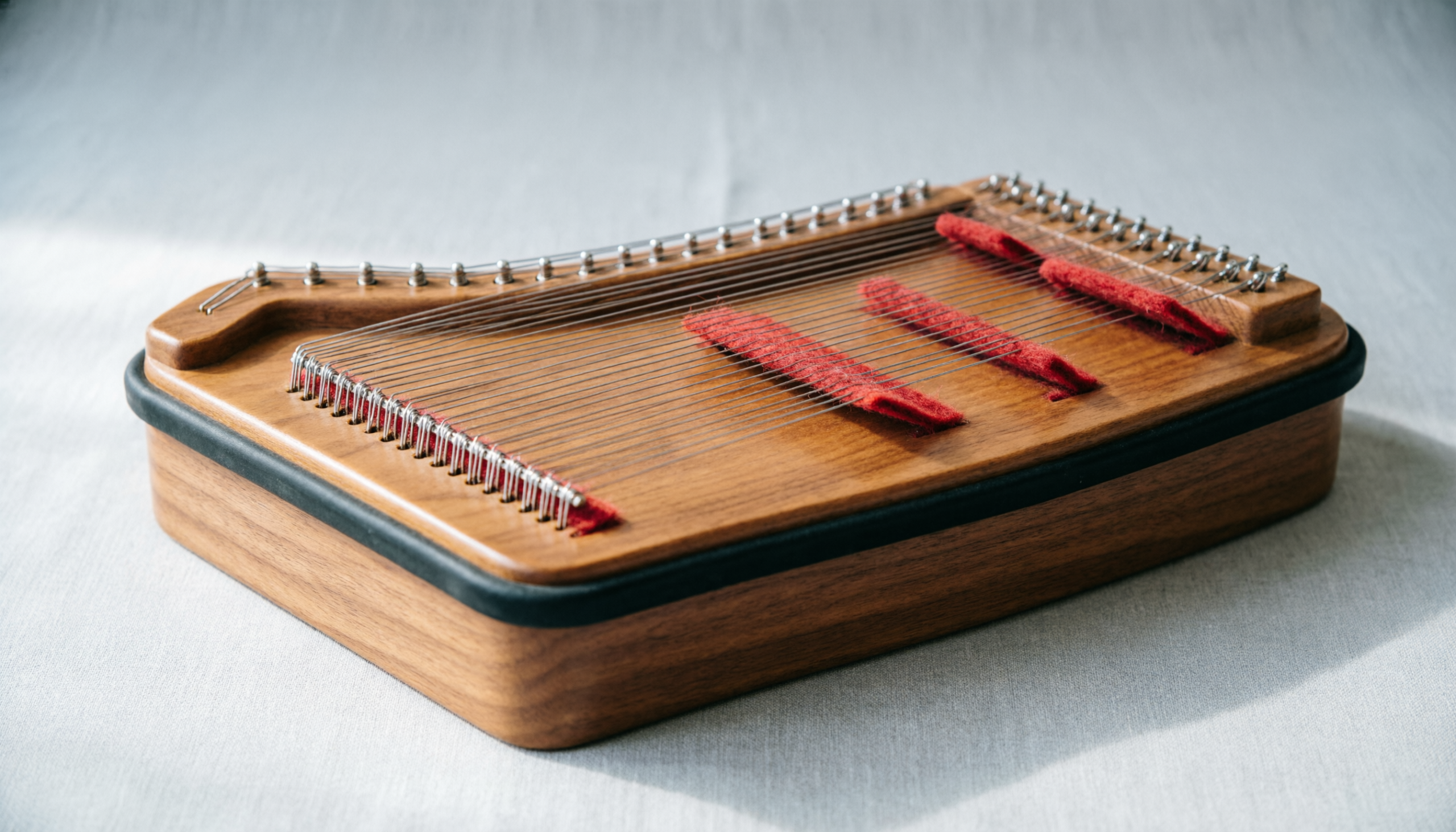
The autoharp’s defining mechanical feature is its chord bar mechanism: when a player presses a labeled button, felt or foam pads attached to the corresponding bar mute all strings except those that form the selected chord, allowing harmonically coherent sound production with minimal technical skill. This ingenious system transforms a complex multi-string instrument into an accessible tool for amateur musicians, as it eliminates the need to learn intricate fingerings or memorize chord shapes. Each chord bar is precisely calibrated so that its damping pads contact specific strings at exact points, ensuring clean chord voicings without unwanted sympathetic vibrations. The mechanism relies on careful engineering of spring tension, pad density, and bar alignment to provide responsive tactile feedback while maintaining consistent damping performance across the instrument’s range. Modern autoharps typically feature 12, 15, or 21 chord bars, offering major, minor, and dominant seventh chords arranged according to historical conventions or systematic musical logic. This chord-selection system represents a remarkable fusion of musical theory and mechanical design, enabling players to focus on rhythm, dynamics, and expression rather than harmonic calculation. The reliability and intuitiveness of this mechanism have been central to the autoharp’s enduring appeal across folk, country, and educational contexts for over a century.
Fact Number 8
Modern autoharps typically feature 36 strings, though specialized models may have up to 47 strings, and rare custom instruments like the Orthey Autoharp No. 136 boast 48 strings, offering expanded tonal range and harmonic possibilities. The standard 36-string configuration provides a practical balance between sonic richness, playability, and manufacturing feasibility, covering approximately three and a half octaves from F2 to C6 in standard chromatic tuning. Instruments with more strings require larger bodies, stronger bracing, and more complex chord bar mechanisms to accommodate the additional tension and damping requirements, which can increase cost and weight while potentially compromising portability. Conversely, fewer-string models may sacrifice range or chord voicing options but offer advantages in affordability and ease of handling, making them popular choices for beginners or traveling musicians. The choice of string count also affects the instrument’s timbre: more strings allow for greater note doubling and richer harmonic textures, while fewer strings produce a more focused, articulate sound. Custom builders often work with players to determine the optimal string configuration based on intended repertoire, playing style, and physical preferences, demonstrating how the autoharp continues to evolve through collaboration between craftsmen and performers.
Fact Number 9
The autoharp’s body is traditionally crafted from wood, with a soundboard featuring a guitar-like sound hole that projects and shapes the instrument’s acoustic output; the top may be constructed from solid tonewoods like spruce or cedar for superior resonance, or from laminated woods for greater durability and affordability. Solid-wood soundboards are prized for their ability to vibrate freely and transmit string energy efficiently, producing warmer, more complex tones that improve with age as the wood “opens up” through playing. Laminated tops, while less resonant, offer greater resistance to humidity changes and physical damage, making them suitable for educational instruments or performers who travel frequently. The body’s internal bracing pattern also significantly influences tonal character, with different configurations emphasizing bass response, treble clarity, or overall balance. High-end autoharps often feature hand-voiced soundboards, where craftsmen carefully carve and tune the wood to achieve specific acoustic properties. The choice of back and side woods—commonly maple, mahogany, or rosewood—further colors the instrument’s voice, contributing to the rich variety of tonal personalities found across different autoharp models and manufacturers.
Fact Number 10
A laminated pin-block holds piano-style tuning pins at one end of the autoharp, while the opposite edge features metal pins or a grooved plate to anchor string ends, creating a stable tension system that maintains precise pitch across all strings. The pin-block, typically made from multiple layers of hard maple glued with alternating grain directions, provides exceptional grip for tuning pins, preventing slippage under the combined tension of 36 or more strings, which can exceed 1,000 pounds total. Piano-style pins allow for fine-tuning adjustments using a specialized wrench, enabling players to compensate for environmental changes or string stretching. At the tail end, anchor pins or a notched plate secure string loops or ball ends, distributing tension evenly to prevent damage to the instrument’s frame. This dual-anchor design ensures that tuning stability is maintained even during vigorous strumming or changes in temperature and humidity. High-quality autoharps often feature hardened steel pins and precision-machined anchor plates to minimize wear and maximize longevity, reflecting the instrument’s engineering heritage and commitment to reliable performance.
Fact Number 11
Chord bars on the autoharp are typically constructed from plastic, wood, or metal and support felt or foam pads that contact the strings when depressed via labeled buttons, forming the core of the instrument’s chord-selection mechanism. The choice of bar material affects both tactile response and durability: plastic bars offer consistent performance and resistance to warping, wood bars provide a traditional aesthetic and warm feel, while metal bars deliver precise action and long-term stability. The damping pads must be carefully selected for density and thickness to mute strings cleanly without producing unwanted buzzing or partial damping; high-quality felts are often hand-cut and glued to ensure perfect alignment with each string. Buttons are labeled with chord names (e.g., C, G7, Am) and arranged in logical sequences to facilitate quick changes during performance. Advanced players may customize their chord bar layouts to suit specific repertoire or tunings, replacing standard bars with specialized voicings or alternative chord types. The precision engineering of this system—where millimeter-scale adjustments can significantly impact sound quality—demonstrates the autoharp’s status as both a musical instrument and a feat of mechanical design.
Fact Number 12
Standard factory autoharp models typically offer 12, 15, or 21 chord bars, providing combinations of major, minor, and dominant seventh chords arranged according to historical conventions or systematic musical logic to facilitate accompaniment in common keys. A 12-bar model might cover the primary chords in three closely related keys (e.g., C, F, and G), making it ideal for folk songs and hymns in those tonalities. A 15-bar configuration often adds secondary chords or extends coverage to a fourth key, while a 21-bar model provides comprehensive harmonic resources for more complex repertoire, including modulations and jazz-influenced progressions. The arrangement of bars follows practical considerations: frequently used chords are positioned for easy access, while less common voicings may require slightly more hand movement. Some manufacturers offer customizable chord bar sets, allowing players to select specific chords or experiment with alternative tunings. This modular approach to harmonic resources reflects the autoharp’s dual identity as both a beginner-friendly instrument and a versatile tool for advanced musicians, adaptable to diverse musical traditions and performance contexts.
Fact Number 13
A typical 36-string chromatic autoharp in standard tuning offers a range of three and a half octaves, spanning from F2 to C6, though it is not fully chromatic throughout that range—a limitation that would require 44 strings to achieve complete chromatic coverage. This design choice represents a practical compromise between tonal range, playability, and manufacturing complexity: by omitting certain less-frequently used pitches, manufacturers can reduce string count while still providing sufficient notes for most folk, country, and popular music repertoire. The standard chromatic tuning follows a logical pattern that facilitates chord formation across multiple keys, with strings arranged in repeating pitch classes that align with the chord bar damping system. Players seeking fully chromatic capability may commission custom instruments or employ specialized techniques like partial bar pressing to access “missing” notes, though these approaches require advanced skill. The three-and-a-half-octave range remains well-suited to the autoharp’s traditional role as an accompaniment instrument, providing ample bass foundation and treble sparkle without overwhelming the vocal or melodic lines it typically supports.
Fact Number 14
The autoharp features three small “feet” affixed to its back, allowing it to rest stably on a flat surface like a table for the traditional horizontal playing position—a design element that reflects the instrument’s origins as a parlor music tool intended for seated performance. These feet, typically made of rubber, felt, or hardwood, prevent slipping and protect both the instrument and the supporting surface from scratches during play. In the horizontal position, the player sits to the right of the autoharp, using the left hand to operate chord buttons while the right hand strums or plucks strings below the chord bars, often with a plectrum for increased volume and articulation. This configuration facilitates relaxed posture and clear visibility of chord labels, making it ideal for beginners and informal gatherings. While modern performance practices often favor the upright “lap-style” position, the feet remain a standard feature, honoring the instrument’s historical playing method and providing versatility for different performance contexts. Some players also use the feet to angle the instrument slightly for ergonomic comfort or acoustic projection, demonstrating how seemingly minor design elements can significantly impact playability.
Fact Number 15
Originally, the autoharp was designed to be played flat on a table, with the left hand operating chord buttons while the right hand strummed the strings below the chord bars using a plectrum—a technique that emphasized rhythmic accompaniment and harmonic support for singing or other instruments. This horizontal playing position aligned with late 19th-century parlor music conventions, where instruments were often arranged on furniture for comfortable group performance. The plectrum, typically made of celluloid or tortoiseshell, allowed for consistent attack and volume control, enabling players to produce clear chordal patterns without excessive finger fatigue. Historical photographs and instruction manuals from the early 20th century frequently depict autoharpists using this tabletop method, which remains popular among traditional players and in educational settings where stability and visibility are prioritized. While contemporary performers often adopt upright positions for greater stage presence and dynamic expression, the original horizontal technique continues to offer advantages for precise chord changes, relaxed posture, and integration with other tabletop instruments like dulcimers or small percussion. Understanding this foundational playing style provides valuable context for appreciating the autoharp’s evolution and the diverse techniques modern players employ.
Fact Number 16
Cecil Null, a performer with the Grand Ole Opry, is widely credited with pioneering the upright “lap-style” playing position for the autoharp in the 1950s, holding the instrument against the chest with straps or supports to free both hands for more expressive techniques. This innovation transformed the autoharp from a primarily accompaniment-focused parlor instrument into a dynamic solo voice capable of melodic flourishes, rhythmic complexity, and theatrical stage presence. By positioning the autoharp vertically, Null enabled players to use the right hand for intricate fingerpicking, strumming patterns, and percussive effects while the left hand managed chord changes with greater speed and flexibility. The lap-style approach also improved audience visibility, allowing performers to engage more directly with listeners and integrate the autoharp into ensemble settings with greater visual cohesion. Null’s influence extended beyond technique: his performances helped elevate the autoharp’s status within country music, inspiring a generation of players to explore its solo potential. Today, the upright position is standard for most professional autoharpists, though many maintain proficiency in both horizontal and vertical techniques to suit different musical contexts.
Fact Number 17
Bryan Bowers, a virtuoso autoharpist who rose to prominence in the 1970s, developed advanced finger-style techniques that revolutionized the instrument’s expressive capabilities, using all five fingers of the right hand to play independent bass lines, melodies, and counter-melodies simultaneously. Bowers’ approach treated the autoharp not merely as a chordal accompaniment tool but as a fully polyphonic instrument capable of complex harmonic and contrapuntal textures akin to piano or classical guitar. His technique involved precise finger placement, dynamic control, and rhythmic independence, allowing him to perform intricate arrangements of folk songs, original compositions, and even classical pieces with remarkable clarity and emotional depth. Bowers also pioneered the use of alternative tunings and custom chord bar configurations to expand the autoharp’s harmonic palette, demonstrating the instrument’s adaptability to diverse musical styles. Through recordings, workshops, and performances, he inspired a new generation of players to explore the autoharp’s technical and artistic potential, contributing significantly to its revival and continued relevance in contemporary folk and acoustic music scenes.
Fact Number 18
Diatonically-strung single-key autoharps produce a uniquely lush and resonant sound by doubling or tripling strings for individual notes within a specific scale, reducing the number of damped strings during chord changes and allowing more strings to ring sympathetically. Unlike chromatic autoharps, which include all twelve pitches of the Western scale to enable modulation between keys, diatonic models are tuned to a single major or minor scale (e.g., G major or D minor), optimizing resonance and volume for repertoire in that key. This design choice creates a richer, more immersive sonic texture, as undamped strings vibrate in harmonic sympathy with played notes, enhancing sustain and tonal complexity. Diatonic autoharps are particularly valued in traditional folk contexts, where songs often remain in one key and the instrument’s resonant character complements vocal melodies and acoustic ensembles. Players may own multiple diatonic autoharps tuned to different keys to accommodate varied repertoire, or they may retune a single instrument for specific projects. The trade-off between harmonic flexibility and acoustic richness makes diatonic autoharps a specialized but deeply rewarding choice for musicians focused on authenticity and tonal beauty within defined musical traditions.
Fact Number 19
A “festival” or “campfire” harp typically refers to a three-key diatonic autoharp tuned to closely related keys in the circle of fifths—commonly G, D, and A—making it ideal for accompanying fiddles, singers, and other instruments in informal outdoor or communal music settings. This compact, portable configuration prioritizes practicality and versatility for spontaneous jam sessions, where quick key changes and robust sound projection are essential. The three-key layout covers a wide range of traditional folk, bluegrass, and old-time repertoire while keeping the instrument lightweight and easy to transport. Festival autoharps often feature durable laminated construction to withstand outdoor conditions, simplified chord bar arrangements for intuitive play, and bright, projecting tonewoods that cut through ensemble textures. Their design reflects the autoharp’s enduring role as a social instrument, facilitating group music-making and intergenerational connection at gatherings where formal performance is secondary to shared participation. For many players, the festival harp represents an accessible entry point into autoharp playing, offering immediate musical satisfaction while encouraging exploration of more complex instruments and techniques over time.
Fact Number 20
Maybelle Carter, a foundational figure in country music and member of the legendary Carter Family, popularized the autoharp during the 1920s and 1930s through her innovative playing style and widespread recordings, helping to define the instrument’s sonic identity in American folk and country traditions. Carter adopted an upright playing position pioneered by Grand Ole Opry star Cecil Null, holding the autoharp against her chest to free both hands for expressive strumming and chord changes. Her distinctive “Carter Scratch” technique—alternating bass notes with rhythmic strums—created a driving, percussive accompaniment that became a hallmark of the Carter Family’s sound, influencing countless musicians across genres. Through radio broadcasts, recordings, and live performances, Carter demonstrated the autoharp’s versatility as both a rhythmic foundation and a melodic voice, elevating its status from parlor novelty to essential country music instrument. Her legacy continues to inspire autoharpists today, with many citing her recordings as formative influences and emulating her blend of technical precision and emotional authenticity. The Carter Family’s enduring popularity ensures that Maybelle Carter’s contributions to autoharp history remain widely recognized and celebrated.
Fact Number 21
The Carter Family’s adoption of an upright playing style, developed by Grand Ole Opry star Cecil Null, became the standard performance approach for autoharpists, fundamentally reshaping how the instrument was perceived and utilized in professional music contexts. By holding the autoharp vertically against the chest, players gained greater freedom of movement, improved stage visibility, and enhanced dynamic control, enabling more expressive performances that could compete with other instruments in ensemble settings. This positional shift also facilitated the integration of advanced right-hand techniques, such as fingerpicking and percussive strumming, which expanded the autoharp’s melodic and rhythmic capabilities beyond simple chordal accompaniment. The upright style aligned with evolving performance practices in country and folk music during the mid-20th century, where visual engagement and instrumental virtuosity became increasingly valued. As the Carter Family’s influence spread through recordings, radio, and television, their playing posture and techniques were emulated by aspiring musicians, cementing the lap-style position as the dominant approach for generations of autoharpists. This transition exemplifies how performance practice innovations can reshape an instrument’s role and reputation within a musical culture.
Fact Number 22
Notable autoharpists span diverse genres and generations, including Kilby Snow—who won “Autoharp Champion of North Carolina” at age five—Bryan Bowers, John Sebastian of The Lovin’ Spoonful, Dolly Parton, Joni Mitchell, Brian Jones of The Rolling Stones, and Sheryl Crow, demonstrating the instrument’s cross-genre appeal and adaptability. Kilby Snow represented the traditional Appalachian folk tradition, preserving old-time techniques and repertoire through performances and recordings. Bryan Bowers expanded the autoharp’s technical and artistic possibilities through virtuosic finger-style playing and innovative arrangements. John Sebastian introduced the autoharp to 1960s rock and folk-rock audiences, using its distinctive sound on hits like “Darlin’ Be Home Soon.” Country icons like Dolly Parton incorporated the autoharp into mainstream Nashville productions, while singer-songwriters like Joni Mitchell and Sheryl Crow employed it for its intimate, resonant texture in confessional folk-pop. Brian Jones’ use of autoharp on Rolling Stones tracks like “Lady Jane” showcased its potential in psychedelic and baroque rock contexts. This diverse roster of players underscores the autoharp’s unique sonic character and mechanical accessibility, enabling musicians from varied backgrounds to incorporate its voice into their artistic expressions.
Fact Number 23
Electric autoharps emerged in the 1960s when Harry DeArmond, a pioneering pickup designer, created a specialized bar magnetic pickup for the instrument, enabling amplification and electronic effects that expanded its sonic possibilities in rock, folk-rock, and experimental music contexts. This innovation allowed autoharpists to perform in louder ensemble settings without sacrificing tonal clarity, and it opened new creative avenues through distortion, reverb, and other signal processing techniques. Roky Erickson’s 1979 album The Evil One prominently featured electric autoharp, using its shimmering, otherworldly tones to complement his psychedelic folk-rock aesthetic and emotionally raw songwriting. The electric autoharp’s distinctive sound—characterized by sustained harmonics, resonant chord swells, and percussive attack—has since been adopted by artists across genres, from indie folk to ambient electronic music. Modern electric models often include built-in pickups, preamps, and output jacks, while acoustic-electric hybrids offer versatility for both amplified and unamplified performance. The development of electric autoharps reflects broader trends in musical instrument innovation, where traditional acoustic designs are adapted to meet the demands of contemporary performance and recording technologies.
Fact Number 24
The Omnichord, later rebranded as the Q-Chord and introduced by Suzuki in 1981, represents a synthesized electronic evolution of the autoharp concept, described by manufacturers as a “digital songcard guitar” that combines chord buttons, strum plates, and preset rhythms in a portable, battery-powered instrument. Like the acoustic autoharp, the Omnichord features chord-selection buttons that trigger harmonic progressions, but it generates sound electronically through digital synthesis rather than vibrating strings, offering a wide range of instrument voices, accompaniment styles, and tempo controls. The strum plate allows players to produce rhythmic patterns by swiping a finger across a touch-sensitive surface, mimicking the motion of strumming while triggering sampled or synthesized tones. This design made the Omnichord particularly appealing to hobbyists, educators, and songwriters seeking an accessible tool for composition and entertainment without the tuning maintenance or acoustic volume constraints of traditional instruments. While purists may distinguish the Omnichord from acoustic autoharps, its conceptual lineage—simplifying chord production through mechanical or electronic interfaces—connects it to the same democratic musical philosophy that inspired Zimmermann’s original 1882 patent.
Fact Number 25
Karl August Gütter’s biographical details reveal a fascinating chapter in autoharp history: though some reference books incorrectly listed his given name as “Christian,” historical records confirm he was born Karl and lived his entire life in Markneukirchen, Germany (1823–1900), where he raised nine children, three of whom emigrated to the United States. Gütter’s work in Markneukirchen—a renowned center of German musical instrument manufacturing—placed him at the heart of a vibrant community of craftsmen who collectively advanced zither and string instrument design during the late 19th century. His contributions to the autoharp’s vertical chord bar mechanism were likely informed by this collaborative environment, where ideas and techniques circulated among workshops and families. The emigration of three of his children to America may have facilitated transatlantic exchange of instrument-making knowledge, potentially influencing the adoption and adaptation of his designs by US manufacturers. Recognizing Gütter’s correct name and life story not only corrects historical inaccuracies but also honors the often-overlooked European craftsmanship that underpins many American musical innovations. His legacy endures in every modern autoharp that employs the vertical damping system he pioneered, a testament to the enduring impact of precise engineering and thoughtful design.
🎵 Autoharp FAQs
❓ What is an autoharp, and is it really a harp?
No, the autoharp is not technically a harp—it is a chorded zither belonging to the box zither family
en.wikipedia.org. While harps produce sound through individually plucked strings running perpendicular to the soundboard, autoharps feature strings stretched parallel to a resonant wooden body, with sound generated by strumming or plucking multiple strings simultaneously while chord bars selectively dampen unwanted notes
stringkingsmusic.com. The name “autoharp” likely originated from marketing considerations in the late 19th century, when “harp” carried connotations of elegance that appealed to parlor music consumers. Despite the misnomer, the autoharp’s mechanical chord-selection system and box-like resonating chamber firmly place it within the zither classification in organology (the scientific study of musical instruments).
❓ What’s the difference between a chromatic and a diatonic autoharp?
A chromatic autoharp includes all twelve pitches of the Western scale across its strings (typically 36 strings covering 3½ octaves), allowing you to play in multiple keys without retuning
autoharp.witch.scot. This versatility makes chromatic models ideal for accompanying other musicians, playing diverse repertoire, or exploring modulations—you won’t need a capo like you might with guitar or banjo. In contrast, a diatonic autoharp is tuned to a single major or minor scale (or occasionally two or three closely related keys), with many strings doubled or tripled to create richer resonance and sympathetic vibration
autoharp.witch.scot. Diatonic models produce a lush, immersive sound well-suited to traditional folk, old-time, and Celtic music where songs often stay in one key. While chromatic autoharps offer flexibility, diatonic instruments provide superior tonal richness within their designated key(s); many serious players own multiple diatonic autoharps tuned to different keys for varied repertoire.
❓ What is the best autoharp for a beginner?
Experts consistently recommend starting with a 36-string, 21-chord chromatic autoharp from a reputable manufacturer like Oscar Schmidt or Chromaharp
autoharp.witch.scot. The 21-chord configuration provides enough harmonic variety to play in multiple keys (Bb, F, C, G, D, and more) without overwhelming a new player, while the 36-string range offers sufficient tonal depth for most folk, country, and popular music
harpersguild.com. When purchasing, prioritize instruments that have been professionally “set up”—meaning chord bars, springs, and damping felts are properly aligned for smooth action—and tuned before delivery
autoharp.witch.scot. If buying used, ensure the instrument has no structural damage (cracks, warping, loose tuning pins) and budget approximately £100/$125 for potential refurbishment including new strings and felts
autoharp.witch.scot. Avoid vintage “Rosen” autoharps or heavily damaged instruments marketed as decorative pieces; these are often unplayable and potentially hazardous due to string tension risks
autoharp.witch.scot.
❓ How do I tune an autoharp?
Tuning an autoharp requires patience, a quality tuning wrench (L-shaped or T-shaped), and an electronic chromatic tuner clipped to the instrument’s headstock
www.oscarschmidt.com. Begin by tuning all the F notes across the instrument’s range, then proceed systematically through G, A, B, C, D, and E
www.get-tuned.com. This method helps maintain consistent temperament across octaves. Always tune from below the target pitch upward to avoid slackening the pin-block, and make small, gradual adjustments—autoharp strings are under significant tension (often exceeding 1,000 pounds total), and over-tightening can damage the instrument
www.autoharpstore.com. For beginners, consider using a smartphone tuning app with visual feedback, though dedicated clip-on tuners offer greater accuracy in noisy environments. If your autoharp has fine tuners (small cams at the tail end), use them for minor pitch adjustments between full tunings; however, fine tuners are a luxury feature, not a necessity
autoharp.witch.scot.
❓ How do I play the autoharp? What techniques should I learn first?
Autoharp playing involves two hands working independently: the left hand presses chord bars to select harmonies, while the right hand strums or plucks strings to produce sound
westmanjams.wordpress.com. Beginners should start with the traditional horizontal position—placing the autoharp flat on a table with the three feet on its back providing stability—and use a plectrum or thumb pick for consistent strumming
westmanjams.wordpress.com. Practice pressing single chord bars while strumming gently to hear clean chord voicings, then progress to simple chord changes (e.g., C → G → F) in time with a metronome. As you advance, explore the upright “lap-style” position pioneered by Cecil Null and popularized by Maybelle Carter, holding the instrument against your chest with a strap to free both hands for more expressive techniques
harpersguild.com. Intermediate players can develop finger-style approaches like Bryan Bowers’ method, using all five right-hand fingers to play independent bass lines, melodies, and counter-melodies simultaneously
en.wikipedia.org. Always start slowly, focus on clean chord transitions, and record yourself to track progress.
❓ What accessories do I need to get started?
Essential autoharp accessories include: a quality tuning wrench (L- or T-shaped) for precise pitch adjustments; finger picks or a thumb pick (celluloid, Delrin, or metal) to protect nails and enhance volume; a clip-on electronic tuner for accurate tuning in any environment; and a protective case or gig bag to shield the instrument from dust, humidity, and physical damage during transport
riverboatmusic.com. If you plan to play standing up or in ensemble settings, install strap buttons and use a supportive strap like the “Slider Strap” harness system to maintain proper posture and prevent repetitive strain
autoharp.witch.scot. For performers, consider adding an under-saddle or soundhole pickup to amplify your autoharp for recordings, open mics, or band settings—many modern autoharps come pre-wired for easy pickup installation
www.autoharpstore.com. Optional but helpful items include silica gel packets to control humidity inside your case, a soft cloth for regular cleaning, and replacement felt pads for chord bars (consumable parts that wear over time).
❓ How do I maintain and care for my autoharp?
Proper autoharp maintenance extends the instrument’s life and preserves its tone. Store your autoharp at stable room temperature (65–75°F / 18–24°C) with moderate humidity (40–60%); avoid attics, basements, or direct sunlight, which can cause wood warping, glue failure, or string corrosion
riverboatmusic.com. Wipe strings and body with a dry, soft cloth after each use to remove oils and dust. Check chord bar felts regularly for wear—grooved or compressed felts produce muted or buzzy chords and should be replaced by a qualified technician or via DIY kits with proper alignment tools
www.autoharpstore.com. Inspect tuning pins for rust or looseness; if pins slip during tuning, the pin-block may need professional attention. Restring your autoharp every 2–5 years depending on play frequency, using manufacturer-specified string types (Model A for pre-1967 instruments with peg anchors; Model B for modern Oscar Schmidt/Chromaharp instruments with aluminum anchor bars)
autoharp.witch.scot. Before shipping or traveling, secure chord bars with cardboard spacers, wrap the body in bubble wrap (never tape directly to wood), and use a rigid outer box labeled “FRAGILE”
autoharp.witch.scot.
❓ Can I customize my autoharp’s chord bars or tuning?
Yes—autoharps are highly customizable instruments. Chord bar felts can be recut or replaced to change chord voicings, add alternative chords (like suspended or minor seventh), or adapt to non-standard tunings
autoharp.witch.scot. Many advanced players adopt the “Bryan Bowers” or “Bluegrass” layout, which centers major chords for ergonomic access and replaces less-used chords (Ab, Bb7, Cm) with more versatile options (Bm, F#m, E)
autoharp.witch.scot. Retuning is also possible: chromatic autoharps can be converted to diatonic setups by replacing unused strings with doubled courses in a target key, creating richer resonance; conversely, diatonic instruments can be re-strung chromatically for greater harmonic flexibility. Customization requires precision tools, replacement felts, and knowledge of string gauges and tension calculations—beginners should consult a luthier or experienced technician before attempting major modifications. Some players commission fully custom autoharps from luthiers like Alec Anness (UK) or specialized builders in the US, who can tailor string count, body woods, chord layouts, and electronics to individual preferences.
❓ Where can I buy a reliable autoharp, and what should I avoid when shopping used?
For new instruments, purchase from reputable dealers who specialize in autoharps and provide professional setup and tuning before shipping—stores like the Autoharp Store, Folk Friends, or manufacturer-authorized retailers offer this critical service
promusicvault.com
www.musicianwave.com. Avoid generic music retailers that lack autoharp expertise; instruments sold “off the shelf” often arrive out of tune, with misaligned chord bars or structural issues
autoharp.witch.scot. When shopping used, prioritize sellers who provide detailed photos of the bridge area, tuning pins, and chord bar mechanism, and who guarantee return privileges if the instrument is unplayable
autoharp.witch.scot. Red flags include: visible cracks or wood separation; “dishing” (a dip toward the soundhole) or bulging of the top; rusted or loose tuning pins; lifted aluminum anchor bars on Oscar Schmidt Model B instruments (a known design flaw); and grooved or missing chord bar felts
autoharp.witch.scot. If possible, test-play the instrument in person or have a knowledgeable musician inspect it. Budget for potential refurbishment costs (£100/$125+) when evaluating used prices, and remember that a playable, well-set-up beginner autoharp is a better investment than a cheap, damaged “bargain.”
❓ How loud is an autoharp, and can I amplify it?
Acoustic autoharps produce a moderate volume—sufficient for personal practice, small gatherings, or accompanying a single vocalist, but often overpowered in ensemble settings or large rooms
www.autoharpstore.com. The instrument’s sound is warm, resonant, and shimmering, with strong midrange presence and gentle sustain. To increase volume or adapt to performance contexts, most autoharps can be fitted with under-saddle piezo pickups, soundhole-mounted microphones, or internal condenser mics
loopholes.blog. Electric and acoustic-electric models (like the Oscar Schmidt OS45CE) come pre-wired with output jacks for direct connection to amplifiers, PA systems, or recording interfaces
promusicvault.com. When amplifying, use a preamp or DI box to match impedance and reduce feedback; apply subtle EQ to enhance clarity without harshness. For recording, blend a pickup signal with a room microphone to capture both direct string articulation and natural acoustic resonance. Even amplified, the autoharp retains its distinctive character—a gentle, chiming texture that cuts through mixes without dominating.
❓ Are there autoharps designed for children or players with small hands?
Yes—while standard autoharps measure approximately 24–26 inches long, smaller-scale instruments are available for young players or those with limited reach. Look for vintage or refurbished autoharps with 18–25 strings and 6–15 chord bars; these compact models are lighter, easier to hold, and less intimidating for beginners
autoharp.witch.scot. Some luthiers, like Alec Anness in the UK, build custom child-sized autoharps to order, though import costs and lead times apply
autoharp.witch.scot. When selecting an instrument for a child, prioritize structural integrity (no cracks, stable tuning pins) and ensure chord bars are within comfortable reach; consider adding a supportive strap to promote proper posture. For players with short arms or mobility considerations, explore “Caroler” models like the Chromaharp Caroler (43 strings, 27 chords), which features a mirrored layout allowing tabletop play without crossing arms, or instruments with adjustable strap systems for ergonomic upright positioning
autoharp.witch.scot.