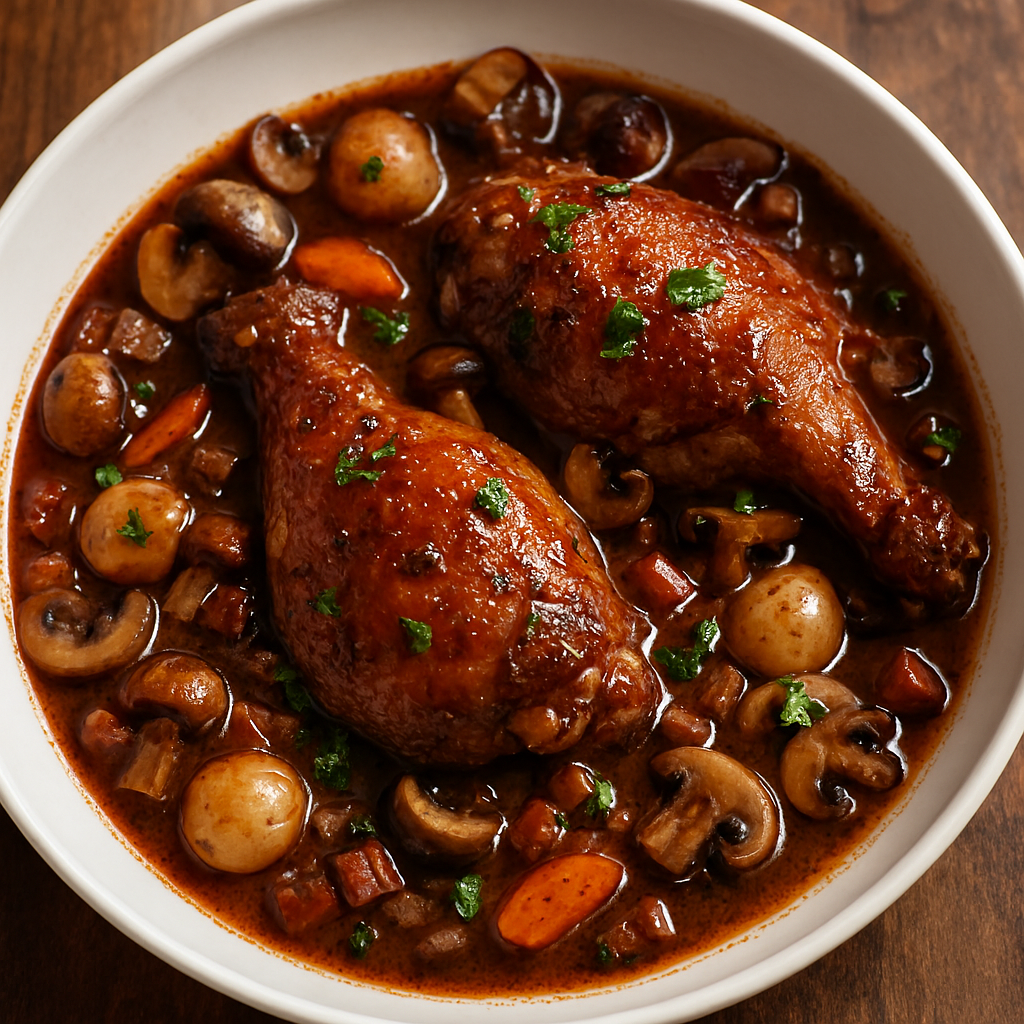
Coq au Vin
Coq au Vin is one of France’s most iconic dishes, a rustic farmhouse recipe that has traveled centuries to become a global comfort food favorite. Literally meaning “rooster with wine,” it was originally created to tenderize tough old birds through slow braising in Burgundy wine, and over time evolved into countless regional variations such as Coq au Riesling, Coq au Champagne, and Coq au Vin Jaune. Legends even tie its origins to Julius Caesar’s conquest of Gaul, while modern fame came in 1961 when Julia Child introduced it to American kitchens through her landmark cookbook. Today, whether simmered for hours with mushrooms, pearl onions, and lardons or adapted with local wines, Coq au Vin remains a symbol of French culinary artistry—rich, hearty, and steeped in tradition, yet endlessly versatile and celebrated worldwide.
📖 Origins & History
1. The name Coq au vin literally means “rooster with wine” in French. This name reflects the rustic origins of the dish, when farmers would use older roosters that were no longer useful for egg production. These birds had tough meat, requiring long, slow cooking methods to make them palatable. By braising the rooster in wine, the acidity and slow heat would break down the fibers, resulting in tender meat infused with deep flavor. The name itself is a reminder of how resourceful rural French cooking was, turning necessity into culinary tradition.
2. Legends trace its roots back to ancient Gaul, with stories linking it to Julius Caesar. One popular legend suggests that when Julius Caesar conquered Gaul, the locals presented him with a tough old rooster cooked in wine as a gesture of hospitality. While historians debate the accuracy of this tale, it highlights how deeply ingrained wine-based cooking was in French culture even in antiquity. Whether fact or folklore, the association with Caesar adds a mythical aura to the dish, connecting rustic French cuisine to ancient history.
3. It was originally a rustic farmhouse dish, made with tough old roosters. Farmers in rural France often had to make do with what they had, and older roosters were not wasted. Instead of discarding them, cooks developed slow braising techniques to tenderize the meat. This practice reflects the ingenuity of peasant cooking, where nothing went to waste and every ingredient was maximized. Over time, what began as a humble farmhouse meal evolved into a celebrated dish served in fine dining restaurants.
4. The first documented recipes appeared in the early 20th century. Although the dish had been cooked for centuries in rural households, it wasn’t formally recorded until the early 1900s. This documentation marked its transition from oral tradition and local practice into the broader culinary canon. Once written down, chefs and home cooks across France could replicate and refine the dish, ensuring its preservation and spread beyond its regional origins.
5. A similar dish, Poulet au vin blanc (chicken in white wine), was published in 1864. This earlier recipe shows that the technique of braising poultry in wine was already established in French cooking. The use of white wine instead of red highlights the adaptability of the method, depending on local wine availability. It also demonstrates how Coq au Vin was part of a broader tradition of wine-based braises, which were central to French gastronomy.
6. Julia Child’s 1961 cookbook Mastering the Art of French Cooking helped popularize it worldwide. Julia Child introduced Coq au Vin to American audiences, making French cuisine accessible to home cooks. Her detailed instructions and approachable style demystified the dish, turning it into a staple of dinner parties and home kitchens in the United States. This moment was pivotal in transforming Coq au Vin from a regional specialty into an international culinary icon.
🍷 Regional Variations
7. Burgundy is the classic wine used, but regions adapted it with their own local wines. The Burgundy region, famous for its Pinot Noir, is considered the birthplace of Coq au Vin. However, as the dish spread, cooks substituted local wines to reflect their terroir. This adaptability ensured that the dish remained relevant across France, with each region adding its own twist while preserving the essence of braising poultry in wine.
8. Coq au vin jaune uses yellow wine from the Jura region. Vin Jaune, a unique wine aged under a layer of yeast, imparts nutty and complex flavors. When used in Coq au Vin, it creates a distinctive variation that reflects Jura’s winemaking traditions. This version showcases how local wines can dramatically alter the character of the dish while maintaining its core technique.
9. Coq au Riesling comes from Alsace, featuring white Riesling wine. Alsace, known for its crisp Riesling, offers a lighter, more aromatic take on Coq au Vin. The acidity of Riesling balances the richness of the chicken and bacon, while its floral notes add elegance. This variation demonstrates the versatility of the dish, adapting seamlessly to different wine profiles.
10. Coq au Champagne is made with sparkling wine from Champagne. Using Champagne adds effervescence and subtle sweetness, creating a celebratory version of the dish. This variation is often reserved for festive occasions, highlighting how Coq au Vin can be elevated from rustic comfort food to refined cuisine suitable for special events.
11. Coq au pourpre/violet uses Beaujolais nouveau for a fruity twist. Beaujolais nouveau, a young and fruity wine, lends a vibrant flavor to the dish. This version is often cooked in November when Beaujolais nouveau is released, tying the dish to seasonal traditions. It reflects how Coq au Vin can be adapted to contemporary wine culture while staying rooted in tradition.
🥘 Ingredients & Technique
12. Traditionally made with rooster, but now chicken is the standard protein. Modern cooks typically use chicken because roosters are less available and their meat is tougher. Chicken provides a more accessible and tender alternative, making the dish easier to prepare while still honoring its origins. This shift illustrates how culinary traditions evolve with changing food availability.
13. Recipes usually call for 750 ml (one bottle) of wine. The wine is not just a flavoring agent but the primary cooking liquid. Using a full bottle ensures that the chicken is fully immersed, allowing the flavors to penetrate deeply. The choice of wine significantly influences the final taste, making it the most critical ingredient after the chicken itself.
14. Lardons (bacon or pancetta) add smokiness to the dish. These small strips of cured pork provide a savory backbone, enhancing the richness of the sauce. Their fat also serves as the cooking medium for browning the chicken, layering flavors from the very beginning of the cooking process.
15. Mushrooms provide earthy depth to balance the wine’s acidity. Mushrooms absorb the braising liquid, becoming little flavor bombs that complement the chicken. Their umami quality rounds out the dish, preventing the wine from overwhelming the palate.
16. Pearl onions (often 20–25 per dish) add sweetness and texture. These small onions caramelize slightly during cooking, offering bursts of sweetness that contrast with the savory sauce. Their size makes them perfect for braises, as they hold their shape while absorbing flavor.
17. Carrots (typically 2–3 medium) bring natural sweetness. Carrots balance the acidity of the wine and add color to the dish. Their subtle sweetness enhances the overall harmony of flavors, making them an essential supporting ingredient.
18. Garlic is optional but often included for aroma. Garlic adds depth and complexity, infusing the sauce with a subtle pungency. While not always traditional, its inclusion reflects the adaptability of the recipe to modern tastes.
19. Chicken is browned first, then simmered slowly in wine and stock. Browning creates a flavorful crust through the Maillard reaction, which enriches the sauce once deglazed with wine. This step is crucial for building layers of flavor before the slow braise.
20. Braising takes 2–3 hours to fully tenderize the meat. The long cooking time allows the wine and stock to break down the chicken’s fibers, resulting in tender meat and a deeply flavored sauce. Patience is key, as rushing the process compromises the dish’s richness.
🌍 Cultural Impact
21. Alongside Boeuf Bourguignon, it’s considered a symbol of rustic French cuisine elevated to fine dining. Both dishes showcase how humble ingredients can be transformed into gourmet meals through technique and patience. They embody the French philosophy of cooking, where simplicity and quality ingredients are elevated by skill.
22. It’s often served with mashed potatoes, buttered noodles, or crusty bread. These accompaniments soak up the rich sauce, ensuring nothing goes to waste. They also provide textural contrast, making the meal more satisfying and complete.
23. The dish is known to taste even better the next day as flavors deepen. Like many braises, Coq au Vin benefits from resting overnight. The flavors meld and intensify, making leftovers arguably superior to the original serving. This quality makes it ideal for dinner parties, as it can be prepared in advance.
24. It’s a staple in French restaurants worldwide, from Paris to New York. Its presence on menus across the globe reflects its status as a culinary ambassador of France. Diners seeking authentic French cuisine often encounter Coq au Vin as a representative dish.
25. Today, it’s recognized globally as one of the quintessential comfort foods of France. Despite its humble origins, Coq au Vin has achieved international fame. It embodies the warmth, richness, and tradition of French cooking, making it both a cultural symbol and a beloved comfort food.
❓ Frequently Asked Questions About Coq au Vin
1. What is Coq au Vin?
Coq au Vin is a traditional French dish that literally means “rooster with wine.” It originated as a rustic farmhouse recipe where older roosters, which had tough meat, were slowly braised in wine to tenderize them. Today, chicken is more commonly used, simmered with wine, bacon (lardons), mushrooms, onions, and herbs to create a rich, savory stew.
2. Where did Coq au Vin originate?
The dish is most closely associated with the Burgundy region of France, famous for its Pinot Noir wines. However, variations exist across France, with each region using its local wine. For example, Alsace uses Riesling, Champagne uses sparkling wine, and Jura uses Vin Jaune.
3. Why was wine used in the recipe?
Wine was traditionally used because it helped tenderize the tough meat of older roosters. The acidity of wine breaks down muscle fibers during long cooking, while also infusing the meat with complex flavors. This technique reflects the resourcefulness of rural French cooking, where nothing was wasted.
4. What wine is best for Coq au Vin?
The classic choice is red Burgundy wine (Pinot Noir), but other dry red wines such as Merlot or Cabernet Sauvignon can be used. Regional variations substitute white wines like Riesling or sparkling wines like Champagne, each giving the dish a unique flavor profile.
5. How long does it take to cook Coq au Vin?
Traditional recipes require 2–3 hours of slow braising to fully tenderize the chicken and develop deep flavors. Modern adaptations may shorten cooking time to about 90 minutes, but the longer the simmer, the richer the sauce becomes.
6. What are the key ingredients?
The essential ingredients include chicken (traditionally rooster), wine, lardons (bacon), mushrooms, pearl onions, carrots, garlic, and herbs like thyme and bay leaf. These combine to create a hearty, aromatic stew.
7. Is Coq au Vin difficult to make?
Despite its reputation as a gourmet dish, Coq au Vin is relatively straightforward. The main steps are browning the chicken, deglazing with wine, adding vegetables and herbs, and simmering slowly. The challenge lies in patience—allowing enough time for flavors to meld.
8. Can Coq au Vin be made ahead of time?
Yes, and it’s actually recommended. The dish tastes even better the next day as the flavors deepen overnight. Many cooks prepare it in advance for dinner parties, reheating gently before serving.
9. What do you serve with Coq au Vin?
Traditional accompaniments include mashed potatoes, buttered noodles, or crusty French bread to soak up the rich sauce. Some also serve it with rice or roasted vegetables for a complete meal.
10. Why is Coq au Vin considered iconic?
Coq au Vin represents the essence of French cooking—transforming humble ingredients into something refined through technique and patience. It embodies both rustic tradition and culinary artistry, making it a staple in French restaurants worldwide.