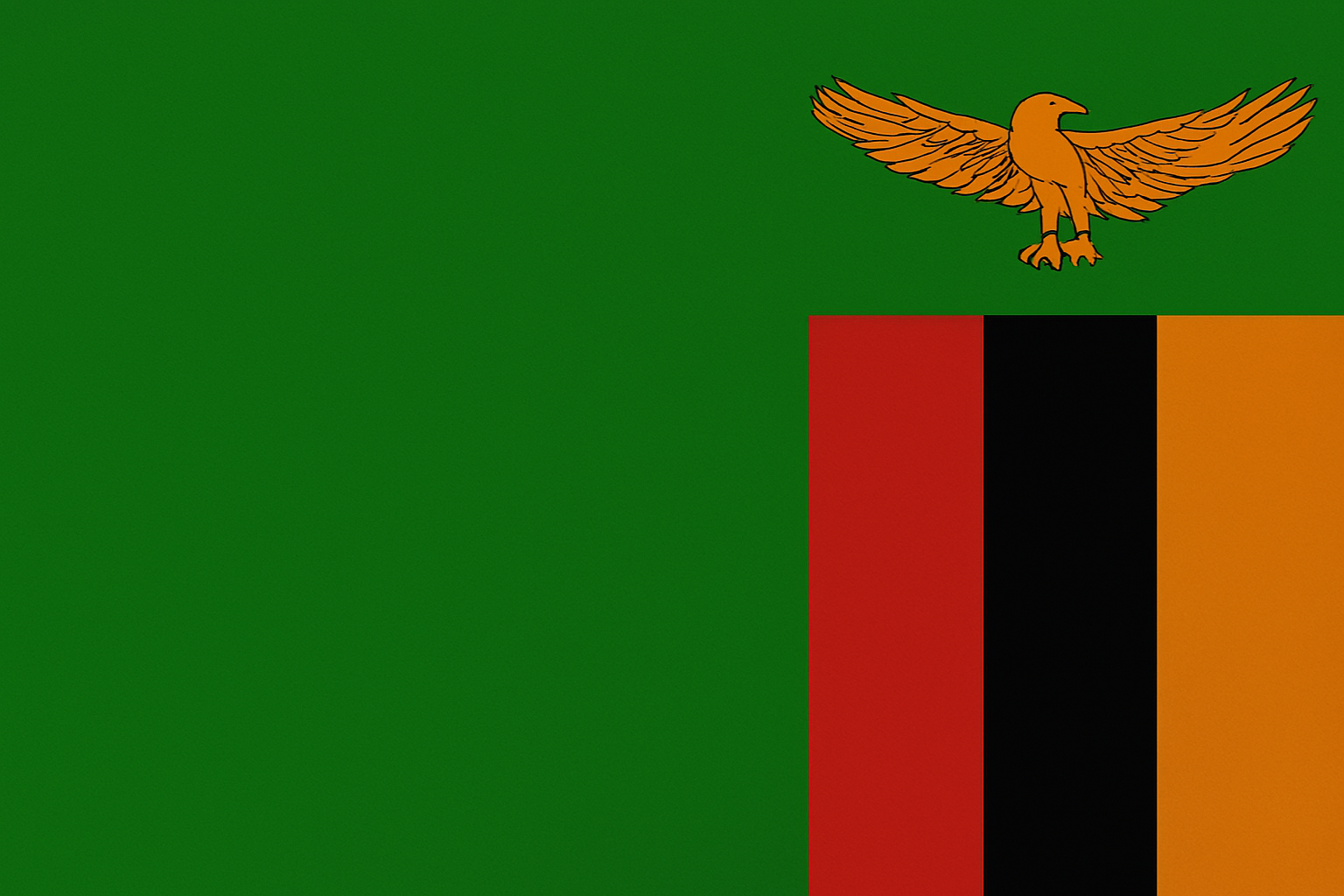
Flag of Zambia
Zambia, known as the “heart of Southern Africa,” is a landlocked country celebrated for its breathtaking natural wonders, rich cultural diversity, and fascinating history. From the thundering Victoria Falls—one of the world’s largest waterfalls—to the bustling capital city of Lusaka and the mineral-rich Copperbelt Province, Zambia offers a unique blend of tradition and modernity. Its story stretches from ancient Khoisan inhabitants and Bantu migrations to British colonial rule and eventual independence in 1964 under President Kenneth Kaunda. Today, Zambia thrives as a multi-ethnic nation united under the motto “One Zambia, One Nation,” with over 70 languages spoken, vibrant music and dance traditions, and a growing reputation as a premier destination for eco-tourism and adventure travel.
1. Landlocked Location
Zambia is a landlocked nation situated in Southern Africa, sharing borders with eight countries: the Democratic Republic of the Congo to the north, Tanzania to the northeast, Malawi to the east, Mozambique to the southeast, Zimbabwe and Botswana to the south, Namibia to the southwest, and Angola to the west. This unique geographic position makes Zambia a crossroads of cultures and trade routes in the region. Despite lacking direct access to the sea, Zambia’s rivers, particularly the Zambezi, provide vital transportation corridors and natural resources that have shaped its history and economy.
2. Capital Lusaka
The capital city of Lusaka, located in the south-central part of the country, serves as Zambia’s political, economic, and cultural hub. With a population exceeding 2 million, Lusaka is a rapidly growing metropolis that blends modern infrastructure with traditional markets. It houses government institutions, international embassies, and universities, making it the center of national decision-making and development.
3. Coordinates
Zambia lies at approximately 15°S, 30°E, placing it firmly within the tropics. This geographic positioning gives the country a warm climate with distinct wet and dry seasons. Its tropical latitude influences agriculture, biodiversity, and tourism, as visitors flock to experience its lush landscapes and wildlife reserves.
4. Population Distribution
Most of Zambia’s population is concentrated around Lusaka and the Copperbelt Province. These areas are economic powerhouses, with Lusaka serving as the administrative capital and the Copperbelt driving mining and industrial activity. Rural regions, while less populated, remain vital for agriculture and traditional lifestyles.
5. Victoria Falls
Zambia is home to Victoria Falls, one of the largest and most spectacular waterfalls in the world. Known locally as “Mosi-oa-Tunya” or “The Smoke That Thunders,” the falls straddle the border with Zimbabwe and attract thousands of tourists annually. The sheer scale and beauty of the falls make them a UNESCO World Heritage Site and a cornerstone of Zambia’s tourism industry.
6. Early Inhabitants
The earliest inhabitants of Zambia were Khoisan hunter-gatherers, later joined by Bantu-speaking peoples during the great migration in the 13th century. These groups established diverse cultural traditions, agricultural practices, and political structures that laid the foundation for Zambia’s ethnic diversity today.
7. European Expeditions
European explorers began visiting Zambia in the 18th century, drawn by its rivers, mineral wealth, and strategic location. These expeditions paved the way for colonial interest, eventually leading to British control.
8. British Sphere of Influence
In 1888, Zambia, then known as Northern Rhodesia, became part of Britain’s sphere of influence. This marked the beginning of formal colonial involvement, with mining and infrastructure projects initiated to exploit the region’s resources.
9. Protectorate Status
By 1924, Northern Rhodesia was officially declared a British protectorate. This status entrenched colonial administration and intensified resource extraction, particularly copper mining, which became the backbone of the economy.
10. Federation Era
Between 1953 and 1963, Zambia was part of the Federation of Rhodesia and Nyasaland, alongside Malawi and Zimbabwe. The federation was controversial, as it favored settler interests over African self-determination, fueling nationalist movements.
11. Federation Dissolution
The federation dissolved in 1963, following widespread opposition and political pressure. This dissolution cleared the path for Zambia’s independence, as nationalist leaders gained momentum.
12. Independence
Zambia achieved independence on 24 October 1964, becoming the Republic of Zambia. This historic moment ended decades of colonial rule and ushered in a new era of self-governance.
13. Kenneth Kaunda
Kenneth Kaunda became Zambia’s first president, serving from 1964 to 1991. He was a central figure in shaping Zambia’s identity, promoting unity under the motto “One Zambia, One Nation.”
14. Broken Hill Man
The discovery of the Broken Hill Man skull in Kabwe was a landmark in paleoanthropology. This fossil provided crucial insights into human evolution and remains one of Zambia’s most significant archaeological finds.
15. National Motto
Zambia’s motto, “One Zambia, One Nation,” emphasizes unity among its diverse ethnic groups. It reflects the government’s commitment to fostering national identity across cultural divides.
16. National Anthem
The national anthem, “Stand and Sing of Zambia, Proud and Free,” lasts 1 minute and 53 seconds. It symbolizes patriotism and pride, often performed at official events and sports competitions.
17. Official Language
English is Zambia’s official language, used in government, education, and business. However, the country recognizes over 70 regional languages, reflecting its rich cultural diversity.
18. Ethnic Groups
Zambia’s population includes major ethnic groups such as the Bemba, Tonga, Tumbuka, Chewa, and Lozi. Each group contributes unique traditions, languages, and cultural practices to the national mosaic.
19. Political System
Zambia is a unitary presidential republic. After decades of one-party rule, multiparty democracy was introduced in 1991, marking a significant political transformation.
20. Copperbelt Economy
The Copperbelt Province is the heart of Zambia’s economy, producing copper and cobalt. Mining has historically driven growth, though dependence on this sector has posed challenges during global price fluctuations.
21. Copper Production
Zambia is one of the world’s largest copper producers, earning it the nickname “the Copperbelt nation.” This resource remains vital for exports and government revenue.
22. Agriculture
Agriculture plays a crucial role, with maize as the staple crop. Farming sustains rural communities and contributes to food security, though modernization efforts are ongoing.
23. Tourism
Tourism is a growing sector, driven by attractions like Victoria Falls, national parks, and wildlife reserves. Zambia markets itself as a premier destination for eco-tourism and adventure travel.
24. Cultural Diversity
Zambia’s cultural diversity is reflected in its music, dance, and storytelling traditions. Festivals and ceremonies highlight the vibrancy of its ethnic groups, reinforcing national identity.
25. Football
Football is Zambia’s most popular sport. The national team’s victory in the 2012 Africa Cup of Nations was a historic achievement, celebrated nationwide as a symbol of resilience and pride.
Frequently Asked Questions about Zambia
🏞 Travel & Tourism FAQs
1. What are the must-visit tourist destinations in Zambia? Zambia is famous for Victoria Falls (Mosi-oa-Tunya), one of the Seven Natural Wonders of the World. Other highlights include South Luangwa National Park (renowned for walking safaris), Lower Zambezi National Park (ideal for canoeing and river safaris), and Kafue National Park, one of Africa’s largest reserves. Adventure seekers often visit the Devil’s Pool at Victoria Falls, while cultural travelers explore Lusaka’s markets and Livingstone’s museums.
2. When is the best time to visit Zambia? The dry season (May–October) is best for game viewing, as animals gather around water sources and vegetation is sparse. For birdwatchers, the wet season (November–April) is ideal, as migratory species arrive and landscapes turn lush and green.
3. Do I need a visa to visit Zambia? Most travelers require a visa, but Zambia offers visa-on-arrival for many nationalities and is part of the KAZA Univisa program, which allows entry into both Zambia and Zimbabwe with one visa. Always check the latest requirements before traveling.
4. Is Zambia safe for tourists? Zambia is generally considered safe and welcoming, with low crime rates compared to many African destinations. However, visitors should exercise normal precautions: avoid walking alone at night in cities, secure valuables, and follow local guidance in rural areas.
🌍 Culture & Society FAQs
5. What languages are spoken in Zambia? Zambia is a multilingual nation with over 70 languages and dialects. English is the official language used in government, education, and business. Major local languages include Bemba, Nyanja, Tonga, Lozi, Kaonde, Lunda, and Luvale, each tied to specific regions and ethnic groups.
6. What religions are practiced in Zambia? Christianity is the dominant faith, with Catholic, Protestant, and Pentecostal denominations widely represented. Traditional beliefs and practices remain influential, especially in rural communities, and Islam and Hinduism are also present among minority groups.
7. What are common customs and etiquette in Zambia? Zambians value greetings and hospitality. It is customary to greet before starting a conversation, and handshakes are common (men wait for women to extend their hand first). Gifts are often exchanged as signs of respect, and meals like nshima (maize porridge) are shared communally, reinforcing social bonds.
💰 Economy & Resources FAQs
8. What drives Zambia’s economy? The backbone of Zambia’s economy is copper mining, with the Copperbelt Province producing significant global output. Agriculture (especially maize), tourism, and manufacturing also contribute. Recent government strategies aim to diversify beyond mining to reduce vulnerability to global commodity price swings.
9. How important is copper to Zambia? Copper accounts for over 70% of Zambia’s export earnings, making the country one of the world’s top producers. The government has set ambitious targets to reach 3 million tonnes of copper production by 2031, underscoring its central role in economic planning.
10. What is Zambia’s current economic outlook? Zambia’s GDP growth is projected at 5.8% in 2025, with average growth of 6.5% expected in 2026–2027. Mining remains dominant, but tourism and agriculture are expanding, offering new opportunities for investment and employment.