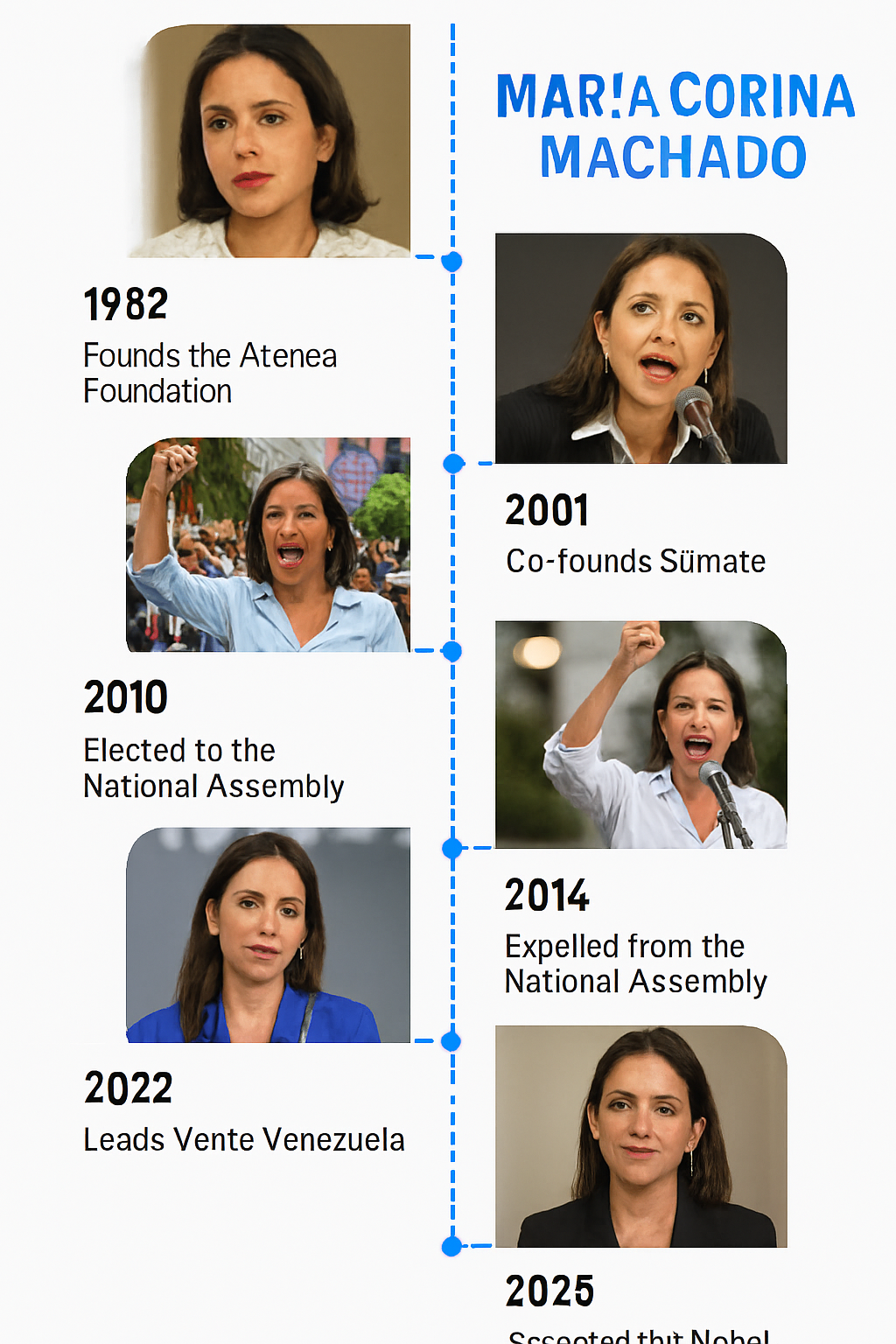
María Corina Machado
María Corina Machado has become one of the most influential voices in Venezuela’s fight for democracy, earning global recognition for her courage and persistence. From her early work helping street children in Caracas to co-founding the electoral watchdog Súmate, serving in the National Assembly, and ultimately leading her own party Vente Venezuela, Machado’s journey is filled with milestones that highlight her resilience against authoritarian regimes. Her international acclaim, capped by the Nobel Peace Prize in 2025, underscores her role as a symbol of peaceful resistance and democratic hope. In this blog post, we’ll explore 25 fascinating facts about her life, career, and legacy that reveal why she stands as a beacon of determination in Latin America’s political landscape.
1. Full name: María Corina Machado Parisca
Her full name, María Corina Machado Parisca, reflects her Venezuelan heritage and family lineage. Names in Latin America often carry both paternal and maternal surnames, which in her case are Machado and Parisca. This naming convention emphasizes family identity and continuity, and it situates her within a broader cultural tradition that values ancestry. Her name has become synonymous with opposition politics in Venezuela, making her one of the most recognizable figures in the country’s modern history.
2. Born: October 7, 1967, in Caracas, Venezuela
Machado was born in Caracas, the capital city of Venezuela, during a period of relative political stability before the rise of Hugo Chávez. Growing up in Caracas exposed her to both the privileges of urban life and the stark inequalities that would later shape her activism. Her birth year places her in a generation that witnessed Venezuela’s transition from a prosperous oil-driven economy to one plagued by political turmoil and economic collapse.
3. Education: Studied Industrial Engineering at Andrés Bello Catholic University
She pursued Industrial Engineering at Andrés Bello Catholic University (UCAB), one of Venezuela’s most prestigious private institutions. This technical background gave her a strong foundation in analytical thinking, problem-solving, and systems management. Her engineering training later influenced her political style, which is often described as methodical, data-driven, and focused on structural reforms rather than populist rhetoric.
4. Graduate studies: Earned a Master’s degree in Finance from IESA
After completing her undergraduate studies, Machado earned a Master’s degree in Finance from IESA, a leading Venezuelan business school. This advanced training equipped her with expertise in economics, financial systems, and organizational management. Her financial knowledge became crucial in her critiques of Venezuela’s economic mismanagement under Chávez and Maduro, allowing her to articulate policy alternatives grounded in fiscal responsibility.
5. Family: She has three children
Despite her demanding political career, Machado is also a mother of three. Balancing family life with activism has been a recurring theme in her public image, as she often highlights the importance of fighting for a better future for the next generation. Her role as a mother has also made her a relatable figure to many Venezuelans, especially women who see her as embodying both resilience and nurturing strength.
6. Early activism: Founded the Atenea Foundation in 1992
In 1992, Machado co-founded the Atenea Foundation, a nonprofit dedicated to supporting street children in Caracas. This initiative reflected her early commitment to social justice and her awareness of Venezuela’s growing inequality. The foundation provided education, shelter, and rehabilitation programs, showcasing her belief in grassroots solutions to systemic problems. This experience laid the groundwork for her later political activism.
7. Co-founder of Súmate (2001)
Machado co-founded Súmate, a civil organization focused on promoting electoral transparency and citizen participation. Súmate became a pivotal force in monitoring elections and organizing referendums, particularly the 2004 recall referendum against Hugo Chávez. Her involvement in Súmate marked her transition from social activism to direct political engagement, positioning her as a key figure in Venezuela’s democratic opposition.
8. Election monitoring: Súmate trained citizens and monitored elections
Through Súmate, Machado helped train thousands of Venezuelans to serve as election monitors, ensuring that voting processes were documented and irregularities reported. This grassroots mobilization empowered ordinary citizens to safeguard democracy. However, it also drew the ire of the Chávez government, which accused Súmate of conspiring with foreign powers, leading to legal harassment against Machado and her colleagues.
9. National Assembly member: Elected in 2010
In 2010, Machado was elected to Venezuela’s National Assembly, representing Miranda state. Her victory was significant because it demonstrated that opposition candidates could still win seats despite government manipulation of electoral systems. As a legislator, she became one of the most outspoken critics of Chávez, often clashing with ruling party members during heated debates.
10. Term in office: Served from January 2011 to March 2014
Machado’s tenure in the National Assembly lasted just over three years. During this period, she consistently challenged government policies, particularly those undermining democratic institutions and economic stability. Her speeches often went viral among opposition supporters, cementing her reputation as a fearless voice against authoritarianism.
11. Expulsion: Removed from the National Assembly in 2014
In March 2014, Machado was expelled from the National Assembly after attending an Organization of American States (OAS) meeting as Panama’s alternate representative. The government accused her of violating constitutional rules, but many saw this as a politically motivated move to silence her. Her expulsion symbolized the shrinking space for dissent in Venezuela’s legislature.
12. Party leadership: Founded and leads Vente Venezuela
After leaving the Assembly, Machado focused on building her own political party, Vente Venezuela. Founded in 2012, the party advocates for liberal democracy, free markets, and individual rights. Under her leadership, Vente Venezuela has become one of the most prominent opposition parties, attracting young activists and professionals disillusioned with traditional politics.
13. Opposition alliances: Affiliated with Justice First and Democratic Unity Roundtable
Before establishing her own party, Machado collaborated with Justice First and the Democratic Unity Roundtable (MUD), two major opposition coalitions. These alliances allowed her to coordinate strategies against the Chávez government, though she often criticized them for being too conciliatory. Her insistence on uncompromising resistance sometimes put her at odds with other opposition leaders.
14. Unitary Platform: Worked within broader opposition coalitions
Machado has also participated in the Unitary Platform, a coalition of opposition groups seeking to present a united front against Maduro. While she supports unity, she has frequently argued that the opposition must adopt a more confrontational stance rather than negotiating with the regime. Her role in these coalitions highlights the tension between pragmatism and principle in Venezuelan politics.
15. Known for: Strong criticism of Chávez and Maduro
Machado is best known for her relentless criticism of both Hugo Chávez and Nicolás Maduro. She has accused them of dismantling democratic institutions, fostering corruption, and plunging Venezuela into economic ruin. Her speeches often emphasize the moral dimension of politics, framing the struggle as one between dictatorship and freedom.
16. Václav Havel Human Rights Prize (2024)
In 2024, Machado received the Václav Havel Human Rights Prize from the Parliamentary Assembly of the Council of Europe. This award recognized her courage in defending democracy despite persecution. Named after the Czech dissident and president Václav Havel, the prize underscored her role as a global symbol of resistance against authoritarianism.
17. Sakharov Prize (2024)
That same year, she was awarded the Sakharov Prize for Freedom of Thought by the European Parliament. This prestigious award is given to individuals who fight for human rights and fundamental freedoms. Machado’s recognition placed her alongside other global icons of resistance, reinforcing her international credibility.
18. Nobel Peace Prize (2025)
In 2025, Machado achieved the pinnacle of recognition when she was awarded the Nobel Peace Prize. The Nobel Committee honored her for her decades-long struggle to promote democracy and peaceful transition in Venezuela. This award elevated her status from national opposition leader to global human rights figure.
19. Prize motivation: Peaceful transition from dictatorship to democracy
The Nobel Committee specifically cited her efforts to achieve a peaceful transition from dictatorship to democracy. Unlike armed resistance movements, Machado has consistently advocated nonviolent strategies, emphasizing dialogue, civil mobilization, and international solidarity. This approach aligned with the Nobel tradition of honoring peaceful activism.
20. Prize share: Awarded individually
Unlike many Nobel Peace Prizes that are shared among organizations or multiple individuals, Machado received the award individually. This distinction highlighted her personal leadership and sacrifices, making her one of the few Latin American women to win the prize alone.
21. Government bans: Frequently barred from running for office
One of the most consistent obstacles in María Corina Machado’s career has been the Venezuelan government’s repeated bans on her candidacy for public office. Authorities have often cited alleged administrative irregularities or procedural violations, but these accusations are widely seen as politically motivated attempts to neutralize her influence. By preventing her from running, the regime sought to weaken the opposition’s electoral prospects and silence one of its most vocal critics. Despite these bans, Machado has remained active in politics, using her platform to rally supporters and maintain visibility both domestically and internationally.
22. Harassment: Subjected to intimidation and threats
Machado’s activism has come at a personal cost, as she has endured harassment, intimidation, and threats from both state institutions and pro-government groups. She has been detained, interrogated, and vilified in state-controlled media, often portrayed as a traitor or foreign agent. These tactics are part of a broader strategy by the Venezuelan government to discourage dissent and instill fear among opposition leaders. Yet Machado has consistently refused to be silenced, framing these attacks as evidence of the regime’s insecurity and its fear of democratic resistance.
23. International advocacy: Speaks abroad to rally support
Recognizing the importance of global solidarity, Machado frequently travels abroad to speak at conferences, universities, and international organizations. Her speeches emphasize the urgency of Venezuela’s democratic crisis and call for stronger international pressure on Nicolás Maduro’s government. By engaging with foreign audiences, she has kept Venezuela’s plight on the international agenda, ensuring that the country’s struggles are not forgotten. Her advocacy has helped secure sanctions, humanitarian aid, and diplomatic support, making her a bridge between Venezuelan civil society and the global community.
24. Symbol of resistance: Prominent female voice in Latin America
As one of the most visible female leaders in Latin America, Machado has become a symbol of resistance against authoritarianism. Her prominence challenges traditional gender roles in Venezuelan politics, where women have historically been underrepresented in leadership positions. She embodies resilience, courage, and determination, inspiring women across the region to take on leadership roles in political and social movements. Her visibility also underscores the intersection of gender and democracy, showing how women’s voices can reshape political landscapes in times of crisis.
25. Future prospects: Nobel Prize amplified her voice
Winning the Nobel Peace Prize in 2025 amplified Machado’s voice globally, cementing her status as a leading figure in the struggle for democracy. The award brought renewed international attention to Venezuela’s crisis, strengthening calls for reform and accountability. However, the recognition also comes with challenges: while it boosts her legitimacy abroad, the domestic political environment remains hostile, with repression and institutional collapse hindering change. Machado’s future prospects depend on her ability to leverage global support while navigating the risks of operating within an authoritarian system. The Nobel Prize has given her unparalleled visibility but translating that recognition into tangible political transformation will require sustained effort and resilience.
❓ Frequently Asked Questions About María Corina Machado
1. Who is María Corina Machado?
María Corina Machado is a Venezuelan politician, activist, and opposition leader. She is the founder and leader of Vente Venezuela, a liberal democratic party, and has been one of the strongest critics of Hugo Chávez and Nicolás Maduro. She won the 2025 Nobel Peace Prize for her decades-long struggle to promote democracy and peaceful transition in Venezuela.
2. Why did she win the Nobel Peace Prize?
She was awarded the Nobel Peace Prize in 2025 for her tireless work defending democratic rights and advocating for a peaceful transition from dictatorship to democracy in Venezuela. The Nobel Committee highlighted her commitment to nonviolent resistance and her leadership in mobilizing civil society against authoritarianism.
3. What is her political background?
Machado studied Industrial Engineering at Andrés Bello Catholic University and earned a Master’s in Finance from IESA. In 2001, she co-founded Súmate, an NGO promoting free and fair elections. She was elected to Venezuela’s National Assembly in 2010, serving until 2014, when she was controversially expelled after attending an OAS meeting. Since 2012, she has led Vente Venezuela.
4. What awards has she received besides the Nobel Prize?
Machado has received several international honors:
- Václav Havel Human Rights Prize (2024)
- Sakharov Prize for Freedom of Thought (2024) These awards recognized her courage in defending democracy and human rights despite persecution.
5. Has she faced persecution in Venezuela?
Yes. Machado has been harassed, banned from running for office, and expelled from parliament. She has faced intimidation, smear campaigns, and threats from the government. Despite this, she continues to mobilize supporters and advocate internationally for Venezuela’s democratic transition.
6. What role does she play internationally?
Machado frequently speaks abroad at conferences and international organizations, urging global solidarity with Venezuelans. She has helped keep Venezuela’s crisis on the international agenda, securing sanctions and diplomatic support against Maduro’s regime.
7. What controversies surround her?
One notable controversy occurred in January 2026, when Machado met Donald Trump in the Oval Office and presented him with her Nobel Peace Prize medal. She described it as a gesture of recognition for his role in Venezuela’s “fight for freedom.” The act sparked debate about whether Nobel medals should be shared or symbolically transferred.
8. What is her future outlook?
Her Nobel Prize amplified her global voice, but Venezuela’s political environment remains hostile. While she has strong international legitimacy, domestic repression continues to hinder change. Her future depends on leveraging global support while navigating risks at home.