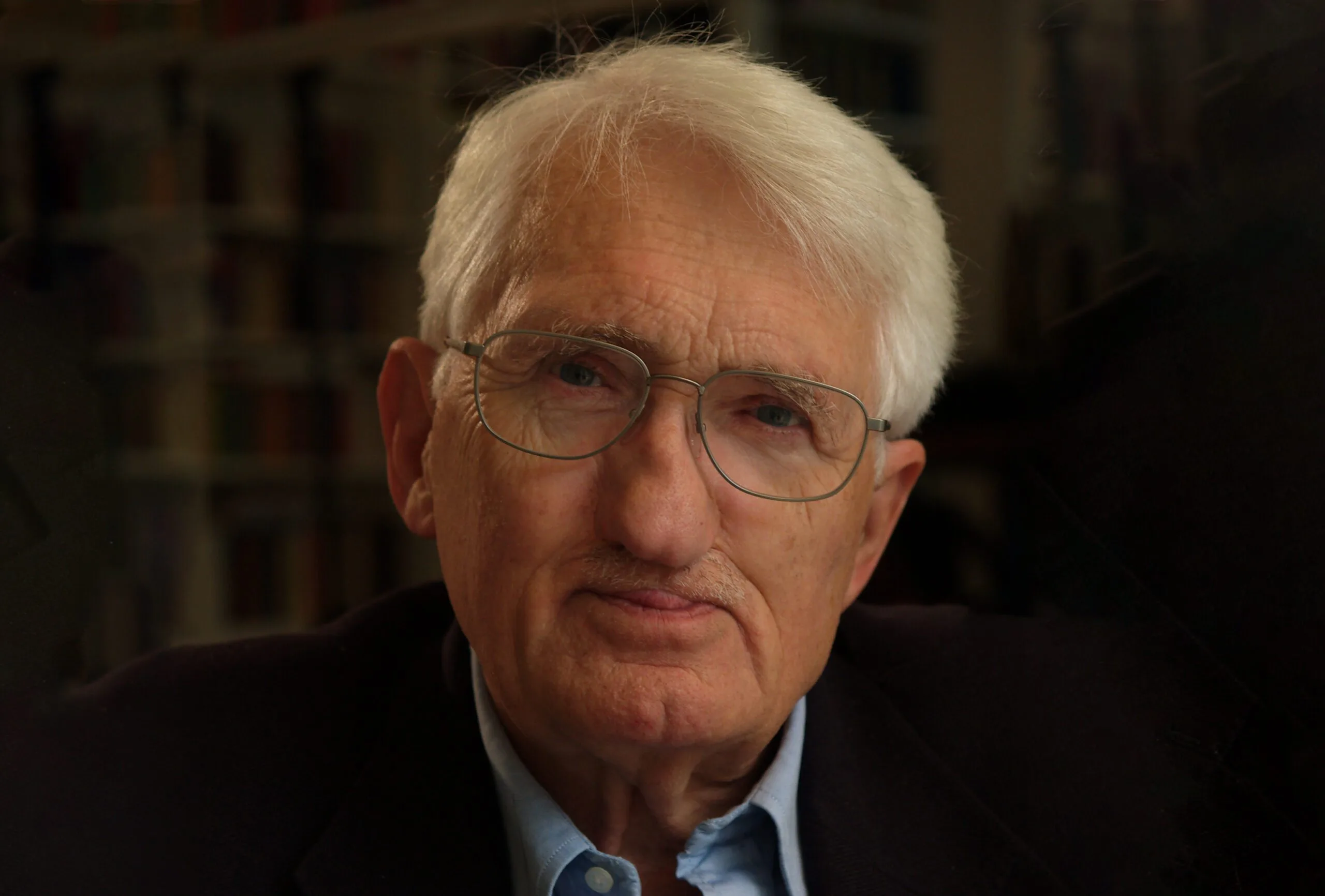
Jürgen Habermas
Jürgen Habermas was not only one of the most influential philosophers of the 20th and 21st centuries but also a public intellectual whose ideas shaped debates on democracy, communication, and modern society across the globe. From his early life in Düsseldorf during the turbulent Weimar years to his groundbreaking theories of communicative action and the public sphere, Habermas’s journey reflects both the struggles and aspirations of postwar Europe. His work bridged philosophy, sociology, and political theory, offering a vision of rational dialogue as the cornerstone of democratic life. In this post, we’ll explore 25 fascinating facts about Habermas—covering his biography, key concepts, major works, and lasting legacy—that reveal why he remains a towering figure in contemporary thought.
1. Full Name: Jürgen Habermas
The name Jürgen Habermas has become emblematic of modern philosophy and social theory. Unlike many thinkers whose work remains confined to academia, Habermas’s name is widely recognized in political debates, public discourse, and even journalism. His identity as a German philosopher is inseparable from the intellectual traditions of postwar Europe, where rebuilding democratic institutions and rational discourse was paramount. Habermas’s name is now shorthand for deliberative democracy, communicative rationality, and the defense of liberal democratic values against authoritarianism and populism.
2. Born: 18 June 1929, Düsseldorf
Habermas was born in Düsseldorf during the fragile years of the Weimar Republic, a period marked by political instability, economic crisis, and the looming threat of fascism. His childhood coincided with the rise of the Nazi regime, and this experience profoundly shaped his intellectual trajectory. Witnessing the collapse of democracy and the horrors of authoritarianism instilled in him a lifelong commitment to defending rational dialogue and democratic institutions. His birth date situates him in a generation that had to grapple directly with the aftermath of World War II and the moral responsibility of rebuilding German society.
3. Died: 14 March 2026, Starnberg
Habermas’s death at the age of 96 in Starnberg marked the end of an era for critical theory. He lived long enough to see his ideas debated across continents, influencing philosophy, sociology, law, and political science. His passing was widely mourned as the loss of one of the last towering figures of the Frankfurt School tradition. Yet his intellectual legacy remains vibrant, as his theories of communicative action and deliberative democracy continue to shape discussions about governance, globalization, and the challenges of digital communication.
4. Spouse: Ute Wesselhoeft
Habermas married Ute Wesselhoeft in 1955, and their marriage lasted for seven decades until her death in 2025. This enduring partnership provided him with personal stability and support throughout his demanding academic career. While Habermas was often in the public eye, his marriage reflected a quieter, private dimension of his life. The longevity of their relationship underscores the balance between his intense intellectual pursuits and his commitment to family life.
5. Children: 3, including Rebekka Habermas
Habermas and Ute raised three children, one of whom, Rebekka Habermas, became a historian of considerable renown. Rebekka’s career illustrates the intellectual environment of the Habermas household, where scholarly inquiry and critical thought were part of everyday life. The continuation of academic pursuits in his family highlights how Habermas’s influence extended beyond philosophy into shaping a culture of intellectual engagement at home.
6. Education: Göttingen, Zurich, Bonn, Marburg
Habermas’s education spanned several prestigious German universities, where he studied philosophy, psychology, and economics. This interdisciplinary background gave him a unique ability to synthesize insights across fields. His time at Bonn culminated in his doctoral dissertation, while his habilitation at Marburg established him as a serious academic. The breadth of his education allowed him to integrate philosophy with sociology and political theory, making his work unusually comprehensive.
7. Doctoral Thesis: Das Absolute und die Geschichte (1954)
His dissertation, The Absolute and History, focused on Schelling’s philosophy of history. This early work reveals Habermas’s engagement with German Idealism, particularly the tension between metaphysical absolutes and historical development. While he later moved toward critical social theory, this thesis laid the foundation for his lifelong interest in how rationality and history intersect.
8. Doctoral Advisor: Erich Rothacker
Erich Rothacker, a cultural philosopher, supervised Habermas’s doctoral work. Rothacker’s influence introduced Habermas to cultural philosophy and hermeneutics, though Habermas would eventually diverge toward a more critical and rationalist approach. This mentorship provided him with a grounding in traditional German philosophy, which he later reworked through the lens of critical theory.
9. Other Advisors: Adorno and Horkheimer
Habermas’s association with Theodor Adorno and Max Horkheimer connected him to the Frankfurt School, a group of thinkers dedicated to critiquing modern capitalist society. While he respected their intellectual rigor, he found their outlook overly pessimistic. Habermas sought to develop a more constructive vision, emphasizing the potential of rational communication rather than focusing solely on domination and alienation.
10. Academic Positions: Heidelberg, Frankfurt, Max Planck Institute
Habermas’s academic career included teaching at Heidelberg and Frankfurt, two of Germany’s most prestigious universities. He also directed the Max Planck Institute in Starnberg, where he conducted interdisciplinary research. These positions gave him a platform to influence generations of scholars and establish himself as one of Europe’s leading intellectuals.
11. Philosophical Era: Contemporary Philosophy
Habermas belongs to the era of contemporary philosophy, bridging the gap between postwar existentialism, structuralism, and postmodernism. His work stands out for offering a systematic alternative to postmodern skepticism, insisting that rational communication remains possible and necessary in modern societies.
12. Philosophical School: Continental Philosophy, Frankfurt School, Neopragmatism
Habermas’s intellectual lineage connects him to continental traditions, but he also absorbed insights from American pragmatism. This hybrid approach gave his work both theoretical depth and practical relevance. By combining critical theory with pragmatism, he created a framework that could address both abstract philosophical questions and concrete political challenges.
13. Main Interests: Epistemology, Critical Social Theory, Political Theory
Habermas’s interests spanned philosophy of knowledge, social critique, and political structures. His ability to integrate these fields made him a rare thinker who could speak to both abstract philosophy and practical politics. This breadth allowed him to develop theories that remain relevant across disciplines.
14. Notable Works: Structural Transformation (1962), Theory of Communicative Action (1981)
These two works are cornerstones of his career. Structural Transformation analyzed the decline of rational public debate in modern societies, while Theory of Communicative Action offered a systematic theory of communication as the foundation of social order. Together, they established Habermas as a leading figure in philosophy and sociology.
15. Key Concepts: Communicative Action, Rationality, Discourse Ethics
Habermas’s key concepts reshaped modern philosophy. By emphasizing communication as the basis of rationality, he provided tools for understanding democracy, law, and morality in pluralistic societies. His discourse ethics offered a framework for resolving moral conflicts through rational dialogue.
16. Public Sphere Theory
Habermas’s theory of the public sphere examined how citizens historically engaged in rational-critical debate. He argued that commercialization and state control threatened this democratic space. His analysis remains relevant in the age of social media, where the quality of public discourse is a pressing concern.
17. Discourse Ethics
Habermas proposed that moral norms are valid only if they can be agreed upon in free, rational dialogue. This principle remains influential in law, politics, and ethics, offering a framework for pluralistic societies to resolve conflicts without coercion.
18. Constitutional Patriotism
Rejecting nationalism, Habermas advocated loyalty to democratic principles as the foundation of modern identity. This idea became central to debates about European integration and multiculturalism, offering a way to build solidarity across diverse societies.
19. System vs. Lifeworld
Habermas distinguished between the “system” (bureaucracy and markets) and the “lifeworld” (everyday communication). He warned that when systems dominate, they erode genuine human interaction and democratic discourse. This distinction remains a powerful tool for analyzing modern societies.
20. Influence: Kant, Marx, Weber, Pragmatism
Habermas synthesized Kant’s rationalism, Marx’s critique of capitalism, Weber’s sociology, and American pragmatism. This eclectic mix gave his theories both philosophical rigor and sociological relevance, making them applicable to a wide range of issues.
21. Doctoral Students: Zoran Đinđić, Rainer Forst, Hans-Hermann Hoppe, Cristina Lafont, Alex Karp
Habermas’s students went on to diverse careers, from politics to philosophy to tech entrepreneurship. This demonstrates the wide-ranging impact of his teaching and mentorship, as his influence extended beyond academia into public life and industry.
22. Awards: Leibniz Prize, Prince of Asturias, Kyoto Prize, Holberg Prize
Habermas received some of the world’s most prestigious academic awards, underscoring his global influence and recognition across disciplines. These honors reflect the breadth and depth of his contributions to philosophy and social theory.
23. Historikerstreit (1986)
In this public debate, Habermas criticized conservative historians for downplaying Nazi crimes. His intervention reinforced Germany’s commitment to critical remembrance of the Holocaust, shaping the country’s approach to historical responsibility.
24. Global Reach
Habermas’s theories influenced debates on democracy, law, globalization, and secular-religious dialogue worldwide. His ideas remain central in political science, philosophy, and sociology curricula, ensuring his continued relevance.
25. Legacy: Frankfurt School Figure
Habermas is widely regarded as the last towering figure of the Frankfurt School, a tradition of critical theory that began with thinkers like Max Horkheimer, Theodor Adorno, and Herbert Marcuse. Unlike his predecessors, who often emphasized domination, alienation, and the pessimistic aspects of modernity, Habermas offered a constructive and forward-looking vision. His theory of communicative action reframed rationality not as a tool of control but as a medium for mutual understanding and democratic deliberation. This shift allowed critical theory to remain relevant in the late 20th and early 21st centuries, bridging the gap between philosophy and practical politics. His legacy lies not only in his scholarly contributions but also in his role as a public intellectual who consistently defended democracy, human rights, and rational discourse against authoritarianism, populism, and the erosion of the public sphere. For many, Habermas represents the enduring possibility of philosophy to shape society in meaningful, progressive ways.
📌 Frequently Asked Questions about Jürgen Habermas
1. Who was Jürgen Habermas?
Jürgen Habermas (1929–2026) was a German philosopher and social theorist, widely considered one of the most influential thinkers of the late 20th and early 21st centuries. He was associated with the Frankfurt School of critical theory and became known for his theories of communicative rationality, discourse ethics, and the public sphere. His work bridged philosophy, sociology, political theory, and law, making him a central figure in debates about democracy and modern society.
2. What is Habermas best known for in philosophy?
Habermas is best known for his concept of communicative action, which argues that rationality is rooted in dialogue aimed at mutual understanding rather than strategic manipulation. He also developed the idea of the public sphere, a space where citizens engage in rational-critical debate, and discourse ethics, which holds that moral norms are valid only if they can be agreed upon in free, open discussion.
3. What does “communicative action” mean?
Communicative action refers to social interaction oriented toward reaching understanding. Unlike instrumental action (focused on achieving goals), communicative action emphasizes dialogue, consensus, and cooperation. Habermas believed this form of rationality is essential for democratic societies, as it fosters legitimacy and trust in institutions.
4. What is Habermas’s idea of the public sphere?
The public sphere is a concept Habermas introduced in his 1962 book The Structural Transformation of the Public Sphere. It describes a space where individuals come together to discuss matters of common concern, free from state or market pressures. Historically, he traced its origins to 18th-century salons and coffeehouses. He warned that commercialization and mass media could undermine this sphere, making it less conducive to rational debate.
5. How did Habermas view the importance of public discussion and debate?
Habermas believed that democracy depends on open, rational dialogue among citizens. Public discussion is not just a political right but a mechanism for generating legitimacy in democratic institutions. He argued that when communication is distorted—by propaganda, misinformation, or systemic pressures—democracy itself is weakened.
6. What is “discourse ethics”?
Discourse ethics is Habermas’s framework for moral reasoning. It holds that norms are valid only if they could be accepted by all participants in an “ideal speech situation” free from coercion. This approach emphasizes inclusivity, fairness, and rational dialogue, making it particularly relevant in pluralistic societies where diverse perspectives must coexist.
7. What is “constitutional patriotism”?
Habermas introduced the idea of constitutional patriotism as an alternative to nationalism. He argued that citizens should base their loyalty not on ethnic or cultural identity but on shared democratic principles enshrined in a constitution. This concept became influential in discussions about European integration and multicultural societies.
8. What were Habermas’s major works?
His most influential books include:
- The Structural Transformation of the Public Sphere (1962)
- Knowledge and Human Interests (1968)
- The Theory of Communicative Action (1981)
- Between Facts and Norms (1992) These works collectively shaped modern debates on democracy, law, and rationality.
9. How did Habermas influence politics and society?
Habermas was not only a philosopher but also a public intellectual. He intervened in major debates such as the Historikerstreit in the 1980s, where he criticized attempts to relativize Nazi crimes. He consistently defended democracy, human rights, and rational discourse, influencing both academic thought and public policy discussions.
10. What is Habermas’s legacy today?
Habermas’s legacy lies in his insistence that democracy requires rational communication and inclusive dialogue. His theories remain central in philosophy, sociology, law, and political science. In the digital age, his warnings about the decline of the public sphere resonate strongly, as societies grapple with misinformation, polarization, and the challenges of online discourse.