Forbidden City in Beijing China
The Forbidden City, nestled in the heart of Beijing, is more than just an ancient palace—it is a living testament to China’s imperial grandeur, architectural mastery, and cultural heritage. Built in the early 15th century under the Ming Dynasty, this sprawling complex of nearly a thousand buildings once served as the exclusive home of emperors and their courts for almost 500 years. Today, it stands as the largest preserved palace in the world, a UNESCO World Heritage Site, and one of the most visited museums globally. In this article, we’ll uncover 25 fascinating facts about the Forbidden City, each shedding light on its history, symbolism, and enduring legacy as a national treasure.
Fact number 1: Built between 1406–1420 under the Yongle Emperor
The Forbidden City’s construction began in 1406, commissioned by the Yongle Emperor of the Ming Dynasty, who sought to establish Beijing as the new imperial capital. Over 14 years, more than a million workers, including artisans, laborers, and craftsmen, were mobilized to create this monumental palace complex. The design followed strict geomantic principles of Feng Shui, aligning the palace with Beijing’s central axis to symbolize cosmic harmony. The completion in 1420 marked not only a triumph of engineering but also a statement of imperial authority, as the palace became the political and ceremonial heart of China for centuries. Its scale and precision reflected the emperor’s vision of a divine mandate, positioning the Forbidden City as the earthly counterpart to heaven’s order.
Fact number 2: Served as the imperial palace for 24 emperors
For nearly 500 years, the Forbidden City was home to 24 emperors—14 from the Ming Dynasty and 10 from the Qing Dynasty. Each emperor ruled from within its walls, conducting state affairs, receiving foreign envoys, and presiding over elaborate ceremonies. The palace was not merely a residence but a symbol of dynastic continuity, where succession rituals and enthronements reinforced the legitimacy of imperial rule. The emperors lived in seclusion, shielded from the outside world, with their lives governed by strict court protocols. This continuity of use across two dynasties underscores the Forbidden City’s enduring role as the epicenter of Chinese governance and culture.
Fact number 3: Covers 72 hectares (178 acres)
Spanning 72 hectares, the Forbidden City is the largest palace complex in the world. Its vast expanse includes ceremonial halls, residential quarters, gardens, and administrative offices, all enclosed within towering walls and a wide moat. The sheer size was intended to awe visitors and reinforce the emperor’s supreme authority. Within this sprawling area, the layout follows a hierarchical order, with the most important structures located along the central axis and secondary buildings arranged symmetrically. The immense scale allowed the palace to function as a self-contained city, housing thousands of officials, eunuchs, guards, and servants who supported the emperor’s daily life and governance.
Fact number 4: Contains nearly 980 surviving buildings
Although time and conflict have taken their toll, nearly 980 buildings of the Forbidden City remain intact today. These structures range from grand ceremonial halls to intimate residential quarters, each designed with meticulous attention to detail. The buildings showcase traditional Chinese wooden architecture, with elaborate rooflines, painted beams, and intricate carvings. Their survival through centuries of upheaval—including wars, rebellions, and foreign invasions—testifies to the resilience of Chinese craftsmanship and the importance placed on preserving imperial heritage. Together, these buildings form a living museum of architectural styles spanning the Ming and Qing dynasties.
Fact number 5: Houses 8,886 rooms
The Forbidden City is often said to contain 8,886 rooms, though traditional Chinese counting methods sometimes yield different figures. Regardless of the exact number, the sheer abundance of rooms highlights the complexity of palace life. These rooms served diverse functions, from housing the emperor and his family to accommodating officials, storing treasures, and hosting rituals. The multiplicity of spaces reflects the rigid hierarchy of the imperial court, where every room had a designated purpose and access was strictly controlled. The vast number of rooms also symbolizes abundance and prosperity, reinforcing the emperor’s role as the guardian of the realm’s wealth.
Fact number 6: Aligned on Beijing’s north-south axis
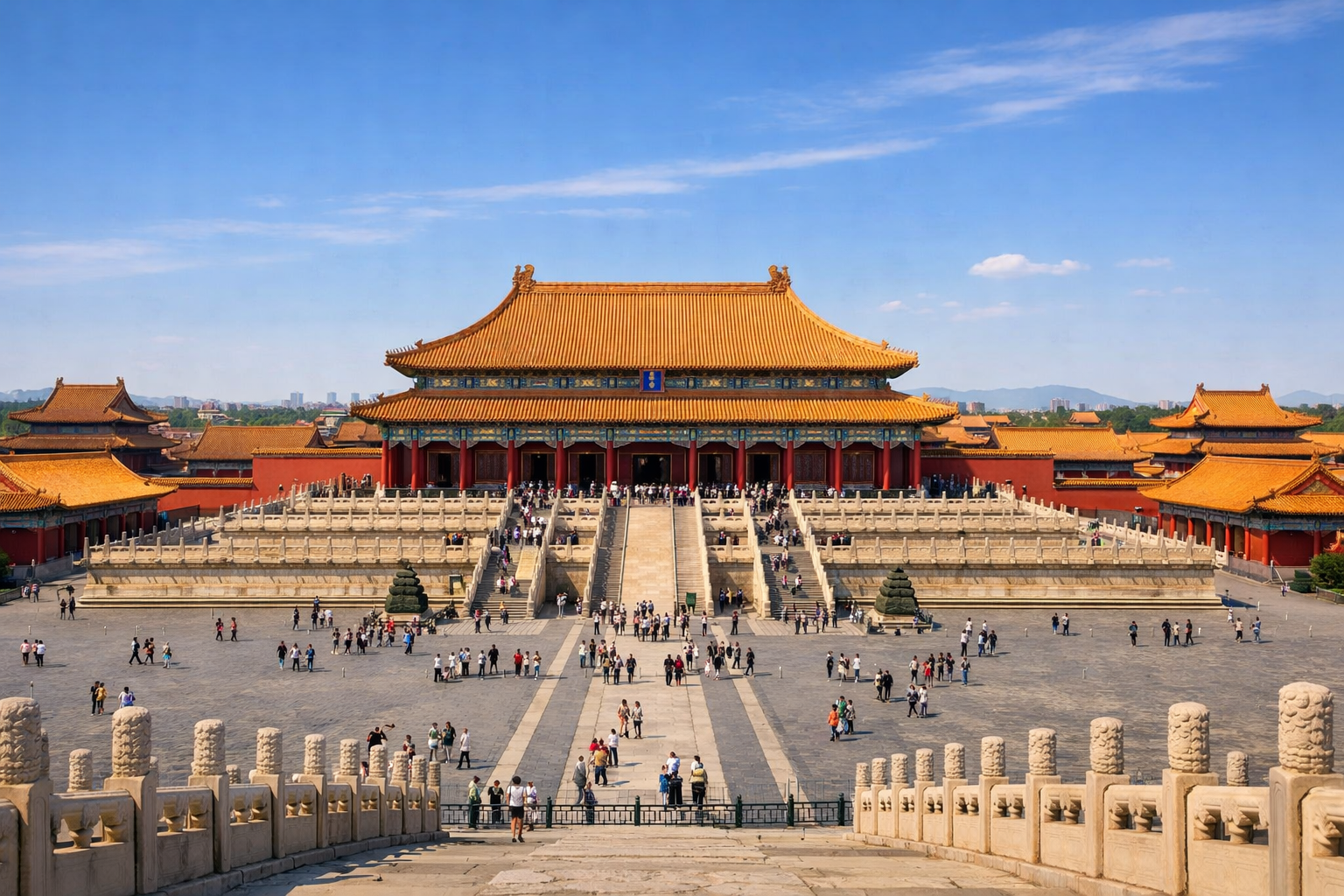
The Forbidden City’s layout is meticulously aligned along Beijing’s north-south axis, a design rooted in ancient Chinese cosmology. This alignment symbolized the emperor’s role as the mediator between heaven and earth, with the palace serving as the earthly center of the universe. The central axis runs through the most important structures, including the Meridian Gate, the Hall of Supreme Harmony, and the Imperial Throne, emphasizing the hierarchical order of space. This alignment also integrated the palace into the broader urban plan of Beijing, reinforcing its status as the capital’s focal point and the heart of imperial power.
Fact number 7: The Hall of Supreme Harmony is the largest wooden structure in China
The Hall of Supreme Harmony, located at the center of the Forbidden City, is the largest surviving wooden structure in China. This grand hall was used for enthronements, imperial weddings, and major state ceremonies, making it the most important building in the complex. Its vast interior, supported by massive wooden columns, could accommodate thousands of officials during ceremonies. The hall’s design embodies the grandeur of imperial authority, with its elevated platform, dragon motifs, and golden throne symbolizing the emperor’s divine mandate. As the pinnacle of Chinese wooden architecture, it remains a marvel of engineering and artistry.
Fact number 8: The Meridian Gate was the main southern entrance
The Meridian Gate, the largest gate of the Forbidden City, served as the main southern entrance. Reserved primarily for the emperor, it was also the site of important announcements and ceremonies. Officials entered through side gates, reinforcing the strict hierarchy of access. The gate’s imposing structure, with five arches and towering pavilions, symbolized the emperor’s authority and the separation between the imperial realm and the outside world. Passing through the Meridian Gate was a privilege reserved for the highest-ranking individuals, underscoring the exclusivity of the palace.
Fact number 9: The Corner Towers have 72 ridges
At each corner of the Forbidden City’s walls stand intricate towers, each with 72 ridges on their roofs. These towers are architectural masterpieces, combining elegance with defensive function. Their complex design showcases the skill of Ming-era craftsmen, who created structures that were both aesthetically pleasing and structurally sound. The towers also served as watchpoints, reinforcing the palace’s security. Their distinctive silhouette has become one of the most recognizable features of the Forbidden City, symbolizing its blend of artistry and practicality.
Fact number 10: Yellow glazed roof tiles symbolize imperial authority
The roofs of the Forbidden City are covered with yellow glazed tiles, a color reserved exclusively for the emperor. In Chinese symbolism, yellow represented the center of the universe and imperial power. By covering the palace with yellow tiles, the architects reinforced the emperor’s status as the “Son of Heaven.” The shimmering roofs created a visual spectacle, especially under sunlight, emphasizing the grandeur of the palace. This use of color coding also reinforced the strict hierarchy of Chinese society, where colors conveyed rank and privilege.
Fact number 11: Green tiles were used for the crown prince’s residence
In the Forbidden City, color was more than decoration—it was a coded language of hierarchy and symbolism. While the emperor’s buildings were adorned with yellow glazed tiles to signify supreme authority, the crown prince’s residence was distinguished by green tiles. Green symbolized growth, renewal, and the promise of succession, reflecting the crown prince’s role as the future ruler. This subtle yet powerful distinction reinforced the rigid order of the imperial court, where even architectural details conveyed status. The use of green tiles also highlighted the importance of continuity, ensuring that the crown prince was visually marked as the heir to the throne within the palace’s grand design.
Fact number 12: Black tiles were used in the library to symbolize water and prevent fire
The library within the Forbidden City was roofed with black tiles, a deliberate choice rooted in symbolism and practicality. In Chinese cosmology, black represented water, which was believed to counteract fire. Since the library housed invaluable manuscripts and records, fire prevention was paramount. By using black tiles, the architects invoked protective symbolism while also creating a visual distinction from other palace buildings. This detail reflects the deep integration of philosophy, superstition, and functionality in Chinese architecture, where every design choice carried layered meaning. The black-tiled library stands as a testament to the empire’s reverence for knowledge and its determination to safeguard cultural treasures.
Fact number 13: Unauthorized entry was punishable by death
The Forbidden City was not merely a palace—it was a sacred realm reserved for the emperor and his court. Commoners were strictly forbidden from entering, and unauthorized access was punishable by death. This harsh rule underscored the emperor’s divine status as the “Son of Heaven” and reinforced the separation between ruler and ruled. The exclusivity of the palace created an aura of mystery, with its towering walls and guarded gates symbolizing the inaccessibility of imperial power. For centuries, the Forbidden City remained a hidden world, its secrets known only to those who lived and worked within its confines.
Fact number 14: Political and ceremonial center for nearly 500 years
From its completion in 1420 until the abdication of the last emperor in 1912, the Forbidden City served as the political and ceremonial heart of China. It was here that emperors issued edicts, received foreign envoys, and presided over elaborate rituals that reinforced their divine mandate. The palace was the stage for enthronements, weddings, and celebrations, as well as moments of crisis, such as invasions and rebellions. Its longevity as the center of governance reflects the stability and continuity of imperial rule, even as dynasties rose and fell. For half a millennium, the Forbidden City was the beating heart of Chinese civilization.
Fact number 15: The last emperor, Puyi, abdicated in 1912 but lived there until 1924
The Forbidden City’s imperial chapter ended with the abdication of Emperor Puyi in 1912, following the fall of the Qing Dynasty. Although stripped of political power, Puyi was allowed to remain in the Inner Court of the palace until 1924. His presence marked the twilight of imperial tradition, as the palace transitioned from a living seat of power to a relic of history. Puyi’s eventual expulsion symbolized the definitive end of dynastic rule in China, paving the way for the Forbidden City’s transformation into a public institution. His story adds a poignant human dimension to the palace’s grand narrative, bridging the gap between empire and modernity.
Fact number 16: Converted into the Palace Museum in 1925
In 1925, the Forbidden City was officially converted into the Palace Museum, opening its gates to the public for the first time. This transformation marked a profound shift in the palace’s role, from a private imperial residence to a national repository of culture and history. The museum houses vast collections of art, artifacts, and manuscripts, offering visitors a glimpse into the opulence and traditions of China’s dynasties. By preserving and showcasing these treasures, the Palace Museum ensures that the legacy of the Forbidden City continues to inspire future generations. Today, it stands as one of the most visited museums in the world.
Fact number 17: Declared a UNESCO World Heritage Site in 1987
The Forbidden City’s global significance was recognized in 1987 when it was declared a UNESCO World Heritage Site. UNESCO praised it as the largest collection of preserved ancient wooden structures in the world, highlighting its architectural and cultural importance. This designation not only affirmed the palace’s value to humanity but also strengthened efforts to preserve and restore its structures. As a World Heritage Site, the Forbidden City is protected under international agreements, ensuring that its legacy endures despite the pressures of modernization and mass tourism. The recognition underscores its role as a universal symbol of human creativity and heritage.
Fact number 18: Layout reflects Confucian hierarchy
The Forbidden City’s design embodies Confucian principles of hierarchy and order. The central axis reserved for the emperor and the symmetrical arrangement of buildings reflect the strict social structure of imperial China. Each space was assigned a specific function, with access determined by rank and status. This architectural hierarchy reinforced the political hierarchy, ensuring that the palace itself became a physical manifestation of Confucian ideals. By embedding philosophy into architecture, the Forbidden City served as both a residence and a moral statement, reminding all who entered of their place within the cosmic and social order.
Fact number 19: The Imperial Garden is compact but filled with pavilions and ancient trees
At the northern end of the Forbidden City lies the Imperial Garden, a serene retreat for the emperor and his family. Though compact compared to the vast palace grounds, the garden is richly landscaped with pavilions, rockeries, and ancient cypress trees. It provided a space for relaxation, reflection, and private family gatherings, offering respite from the formality of court life. The garden’s design reflects traditional Chinese aesthetics, blending natural elements with architectural features to create harmony. Its enduring beauty highlights the importance of balance between nature and structure in Chinese culture.
Fact number 20: Design aligns with the North Star
The Forbidden City’s layout was deliberately aligned with the North Star, symbolizing the emperor’s role as the cosmic center of the universe. In Chinese cosmology, the North Star represented stability and permanence, qualities associated with imperial authority. By situating the palace along this celestial axis, the architects reinforced the emperor’s divine mandate as the “Son of Heaven.” This alignment connected the earthly palace with the heavens, creating a powerful symbolic link between human governance and cosmic order. The design thus elevated the emperor’s role from political leader to spiritual mediator.
Fact number 21: The Forbidden City was damaged during the Boxer Rebellion (1900)
In 1900, the Forbidden City suffered significant damage during the Boxer Rebellion, a violent anti-foreign and anti-Christian uprising that swept across China. As foreign troops entered Beijing, the palace—long a symbol of imperial authority—was caught in the chaos. Looting and destruction marred its halls, with priceless artifacts stolen or destroyed. The invasion of this sacred space underscored the vulnerability of the Qing Dynasty, which was already weakened by internal strife and external pressures. The damage inflicted during this period highlighted the decline of imperial power and the encroachment of foreign influence, leaving scars that would later necessitate extensive restoration efforts.
Fact number 22: Restoration projects began in the 20th century and continue today
Following the fall of the Qing Dynasty and the conversion of the Forbidden City into the Palace Museum, restoration projects became essential to preserve its grandeur. Beginning in the early 20th century, Chinese authorities and later UNESCO-backed initiatives undertook systematic efforts to repair damaged structures, repaint faded murals, and stabilize ancient wooden beams. These projects continue today, with modern technology aiding in the preservation of delicate artifacts and architectural details. Restoration is not merely about aesthetics—it is about safeguarding cultural heritage for future generations. The ongoing work reflects China’s commitment to honoring its past while adapting to the demands of modern tourism and conservation.
Fact number 23: The palace holds one of the world’s largest collections of Chinese art and artifacts
The Palace Museum within the Forbidden City houses one of the most extensive collections of Chinese art and artifacts in the world. Its treasures include imperial robes, jade carvings, porcelain, calligraphy, and paintings spanning centuries of dynastic rule. Many of these items were once used by emperors and their courts, offering a tangible connection to China’s imperial past. The collection also includes rare manuscripts and ceremonial objects, each piece telling a story of tradition, craftsmanship, and cultural evolution. As a repository of national heritage, the museum not only preserves these artifacts but also educates millions of visitors about the richness of Chinese civilization.
Fact number 24: In 2019, it welcomed over 19 million visitors
The Forbidden City is not only a historical monument but also one of the most visited cultural sites in the world. In 2019, it welcomed over 19 million visitors, a testament to its enduring appeal and significance. Tourists from across the globe flock to Beijing to walk through its grand halls, marvel at its intricate architecture, and immerse themselves in centuries of history. The sheer volume of visitors underscores the palace’s role as a living museum, bridging the gap between past and present. Managing such large crowds poses challenges, but it also highlights the universal fascination with China’s imperial legacy.
Fact number 25: It remains a national symbol of heritage
Today, the Forbidden City stands as a powerful national symbol of China’s heritage, appearing in literature, film, and popular culture. Its image is instantly recognizable, representing not only the grandeur of the Ming and Qing dynasties but also the resilience of Chinese civilization. As a cultural icon, it embodies the continuity of tradition, the artistry of ancient craftsmanship, and the authority of imperial rule. Beyond its historical significance, the Forbidden City serves as a reminder of China’s identity, inspiring pride among citizens and awe among international visitors. Its preservation ensures that future generations will continue to draw meaning and inspiration from this unparalleled architectural masterpiece.
❓ FAQs About the Forbidden City
1. What is the Forbidden City?
The Forbidden City is the world’s largest and best-preserved wooden palace complex, built between 1406–1420 under the Ming Dynasty’s Yongle Emperor. It served as the imperial palace for 24 emperors until 1911. Today, it is the Palace Museum, showcasing ancient architecture, treasures, and artworks.
2. Why is it called the “Forbidden City”?
The name comes from the fact that commoners were forbidden to enter without permission. Only the emperor, his family, and select officials could access it. Unauthorized entry was punishable by death. Now, it is open to the public as a museum.
3. Where is the Forbidden City located?
It sits at the center of Beijing, directly north of Tiananmen Square. The main entrance is the Meridian Gate (South Gate), which is the only entry point for visitors today.
4. How big is the Forbidden City?
The complex measures 961 meters north-south and 753 meters east-west, covering 72 hectares (178 acres). It contains 980 buildings and over 8,700 rooms, arranged in perfect symmetry along Beijing’s central axis.
5. Who built the Forbidden City?
It was commissioned by Emperor Yongle (Zhu Di) of the Ming Dynasty, who moved the capital from Nanjing to Beijing. Construction involved 100,000 artisans and a million laborers, using materials sourced from across China.
6. What can visitors see inside?
Visitors can explore ceremonial halls, towers, gardens, and pavilions, along with exhibitions of imperial treasures such as jade, porcelain, clocks, paintings, and calligraphy. Highlights include the Hall of Supreme Harmony, the Imperial Garden, and the Corner Towers.
7. When was the Forbidden City converted into a museum?
After the abdication of the last emperor, Puyi, in 1912, the palace was transformed into the Palace Museum in 1925. Since then, it has been open to the public and is now one of the most visited museums worldwide.
8. How many visitors does it receive annually?
Before the pandemic, the Forbidden City welcomed over 19 million visitors annually (2019 data), making it one of the busiest museums in the world.
9. What are the opening hours and ticket prices?
- Opening Hours: 8:30 AM–5:00 PM (April–October), 8:30 AM–4:30 PM (November–March), closed Mondays.
- Tickets: CNY 60 (peak season), CNY 40 (off-season).
10. Why is the Forbidden City important today?
It is a UNESCO World Heritage Site (since 1987), recognized as the largest collection of preserved ancient wooden structures in the world. It remains a symbol of Chinese heritage, blending history, architecture, and cultural identity.