Traffic Light
From the gas-lit semaphores of Victorian London that literally exploded to the AI-driven smart intersections of today, the humble traffic light has undergone a remarkable evolution that few of us stop to consider during our daily commute. While we instinctively obey the universal red-amber-green sequence, the history behind these roadside sentinels is filled with surprising twists, cultural quirks, and technological innovations—from Japan’s “blue” green lights and South Africa’s unique “robot” terminology to the dangerous “yellow trap” and Ferrari’s infamous pit-stop blunder. In this post, we’ll peel back the layers of this everyday infrastructure to reveal 25 fascinating facts that prove there is much more to those glowing lenses than just telling you when to stop and go.
The First Traffic Signal in London
The world’s first traffic signal was installed in December 1868 outside the Houses of Parliament in London, specifically on Parliament Square. This pioneering device was not electric but rather a gas-lit semaphore system designed by railway engineer John Peake Knight. Its primary purpose was to reduce the need for police constables to manually direct the heavy flow of horse-drawn carriages and pedestrians in one of the city’s busiest areas. The system featured semaphore arms that could be raised or lowered to signal “stop” or “go,” accompanied by gas lamps for visibility at night, marking the beginning of organized mechanical traffic control.
The Explosive Failure of 1869
The inaugural traffic signal in London had a dangerously short lifespan due to a catastrophic failure. On January 2, 1869, just weeks after its installation, the gas-powered mechanism exploded. The explosion was severe enough to injure the police constable who was operating the signals at the time. As a result of this accident and the inherent dangers of using gas lighting in such a volatile manner near public thoroughfares, the device was immediately dismantled. This incident halted the immediate adoption of similar gas-lit systems, pushing engineers to seek safer, non-combustible alternatives for future signaling devices.
John Peake Knight’s Railway Inspiration
John Peake Knight, a railway engineer, is credited with inventing the first traffic signal system. Drawing inspiration from the railway semaphore signals used to control train movements, Knight adapted the technology for road use. His design utilized vertical semaphore arms that were manually operated by a police officer. During the day, the position of the arms indicated whether traffic should stop or proceed, while at night, red and green gas lamps were used to convey the same instructions. Knight’s innovation laid the conceptual groundwork for modern traffic management, even though his specific gas-lit implementation proved unsafe.
Lester Wire’s Electric Innovation
The transition from manual semaphores to electric signals began in 1912 when Lester Wire, a police officer in Salt Lake City, Utah, developed the first electric traffic light. Wire’s invention was born out of necessity to manage increasing automobile traffic without requiring constant manual intervention by officers. His device used red and green lights powered by electricity, which was a significant safety improvement over the earlier gas-lit models. This invention marked a pivotal moment in traffic engineering, as it introduced the reliability and safety of electric illumination to road signaling, paving the way for the automated systems that would follow in subsequent decades.
William Potts and the Amber Light
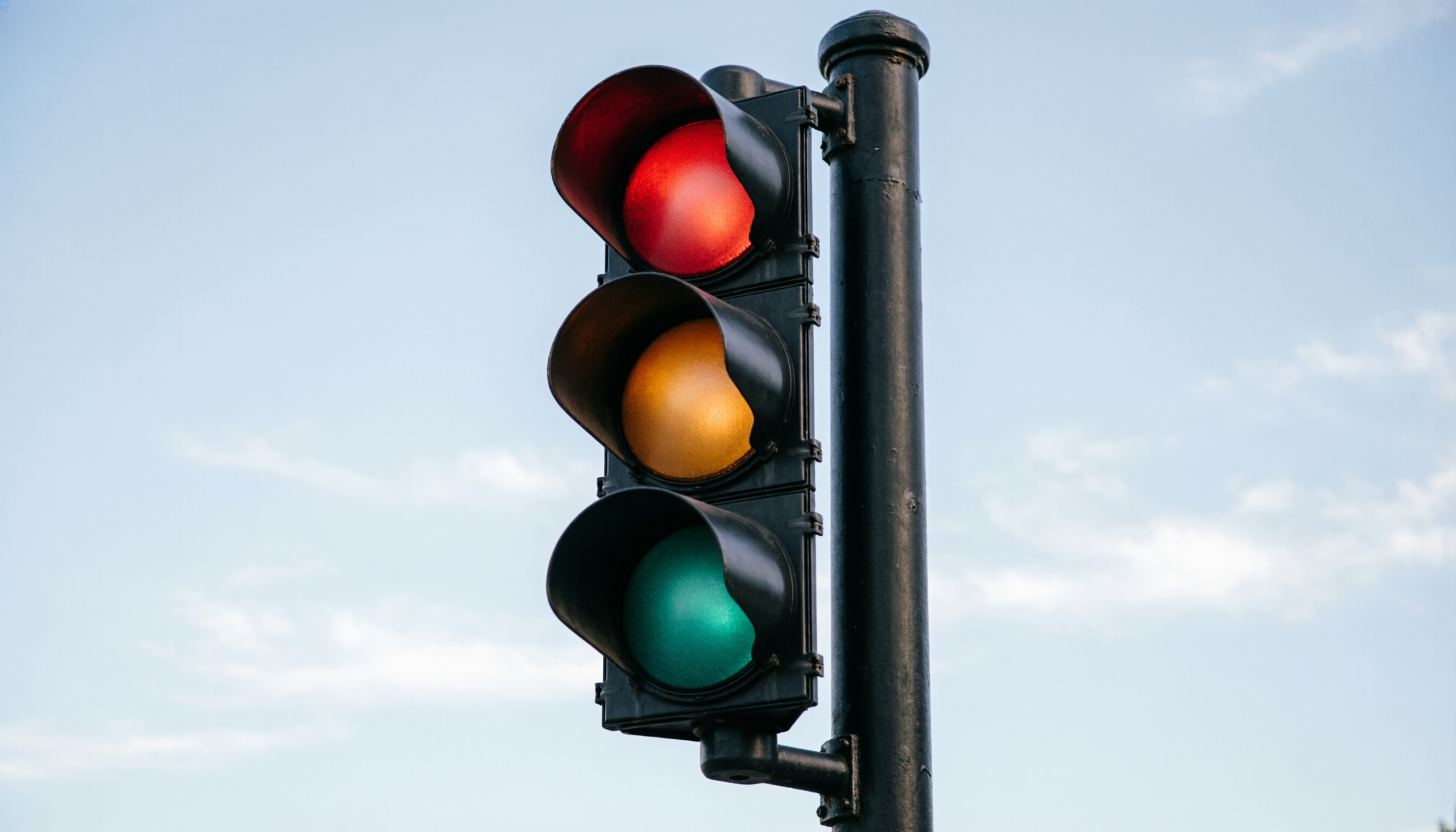
William Potts, a superintendent of signals for the Detroit Police Department, invented the first four-way, three-color traffic light in 1920. Prior to Potts’ invention, most signals only had two colors (red and green), which left drivers uncertain about when the light was about to change. Potts added the amber (yellow) “caution” light to provide a warning interval, allowing drivers to prepare to stop safely. He installed these automatic four-way, three-color lights in 15 towers across Detroit in 1921, setting the standard for the red-amber-green sequence that is now recognized internationally as the universal language of traffic control.
Massive Savings from Automation
The widespread adoption of automatic timer-controlled traffic lights in the early 1920s led to massive financial savings for major cities. In New York City, the shift from manual control by police officers to automatic timers allowed the city to reassign nearly all of its 6,000 traffic squad officers to other duties, retaining only 500 for essential tasks. This operational efficiency resulted in a staggering savings of $12,500,000 for the city. This economic benefit accelerated the global adoption of automated traffic signals, as municipalities realized they could improve traffic flow while significantly reducing labor costs associated with manual traffic direction.
Why South Africans Call Them “Robots”
In South Africa, Zambia, and Namibia, traffic lights are colloquially known as “robots.” This unique terminology traces its roots back to Karel Čapek’s 1920 play R.U.R. (Rossum’s Universal Robots), which introduced the word “robot” to the English language. When traffic lights were first installed in England in the late 1920s, the term “robot” became fashionable for a short period to describe these automated, human-like controllers of traffic. While this usage faded in the UK, it traveled to South Africa in the early 1930s when the country installed its first traffic lights. The term stuck in Southern Africa and remains in common use today, nearly a century later.
Japan’s Blue-Green Compromise
Japan presents a fascinating linguistic and visual anomaly in traffic lighting: the “go” signal is officially referred to as ao (blue) rather than green. Historically, the Japanese language did not distinguish between blue and green, using the same term for both. To align the physical color of the light with the traditional linguistic description without violating international standards that require a green “go” signal, Japanese officials issued a decree in 1973. They mandated that the green light be changed to the bluest possible shade of green. This compromise allows the light to technically remain green for international compliance while appearing blue enough to satisfy the cultural and linguistic expectation of ao.
Toronto’s Computerized Pioneer Status
Toronto, Canada, became a pioneer in intelligent traffic systems in 1967 by becoming the first city to use advanced computers for vehicle detection and signal control. Unlike earlier timer-based systems, Toronto’s computerized network could detect the presence of vehicles and adjust signal timing accordingly. The system maintained control over 159 signals through telephone lines, allowing for real-time adjustments based on actual traffic conditions rather than fixed schedules. This innovation marked the beginning of the modern era of adaptive traffic control, where technology actively responds to traffic flow to optimize efficiency and reduce congestion.
The Danger of the Yellow Trap
The “yellow trap” is a dangerous traffic scenario that occurs when a left-turning driver sees a yellow light and assumes oncoming traffic will also receive a yellow or red light, leading them to initiate a turn. However, if the oncoming traffic has an extended green phase or a different signal cycle, a collision can occur. Recognizing this hazard, the United States bans signal sequences that may cause a yellow trap. To mitigate risks where such conditions might exist due to emergency preemption or specific intersection designs, signs reading “Oncoming traffic has extended green” must be posted to warn drivers not to assume the opposing traffic is stopping.
The Rise and Fall of Countdown Timers
Countdown timers, which display the remaining seconds for a signal phase, are widely used in countries like Vietnam and China to help drivers and pedestrians anticipate changes. However, trends in traffic management are shifting. In Metro Manila, Philippines, the Metropolitan Manila Development Authority phased out countdown timers in 2025 in favor of a volume-based traffic signalling system. Under this new system, instead of a numeric countdown, green signals blink five times before turning yellow. This change aims to create a more responsive traffic flow that adapts to real-time vehicle density rather than relying on fixed temporal cues.
South Korea’s Strict Amber Law
In South Korea, the legal interpretation of the amber (yellow) light is exceptionally strict compared to many other countries. The “dilemma zone”—where a driver cannot safely stop before the intersection when the light turns amber—is not legally recognized. In May 2024, the Supreme Court of Korea reaffirmed that drivers must stop when the amber light appears, even if it means stopping abruptly within the intersection. This ruling applied to a case where a driver was speeding, but critics argue the policy is unrealistic and contributes to rear-end collisions due to sudden braking, sparking ongoing debate about traffic safety laws.
The Barnes Dance Pedestrian Scramble
The “Barnes Dance,” also known as a pedestrian scramble, is an intersection design where all vehicular traffic is stopped simultaneously, allowing pedestrians to cross in any direction, including diagonally. The system is named after Henry A. Barnes, an American traffic engineer who strongly advocated for its adoption. Barnes did not claim to invent the concept but was inspired by the difficulties his daughter faced when crossing busy streets to get to school. By giving pedestrians exclusive right-of-way, the Barnes Dance eliminates conflicts between turning vehicles and walkers, significantly enhancing pedestrian safety in high-traffic urban areas.
Unique Figures in Wellington
Wellington, New Zealand, has added a cultural and historical twist to its pedestrian signals. At several intersections near Parliament Buildings, the standard walking figure has been replaced by silhouettes of Kate Sheppard, a leading figure in the women’s suffrage movement. Additionally, along Cuba Street, some signals feature the silhouette of Carmen Rupe, a renowned drag performer and LGBT rights activist. These unique figures serve not only as functional traffic signals but also as tributes to important local figures who have shaped New Zealand’s social and political landscape, blending utility with public art and recognition.
Germany’s Ampelmännchen Nostalgia
In Germany, particularly in the former East Germany, the pedestrian traffic light figures known as Ampelmännchen (little traffic light men) have become iconic symbols of nostalgia. Designed by psychologist Karl Peglau in 1961, the distinctive hat-wearing figure was a staple of the German Democratic Republic (GDR). After reunification, there were plans to replace them with the standard Western German figures, but public affection for the Ampelmännchen led to their preservation in many areas. Today, they are celebrated as a piece of Cold War-era design heritage and are even featured on souvenirs, representing a cherished aspect of East German identity.
LED Strips for Smartphone Zombies
To combat the growing danger of distracted pedestrians, often referred to as “smartphone zombies,” several cities including Sydney, Seoul, Augsburg, and Singapore have installed LED strips embedded in the sidewalk before crosswalks. These lights are synchronized with the overhead traffic signals and illuminate red or green to indicate when it is safe to cross. The goal is to alert pedestrians who are looking down at their phones without requiring them to lift their heads. This innovative infrastructure aims to reduce accidents caused by mobile phone distraction by bringing the signal information directly into the pedestrian’s line of sight.
Bird Songs for the Visually Impaired in Japan
In Japan, traffic lights utilize auditory signals to assist visually impaired pedestrians, but with a unique cultural twist. Instead of simple beeps, many crossings emit electronic sounds that mimic birdsong. The type of bird call indicates the direction of the green light; for example, a Piyo-piyo sound (mimicking a small bird) might indicate one direction, while a Ka-kakkō sound (mimicking a cuckoo) indicates another. This system helps blind pedestrians orient themselves and determine which way is safe to cross, providing a more intuitive and less stressful navigation experience than uniform mechanical tones.
Tactile Feedback in New Zealand
New Zealand employs advanced tactile technology to assist deaf and blind pedestrians at crosswalks. In addition to auditory signals, some push-button units feature a small pad housed in an indentation at the base of the box. When the traffic light changes to allow crossing, this pad moves downward. This physical movement provides a tactile cue that can be felt by hand, informing users with limited visual or auditory abilities that it is safe to cross. This inclusive design ensures that individuals with multiple sensory impairments can navigate intersections independently and safely.
Shaped Lights in Quebec
In the Canadian province of Quebec and the Maritime provinces, traffic lights often deviate from the standard circular lens design to assist drivers, particularly those with color blindness. In these regions, the lights are frequently arranged horizontally, and each color has a distinct shape: the red light is a square (often paired at either end of the fixture), the amber light is a diamond, and the green light is a circle. This geometric differentiation allows drivers to identify the signal state by shape rather than color alone, enhancing safety and accessibility for all road users.
Horizontal Lights for Hurricane Resistance
In many southern and southwestern states of the US, such as Florida and Texas, traffic signals are predominantly oriented horizontally rather than vertically. This design choice is primarily driven by weather considerations. Horizontal mounting reduces wind resistance, making the signals more stable and less likely to be damaged or torn down during high winds, storms, and hurricanes. By lowering the profile exposed to the wind, these regions protect critical infrastructure from severe weather events, ensuring that traffic control remains operational or can be quickly restored after storms.
Confusion Over Flashing Green Lights
In parts of Canada, specifically Ontario and Quebec, a flashing green light has a unique meaning: it indicates that drivers have permission to turn left in front of opposing traffic, which is held by a steady red light. This “advance green” can be confusing for visitors, particularly those from British Columbia, where a flashing green signal denotes a pedestrian-controlled crosswalk. Due to this regional inconsistency and the potential for driver confusion, Ontario has been phasing out flashing green lights in favor of dedicated arrow signals, aiming to standardize traffic communication and improve safety for both locals and tourists.
Ferrari’s Pit Stop Blunder
Scuderia Ferrari, the famous Formula One racing team, once used a traffic light system to coordinate pit stops. The lights signaled when tire changes and refueling were complete, with green indicating the car could leave. However, during the 2008 Singapore Grand Prix, the system failed dramatically. A mechanic accidentally pressed the green button while the fuel hose was still attached to Felipe Massa’s car. Massa drove off with the hose trailing, eventually stopping at the end of the pit lane and causing a chaotic scene that cost him valuable time and a penalty. This incident led Ferrari to abandon the automated light system in favor of traditional manual signals.
The Christmas Tree in Drag Racing
Drag racing utilizes a specialized vertical stack of lights known as the “Christmas Tree” to start races. This system includes blue staging lights at the top, followed by three amber lights, a green light, and a red light at the bottom. Drivers stage their cars under the blue lights, and once both are ready, the amber lights sequence down. When the green light illuminates, the race begins. If a driver leaves before the green light (a “red light foul”), the red light activates, disqualifying them. This precise visual system ensures fair starts and is central to the sport’s competitive integrity.
LED Snow Accumulation Issues
The shift from incandescent bulbs to energy-efficient LEDs in traffic signals has introduced an unexpected winter hazard. Incandescent bulbs generate significant heat, which helps melt snow and ice that accumulate on the lens. LEDs, being much cooler, do not produce enough heat to clear precipitation. As a result, snow and ice can build up on the lens, obscuring the light and making it invisible to drivers. This issue has led to accidents in colder climates, prompting some municipalities to install heating elements or fans in LED signal heads to prevent obstruction during winter months.
Traffic Light Emojis in Unicode
Recognizing the ubiquity of traffic lights in daily life and digital communication, Unicode has assigned specific emojis to them. U+1F6A5 (🚥) represents a horizontal traffic light, typically showing the lights side-by-side, while U+1F6A6 (🚦) represents a vertical traffic light, with the lights stacked one above the other. These emojis allow users to convey concepts related to stopping, going, waiting, or traffic rules in text messages and social media posts, adding a visual layer to digital conversations about travel, delays, or decision-making processes.
FAQs about Traffic Lights
The choice of colors is rooted in both physics and history.
Red: Red has the longest wavelength in the visible spectrum, meaning it scatters less than other colors and can be seen from greater distances, even in fog or rain. Historically, red has also been associated with danger and stopping for centuries (e.g., in railway signals).
Green: Green was chosen because it is distinct from red and easily distinguishable by the human eye. In early railway systems, white was used for “go,” but this caused accidents when white lenses fell out, making the light appear clear/white when it should have been dangerous. Green replaced white to avoid this confusion.
Yellow/Amber: Yellow was introduced as a caution signal because it is highly visible and distinct from both red and green. It provides a critical buffer zone, allowing drivers to prepare to stop safely rather than having to slam on their brakes when the light suddenly turns red.
In many jurisdictions, including most of the United States, Canada, and some European countries, you are allowed to turn right on red after coming to a complete stop, provided there is no sign prohibiting it (“No Turn on Red”) and it is safe to do so. You must yield to pedestrians and oncoming traffic.
Exceptions: Some cities or specific intersections ban this practice due to high pedestrian traffic or poor visibility.
International Variations: In countries that drive on the left (like the UK, Australia, and Japan), the equivalent is turning left on red, which is generally not permitted unless a specific arrow or sign allows it. In Germany, a green arrow sign (Grünpfeil) may permit a right turn on red after stopping, but this is not universal across Europe.
Most modern traffic lights do not operate on simple timers alone; they use vehicle detection systems. The two most common technologies are:
Induction Loops: These are wires buried in the pavement in a square or rectangular pattern. When a metal vehicle (like a car) stops over the loop, it changes the magnetic field’s inductance, signaling the computer that a vehicle is present. This is why motorcycles sometimes fail to trigger the light—they have less metal mass.
Video Detection/Cameras: Many newer systems use cameras and artificial intelligence to visually detect vehicles, bicycles, and pedestrians. These systems are more flexible and can be adjusted without digging up the road.
Microwave/Radar Sensors: These detect motion and presence using radio waves and are often used in colder climates where snow might cover induction loops.
If a traffic signal is dark due to a power outage or malfunction, it is legally treated as a four-way stop in most jurisdictions (including the US and Canada).
Procedure: Come to a complete stop. Yield to any vehicle that arrived before you. If two vehicles arrive at the same time, the vehicle on the right has the right-of-way. If vehicles are facing each other and arriving simultaneously, straight-through traffic generally has priority over turning traffic. Proceed with extreme caution.
Flashing signals are used to indicate a change in priority during low-traffic periods, typically late at night.
Flashing Yellow: This means “proceed with caution.” It is usually placed on the main road, indicating that drivers do not need to stop but should be alert for cross traffic.
Flashing Red: This is equivalent to a stop sign. It is usually placed on the side street. Drivers must come to a complete stop, look for traffic on the main road, and proceed only when safe. This system improves traffic flow on main roads while maintaining safety at intersections when full signal cycles are unnecessary.
Yes, but it can be difficult.
Motorcycles: Older induction loops require a significant amount of metal to disrupt the magnetic field. Some motorcycles may not have enough metal mass to trigger the sensor. Riders are often advised to stop over the cut lines in the pavement (where the loop is most sensitive) or position their bike perpendicular to the lane to maximize metal exposure. Newer video-based sensors are much better at detecting motorcycles.
Bicycles: Bicycles have very little metal and rarely trigger induction loops. Cyclists should look for bicycle-specific detectors (often marked with a bicycle symbol on the pavement) or use push-buttons if available. In many places, cyclists are legally permitted to treat a non-triggering light as a stop sign after waiting a reasonable amount of time, but local laws vary.
A “yellow trap” occurs when a driver is waiting to turn left (in right-hand traffic) and the light turns yellow. The driver assumes oncoming traffic also has a yellow light and will stop, so they initiate the turn. However, if the oncoming traffic has a green arrow or an extended green phase, they will not stop, leading to a potential T-bone collision.
Solution: Modern traffic engineering avoids this by using protected left-turn arrows or ensuring that opposing traffic phases end simultaneously. If you encounter a situation where you suspect a yellow trap, wait for a dedicated green arrow or a clear gap in traffic before turning.
Studies generally show that red light cameras reduce the number of right-angle (T-bone) collisions, which are often the most severe and deadly types of intersection crashes. However, some data suggests they may lead to an increase in rear-end collisions, as drivers slam on their brakes to avoid the ticket. Overall, they are considered an effective tool for enforcing traffic laws and improving intersection safety, though their implementation is sometimes controversial due to privacy concerns and revenue-generation accusations.
Vertical: This is the standard arrangement in most of the world. It is intuitive (red on top, green on bottom) and saves space.
Horizontal: In regions prone to high winds, hurricanes, or heavy snow (such as the southern US, Canada, and parts of Europe), horizontal lights are preferred. They offer less wind resistance and are less likely to swing or break during storms. Additionally, in areas with heavy snowfall, horizontal lights are less likely to have snow accumulate on the visors, obscuring the light.
The meaning of a flashing green light varies significantly by location:
Canada (Ontario/Quebec): It indicates an advanced left turn. Oncoming traffic has a red light, so you can turn left without yielding.
Canada (British Columbia): It indicates a pedestrian-controlled crosswalk. The light will remain green until a pedestrian presses the button, at which point it will turn yellow and then red.
Other Regions: In some places, a flashing green may simply indicate that the intersection is pedestrian-activated or that the signal is in a special mode. Always check local driving manuals, as misinterpreting this signal can lead to accidents.