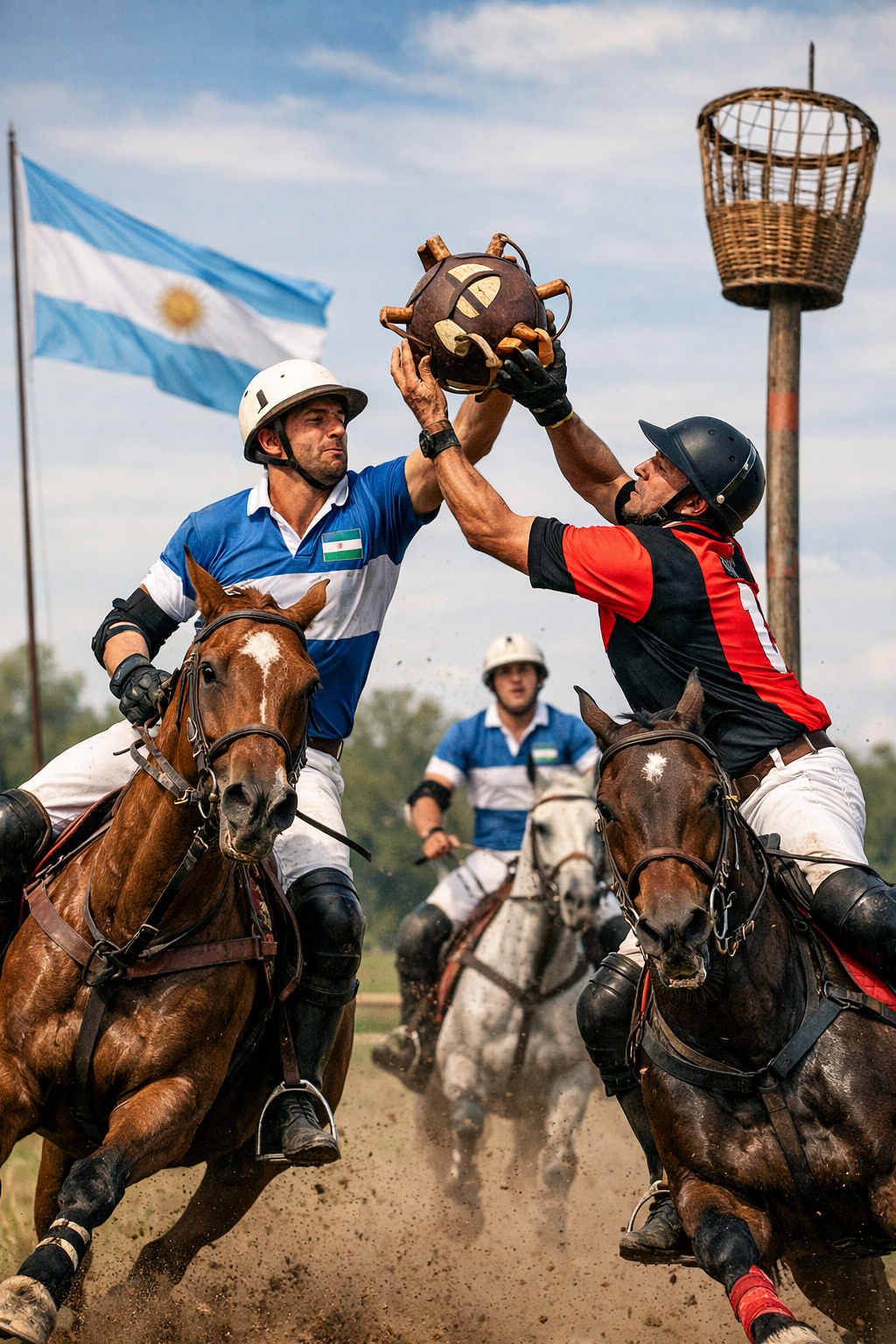
Pato
From the dusty pampas of 17th-century Argentina to its modern status as the country’s official—but surprisingly little-known—national sport, Pato is a story of wild origins, brutal violence, and remarkable evolution wrapped in leather handles and galloping hooves. Imagine a game that began with gauchos fighting over a live duck stuffed in a basket, was banned repeatedly for its deadly chaos, and was eventually transformed into a graceful yet intense hybrid of polo and basketball played by four riders per team on a field the size of two soccer pitches. Whether you’re a history enthusiast, an equestrian aficionado, or simply curious about the world’s most unusual team sports, these 25 captivating facts will transport you through centuries of cultural tradition, regulatory drama, and athletic innovation: discover why the ball has six handles, what the “negada” rule reveals about fair play, how a priest once denied Christian burial to fallen players, and why 90% of Argentines have never actually seen their own national sport in action. So saddle up—because behind every cinchada, vertical ring, and weekend fair lies a tale of resilience, identity, and the enduring spirit of the gaucho that just might make you see sports history in a whole new light.
Fact Number 1: The Name Means “Duck”
“Pato” is the Spanish word for “duck,” and the sport’s full traditional name is “juego del pato,” which literally translates to “duck game.” This unusual and somewhat whimsical name is a direct reference to the sport’s extraordinarily bizarre and controversial origins. In the earliest versions of the game, played by gauchos on the Argentine pampas during the colonial era, participants did not use a ball at all. Instead, they placed a live duck inside a woven basket or leather pouch, and this duck-filled container served as the object of competition. Players on horseback would fiercely compete to capture the duck, carry it away from opponents, and deliver it to a designated location. The duck itself was sometimes used as part of the gameplay mechanics, with its movements and struggles adding an unpredictable element to the contest. This practice of using a live animal gave the sport its enduring name, though modern sensibilities rightly consider such treatment of animals to be unacceptable cruelty. Today, the name “pato” remains as a historical echo of the sport’s rough-and-tumble origins, even though the duck has long been replaced by a specially designed leather ball with handles.
Fact Number 2: First Documented in 1610
Written accounts of pato date back to 1610, making this sport over four centuries old and one of the oldest continuously documented equestrian games in the Americas. A particularly significant early document was drafted by the renowned military anthropologist and naturalist Félix de Azara, who described a vivid pato sport scene taking place in Buenos Aires. This description was recorded just thirty years after the city’s second foundation in 1580, providing invaluable historical insight into the social and recreational life of early colonial Argentina. Azara’s account details how gauchos—skilled horsemen of the South American plains—would gather for these spirited competitions, which served not only as entertainment but also as demonstrations of horsemanship, bravery, and physical prowess. The fact that pato was being played and documented so early in Argentina’s colonial history underscores its deep roots in the cultural identity of the region. Over the centuries, the sport evolved significantly, but its core elements of horseback riding, team competition, and spirited physical contest have remained remarkably consistent, connecting modern players to their gaucho ancestors.
Fact Number 3: Originally Used a Live Duck
The earliest iterations of pato were remarkably unconventional by modern sporting standards: they utilized a live duck placed inside a basket or leather sack as the central object of play. This practice was not merely symbolic; the duck itself became an active, if unwilling, participant in the game. Players on horseback would compete aggressively to seize the duck-filled container, often engaging in intense physical struggles while riding at high speeds across open terrain. The duck’s natural movements, flapping, and vocalizations added an element of chaos and unpredictability to the contest, making each game unique. In some variations, the basket containing the duck was designed with specific features to make it easier to grip or harder to steal, adding strategic complexity to the gameplay. However, this practice inevitably resulted in significant harm or death to the duck, and the violent nature of the competition often led to serious injuries or fatalities among the human participants as well. As societal attitudes toward animal welfare evolved and organized sports governance emerged, the use of live animals was universally abandoned. The transition to a manufactured ball with handles represented not only a practical improvement but also a moral evolution, allowing the sport to continue while respecting contemporary ethical standards.
Fact Number 4: Argentina’s National Sport Since 1953
Pato achieved the distinguished status of Argentina’s official national sport on September 16, 1953, when President Juan Domingo Perón formally declared it so through Decree Nº 17468. This presidential decree was not merely ceremonial; it carried specific language emphasizing that pato was “truly Argentinean in origin” and had developed organically from an old game engaged in by gauchos—the iconic cowboys of the South American pampas. The designation was intended to celebrate and preserve a unique aspect of Argentine cultural heritage, distinguishing it from imported sports like football (soccer) that, while immensely popular, lacked indigenous roots. By elevating pato to national sport status, the Perón administration sought to reinforce national identity, promote traditional gaucho culture, and support the preservation of equestrian skills that had been central to Argentina’s rural history. The decree also had practical implications, potentially opening doors for government support, funding, and institutional recognition for pato organizations. Despite this official status, pato has never achieved widespread popularity among the general Argentine population, creating an interesting paradox where the nation’s most officially honored sport remains relatively obscure compared to football, which dominates the country’s sporting culture and international reputation.
Fact Number 5: Banned Multiple Times for Violence
Throughout its long history, pato was banned on numerous occasions due to the extreme and often lethal violence that characterized early versions of the game. The brutality was not limited to the duck, which frequently suffered injury or death during play; human participants also faced significant dangers. Gauchos competing in pato matches would engage in fierce physical struggles while riding at high speeds, often resulting in riders being trampled underfoot by horses, thrown from their mounts, or injured in collisions with other players. Perhaps most alarmingly, the intense competitive spirit and heated emotions generated by the game frequently escalated into knife fights among participants, leading to serious injuries and even deaths. These violent outcomes drew condemnation from religious authorities, government officials, and community leaders who viewed the sport as a threat to public order and moral decency. Each ban reflected growing concerns about safety, animal welfare, and social harmony, though enforcement was often inconsistent given the sport’s deep cultural roots in rural communities. The repeated prohibitions underscore the tension between preserving traditional practices and adapting them to evolving standards of acceptable behavior—a tension that would eventually lead to the sport’s modernization rather than its complete elimination.
Fact Number 6: Denied Christian Burial
In 1796, a Catholic priest in Argentina took an exceptionally strong moral stance against the violence associated with pato, declaring that players who died during the game should be denied Christian burial. This was a profoundly serious condemnation in a deeply religious society, as denial of Christian burial carried significant spiritual and social consequences for the deceased and their families. The priest’s position reflected broader concerns within the Church about the sport’s brutality, its potential to incite sin through violence and anger, and its disregard for the sanctity of life—both human and animal. By linking participation in pato to spiritual consequences, religious authorities added moral weight to existing legal and social criticisms of the game. This ecclesiastical condemnation likely influenced public opinion and contributed to the periodic governmental bans on the sport. The incident also illustrates how pato existed at the intersection of cultural tradition, religious morality, and social order in colonial Argentina, with different institutions competing to shape acceptable forms of recreation and community life. The priest’s stance, while extreme, highlighted the genuine dangers and ethical concerns that early pato presented, ultimately helping to catalyze the reforms that would transform the sport into its modern, regulated form.
Fact Number 7: 19th Century Government Bans
Throughout the 1800s, government ordinances forbidding the practice of pato were common across Argentina, reflecting sustained official concern about the sport’s violent nature and social consequences. These bans were issued by various levels of authority—local municipalities, provincial governments, and national administrations—each responding to incidents of injury, death, or public disorder associated with pato matches. The ordinances typically cited specific harms: the risk to participants from falls, trampling, and weapon-related violence; the suffering inflicted on the ducks used in early versions of the game; and the disruption to community peace when competitions escalated into brawls. Enforcement of these bans was often challenging, however, given pato’s deep cultural significance among gauchos and rural communities who viewed the sport as an important expression of their identity and skills. In many cases, the game continued informally despite official prohibitions, demonstrating the tension between top-down regulatory efforts and grassroots cultural practices. The persistence of these bans throughout the 19th century indicates that concerns about pato’s violence were not fleeting moral panics but sustained, serious considerations that ultimately contributed to the pressure for reform. Rather than eliminating the sport entirely, these regulatory efforts helped create the conditions for its eventual modernization into a safer, more structured competition that could coexist with evolving social norms.
Fact Number 8: Modernized in the 1930s
The transformation of pato from a violent, informal gaucho pastime into a regulated modern sport occurred primarily during the 1930s, thanks largely to the efforts of ranch owner Alberto del Castillo Posse. Recognizing both the cultural value of pato and the urgent need to address its dangerous aspects, del Castillo Posse undertook the ambitious project of drafting a comprehensive set of rules inspired by the structure and safety standards of modern polo. His rulebook introduced critical innovations: replacing the live duck with a specially designed leather ball featuring handles for safe gripping; establishing defined playing fields with clear boundaries; implementing standardized team sizes and match durations; and creating officiating protocols to enforce fair play and player safety. These reforms were not merely cosmetic; they fundamentally restructured the sport to emphasize skill, strategy, and sportsmanship over brute force and chaos. The modernization effort also included organizing formal competitions, training referees, and promoting the sport through emerging media channels. By aligning pato with the organizational models of internationally recognized equestrian sports, del Castillo Posse helped legitimize the game in the eyes of authorities, sponsors, and potential participants. This pivotal decade laid the foundation for pato’s survival and evolution, allowing it to transition from a marginalized, controversial practice to an officially recognized national sport with institutional support and a sustainable future.
Fact Number 9: Combines Polo and Basketball
Modern pato is a fascinating hybrid sport that artfully combines elements from two very different athletic traditions: the equestrian elegance of polo and the dynamic scoring mechanics of basketball. Like polo, pato is played entirely on horseback, requiring riders to possess exceptional horsemanship, balance, and coordination while moving at speed across a large field. Players must control their mounts with one hand while using the other to grip, pass, or shoot the ball—a demanding physical challenge that rewards both riding skill and athletic agility. However, unlike polo, where players use mallets to strike a small ball toward a goal, pato features a much larger ball with six leather handles that players grasp directly, and scoring is accomplished by throwing the ball through a vertically positioned ring, similar to basketball’s hoop but oriented vertically rather than horizontally. This unique combination creates a distinctive gameplay experience: the strategic passing and team coordination of basketball merged with the speed, power, and spatial awareness of equestrian sport. The result is a fast-paced, visually spectacular competition that demands versatility from its athletes, who must excel at riding, throwing, defending, and tactical decision-making—all while maintaining control of a powerful animal partner. This hybrid nature makes pato unlike any other sport in the world, offering spectators a unique blend of traditions and skills.
Fact Number 10: Four Players Per Team
Modern pato features two competing teams, each consisting of exactly four members, with all players mounted on horses throughout the match. This team size was carefully chosen to balance several factors: it provides enough players for meaningful tactical complexity and strategic passing options, while remaining small enough to ensure that each individual’s contributions significantly impact the game’s outcome. Players on each team must be numbered from 1 to 4, a requirement that facilitates clear communication, official tracking, and statistical recording during matches. The four-player format also influences field positioning and movement patterns, with teams typically organizing into offensive and defensive roles that can shift dynamically as possession changes. Importantly, traditional pato regulations specify that the sport is strictly male-only, with no provision for mixed-sex competition—a reflection of its historical origins in gaucho culture and the physical demands traditionally associated with the sport. While this gender restriction has been questioned in contemporary discussions about inclusivity in sports, it remains part of the official rules as maintained by the sport’s governing bodies. The four-player team structure, combined with the requirement for skilled horsemanship, creates a high barrier to entry that contributes to pato’s niche status but also ensures that matches feature highly trained athletes performing at an impressive level of coordination and ability.
Fact Number 11: The Ball Has Six Handles
The pato ball is one of the most distinctive pieces of equipment in all of sports, featuring six conveniently-sized leather handles strategically attached around its circumference. This unique design serves multiple critical functions within the game’s mechanics. First and foremost, the handles provide secure grip points that allow players to maintain control of the ball while riding at high speeds, navigating uneven terrain, and engaging in physical contests with opponents. During the crucial “cinchada” or tug-of-war moments when two players compete for possession, the handles enable competitors to grasp the ball firmly and apply leverage without risking injury from slipping or losing control. The six-handle configuration also facilitates passing and shooting, as players can quickly adjust their grip to execute different types of throws or transfers to teammates. The ball itself is constructed from durable leather with an inflated rubber chamber inside, giving it substantial weight (between 1050 to 1250 grams) and a diameter of approximately 40 centimeters when measured handle-to-handle. This size and weight make the ball challenging to control but also ensure that it travels predictably when thrown and can be securely held during intense physical competition. The thoughtful engineering of the pato ball exemplifies how equipment design can shape a sport’s character, enabling the unique blend of equestrian skill and ball-handling technique that defines modern pato.
Fact Number 12: Vertical Scoring Rings
Unlike the horizontal rims familiar to basketball fans, pato utilizes vertically positioned rings for scoring, creating a distinctive challenge that requires specialized technique and precision. Each scoring ring has a diameter of 100 centimeters (approximately 3.3 feet) and is mounted atop poles that stand 240 centimeters (about 7.9 feet) high from the ground. This vertical orientation fundamentally changes the dynamics of scoring: players must throw the ball not in an arc toward a downward-facing hoop, but rather with enough accuracy and force to pass it through a ring that faces sideways, essentially requiring a straight-line trajectory at a specific height. The vertical ring design also influences defensive strategy, as opponents can more easily block shots by positioning themselves between the shooter and the ring, or by attempting to intercept the ball during its flight. Scoring requires not only accurate throwing but also careful timing and positioning, as players must approach the ring at the right angle and speed while maintaining control of their horse. The height of the ring—roughly at chest level for a standing person—means that riders must either shoot from a relatively level position or adjust their throwing technique to account for their elevated position on horseback. This unique scoring mechanism is one of the key features that distinguishes pato from other equestrian or ball sports, demanding a specialized skill set that players develop through extensive practice and experience.
Fact Number 13: Special Goal Netting
Attached to each vertical scoring ring in pato is a closed net that extends for 140 centimeters (approximately 4.6 feet) beyond the ring itself. This netting serves several important practical functions that enhance the flow and fairness of the game. First and foremost, it catches and contains the ball immediately after a successful goal is scored, preventing the ball from bouncing away across the large playing field and requiring time-consuming retrieval. This containment allows play to resume quickly after a score, maintaining the game’s pace and intensity. The net also provides clear visual confirmation of a successful goal for players, officials, and spectators, eliminating ambiguity about whether the ball truly passed through the ring. Additionally, the netting helps protect the structural integrity of the scoring apparatus by absorbing the impact of the ball, reducing wear and tear on the ring and pole over time. The design of the net—closed on all sides except the opening at the ring—ensures that the ball cannot escape once it has entered, while still allowing officials to easily retrieve it for the next play. This seemingly simple piece of equipment exemplifies how thoughtful design details can improve a sport’s functionality, spectator experience, and competitive integrity, contributing to pato’s evolution into a well-organized modern competition.
Fact Number 14: Six Periods of Play
A regulation pato match is structured into six distinct periods of play, each lasting exactly eight minutes, for a total of 48 minutes of regulation game time. This segmented format serves multiple strategic and practical purposes. By dividing the match into shorter periods, the game allows for natural breaks where teams can regroup, receive coaching instructions, make tactical adjustments, and give horses brief moments to recover from intense exertion. The eight-minute duration of each period is long enough to allow for sustained offensive and defensive sequences, yet short enough to maintain high energy levels and prevent excessive fatigue in both players and horses. Between periods, teams switch ends of the field, ensuring that environmental factors like wind direction or field conditions do not disproportionately advantage one side. The winner of a pato match is determined simply by which team has scored the most goals after all six periods have been completed; there is no complex point system or bonus scoring—just straightforward goal counting. If the score is tied at the end of regulation time, overtime procedures may apply depending on the specific competition rules, though traditional pato often accepts ties in friendly matches. This clear, time-based structure provides a predictable framework for players, officials, and spectators while allowing for the dynamic, fluid gameplay that characterizes the sport.
Fact Number 15: Massive Playing Field
The dimensions of a pato playing field are impressively large, reflecting the sport’s equestrian nature and the space required for horses to reach meaningful speeds while executing tactical maneuvers. The field’s length ranges from 180 to 220 meters (approximately 196.9 to 240.6 yards), while its width spans between 80 and 90 meters (about 87 to 98 yards). To put this in perspective, a pato field is roughly two to two-and-a-half times longer than a standard soccer pitch and significantly wider than many other team sport venues. This expansive playing area serves several important functions: it provides ample room for horses to accelerate, turn, and maneuver safely without crowding; it creates strategic depth that rewards teams capable of effective long-distance passing and coordinated movement; and it allows for the spectacular visual display of riders covering ground at speed that makes pato so compelling to watch. The large field also necessitates exceptional physical conditioning from both players and horses, as matches require sustained effort across considerable distances. Field surfaces are typically natural grass or dirt, maintained to provide good traction for horses while minimizing injury risk. The generous dimensions reflect pato’s origins in the open landscapes of the Argentine pampas, where space was abundant and the sport evolved to utilize the vast terrain available to gauchos. Even in modern, more constrained settings, maintaining these substantial field requirements helps preserve the authentic character and athletic demands of traditional pato.
Fact Number 16: Specialized Ball Specifications
The pato ball is a marvel of purposeful design, engineered specifically to meet the unique demands of a sport played on horseback at high speeds. Constructed from durable, high-quality leather, the ball features an inflated rubber chamber inside that provides the right balance of weight, bounce, and grip. Its most distinctive feature is the six leather handles strategically attached around its circumference, each sized to allow secure grasping by riders wearing gloves while maintaining control during intense physical competition. The ball’s diameter, measured from handle to handle across its widest point, is precisely 40 centimeters (about 15.7 inches), making it substantially larger than most team sport balls and easier to control while riding. Its weight ranges between 1050 and 1250 grams (approximately 2.3 to 2.8 pounds), providing enough mass to travel predictably when thrown while remaining manageable for players to grip, pass, and shoot with one hand. The leather exterior is treated for durability and weather resistance, ensuring consistent performance in various outdoor conditions. These careful specifications are not arbitrary; they result from decades of refinement aimed at optimizing the ball for pato’s specific requirements: secure handling during tugs, accurate throwing toward vertical rings, resilience against impacts with the ground or other equipment, and safety for both players and horses. The pato ball exemplifies how equipment design can fundamentally shape a sport’s character, enabling the unique blend of equestrian skill and ball-handling technique that defines modern pato competition.
Fact Number 17: The “Negada” Rule
One of pato’s most distinctive and strategically important rules is the “negada” (Spanish for “refusal” or “denial”), which governs how players must behave when they gain possession of the ball. According to this rule, any player who has control of the pato—meaning they are holding the ball by one of its leather handles—must ride with their right arm fully outstretched, actively offering the ball to opposing players so that rivals have a fair opportunity to tug at the handles and attempt to steal possession. This requirement serves multiple purposes: it prevents a player from simply clutching the ball tightly against their body and riding away uncontested, which would eliminate one of the sport’s most exciting elements; it encourages continuous competition for possession rather than allowing one team to dominate through defensive hoarding; and it creates the dramatic “cinchada” moments that are central to pato’s appeal. A player who fails to extend their arm while riding with the ball commits a “negada” offense, which results in a penalty that typically awards possession to the opposing team. This rule reflects pato’s philosophical emphasis on fair competition, skillful contest, and spectator entertainment over purely defensive or obstructive tactics. By mandating that possession must be actively contested rather than passively protected, the negada rule ensures that pato remains a dynamic, engaging sport where momentum can shift rapidly and every moment of play offers the potential for exciting action.
Fact Number 18: The “Cinchada” – The Exciting Tug
The “cinchada”—Spanish for “tightening” or “tug”—represents the most dramatic and physically demanding moment in pato, occurring when two opposing players simultaneously grasp the ball and engage in a test of strength, balance, and horsemanship to gain possession. During this intense contest, both riders must stand up in their stirrups, rising out of the saddle to maximize their leverage and stability, while keeping the hand not involved in the tug firmly on the reins to maintain control of their horse. This requirement to stand while tugging adds significant difficulty, as riders must coordinate their lower body balance with their upper body strength while their mounts continue moving at speed. The cinchada is typically the most thrilling part of a pato match for spectators, as it showcases the raw physicality, skill, and courage of the competitors. The outcome of a cinchada can dramatically shift momentum in a game, as gaining possession often leads to immediate scoring opportunities. Because the ball has six handles, multiple players can potentially engage in a cinchada simultaneously, creating complex multi-way struggles that test teamwork as well as individual ability. The rules governing cinchadas are carefully designed to ensure safety: players cannot use excessive force that might endanger horses or opponents, and officials monitor these contests closely to enforce fair play. The cinchada embodies pato’s unique fusion of equestrian tradition and competitive sport, creating moments of high drama that distinguish the game from other team athletics.
Fact Number 19: Originally Played Between Ranches
In the earliest, most rustic versions of pato, the concept of a defined “playing field” was remarkably fluid: matches would often stretch across the vast open distances between neighboring estancias (large Argentine ranches). Rather than competing within marked boundaries, teams would begin at one ranch and attempt to carry the duck-filled basket to their own casco (the main ranch house or headquarters), with the first team to successfully deliver the object to their destination declared the winner. This format transformed pato into essentially a long-distance, cross-country race combined with intense physical competition, as riders navigated natural terrain, obstacles, and sometimes even property boundaries while fiercely contesting possession of the duck. The expansive scale of these early matches reflected both the geography of the Argentine pampas—where distances between settlements could be considerable—and the gaucho culture’s emphasis on endurance, navigation skills, and mastery of the open landscape. Playing between ranches also added social and communal dimensions to the sport, as matches often coincided with festivals, celebrations, or inter-ranch gatherings that reinforced community bonds. While modern pato has adopted standardized field dimensions for practical and competitive reasons, the sport’s origins in these epic cross-ranch contests continue to influence its character, emphasizing stamina, strategic movement across space, and the integration of athletic competition with cultural tradition.
Fact Number 20: 90% of Argentines Have Never Seen It
Despite holding the prestigious title of Argentina’s official national sport, pato remains remarkably obscure among the country’s own population: it is estimated that approximately 90% of Argentines have never witnessed a pato match in person or even on television. This striking statistic highlights a fascinating paradox in Argentine sporting culture. While virtually the entire population are passionate fans and participants in football (soccer)—a sport imported from Europe that dominates media coverage, public discourse, and national identity—pato, the indigenous game celebrated in official decrees, struggles to attract widespread attention or participation. Several factors contribute to this disconnect: limited media coverage and broadcasting of pato competitions; the sport’s concentration in specific rural or traditional communities rather than major urban centers; the high barrier to entry requiring skilled horsemanship and specialized equipment; and competition from globally popular sports for spectators’ time and interest. The result is a national sport that functions more as a symbol of cultural heritage than as a widely practiced or followed athletic activity. This situation has prompted ongoing discussions about how to promote pato more effectively while respecting its traditional character, and whether official recognition should be accompanied by concrete efforts to increase accessibility and visibility for the general population.
Fact Number 21: Challenged by Football
The tension between pato’s official status and football’s overwhelming popularity came to a head in 2010, when a bill was introduced in the Argentine legislature proposing to elevate football to the status of national sport while demoting pato to the designation of merely a “traditional sport.” This legislative effort reflected the undeniable reality that football is far more widely played, watched, and celebrated throughout Argentina than pato ever has been. Football permeates Argentine culture at every level: from neighborhood pickup games to world-class professional leagues, from childhood fandom to national pride in international competitions. Proponents of the bill argued that official recognition should align with actual cultural practice and public engagement, rather than preserving a symbolic designation for a sport with limited contemporary relevance. However, defenders of pato’s status successfully resisted the change, emphasizing that official recognition serves important cultural preservation functions beyond mere popularity metrics. The debate highlighted broader questions about how nations balance celebrating historical traditions with acknowledging contemporary realities, and whether “national sport” designations should reflect cultural heritage, popular participation, or competitive achievement. While pato retained its official status, the 2010 controversy underscored the ongoing challenge of maintaining relevance for traditional sports in an era dominated by globalized, commercially driven athletic entertainment.
Fact Number 22: Defended as Indigenous
One of the strongest arguments for maintaining pato’s status as Argentina’s national sport, despite its limited popularity, is its claim to complete indigenous origin. Defenders of pato’s official designation emphasize that, unlike football, tennis, basketball, or most other sports widely practiced in Argentina, pato developed organically within the country’s own cultural and geographical context. The sport emerged from the traditions, skills, and social practices of gauchos—the iconic horsemen of the Argentine pampas—and evolved through centuries of local adaptation rather than being imported from foreign cultures. This authenticity, proponents argue, gives pato unique value as a living connection to Argentina’s historical identity and rural heritage. In an era of globalization where cultural distinctiveness can feel threatened, preserving and celebrating indigenous traditions like pato serves important functions: it honors ancestral knowledge, maintains diverse expressions of human creativity, and provides alternatives to homogenized global culture. Supporters also note that official recognition can help protect pato from marginalization or extinction, providing institutional support for teaching, competition, and cultural transmission. While acknowledging that popularity matters for a sport’s vitality, defenders argue that national policy should balance mass appeal with cultural preservation, ensuring that uniquely Argentine traditions receive the recognition and resources needed to survive for future generations.
Fact Number 23: Similar to Horseball
Pato shares notable similarities with another equestrian team sport called horseball, which is played primarily in France, Portugal, Spain, and several other European and South American countries. Both sports feature teams of riders on horseback competing to gain possession of a ball and score by throwing it through an elevated ring or net. The games emphasize similar skills: exceptional horsemanship, precise ball-handling while riding at speed, strategic passing and positioning, and physical contest for possession. However, important differences distinguish the two sports. Horseball typically uses a ball with handles similar to pato’s, but the scoring mechanism, field dimensions, team sizes, and specific rules vary between the competitions. Horseball has achieved greater international organization and competition, with regular world championships and broader participation across multiple continents, while pato remains more concentrated in Argentina with limited international expansion. The Argentine Federation of Pato and Horseball governs both sports within the country, recognizing their complementary nature and shared equestrian heritage. Some observers suggest that closer collaboration between pato and horseball communities could benefit both sports through shared training methods, cross-promotion, and potential rule harmonization that might facilitate international competition. The relationship between these two similar but distinct sports illustrates how cultural variations can produce parallel athletic traditions that enrich the global landscape of equestrian competition.
Fact Number 24: Played at Weekend Fairs
Pato maintains a vibrant presence in Argentine cultural life primarily through its association with weekend fairs, festivals, and traditional gaucho gatherings, where it is often featured alongside other rural traditions like doma (Argentine rodeo), folk music, dance, and regional cuisine. These events provide important venues for pato competition at multiple levels: formal tournaments for skilled athletes, exhibition matches for spectators, and informal games that allow community members to participate recreationally. The integration of pato into broader cultural celebrations helps sustain interest in the sport by connecting it to valued social experiences beyond pure athletic competition. For many Argentines, especially those in rural areas or with gaucho heritage, attending a weekend fair that features pato offers a meaningful connection to family traditions, regional identity, and historical continuity. The festive atmosphere of these events—often including food, music, crafts, and community gathering—makes pato accessible and appealing to audiences who might not seek out the sport in isolation. Additionally, weekend fairs serve as important recruitment and training grounds for new pato players, allowing interested individuals to observe competitions, meet experienced athletes, and potentially try the sport themselves in a supportive environment. By embedding pato within rich cultural contexts, these events help ensure the sport’s transmission across generations even as its profile in mainstream media remains limited.
Fact Number 25: Governed by Specialized Federation
The highest governing body for pato is the Federación Argentina de Pato y Horseball (Argentine Federation of Pato and Horseball), a specialized organization responsible for overseeing both sports within Argentina and representing them in international contexts. This federation performs critical functions that sustain and develop pato as a modern competitive sport: maintaining and updating the official rules of play; organizing national championships and qualifying events; training and certifying referees, coaches, and officials; promoting the sport through media, education, and community outreach; and coordinating with international bodies to facilitate cross-border competition and knowledge exchange. The federation also plays a vital role in preserving pato’s cultural heritage while supporting its evolution, balancing respect for traditional elements with adaptation to contemporary standards of safety, fairness, and spectator engagement. By governing both pato and horseball, the federation recognizes the complementary nature of these similar equestrian sports and leverages shared resources, expertise, and networks to benefit both communities. The existence of a dedicated national federation provides institutional stability and professional management that help pato navigate the challenges of maintaining relevance in a competitive sporting landscape. For players, fans, and cultural advocates, the federation serves as a central resource for information, participation opportunities, and advocacy, ensuring that Argentina’s national sport continues to thrive as both a living tradition and a dynamic athletic competition.
🐴 Pato FAQs: Your Complete Guide to Argentina’s National Sport
Below are the most frequently searched questions about Pato, answered in detail based on historical records, official regulations from the Federación Argentina de Pato y Horseball, and cultural documentation.
❓ What exactly is Pato?
Pato (Spanish for “duck”) is Argentina’s official national sport, declared so by presidential decree in 1953. It is a unique equestrian team sport played on horseback that combines elements of polo and basketball. Two teams of four riders each compete on a large rectangular field (180–220 meters long by 80–90 meters wide) to score goals by throwing a specially designed leather ball with six handles through a vertically positioned ring mounted on a 2.4-meter pole. The game consists of six 8-minute periods, and the team with the most goals at the end wins. What makes Pato truly distinctive is its dramatic “cinchada” moments—intense tugs-of-war where two riders stand in their stirrups, each gripping the ball’s handles, battling for possession while controlling their horses at speed. Despite its official status, Pato remains relatively obscure, with an estimated 90% of Argentines having never witnessed a match, making it a fascinating example of a culturally significant but niche athletic tradition.
❓ Where did Pato originate, and why is it called “duck”?
Pato originated in the rural pampas of Argentina during the early colonial period, with the first documented accounts dating back to 1610. The sport’s unusual name—”juego del pato,” or “duck game”—stems directly from its bizarre and controversial origins: early versions used a live duck placed inside a woven basket or leather pouch as the object of competition. Gauchos on horseback would fiercely compete to capture the duck-filled container, carry it across open terrain, and deliver it to a designated location (often their own ranch house). The duck’s movements added unpredictability to the game, but the practice inevitably caused harm to the animal and frequently led to violent confrontations among players. As societal attitudes toward animal welfare evolved, the live duck was replaced by a manufactured leather ball with handles in the 1930s, but the name “Pato” endured as a historical reference to the sport’s rough-and-tumble gaucho roots. This etymology serves as a reminder of how cultural traditions can transform while retaining symbolic connections to their origins.
❓ Why was Pato banned multiple times throughout history?
Pato was banned on numerous occasions—particularly throughout the 18th and 19th centuries—due to the extreme violence and public disorder associated with early versions of the game. The dangers were multifaceted: human participants risked serious injury or death from being trampled by horses, thrown during high-speed collisions, or wounded in knife fights that erupted from competitive tensions. The use of a live duck also raised early ethical concerns about animal cruelty. Religious authorities amplified these criticisms; notably, in 1796, a Catholic priest declared that players who died during Pato matches should be denied Christian burial, reflecting the moral condemnation the sport faced. Government ordinances prohibiting Pato were common across Argentine provinces, though enforcement was often inconsistent given the sport’s deep cultural significance among rural gaucho communities. These repeated bans ultimately created pressure for reform rather than elimination, catalyzing the modernization efforts of the 1930s that transformed Pato into a regulated, safer competition while preserving its core cultural identity.
❓ How is modern Pato played? What are the basic rules?
Modern Pato follows a structured rulebook established in the 1930s and maintained by the Federación Argentina de Pato y Horseball. Key rules include:
🔹 Teams: Two teams of four riders each, all mounted on horses throughout the match
🔹 Field: Rectangular pitch measuring 180–220m × 80–90m, typically grass or dirt surface
🔹 Equipment: A leather ball (40cm diameter, 1050–1250g) with six handles; vertical scoring rings (100cm diameter) mounted on 240cm poles with 140cm nets
🔹 Match structure: Six periods of 8 minutes each (48 minutes total regulation time)
🔹 Scoring: A goal is scored when the ball passes completely through the vertical ring; the team with the most goals wins
🔹 Possession rules: A player holding the ball must extend their right arm outward (“negada” rule) to allow opponents a fair chance to contest; failure to do so results in a penalty
🔹 The cinchada: When two players grip the ball simultaneously, they must stand in their stirrups (not sit on the saddle) while tugging for possession, with the free hand controlling the reins
🔹 Safety: Excessive force, dangerous riding, or unsportsmanlike conduct results in penalties or ejection
These rules balance competitive intensity with player and animal safety, creating a fast-paced, strategic sport that rewards horsemanship, teamwork, and tactical decision-making.
❓ What makes the Pato ball unique?
The Pato ball is one of the most distinctive pieces of equipment in global sports, engineered specifically for the demands of equestrian competition. Its key features include:
✅ Six leather handles: Strategically attached around the circumference to provide secure grip points for riders wearing gloves, enabling safe tugging (“cinchada”), passing, and shooting while riding at speed
✅ Size and weight: 40cm (15.7 inches) in diameter handle-to-handle; weighs 1050–1250 grams (2.3–2.8 pounds)—substantially larger and heavier than most team sport balls to ensure predictable flight and secure handling
✅ Construction: Durable leather exterior with an inflated rubber chamber inside, providing the right balance of resilience, grip, and weight distribution
✅ Weather resistance: Treated materials ensure consistent performance in outdoor conditions, from dry pampas sun to occasional rain
This thoughtful design enables Pato’s signature gameplay: players can securely grip the ball with one hand while controlling their horse with the other, execute precise throws toward vertical rings, and engage in physical contests for possession without compromising safety. The ball’s engineering exemplifies how equipment innovation can shape a sport’s character and competitive integrity.
❓ Is Pato similar to polo or horseball?
Yes—Pato shares important similarities with both polo and horseball, but it remains a distinct sport with unique rules and cultural identity:
| Feature | Pato | Polo | Horseball |
|---|---|---|---|
| Origin | Argentina (indigenous) | Persia/UK (imported) | France (modern adaptation) |
| Team size | 4 riders | 4 riders | 6 riders |
| Ball | Leather with 6 handles | Small hard plastic/wood | Similar to Pato but slightly different specs |
| Scoring | Throw through vertical ring | Hit through horizontal goal | Throw through elevated net |
| Possession contest | “Cinchada” tug with handles | Mallet-based; no direct gripping | Similar to Pato but different rules |
| Field size | 180–220m × 80–90m | 275m × 180m (max) | 65–75m × 20–30m |
| Cultural status | Argentina’s national sport | Global elite sport | Growing international sport |
💡 Key distinction: While polo emphasizes mallet skills and horseball features a smaller field with more players, Pato’s vertical scoring rings, six-handle ball, and “negada/cinchada” possession rules create a uniquely Argentine athletic experience. The Argentine Federation governs both Pato and Horseball domestically, recognizing their complementary equestrian heritage while preserving each sport’s distinct identity.
❓ Why isn’t Pato more popular, even in Argentina?
Despite being Argentina’s official national sport since 1953, Pato remains surprisingly obscure, with estimates suggesting 90% of Argentines have never seen a match. Several interconnected factors explain this paradox:
🔹 Cultural competition: Football (soccer) dominates Argentine sporting culture, media coverage, and national identity, leaving limited attention for other sports
🔹 High barrier to entry: Pato requires skilled horsemanship, access to horses, specialized equipment, and large fields—resources unavailable to most urban residents
🔹 Limited media exposure: Few televised broadcasts, minimal digital content, and scarce international coverage restrict visibility
🔹 Regional concentration: Pato is primarily played in rural areas and traditional gaucho communities, far from major population centers
🔹 Historical stigma: Past associations with violence and animal cruelty, though long resolved, may linger in public perception
🔹 Institutional focus: While officially recognized, Pato has received less sustained promotional investment compared to globally marketable sports
In 2010, a legislative proposal sought to elevate football to national sport status and reclassify Pato as merely a “traditional sport,” highlighting the tension between symbolic heritage and contemporary popularity. Defenders successfully argued that official recognition serves vital cultural preservation functions beyond mass appeal.
❓ Where can I watch or play Pato?
✅ In Argentina:
- Weekend fairs and traditional gaucho festivals, especially in provinces like Buenos Aires, La Pampa, and Córdoba
- Official competitions organized by the Federación Argentina de Pato y Horseball
- Cultural events like Día de la Tradición (Day of Tradition) celebrations
✅ Online:
- YouTube channels featuring exhibition matches or documentary footage (search “Pato Argentina” or “juego del pato”)
- Argentine cultural heritage websites and tourism portals occasionally host video content
- Social media accounts of the Federación Argentina de Pato y Horseball may share highlights
✅ Participation:
- Contact the Federación Argentina de Pato y Horseball for information on clubs, training programs, or introductory events
- Rural equestrian centers in Argentina may offer recreational Pato experiences for visitors
- Note: Participation typically requires prior horsemanship experience and access to suitable equipment
⚠️ Important: Pato is not widely practiced outside Argentina. If you’re interested in similar equestrian sports internationally, explore horseball clubs in France, Portugal, or Spain, which share conceptual similarities and may be more accessible.
❓ What cultural significance does Pato hold for Argentina?
Pato embodies profound cultural meaning for Argentina beyond its athletic dimensions:
🇦🇷 Symbol of national identity: As the only sport declared “truly Argentinean in origin” by presidential decree, Pato represents cultural authenticity and resistance to homogenizing global influences
🤠 Gaucho heritage: The sport preserves and celebrates the skills, values, and traditions of gauchos—the iconic horsemen of the pampas who shaped Argentina’s rural history and national mythology
🔄 Narrative of transformation: Pato’s evolution from violent colonial pastime to regulated modern sport mirrors Argentina’s broader journey of balancing tradition with progress, local identity with global engagement
🎭 Living folklore: Weekend fairs featuring Pato connect communities to ancestral practices through shared experiences of music, food, dance, and competition
🌍 Cultural diplomacy: As a unique Argentine export, Pato offers opportunities for international cultural exchange and soft power, showcasing the nation’s distinctive heritage
For many Argentines, especially in rural areas, Pato is not merely a sport but a vessel for intergenerational storytelling, community bonding, and pride in indigenous cultural achievement.
❓ Are there health or safety concerns with playing Pato?
Like all equestrian sports, Pato carries inherent risks that are managed through regulations, training, and equipment standards:
⚠️ Primary risks:
- Falls from horses at speed, potentially causing fractures, concussions, or soft-tissue injuries
- Collisions between riders or with field obstacles
- Strain or injury during “cinchada” tugs if technique is improper
- Horse-related incidents (kicks, bites, unpredictable behavior)
✅ Safety measures:
- Mandatory protective gear: helmets, boots, and often body protectors for riders
- Strict rules against excessive force or dangerous riding during possession contests
- Certified referees monitor matches to enforce safety protocols and penalize violations
- Horses must be trained specifically for Pato’s demands and undergo regular veterinary care
- Fields are maintained to provide safe footing and minimize tripping hazards
💡 For prospective players: Begin with foundational horsemanship training before attempting Pato-specific skills. Work with certified instructors and join established clubs where safety culture and proper technique are prioritized. As with any high-intensity sport, physical conditioning and gradual skill progression reduce injury risk.
❓ How can I learn more about Pato or support its preservation?
✅ Research and education:
- Explore the Wikipedia article on Pato for historical context and rule summaries
- Review publications from the Federación Argentina de Pato y Horseball (available in Spanish)
- Seek academic articles on Argentine cultural heritage, gaucho history, or equestrian sports
✅ Cultural engagement:
- Visit Argentina during traditional festivals featuring Pato demonstrations
- Support Argentine cultural organizations that promote rural traditions and equestrian heritage
- Share accurate information about Pato on social media to raise global awareness
✅ Ethical considerations:
- Acknowledge Pato’s historical use of live animals while celebrating its modern, humane evolution
- Respect the sport’s cultural context rather than exoticizing or trivializing its traditions
- Advocate for balanced representation that honors both heritage and contemporary values
💡 Final thought: Pato offers a compelling case study in how societies preserve distinctive traditions amid globalization. Whether you’re drawn to its history, athleticism, or cultural symbolism, engaging with Pato thoughtfully contributes to the broader mission of safeguarding diverse human expressions of play, community, and identity.
Sources: Wikipedia – “Pato”, Federación Argentina de Pato y Horseball, Argentine government cultural archives, BBC Travel, and academic publications on Latin American sporting heritage.