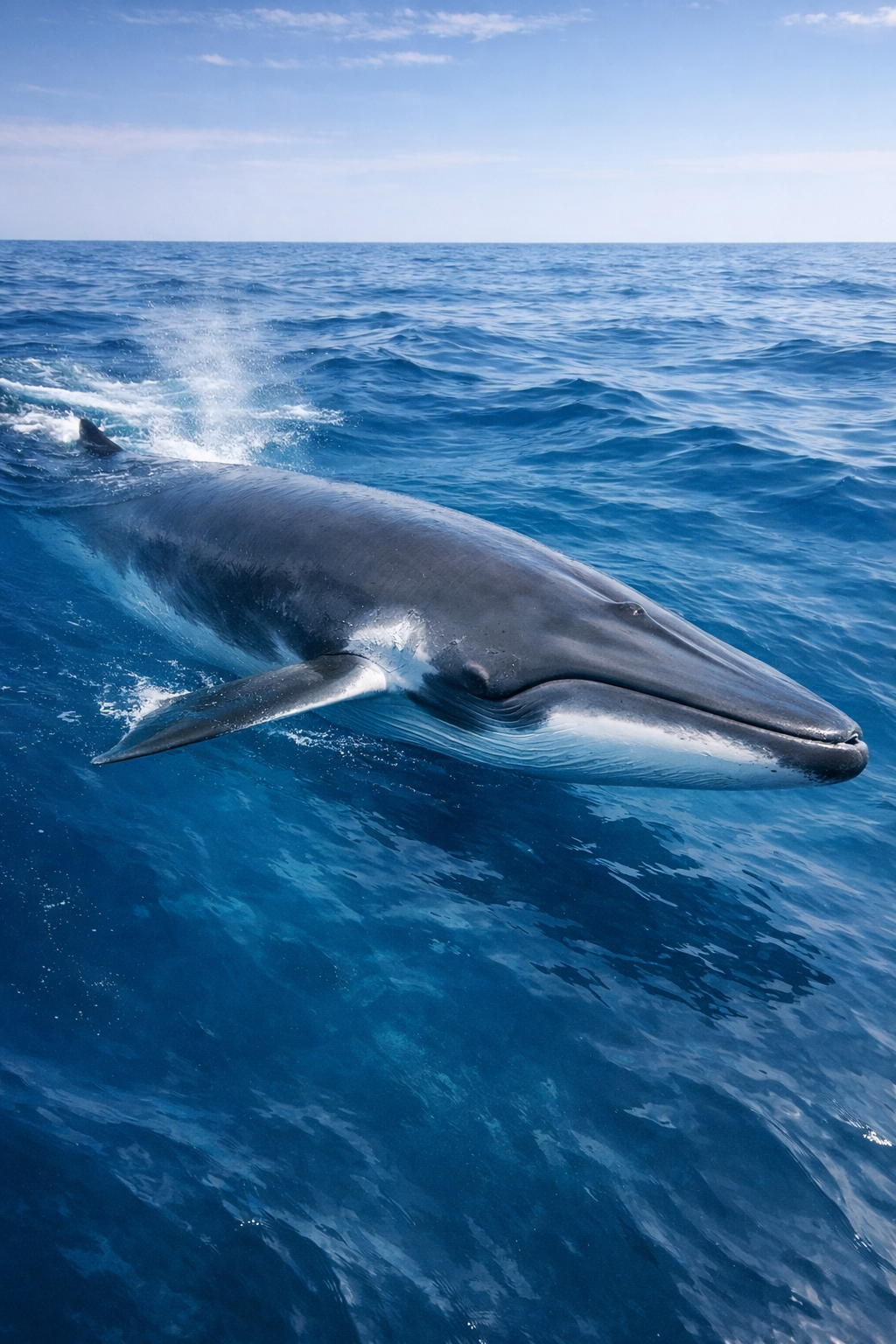
Fin Whale
When we think of ocean giants, the blue whale usually steals the spotlight, but its slightly smaller, incredibly swift cousin, the fin whale, is a marvel of the deep that deserves its own moment in the sun. Known as the “greyhound of the sea” for its remarkable speed and sleek, torpedo-like silhouette, this second-largest animal on Earth is a master of the oceans, navigating global waters with astonishing grace and producing low-frequency songs so powerful they can literally vibrate the seafloor. Whether you are a seasoned marine biology enthusiast or simply in awe of nature’s most magnificent creatures, there is always more to discover about these asymmetrical, filter-feeding titans. Dive in as we explore 25 interesting facts about fin whales that will completely change the way you look at the second-largest animal to ever grace our planet.
Fact number 1
The fin whale, scientifically classified as Balaenoptera physalus, goes by several common names that reflect its physical characteristics and taxonomic family. It is frequently called the “finback whale,” a direct reference to the prominent, falcate (sickle-shaped) dorsal fin located about two-thirds of the way down its back, which remains visible for a long time after the whale dives. It is also known as the “common rorqual,” placing it within the rorqual family (Balaenopteridae), a name derived from the Norwegian word røyrkval meaning “furrow whale.” This name perfectly describes the defining anatomical feature of the family: the series of long, accordion-like throat grooves that allow the whale’s mouth to expand massively during feeding.
Fact number 2
Securing the title of the second-longest cetacean on the planet is a monumental biological achievement, placing the fin whale just behind the colossal blue whale in the size hierarchy. To put this immense scale into perspective, a fully grown adult fin whale is significantly longer than a standard regulation basketball court and vastly outweighs the largest land animals, including elephants and dinosaurs like the T-Rex. Despite being slightly smaller than the blue whale, the fin whale’s sleek, torpedo-like body shape often makes it appear more agile and streamlined in the water, earning it a reputation as one of the most gracefully proportioned giants of the deep.
Fact number 3
The maximum recorded length of a fin whale is a subject of historical debate and modern scientific measurement, with the largest individuals reportedly stretching between 26 and 27.3 meters (85 to 90 feet). During the era of commercial whaling, measurements were sometimes exaggerated or taken imprecisely on the flensing decks, but modern photogrammetry and laser-ranging from research vessels have confirmed that lengths approaching 27 meters are indeed possible. It is also worth noting that fin whales exhibit sexual dimorphism, meaning females are generally larger and longer than males, so the record-breaking lengths almost exclusively belong to mature females in populations like the North Atlantic or North Pacific.
Fact number 4
While their length is staggering, the maximum recorded weight of a fin whale is estimated to fluctuate between 65.5 and an astonishing 120 metric tonnes. This massive variance in weight is largely tied to their annual migratory cycle and feeding habits. During the summer months in nutrient-rich polar waters, fin whales gorge themselves on krill and small fish, packing on hundreds of kilograms of blubber to serve as both insulation and an energy reserve. As they migrate to warmer, low-latitude waters in the winter to mate and give birth, they fast for months, steadily burning through these fat reserves and losing a significant portion of their body weight before returning to the poles to feed again.
Fact number 5
The fin whale’s body is a masterclass in evolutionary camouflage, featuring a long, slender frame that is brownish-gray or dark gray on its dorsal (top) side and transitions to a stark, pale white or light gray on its ventral (under) side. This specific coloration pattern is a classic example of countershading, a visual trick used by many marine animals to evade predators. When viewed from above by a predator like an orca, the whale’s dark back blends seamlessly into the dark, murky depths of the ocean. Conversely, when viewed from below against the bright surface, its pale belly mimics the sunlight filtering down from the water’s surface, effectively making the whale’s silhouette disappear.
Fact number 6
One of the most unique and easily identifiable physical traits of the fin whale is its highly asymmetrical head coloration, which sets it apart from almost all other whale species. The left side of the whale’s head, including the lower jaw, is uniformly dark gray, matching the color of its back. In stark contrast, the right side of the head features a complex, striking pattern of light and dark markings, most notably a brilliant white or light gray right lower jaw. Marine biologists believe this asymmetry plays a functional role in their feeding strategy; when the whale rolls onto its right side during a lunge feed, the stark white jaw may startle or confuse schooling fish, herding them into the center of the prey ball for an easier catch.
Fact number 7
The fin whale is a truly cosmopolitan species, boasting one of the most widespread global ranges of any large marine mammal on Earth. They can be found cruising through all of the world’s major oceans, from the freezing, nutrient-dense waters of the Arctic and Antarctic to the warm, tropical currents near the equator. Because of this vast distribution, scientists recognize several distinct subspecies, primarily the North Atlantic fin whale, the North Pacific fin whale, the Southern fin whale (Antarctic), and a poorly understood subspecies that may inhabit the tropical waters of the Indian and Pacific Oceans. This global presence allows them to exploit seasonal blooms of prey in both hemispheres.
Fact number 8
Despite their nearly global distribution, fin whales have specific habitat limitations and are generally absent from certain extreme or enclosed marine environments. They are rarely found in waters immediately adjacent to the dense pack ice at the extreme polar regions, as they lack the specialized anatomy of bowhead or beluga whales to break through thick ice or navigate narrow, shifting leads. Furthermore, they are notably absent from small, enclosed, or unusually warm bodies of water, such as the Red Sea, the Mediterranean Sea (though a small resident population exists in the deeper parts of the Med), and the Baltic Sea. These areas often lack the massive upwellings of cold, nutrient-rich water required to sustain the dense schools of prey that fin whales rely on.
Fact number 9
The diet of the fin whale is highly varied but primarily consists of small, schooling marine organisms that can be consumed in massive quantities, including small fish like herring, capelin, and sand lance, as well as small squid and various crustaceans. Their absolute favorite prey, however, tends to be krill and copepods, tiny shrimp-like creatures that form incredibly dense swarms in polar and sub-polar waters. To consume these tiny creatures, fin whales employ a highly energetic technique called “lunge feeding,” where they accelerate to high speeds, open their mouths to nearly 90 degrees, and engulf a volume of water that can exceed the size of their own bodies, before using their massive tongue to push the water out through their baleen plates, trapping the prey inside.
Fact number 10
The mating habits of the fin whale are deeply tied to their extensive migratory patterns, with reproduction taking place almost exclusively in temperate, low-latitude seas during the winter months. After spending the summer gorging in cold polar waters, fin whales embark on a long migration toward the equator to breed and give birth. The warm waters of these tropical and subtropical breeding grounds are crucial for the survival of newborn calves, which are born with very little insulating blubber and would quickly succumb to hypothermia in the freezing polar seas. The gestation period lasts about 11 to 12 months, and females typically give birth to a single calf every two to three years, ensuring the mother has enough time to rebuild her energy reserves between pregnancies.
Fact number 11
Unlike highly social cetaceans such as sperm whales or pilot whales that form tight-knit, lifelong family units, fin whales generally have a loose and fluid social structure. They are most often observed traveling alone or in very small, transient pods of 6 to 10 animals, which usually consist of a mother and her calf, or temporary associations of two or three adults. However, this solitary nature is entirely abandoned when food is abundant; in areas where prey is incredibly dense, such as a massive swarm of krill or a tightly packed school of herring, fin whales will form opportunistic feeding aggregations that can reach up to 250 individuals. These massive groups are not social pods, but rather a temporary gathering of individuals capitalizing on a localized feast.
Fact number 12
Fin whales communicate using a series of incredibly loud, low-frequency, frequency-modulated sounds that typically range from 16 to 40 hertz. This is an astonishingly low pitch, sitting right at the very bottom edge of human hearing (for context, the lowest note on a standard piano is 27.5 Hz). Evolution has favored these ultra-low frequencies because low-pitched sound waves experience much less attenuation (loss of energy) as they travel through water compared to high-pitched sounds. This allows fin whale calls to propagate across vast ocean basins, enabling individuals to communicate, navigate, and potentially find mates over distances of hundreds, or even thousands, of miles.
Fact number 13
The whaling history of the fin whale is a tragic tale of near-annihilation, particularly during the 20th century when industrial whaling reached its peak. Because of their incredible speed, early whalers using sail-powered ships could not catch them, earning the fin whale the nickname “the greyhound of the sea” and keeping it safe for centuries. However, the invention of the steam-powered catcher boat and the explosive harpoon in the late 19th century suddenly made them vulnerable. During the “heyday” of commercial whaling, they became the most heavily hunted whale species on the planet; over 725,000 fin whales were reportedly taken from the Southern Hemisphere alone between 1905 and 1976, driving the population to the absolute brink of extinction before international protections were finally enforced.
Fact number 14
As a direct result of this devastating commercial exploitation, the fin whale’s population was decimated, and as of 2018, the International Union for Conservation of Nature (IUCN) assesses the species as “Vulnerable” on the Red List of Threatened Species. While this is an improvement from their previous “Endangered” status—and a testament to the success of the 1986 global moratorium on commercial whaling—their global population is still estimated to be at less than a third of its pre-whaling numbers. Today, while they no longer face the threat of industrial harpoons, they must navigate a modern ocean filled with new anthropogenic threats, including fatal ship strikes, entanglement in heavy fishing gear, and the detrimental effects of climate change on their prey populations.
Fact number 15
The scientific name of the fin whale, Balaenoptera physalus, is a fascinating linguistic blend of Latin and ancient Greek that perfectly describes the animal’s most prominent features. The genus name Balaenoptera is derived from the Latin word balaena (meaning whale) and the Greek word pteron (meaning wing or fin), referring to the long, wing-like pectoral flippers and the prominent dorsal fin. The specific epithet physalus comes directly from the Greek word φυσα (physa), which translates to “bellows,” “blowhole,” or “breath.” This name was chosen by the Swedish naturalist Carl Linnaeus in 1758 to describe the spectacular, towering spout of mist that the whale exhales when it surfaces to breathe.
Fact number 16
Recent advancements in genetic sequencing and genomic analysis have completely reshaped our understanding of the evolutionary family tree of rorqual whales, revealing surprising genetic relatives for the fin whale. For a long time, scientists assumed the fin whale was most closely related to the minke whale due to their somewhat similar physical appearances and shared anatomical features. However, DNA evidence has proven this assumption wrong, suggesting that the fin whale is actually more closely related to the humpback whale and the gray whale. This genetic revelation highlights how convergent evolution can make unrelated species look similar, while true evolutionary relationships are hidden deep within their molecular code.
Fact number 17
Because the genetic lines between certain giant rorquals are remarkably porous, hybridization between blue whales and fin whales occurs with relative frequency in the wild. This interbreeding is made possible by their overlapping distribution, similar diets, and the fact that their mating seasons and habitats often coincide in the same oceanic regions. These “blue-fin” hybrids are fully viable and have been documented in both the North Atlantic and the North Pacific, as well as the Southern Hemisphere. The existence of these fertile hybrids is a fascinating biological phenomenon that proves the two species, despite their massive size differences, are still genetically similar enough to successfully reproduce and pass on a mix of their giant traits.
Fact number 18
The internal and external anatomy of the fin whale is perfectly engineered for its massive scale and filter-feeding lifestyle, featuring an elongated dorsal ridge and a mouth lined with hundreds of baleen plates. Instead of teeth, fin whales possess around 260 to 480 baleen plates on each side of their upper jaw, which are made of keratin—the same protein found in human hair and fingernails. These plates are dark gray or black on the outside but feature fine, white, hair-like bristles on the inner edge that act as a highly efficient sieve. When the whale expels water from its mouth, these bristles trap the tiny krill and fish, allowing the whale to swallow mouthfuls of food that would otherwise slip through.
Fact number 19
When a fin whale surfaces to breathe, it produces a spectacular, towering spout of water that is easily visible from miles away, thanks to the immense power of its blowholes. The whale has two blowholes located at the top of its head, protected by large muscular flaps, which expel air at high pressure to clear the respiratory tract before inhaling fresh oxygen. This exhalation is so forceful that it can shoot a narrow, columnar spout of condensed water vapor and mucus straight up into the air to a height of 4 to 6 meters (13 to 20 feet). Early whalers used this tall, distinctive, and relatively thin blow to identify fin whales from a distance, differentiating it from the broader, V-shaped blow of the humpback or the bushy blow of the sperm whale.
Fact number 20
To sustain a body of such incomprehensible size, the fin whale has evolved the largest internal organs of any known animal on Earth, requiring a biological engine of immense power. Its liver, which is responsible for processing the massive amounts of energy derived from its diet and filtering toxins, weighs a staggering 230 to 600 kilograms (500 to 1,300 lbs)—about the weight of a grand piano. Even more astonishing is its heart, which weighs between 130 and 290 kilograms (roughly the weight of a large adult human or a small ATV). This massive, four-chambered heart must beat with incredible force to pump oxygenated blood through a 27-meter-long vascular system, ensuring that even the extremities of the tail flukes receive the oxygen they need for high-speed swimming.
Fact number 21
Despite weighing as much as a fleet of cars, the fin whale is one of the fastest cetaceans in the ocean, capable of sustaining cruising speeds of 37 to 41 km/h (23 to 25 mph) over long distances. When threatened or executing a high-speed lunge feed, it can burst at even faster speeds for short durations. This incredible velocity is made possible by its highly hydrodynamic, torpedo-shaped body, its smooth skin, and the powerful, up-and-down thrust of its massive tail flukes. This speed is the very reason it earned the famous nickname “the greyhound of the sea,” an evolutionary trait that historically allowed it to outrun early whaling ships and currently allows it to escape predators and migrate across entire ocean basins with remarkable efficiency.
Fact number 22
The lifespan of a fin whale is exceptionally long, with individuals living, on average, to be 75 to 90 years old, meaning a single whale can witness nearly a century of changes in the ocean’s climate and ecology. Determining the exact age of a fin whale is notoriously difficult, as they do not have the distinct earwax layers used to age some other species, but scientists use techniques like aspartic acid racemization in the eye lens or counting the corpora scars on the ovaries of females to estimate age. Through these methods, some studies have recorded maximum lifespans of up to 114, and in a few highly debated cases, even 140 years, placing them among the longest-living mammals on the planet alongside humans and bowhead whales.
Fact number 23
The incredibly loud, low-frequency songs of the fin whale led to one of the most amusing misunderstandings in the history of marine acoustics during the mid-20th century. When US Navy sonar operators and marine biologists first began picking up these powerful, rhythmic 20-Hz pulses echoing through the ocean, they were completely baffled. The sounds were so loud, regular, and low-pitched that the human ear could barely register them, and scientists at the time could not fathom that a biological creature could produce such immense acoustic energy. As a result, they initially hypothesized that the sounds were equipment malfunctions, mysterious geophysical phenomena, or even a highly classified Soviet scheme for testing underwater submarine detection equipment, before finally realizing they were listening to the voices of fin whales.
Fact number 24
The acoustic power generated by a fin whale’s song is so immense that it doesn’t just travel through the water; it actually penetrates the ocean floor, vibrating the earth’s crust to depths of over 2,500 meters (8,200 feet) below the seafloor. Recognizing the sheer power and consistency of these biological sound sources, innovative seismologists and geophysicists have figured out how to use fin whale songs to their advantage. By deploying specialized ocean-bottom seismometers, they can track the echoes of these whale calls bouncing off sub-seafloor rock layers, effectively using the whales as free, biological “airguns” to map underwater geological structures and assist in seismic surveys without the need to detonate actual explosives.
Fact number 25
Despite their massive size and incredible speed, fin whales are not entirely immune to predation, as the only known natural predator capable of taking them is the killer whale (orca). Orcas are highly intelligent, cooperative hunters that operate in large, coordinated pods, and they will occasionally target fin whales, usually focusing on vulnerable, isolated calves, sick individuals, or sometimes even healthy adults by exhausting them over long chases. However, because of the fin whale’s sheer size and its ability to reach speeds of over 40 km/h, healthy adults are incredibly difficult to catch. When attacked, fin whales will usually rely on their speed to flee, but if cornered, they are known to use their massive, powerful tail flukes to deliver crushing blows to the orcas in a desperate bid for survival.
FAQs about Fin Whales
While both are massive rorqual whales, they have distinct physical and behavioral differences that make them easy to tell apart once you know what to look for. The most obvious difference is size: the blue whale is the largest animal known to have ever lived, while the fin whale is the second largest. A blue whale can reach lengths of up to 30 meters (100 feet) and weigh as much as 200 tonnes, whereas a fin whale maxes out around 27 meters (85-90 feet) and 120 tonnes.
Physically, the fin whale is much slenderer and more streamlined than the bulky, robust blue whale, giving it a more torpedo-like appearance. The most foolproof way to identify a fin whale, however, is its unique asymmetrical head coloring. A fin whale has a dark gray left lower jaw and a stark white right lower jaw. The blue whale, on the other hand, has a more uniformly mottled blue-gray coloration across its entire head and body, with a broad, flat, U-shaped head compared to the fin whale’s more pointed, V-shaped rostrum (snout).
Currently, the fin whale is classified as “Vulnerable” on the IUCN Red List of Threatened Species, which is an improvement from its previous “Endangered” status, but they are still far from being out of the woods. During the 20th century, the invention of the explosive harpoon and steam-powered catcher boats led to the industrial slaughter of fin whales. Because they were so fast, early whalers couldn’t catch them, earning them the nickname “the greyhound of the sea.” Once technology caught up to their speed, over 725,000 fin whales were killed in the Southern Hemisphere alone between 1905 and 1976.
Although the 1986 global moratorium on commercial whaling allowed their numbers to slowly recover, their populations are still estimated to be at less than a third of their pre-whaling numbers. Today, they face new, modern threats. Ship strikes from massive commercial cargo vessels are a leading cause of fatal injuries, as the whales’ fast swimming speeds give them little time to dodge incoming ships. They are also highly susceptible to getting entangled in heavy commercial fishing gear, and climate change is altering the distribution of the krill and small fish they rely on for survival.
The fin whale is widely considered the fastest large whale in the ocean, earning it the famous moniker “the greyhound of the sea.” When cruising, a fin whale can sustain speeds of about 37 to 41 km/h (23 to 25 mph). However, when motivated—such as when executing a high-speed lunge feed, migrating long distances, or fleeing from a pod of hunting killer whales—they can burst at speeds exceeding 40 km/h (25 mph) and have been clocked at short bursts of up to 48 km/h (30 mph).
This incredible speed is an evolutionary marvel made possible by their highly hydrodynamic, torpedo-shaped body, smooth skin, and the immense, powerful thrust generated by their massive tail flukes. Historically, this speed was their primary defense against early whalers using sail-powered ships, and today, it allows them to efficiently migrate thousands of miles between their polar feeding grounds and tropical breeding areas.
Fin whales are opportunistic filter feeders, meaning their diet consists of whatever small marine life is most abundant in their area. Their primary diet includes massive swarms of krill and copepods (tiny crustaceans), but they also eat small schooling fishlike herring, capelin, and sand lance, as well as various species of small squid.
To eat, they use a highly energetic and acrobatic technique called “lunge feeding.” When a fin whale spots a dense school of prey, it accelerates to top speed and opens its mouth to an astonishing 90-degree angle. It possesses a series of accordion-like throat grooves (ventral pleats) that expand massively, allowing the whale to engulf a volume of water and prey that can actually exceed the size of its own body. Once its mouth is full, the whale closes its jaws and uses its massive, muscular tongue to push the water back out. As the water exits, it passes through the whale’s 260 to 480 keratinous baleen plates, which act like a sieve, trapping the krill and fish inside so the whale can swallow them whole.
The sheer scale of a fin whale is difficult for the human mind to comprehend. Adult fin whales typically reach lengths of 20 to 25 meters (65 to 82 feet), but the absolute largest individuals—almost always mature females, as the species exhibits sexual dimorphism—can grow up to 26.8 meters (88 feet) or even slightly over 27 meters (90 feet).
In terms of weight, a fully grown, well-fed fin whale can weigh anywhere from 65 to 80 metric tonnes, with maximum recorded weights pushing toward 120 tonnes. To put that into perspective, a 27-meter fin whale is longer than a standard regulation basketball court, and its weight is equivalent to about 15 to 20 adult African elephants, or roughly 1,500 average-sized adult humans. Despite this colossal weight, their streamlined shape allows them to move through the water with breathtaking agility.
Yes, fin whales are highly migratory, and their movements are driven by the dual needs of feeding and reproducing. They follow a classic seasonal migration pattern. During the long, sunlit summer months, they migrate to the freezing, nutrient-rich waters of the Arctic and Antarctic. Here, massive upwellings of cold water create explosive blooms of phytoplankton, which in turn support billions of krill and small fish. The whales spend the summer gorging themselves, packing on hundreds of kilograms of blubber.
As winter approaches and the ice begins to form, they abandon the polar feeding grounds and embark on a long migration toward temperate, subtropical, and tropical waters near the equator. They spend the winter in these warm seas to mate and give birth. The warm water is crucial for the survival of the newborn calves, which are born with very little insulating blubber and would quickly freeze to death in the polar oceans. Interestingly, while most populations migrate, some fin whales in areas where food is available year-round (like parts of the North Pacific or the Mediterranean) have been observed staying in the same area permanently, skipping the migration entirely.
Fin whales are famous in the scientific community for their incredibly loud, low-frequency vocalizations, often referred to as the “20-Hertz song.” These calls are pulsing, rhythmic sounds that sit at the very bottom edge of human hearing (for context, the lowest note on a standard piano is 27.5 Hz). Despite being so low-pitched that humans can barely hear them, these songs can reach up to 190 decibels, making them one of the loudest sounds produced by any animal on Earth.
Because low-frequency sound waves lose very little energy as they travel through water, a fin whale’s song can propagate across entire ocean basins, traveling thousands of miles. This acoustic power is so immense that the sound waves can actually penetrate the ocean floor, vibrating the earth’s crust up to 2,500 meters below the seafloor. In fact, the songs are so powerful and consistent that modern seismologists actually use them as a free, biological tool to map underwater geological structures! Historically, when the US Navy first detected these loud, rhythmic pulses in the 1940s and 50s, they were so baffled that they suspected the sounds were either equipment malfunctions or a secret Soviet submarine detection system.
Fin whales are among the longest-living mammals on the planet, with an average lifespan of 75 to 90 years. However, they are capable of living much longer than that. Through various scientific aging methods, researchers have estimated that some individuals can live to be 114 years old, and a few highly debated studies suggest maximum lifespans of up to 140 years. This means a single fin whale could be born in the late 1800s and still be swimming the oceans today, having witnessed over a century of global climate and ecological changes.
Determining the exact age of a fin whale is notoriously difficult. Unlike toothed whales (like sperm whales), which have layers of earwax that accumulate over time and can be counted like tree rings, baleen whales do not have earwax plugs. Instead, scientists estimate their age by analyzing the racemization of aspartic acid in the lens of the whale’s eye, a chemical process that changes at a predictable rate over time. For female fin whales, scientists can also estimate a minimum age by counting the “corpora scars” on their ovaries, which are left behind every time the whale ovulates or becomes pregnant.