Closing chapters, one zip at a time
Think about how many times you’ve used a zipper today, whether it was fastening your jacket, closing your jeans, or securing your backpack. We rely on this tiny marvel of engineering constantly, yet we rarely think about its fascinating journey from a clunky, jam-prone alternative to boot laces to a globally recognized wardrobe staple. Filled with quirky inventions, accidental branding, and brilliant mechanical tweaks, the history of the zipper is far more complex than a simple pull and slide. If you’ve ever wondered how this everyday object came to be, dive in and discover the surprising origins and hidden mechanics behind one of the world’s most useful inventions with these 25 interesting facts about zippers!
1. 1851 First Patent While Elias Howe is universally famous for inventing the sewing machine, he actually received the first U.S. patent for a clothing closure in 1851. He called it an “Improvement in Fastenings for Garments.” However, Howe was so focused on defending his sewing machine patents in court and building his sewing machine empire that he never bothered to manufacture or market his clothing fastener, missing out on a second massive invention.
2. Not a True Zipper Howe’s 1851 invention wasn’t a zipper as we know it today. It didn’t feature interlocking metal teeth. Instead, it was essentially an elaborate, continuous drawstring system that tied the garments together. Because it lacked the sliding mechanism and interlocking teeth that define modern zippers, historians don’t consider it a true slide fastener.
3. 42-Year Gap It took over four decades for the next major patent to appear in 1893. This massive gap wasn’t due to a lack of ideas, but rather a lack of manufacturing technology. Creating a functional zipper requires metal teeth to be stamped and aligned with microscopic precision. The metalworking and manufacturing tolerances of the mid-19th century simply weren’t advanced enough to produce a reliable, mass-produced interlocking fastener.
4. Shoelace Replacement In the late 1800s, high-top button-up boots were the standard fashion for both men and women. However, buttoning or lacing up a pair of tall boots was a tedious, time-consuming chore. Whitcomb L. Judson specifically developed his fastening device to be a quick, convenient alternative to boot laces, aiming to save people time when getting dressed.
5. Second Patent Not satisfied with his first attempt, Judson secured a second patent on August 29, 1893, for a “clasp-locker” device. This design used a hook-and-eye system. While it was a step closer to a modern zipper, it was still fundamentally different from today’s interlocking teeth and relied on a guide to force the hooks into the eyes.
6. Jamming Problems The fatal flaw of Judson’s “clasp-locker” was its unreliable mechanics. The slider didn’t align the hooks and eyes perfectly, leading to frequent jamming, snagging, and popping open. Frustrated users quickly abandoned the device in favor of the reliability of traditional buttons and laces.
7. Personal Use Because the device was so prone to jamming, Judson and his business partner, Colonel Lewis Walker, essentially became their own guinea pigs. They installed the clasp-lockers directly into their own boots to test them in real-world conditions, experiencing the mechanical failures firsthand before trying to sell them to the public.
8. Universal Fastener Company To manufacture and sell his invention, Judson partnered with Colonel Lewis Walker to form the Universal Fastener Company. The company was headquartered in Elyria, Ohio, and later moved to Pennsylvania. The company would go through several name changes over the decades, eventually becoming Talon, Inc., which was a major zipper manufacturer for most of the 20th century.
9. World’s Fair Flop Judson debuted his “clasp-locker” to the public at the massive 1893 Chicago World’s Fair (the World’s Columbian Exposition). Despite the fair being a premier showcase for cutting-edge technology and innovation, Judson’s fastener was a commercial flop. The public recognized the novelty, but the device was simply too clunky and unreliable for everyday use.
10. Swedish-American Engineer The company struggled for years until they hired Gideon Sundbäck in 1906. Sundbäck was a brilliant Swedish-American electrical and mechanical engineer. He was brought on specifically to solve the mechanical flaws of the clasp-locker. His background in precision engineering was the exact catalyst the company needed to finally create a viable product.
11. 1913 Birth Sundbäck completely scrapped the old hook-and-eye design. In 1913, he introduced the “Hookless Fastener No. 1,” which is widely considered the birth of the modern zipper. By moving away from hooks and utilizing interlocking teeth, he created a smooth, continuous, and highly durable fastening system that actually worked.
12. Teeth Density Increase One of Sundbäck’s most crucial engineering tweaks was changing the geometry of the teeth. Early fasteners only had about four teeth per inch, which didn’t provide enough surface area to hold together under tension. Sundbäck increased the density to ten or eleven teeth per inch. This tighter spacing distributed the physical stress evenly, preventing the zipper from bursting open.
13. Two-Row Design Sundbäck’s genius was in the slider mechanism. He designed a Y-shaped channel that forced two facing rows of interlocking teeth to mesh perfectly together on one side of the slider, and pull apart on the other. This simple but brilliant mechanical action is the exact same principle used in every zipper manufactured today.
14. 1917 Patent Sundbäck patented his revolutionary “Separable Fastener” in 1917. This patent established the legal and mechanical foundation for the modern zipper. It was such a massive improvement over previous designs that it finally convinced the clothing and manufacturing industries that slide fasteners were here to stay.
15. Name Origin For years, the device was known by clunky industrial names like the “hookless fastener” or “slide fastener.” The catchy, universally known term “zipper” didn’t come from the inventors, but rather from a corporate marketing team years later.
16. Rubber Boots In 1923, the B.F. Goodrich Company decided to use Sundbäck’s fastener on a new line of rubber galoshes (overshoes). The executives at B.F. Goodrich loved the distinct “zzz-zip” sound the slider made when pulled. They decided to market the boots with the catchy onomatopoeic name “zipper,” and the slang term quickly became the official name for the device worldwide.
17. Early Uses Before it was a staple in fashion, the zipper was strictly utilitarian. In the 1910s and 1920s, the two largest commercial markets for the new fastener were closing tobacco pouches (which needed a secure, airtight seal to keep the tobacco fresh) and heavy winter boots.
18. Fashion Debut The zipper finally crossed over into mainstream fashion in 1925 when the apparel company Schott NYC began using them on their “Perfecto” leather motorcycle jackets. This was a cultural milestone. It transitioned the zipper from a hidden, utilitarian gadget into a visible, stylish, and slightly rebellious fashion statement.
19. NASA Innovation Standard zippers are not airtight; air can easily pass through the tiny gaps between the teeth. When NASA began developing high-altitude pressure suits and later spacesuits, they needed a way for astronauts to seal themselves inside a pressurized garment while maintaining mobility. NASA engineers had to invent specialized, airtight coil zippers with integrated rubber seals capable of holding back the vacuum of space.
20. YKK Dominance If you look at the zipper on your jeans or jacket, there is a very high chance it says “YKK” on the slider. Founded in Japan, YKK (Yoshida Kogyo Kabushiki) grew to become an absolute titan of the industry. By the 1980s, they controlled nearly half of the global zipper market. They achieved this through “vertical integration”—meaning they manufacture their own brass, weave their own thread, and build their own proprietary manufacturing machines, ensuring unparalleled quality control.
21. 1934 Foundation The origins of YKK trace back to January 1934, when a Japanese entrepreneur named Tadao Yoshida founded a small company in Tokyo called San-es Shokai. Initially, it was just a modest business focused on processing and selling imported zippers, but Yoshida’s vision for quality and innovation quickly set the stage for global expansion.
22. War Destruction World War II was a devastating period for Japanese manufacturing. During the Great Tokyo Air Raids in March 1945, Yoshida’s primary manufacturing plant was completely burned to the ground by Allied bombing. The physical assets of the company were wiped out, forcing Yoshida to flee the city with his family for safety.
23. YKK Rebirth Refusing to give up, Yoshida relocated to his wife’s hometown of Uozu in Toyama Prefecture. Operating under the newly formalized name “Yoshida Kogyo Kabushiki Kaisha” (YKK), he rebuilt the company from scratch at the end of the war. He instilled a corporate philosophy called the “Cycle of Goodness,” which posited that creating products that benefit society would ultimately benefit the company itself.
24. Spanish Success While the U.S. and Japan dominated the zipper industry, Europe had its own manufacturing powerhouses. In 1926, the Cremalleras Rubi company was established in Spain. They became a massive supplier for the European market, showcasing the global demand for fasteners. By 2012, this single Spanish company was still producing and selling over 30 million zippers a year.
25. China’s Dominance In the late 20th and early 21st centuries, the center of global manufacturing shifted heavily toward Asia. By 2005, China had captured an astonishing 80 percent of the international zipper market. The epicenter of this industry is Qiaotou, located in Yongjia County, Zhejiang Province. Known as the “Zipper Town” of China, Qiaotou produces billions of zippers annually, supplying everything from fast fashion to high-end luxury brands.
Frequently Asked Questions about Zippers
The invention of the zipper wasn’t a single “eureka” moment, but rather a three-step evolution over several decades:
Elias Howe (1851): The man who invented the sewing machine patented an “Automatic, Continuous Clothing Closure.” However, he was too busy marketing his sewing machine to bother manufacturing or selling his fastener.
Whitcomb L. Judson (1893): Judson patented a “Clasp Locker” designed to replace complicated button-up boots. He debuted it at the 1893 Chicago World’s Fair, but it was prone to jamming and popping open, so it failed commercially.
Gideon Sundbäck (1913): A Swedish-American engineer hired by Judson’s company, Sundbäck is the true father of the modern zipper. He abandoned the hook-and-eye design and invented the interlocking teeth system with a slider, patenting the “Separable Fastener” in 1917.
If you look closely at the slider on your jeans, jacket, or backpack, you will almost certainly see the letters “YKK” stamped on it. It stands for Yoshida Kogyo Kabushikikaisha, which translates roughly to “Yoshida Company Limited.” Founded in Japan in 1934 by Tadao Yoshida, YKK is the undisputed titan of the zipper industry, manufacturing roughly half of all the zippers on Earth (billions every year). The reason you see them everywhere is their legendary reliability. YKK operates on a philosophy of vertical integration—they smelt their own brass, formulate their own polyester, weave their own fabric tapes, and even build their own zipper-manufacturing machines to ensure absolute quality control. Clothing brands use YKK because a broken zipper can ruin a $200 jacket, and YKK zippers rarely fail.
The magic of a zipper lies entirely inside the small metal or plastic slider. The slider contains a Y-shaped channel.
When zipping up: The wide end of the “Y” takes in the two separate rows of teeth. As the slider moves up, the channel narrows, forcing the teeth to interlock at precise angles, wedging them tightly together so they cannot pull apart.
When zipping down: A small wedge in the center of the slider acts like a plow. As you pull the slider down, this center wedge pushes the locked teeth outward, separating the two rows at the exact point where they meet.
You may have noticed that men’s jackets and pants typically zip or button left-over-right (with the pull/tab on the right side), while women’s clothing usually zips right-over-left (with the pull/tab on the left side). This bizarre quirk dates back to the 13th century when buttons were first invented. Wealthy men dressed themselves, and having buttons on the right allowed them to easily unbutton their coats with their left hand while drawing a sword with their right hand (preventing the hilt from catching on the fabric). Wealthy women, however, did not dress themselves; they were dressed by right-handed maids. Having the buttons on the left side made it much easier for the maid standing across from them to fasten the garments. Even after the Industrial Revolution made mass-produced clothing affordable and zippers replaced buttons, the manufacturing templates simply stayed the same, and the tradition lives on today.
Not all zippers are created equal. Manufacturers use different types based on the garment’s needs:
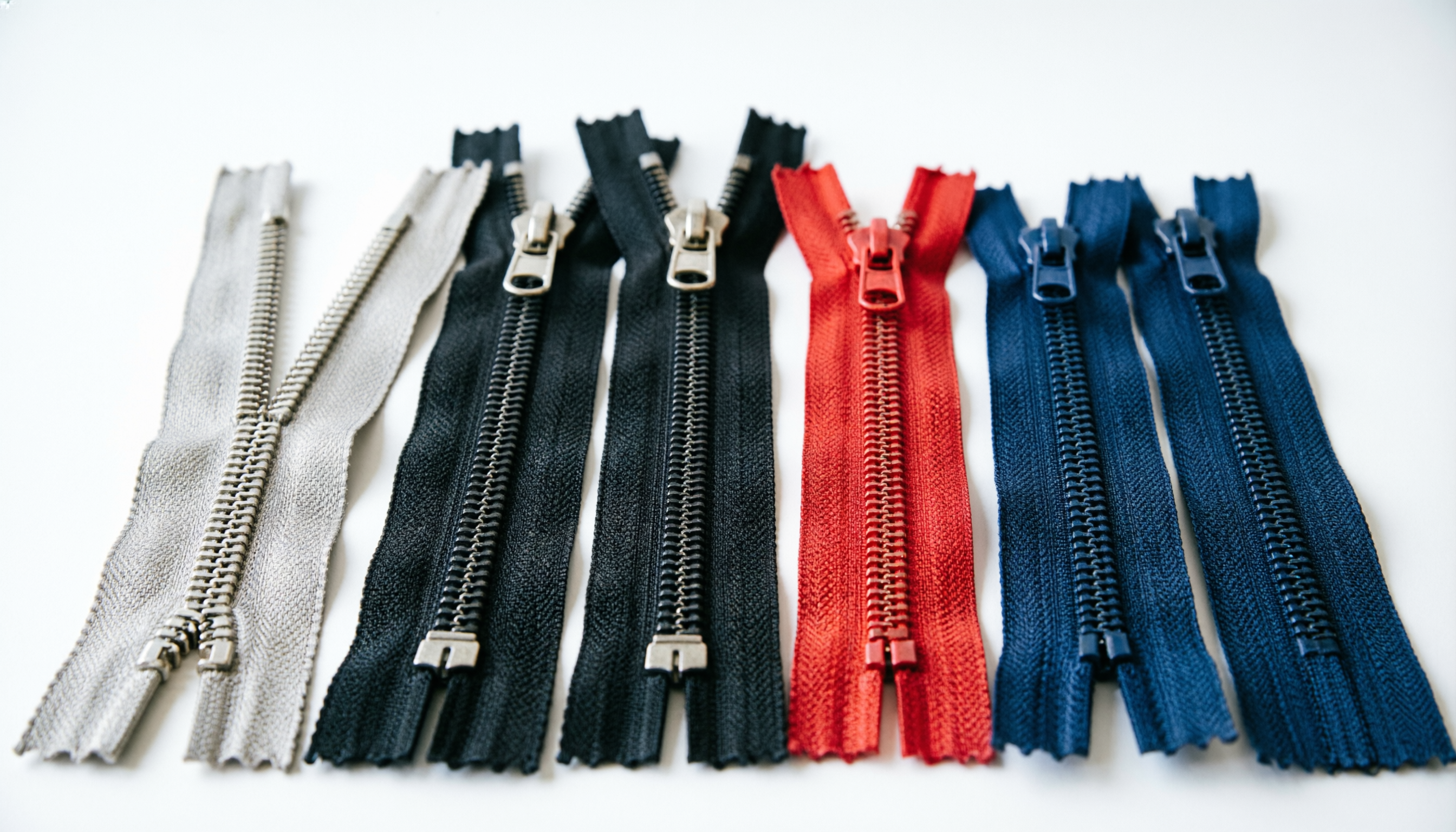
Coil Zippers: The teeth are actually continuous coils of nylon or polyester plastic sewn onto the tape. They are lightweight, highly flexible, and rust-proof, making them the standard for luggage, sportswear, and lightweight jackets.
Metal Zippers: Made of individual pieces of brass, nickel, or aluminum clamped onto the tape. They are incredibly durable and heavy-duty, which is why they are the standard for denim jeans and leather motorcycle jackets.
Molded Plastic Zippers: Each individual tooth is injected-molded out of plastic and fused directly to the tape. They can be made in any color, are completely rust-proof, and are flexible. You will often find these on winter parkas, sleeping bags, and marine gear.
Invisible Zippers: A special type of coil zipper where the coil is hidden behind the fabric tape. When sewn into a garment, only the tiny slider is visible. These are heavily used in formal wear, skirts, and dresses where a visible zipper line would ruin the aesthetic.
This is one of the most searched DIY clothing repairs on the internet!
If the zipper splits open after you zip it: Over time, the metal slider stretches out slightly from pulling, meaning the Y-channel is no longer wide enough to force the teeth tightly together. To fix this, take a pair of needle-nose pliers and very gently squeeze the top and bottom plates of the slider together. This tightens the gap and forces the teeth to lock properly again. (Be careful not to squeeze too hard, or you’ll break the slider!).
If a zipper on jeans keeps sliding down: This usually happens because the slider is too loose to fight the tension of the denim. You can use the pliers trick mentioned above or simply use a small metal keyring. Loop the keyring through the hole in the zipper pull, zip the jeans up, and hook the ring over the button of your jeans before buttoning them. It acts as a physical lock and guarantees your zipper will never slide down again!