Fire Extinguishers
From ancient gunpowder-powered contraptions to today’s smart, sensor-equipped devices, fire extinguishers have evolved far beyond the red cylinder hanging quietly in your hallway—they’re marvels of engineering, chemistry, and human ingenuity packed into portable life-saving tools. Whether you’re a safety professional, a history buff, or simply curious about the science behind everyday emergency gear, this collection of 25 fascinating facts will ignite your interest: discover how a 1723 explosion sparked the first extinguisher patent, why purple powder outperforms the standard, how sound waves might fight flames in space, and what “forever chemicals” have to do with your kitchen fire safety. Buckle up—because behind that simple pull-pin lies centuries of innovation, environmental debate, and surprising trivia that just might change how you see this essential piece of emergency equipment forever.
Fact Number 1
The first fire extinguisher of which there is any recorded patent was granted in England in 1723 to Ambrose Godfrey, a renowned chemist of his era. His ingenious but rudimentary device consisted of a cask filled with a fire-extinguishing liquid, into which a small pewter chamber containing gunpowder was integrated. This chamber was connected to a system of fuses that, when ignited, would explode the gunpowder, violently scattering the extinguishing solution onto the flames. While primitive by modern standards, this mechanism represented a foundational concept in active fire suppression: using a controlled explosion to rapidly distribute a fire-fighting agent. Historical records, including Bradley’s Weekly Messenger from November 7, 1729, document that Godfrey’s device was successfully employed to stop a fire in London, demonstrating its practical utility and marking the beginning of engineered fire extinguishing technology that would evolve over the next three centuries.
Fact Number 2
In 1816, British Captain George William Manby invented the “Extincteur,” widely recognized as the first portable pressurized fire extinguisher. Demonstrated to the Commissioners for the Affairs of Barracks, Manby’s device consisted of a copper vessel holding approximately 3 gallons (13.6 liters) of pearl ash (potassium carbonate) solution, which was contained under compressed air pressure. When the operator opened a valve, the pressurized air forced the liquid agent out through a nozzle and onto the fire. This was a revolutionary advancement because it introduced the principle of stored pressure to propel extinguishing agents—a concept that remains central to most modern extinguishers. Manby’s invention moved fire suppression technology from stationary, building-mounted systems to truly portable, handheld devices that could be rapidly deployed by individuals at the scene of a small fire.
Fact Number 3
The soda-acid fire extinguisher, first patented in France in 1866 by François Carlier, represented a major leap in extinguisher design by utilizing a chemical reaction to generate its own propellant gas. The device contained a solution of water and sodium bicarbonate (baking soda) in the main cylinder, with a separate vial of tartaric acid suspended inside. When the extinguisher was activated—typically by striking a plunger or releasing a stopple to break the acid vial—the acid mixed with the bicarbonate solution, producing carbon dioxide gas through a vigorous chemical reaction. This CO₂ gas pressurized the cylinder and forced the resulting solution out through a hose or nozzle. The soda-acid design became extremely popular in the late 19th and early 20th centuries because it was self-pressurizing, relatively simple to manufacture, and effective on common Class A fires involving wood, paper, and cloth.
Fact Number 4
The carbon dioxide (CO₂) fire extinguisher was invented in the United States in 1924 by the Walter Kidde Company, developed specifically in response to a request from Bell Telephone. Telephone switchboards of the era presented a unique fire hazard: electrical equipment that could not be safely extinguished with water or conductive agents. CO₂ was ideal because it is electrically non-conductive, leaves no residue, and extinguishes fires primarily by displacing oxygen around the flame. Kidde’s original design featured a tall metal cylinder containing 7.5 pounds (3.4 kg) of liquid CO₂, a wheel valve for control, and a woven brass hose with a composite horn nozzle. This invention not only solved a critical industrial safety problem but also established CO₂ as a “clean agent” that remains widely used today in environments where residue-free suppression is essential, such as server rooms, laboratories, and film production sets.
Fact Number 5
Carbon tetrachloride (CTC) extinguishers, popular in the early-to-mid 20th century, were eventually withdrawn from service in the 1950s due to serious health and safety concerns. CTC worked by vaporizing when discharged; the heavy vapor would blanket a fire and interrupt the chemical chain reaction of combustion. However, when exposed to the intense heat of a fire, CTC could decompose into phosgene gas—a highly toxic chemical warfare agent used in World War I. Additionally, prolonged exposure to CTC vapors, even without fire, could cause severe damage to the nervous system, liver, and kidneys. As awareness of these dangers grew and safer alternatives like CO₂ and dry chemical agents became available, regulatory agencies phased out CTC extinguishers. Today, vintage CTC units are primarily collector’s items, serving as historical reminders of the evolving balance between fire suppression effectiveness and human safety.
Fact Number 6
Halon extinguishers, which use halogenated hydrocarbons like Halon 1211 and 1301, were once prized for their exceptional effectiveness on electrical and flammable liquid fires. However, their use has been severely restricted globally since the adoption of the Montreal Protocol in 1987. The protocol identified Halons as potent ozone-depleting substances; when released into the atmosphere, their bromine and chlorine atoms catalyze the destruction of stratospheric ozone, which shields Earth from harmful ultraviolet radiation. While Halons remain in limited use for critical applications where no adequate substitute exists—such as military aircraft, spacecraft, and certain industrial processes—most civilian applications have transitioned to environmentally safer “clean agents” like FM-200, Novec 1230, or inert gas systems. The phase-out of Halons represents one of the most successful international environmental regulatory efforts in history.
Fact Number 7
Aqueous Film-Forming Foam (AFFF), long a staple for fighting flammable liquid fires, is currently undergoing a major phase-out in many regions due to environmental concerns over its chemical composition. Traditional AFFF formulations contain per- and polyfluoroalkyl substances (PFAS), including PFOA and PFOS—so-called “forever chemicals” that persist in the environment, accumulate in living organisms, and are linked to serious health issues. European regulations mandate the elimination of AFFF containing these substances by July 2025, and major U.S. manufacturers like Amerex and Badger have announced they will cease production of traditional foam extinguishers. The industry is transitioning to newer, fluorine-free foams (F3) and alternative agents that provide effective vapor suppression without the persistent environmental contamination. This shift underscores the growing priority of environmental sustainability in fire protection engineering.
Fact Number 8
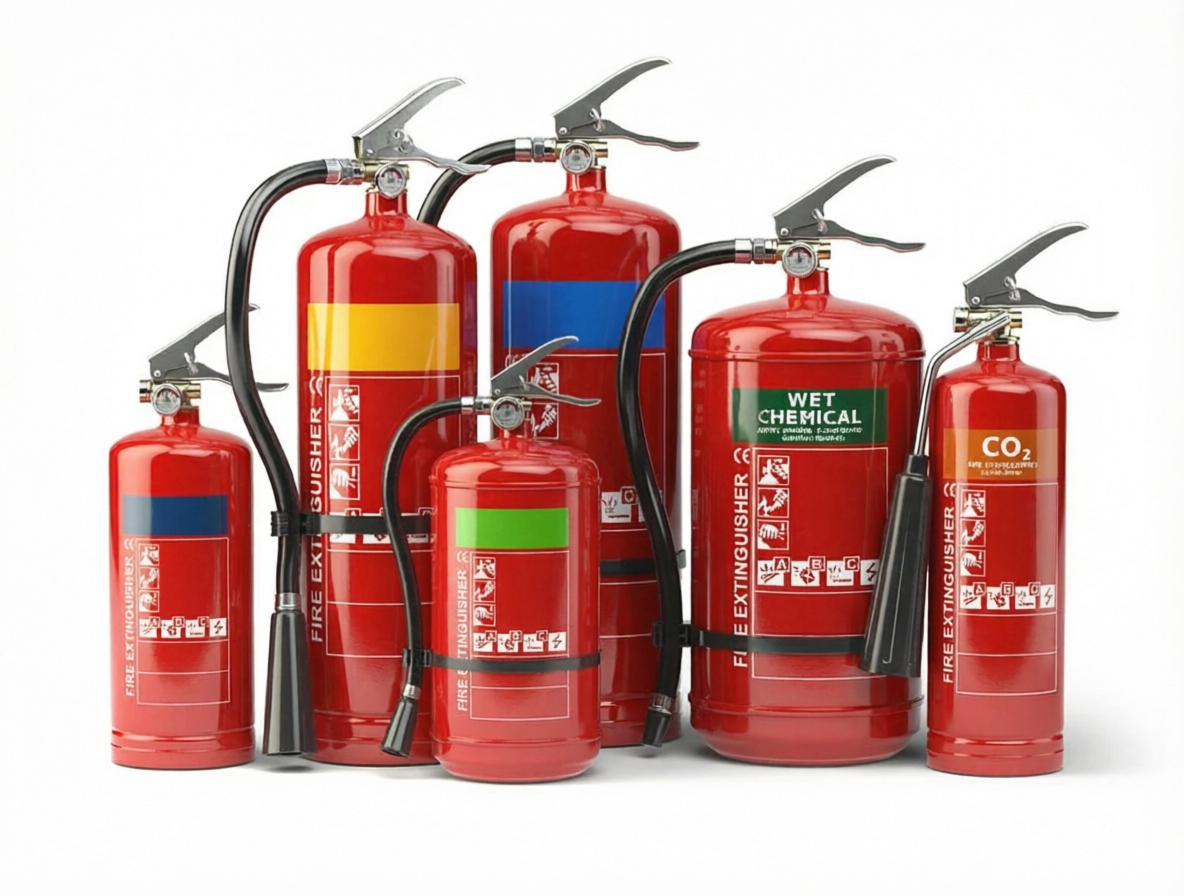
Fire extinguisher color-coding conventions vary significantly by region, reflecting different regulatory philosophies and historical practices. In the United Kingdom and most of Europe, standards like BS EN 3 require extinguishers to be painted signal red (RAL 3000) with a colored band or circle covering 5–10% of the surface area to indicate the extinguishing agent: cream for foam, blue for dry powder, black for CO₂, yellow for wet chemical, and so on. This system allows quick visual identification while maintaining a uniform appearance. In contrast, the United States has no official federal color standard; extinguishers are typically red but may be silver (for water or Class K), yellow (for Class D metal fires), or white (for water mist). Identification relies primarily on pictograms and text labels rather than color alone. These differences highlight how regional safety standards evolve independently to meet local needs and regulatory frameworks.
Fact Number 9
Australia enforces some of the world’s strictest regulations regarding Halon fire extinguishers. Due to the country’s vulnerability to ozone depletion effects—such as increased UV radiation impacting agriculture and public health—Australian law prohibits the ownership, use, or disposal of yellow-coded Halon extinguishers unless a specific “essential use” exemption is granted by the government. These exemptions are reserved for truly critical applications where no technically and economically feasible alternative exists, such as certain military or aviation contexts. Even then, strict accounting and containment protocols apply. This regulatory stance reflects Australia’s proactive commitment to the Montreal Protocol and serves as a model for how national policies can accelerate the global transition away from ozone-depleting substances.
Fact Number 10
Fire extinguishers operate via two fundamental mechanical designs: stored-pressure and cartridge-operated systems. In stored-pressure extinguishers—the most common type found in homes and offices—the expellant gas (typically nitrogen for dry chemical units or air for water/foam) is stored in the same chamber as the extinguishing agent. When the handle is squeezed, a valve opens, allowing the pressurized gas to force the agent out through the hose. Cartridge-operated extinguishers, more common in industrial settings, keep the expellant (usually compressed CO₂) in a separate, replaceable cartridge inside the main body. Activation punctures the cartridge, releasing gas into the agent chamber to create discharge pressure. The cartridge design allows for rapid recharging in the field and is preferred where frequent use or immediate redeployment is anticipated, such as on oil rigs or in aircraft hangars.
Fact Number 11
Fire extinguishers span an enormous range of sizes and weights to match diverse fire risks and operational contexts. Handheld portable units, designed for individual use, typically weigh between 0.5 kg (1.1 lb) for small kitchen models and 26.8 kg (59 lb) for large industrial units. These are engineered to be carried and operated by one person during the critical first minutes of a fire. For larger-scale hazards—such as airport runways, heliports, marine docks, or industrial facilities—cart-mounted or wheeled extinguishers are employed. These robust units often exceed 106.6 kg (235 lb) and are mounted on sturdy frames with large wheels for mobility. They may contain hundreds of pounds of agent and deliver high-volume discharge streams capable of tackling substantial flammable liquid or gas fires that would overwhelm handheld devices.
Fact Number 12
ABC dry chemical extinguishers, which use monoammonium phosphate as their active agent, earn their versatile “tri-class” rating through a unique physical mechanism. When discharged onto a Class A fire involving ordinary combustibles like wood or paper, the fine powder melts at approximately 190°C (374°F) and flows over the burning surface. This molten layer forms a sticky, oxygen-excluding crust that smothers flames and prevents re-ignition by sealing off the fuel from atmospheric oxygen. Simultaneously, the powder interrupts the chemical chain reaction of combustion at a molecular level, making it effective on Class B (flammable liquids) and Class C (electrical) fires as well. This multi-mechanism action—smothering, cooling, and chemical inhibition—makes ABC dry chemical the most widely used general-purpose extinguishing agent worldwide.
Fact Number 13
Purple-K, a dry chemical agent whose active ingredient is potassium bicarbonate, is approximately twice as effective as standard sodium bicarbonate (ordinary dry chemical) on Class B flammable liquid fires. This superior performance stems from potassium ions’ greater efficiency at interrupting the free radical chain reactions that sustain combustion in vapor-phase fires. Purple-K also exhibits better resistance to burn-back (re-ignition after initial suppression) and maintains effectiveness in windy or turbulent conditions. Developed by the U.S. Navy in the late 1960s and named for its distinctive violet color, Purple-K has become the preferred dry chemical agent in high-hazard industries like oil and gas, petrochemical refining, and aviation fueling, where rapid, reliable suppression of large liquid fuel fires is critical to preventing catastrophic escalation.
Fact Number 14
Water mist fire extinguishers represent a sophisticated evolution of traditional water-based suppression, engineered to be safe for use near energized electrical equipment. Instead of discharging a solid stream, these units use specially designed nozzles to break de-ionized water into an ultra-fine mist with droplets typically smaller than 1,000 microns. This mist has minimal electrical conductivity, allowing it to be used on Class C (electrical) fires without risking shock to the operator. The fine droplets also provide superior cooling efficiency due to their high surface-area-to-volume ratio, rapidly absorbing heat and converting to steam, which further displaces oxygen. Water mist systems are increasingly favored in sensitive environments like hospitals, data centers, and MRI suites, where non-toxicity, residue-free operation, and equipment compatibility are paramount.
Fact Number 15
Wet chemical fire extinguishers, designed primarily for commercial kitchen Class K (cooking oil/fat) fires, employ a sophisticated chemical process called saponification to achieve suppression. When the potassium acetate-, carbonate-, or citrate-based agent contacts hot cooking oil, it reacts with the fats to form a soapy, foam-like blanket on the oil’s surface. This blanket serves two critical functions: it seals the oil from atmospheric oxygen, preventing re-ignition, and the water content in the agent absorbs heat, cooling the oil below its auto-ignition temperature. Unlike water, which would cause dangerous splattering and steam explosions when applied to burning oil, wet chemical agents are specifically formulated to mix safely with hot fats. This targeted chemistry makes them indispensable in restaurant kitchens, where deep-fat fryers present a unique and high-risk fire hazard.
Fact Number 16
Class D fire extinguishers, designed for combustible metal fires (such as magnesium, titanium, sodium, or lithium), require highly specialized agents because water and conventional extinguishers can cause violent explosions or intensify the fire. These agents—such as sodium chloride, copper powder, graphite, or ternary eutectic chloride—work primarily by smothering: they form a heat-resistant, oxygen-excluding crust over the burning metal. Many also act as heat sinks, absorbing and dissipating the intense thermal energy characteristic of metal fires. Application technique is critical; Class D extinguishers typically feature low-velocity nozzles or discharge wands that allow the agent to be gently applied in large volumes without disturbing the burning metal particles, which could spread the fire. Due to the extreme hazards involved, Class D extinguishers are found only in specialized industrial, laboratory, or aerospace settings where combustible metals are processed or stored.
Fact Number 17
Trimethoxyboroxine (TMB), a unique and somewhat paradoxical extinguishing agent developed for magnesium fires in the 1950s, illustrates the creative—and sometimes counterintuitive—approaches taken in fire suppression research. TMB consists of a boron compound dissolved in methanol, a flammable solvent. When discharged onto a burning magnesium surface, the methanol ignites and burns with a distinctive green flame (due to boron emission), while the boron compound reacts with the metal to form a glassy crust of boric oxide. This crust seals the magnesium from oxygen, ultimately extinguishing the fire. The agent’s shelf life was limited to 6–12 months because methanol absorbs atmospheric moisture, which could corrode the extinguisher or impair performance. Though largely obsolete today, TMB remains a fascinating case study in how fire science sometimes embraces controlled combustion to achieve ultimate suppression.
Fact Number 18
Modern fire extinguishing balls represent a novel approach to passive and active fire suppression. These spherical devices, typically about the size of a softball, contain a core of ABC dry chemical powder surrounded by a heat-sensitive fuse mechanism. When thrown into a fire or placed in a fire-prone area, the fuse ignites upon contact with flame or sufficient heat (usually around 150–200°C), causing a small charge to burst the shell and disperse the powder over an area of approximately 5 square meters (54 square feet). Some models are designed for automatic deployment: mounted on ceilings or walls, they activate when ambient temperature reaches a critical threshold. The loud report upon activation also serves as an audible alarm. While not a replacement for traditional extinguishers in all scenarios, these balls offer a simple, intuitive option for homes, vehicles, or remote locations where rapid, no-training-required suppression is valuable.
Fact Number 19
Vintage “fire grenades”—glass spheres filled with extinguishing liquid popular from the 1880s through the early 1900s—offer a glimpse into early fire safety culture. Typically holding about one imperial pint (0.57 L), these grenades contained either salt water (to lower freezing point and enhance conductivity) or, more effectively, carbon tetrachloride (CTC). In an emergency, a person would hurl the grenade at the base of a fire; the glass would shatter on impact, releasing the agent to smother flames. Some later models, like those from Red Comet, were designed for passive operation: mounted in special holders with fusible links that would melt in a fire, automatically breaking the glass and releasing the contents. Today, these ornate glass bottles are prized by collectors of firefighting memorabilia, though CTC-filled examples are handled with caution due to residual toxicity.
Fact Number 20
Condensed aerosol fire suppression technology represents a hybrid approach between gaseous clean agents and dry chemical powders. These systems generate an ultra-fine aerosol of solid particles (typically less than 10 micrometers in diameter) suspended in gas, produced by igniting a specialized aerosol-forming compound. The microscopic particles flood an enclosed space, interrupting combustion at the molecular level by scavenging free radicals in the flame zone. Unlike directional dry chemical extinguishers that must be aimed precisely at the fire, condensed aerosols act as “flooding agents,” effective regardless of fire location or height within a protected volume. This makes them ideal for protecting complex machinery, electrical enclosures, or confined spaces where traditional agents might not reach all potential fire zones. However, their use is generally limited to total-flooding applications rather than handheld portable units.
Fact Number 21
In the United States, the installation height of fire extinguishers is governed by overlapping requirements from the National Fire Protection Association (NFPA) and the Americans with Disabilities Act (ADA). While NFPA 10 sets a general maximum mounting height of 60 inches (1.5 m) for extinguishers under 40 lb (18 kg), the ADA imposes a stricter limit: the operating handle must be no higher than 48 inches (1.2 m) above the floor to ensure accessibility for wheelchair users. This lower threshold ensures that individuals with mobility impairments can independently grasp and operate the extinguisher in an emergency. Facilities must comply with both standards, meaning the ADA’s 48-inch rule effectively governs most installations in public and commercial buildings. This intersection of fire safety and accessibility law underscores the importance of inclusive design in life-safety equipment.
Fact Number 22
The Americans with Disabilities Act also regulates how far fire extinguishers and their mounting cabinets may protrude into walking paths. Specifically, any object mounted adjacent to a circulation route cannot project more than 4 inches (10 cm) into the path if its bottom edge is higher than 27 inches (0.69 m) above the floor. This rule protects individuals who are blind or have low vision, who may use a cane to detect obstacles at lower levels but might not detect a protruding extinguisher cabinet at chest or head height. As a result, extinguishers are often recessed into walls or mounted in shallow cabinets that comply with this protrusion limit. This seemingly minor architectural detail plays a crucial role in ensuring that emergency egress routes remain safely navigable for all building occupants.
Fact Number 23
Hydrostatic pressure testing is a critical maintenance procedure required to ensure the structural integrity of fire extinguisher cylinders over time. Because extinguishers are pressure vessels subjected to repeated pressurization cycles, temperature fluctuations, and potential corrosion, their metal walls can weaken. Hydrostatic testing involves filling the cylinder with water, pressurizing it to a specified test pressure (typically 1.5 to 2 times the working pressure), and inspecting for leaks, permanent expansion, or deformation. Testing intervals vary by agent type: water and CO₂ extinguishers generally require testing every 5 years, while dry chemical units may be tested every 12 years. This preventative measure prevents catastrophic failures—such as ruptures or explosions—that could injure personnel or render the extinguisher useless when needed most.
Fact Number 24
The National Fire Protection Association (NFPA) now permits electronic monitoring systems to replace the traditional requirement for monthly visual inspections of fire extinguishers in commercial buildings. Under NFPA 10 (2022 edition), a compliant electronic system must continuously monitor three key parameters: the physical presence of the extinguisher (via tamper switches or RFID), internal pressure (via integrated sensors), and accessibility (ensuring no obstructions block access). The system must maintain an electronic event log at a central control panel and immediately alert facility staff or monitoring services if any parameter falls outside acceptable ranges. This technology-enabled approach can improve reliability by providing real-time status updates and reducing human error in inspection records, though it requires upfront investment in sensors, connectivity, and software infrastructure.
Fact Number 25
In 2015, researchers at George Mason University demonstrated a novel fire suppression concept using low-frequency sound waves in the 30–60 Hz bass range. The principle, initially explored by DARPA, relies on acoustic pressure to displace oxygen away from the combustion zone, effectively “blowing out” the flame without physical contact or chemical agents. In laboratory tests, a prototype device successfully extinguished small propane and ethanol fires by directing focused sound waves at the flame base. While not yet practical for widespread deployment, this technology holds particular promise for specialized environments like spacecraft or space stations, where traditional mass-based extinguishers pose challenges related to residue, weight, and microgravity fluid behavior. Sound-based suppression could offer a clean, reusable, and propellant-free method for managing fires in the unique conditions of outer space.
🔥 Fire Extinguisher FAQs
Below are the most frequently searched questions about fire extinguishers, answered in detail based on guidance from the U.S. Fire Administration, NFPA, and leading fire safety manufacturers.
❓ What are the different types of fire extinguishers and what fires do they fight?
Fire extinguishers are classified by the types of fires they can safely extinguish
www.usfa.fema.gov:
| Class | Fire Type | Examples | Suitable Extinguishers |
|---|---|---|---|
| A | Ordinary combustibles | Wood, paper, cloth, rubber, trash | Water, Foam, ABC Dry Chemical, Water Mist |
| B | Flammable liquids | Gasoline, oil, grease, paint, solvents | Foam, CO₂, Dry Chemical, Purple-K |
| C | Electrical equipment | Appliances, tools, wiring, circuit breakers | CO₂, Dry Chemical, Water Mist (de-ionized) |
| D | Combustible metals | Magnesium, titanium, sodium, lithium | Specialized dry powder (Class D only) |
| K | Cooking oils/fats | Vegetable oil, animal fat in commercial fryers | Wet Chemical (saponifying agents) |
Multipurpose extinguishers labeled “ABC” are the most versatile for home and office use, as they cover Classes A, B, and C fires
www.usfa.fema.gov. Always check the label for the specific rating before purchasing.
❓ How do I properly use a fire extinguisher?
Remember the PASS method, endorsed by FEMA and fire departments worldwide
www.usfa.fema.gov:
- P – Pull the pin: Break the tamper seal and pull the safety pin to unlock the operating lever.
- A – Aim low: Point the nozzle or hose at the base of the fire, not the flames.
- S – Squeeze the handle: Press slowly and evenly to release the extinguishing agent.
- S – Sweep side to side: Move the nozzle back and forth across the base of the fire until it’s out.
⚠️ Critical safety tip: Stand 6–8 feet away from the fire, keep your back to a clear exit, and never turn your back on a fire you’re fighting. If the fire grows or smoke becomes thick, evacuate immediately and call 911
www.usfa.fema.gov.
❓ When should I use a fire extinguisher—and when should I evacuate?
Use a fire extinguisher only if all of the following are true
www.usfa.fema.gov:
✅ The fire is small, contained, and not spreading (e.g., wastebasket, stovetop pan)
✅ You have alerted others and someone has called the fire department
✅ You are physically capable of operating the extinguisher
✅ You have a clear escape route behind you
✅ The air is breathable and you’re not exposed to toxic smoke
✅ You have the correct type of extinguisher for the fire class
❌ Evacuate immediately if:
- The fire is larger than a small trash can
- Flames are spreading rapidly
- Smoke is thick or visibility is poor
- You’re unsure about the fire type or extinguisher compatibility
- You feel unsafe at any point
Young children and older adults should not attempt to use fire extinguishers
www.usfa.fema.gov.
❓ How often do fire extinguishers need to be inspected?
Per NFPA 10 standards, fire extinguishers require three levels of maintenance
www.nfpa.org:
| Maintenance Type | Frequency | Who Performs It | What’s Checked |
|---|---|---|---|
| Visual Inspection | Monthly | Any knowledgeable person | Location, accessibility, pressure gauge, physical damage, tamper seal |
| Professional Maintenance | Annually | Certified technician | Internal/external examination, agent condition, mechanical parts |
| Hydrostatic Testing | Every 5 or 12 years* | Certified testing facility | Cylinder integrity under pressure to prevent rupture |
* Interval depends on extinguisher type: CO₂ and water = 5 years; dry chemical = 12 years
www.nfpa.org.
Records of inspections must be kept for at least 12 months, with tags or digital logs showing date, inspector name, and findings
www.nfpa.org.
❓ Do fire extinguishers expire? How long do they last?
Yes—fire extinguishers have a finite service life
pyebarkerfs.com:
- Disposable (non-rechargeable) extinguishers: Replace every 10–12 years from the manufacture date (found on the label or cylinder neck) pyebarkerfs.comkordfire.com.
- Rechargeable extinguishers: Can last 15+ years with proper annual maintenance, but must be hydrostatically tested per schedule www.nfpa.org.
- Signs it needs replacement: Rust/corrosion, dents, damaged hose/nozzle, pressure gauge in the red, broken tamper seal, or failed inspection servicefireequip.com.
⚠️ Even unused extinguishers degrade over time due to internal corrosion, agent settling, or seal deterioration. Never use an extinguisher past its service life.
❓ How do I read the rating label on a fire extinguisher?
Extinguisher labels follow UL 711 testing standards
support.firstalert.com. Example: 3-A:40-B:C
- Number before “A” = Water equivalency: 3-A = 3 × 1.25 gal = 3.75 gallons of water effectiveness on Class A fires.
- Number before “B” = Square footage coverage: 40-B = can extinguish a 40 sq. ft. flammable liquid fire.
- “C” = Safe for use on energized electrical equipment (no number; it’s a yes/no rating).
🔍 Tip: Choose the largest extinguisher you can comfortably operate—higher ratings mean greater firefighting capacity
www.usfa.fema.gov.
❓ Where should I install fire extinguishers in my home or business?
Follow these placement guidelines
www.kwfireprotection.co.uk
inspecttrack.com:
✅ Accessibility: Mount where visible and unobstructed; handles ≤48 inches high for ADA compliance
✅ Proximity to hazards: Kitchen (Class K or ABC), garage (ABC), workshop (ABC), electrical panel (CO₂ or ABC)
✅ Travel distance: In commercial settings, no more than 75 feet from any point to an extinguisher; one unit per ~3,000 sq. ft.
servicefireequip.com
✅ Environment: Avoid extreme temperatures (<40°F or >120°F), moisture, or corrosive chemicals
✅ Mounting: Use approved brackets; ensure extinguisher is upright and secure
🚫 Never store extinguishers behind doors, inside locked cabinets (unless break-glass), or in hard-to-reach closets.
❓ Can I store a fire extinguisher in my car?
Yes—with precautions
support.firstalert.com:
- Choose an automotive-rated extinguisher (typically 1-A:10-B:C, compact size)
- Ensure ambient temperature stays within the unit’s rated range (usually -40°F to 120°F / -40°C to 49°C)
- Mount securely in a bracket (not loose in trunk or under seat) to prevent damage in collisions
- Check pressure gauge monthly; vehicle vibration can accelerate wear
⚠️ Standard home extinguishers may fail in extreme car temperatures. Dedicated auto models are engineered for this environment.
❓ What should I do after using a fire extinguisher?
Even partial discharge requires action
support.firstalert.com:
- Evacuate and call 911 if the fire isn’t fully out or reignites.
- Ventilate the area—dry chemical residue can irritate lungs; CO₂ displaces oxygen.
- Clean residue carefully: Sweep/vacuum dry powder first, then wipe surfaces with damp cloth. Avoid water on electrical equipment until powered off and cooled.
- Service or replace the unit:
- Rechargeable: Take to a certified technician for refill and inspection.
- Disposable: Replace immediately—even a short burst compromises integrity.
- Document the incident for insurance and safety review.
❓ Are fire extinguishers required by law?
Requirements vary by jurisdiction and occupancy
fireco.co.nz
fireproof.co.uk:
- Homes: Generally not legally required, but strongly recommended by fire marshals and insurers.
- Businesses/Public buildings: Most jurisdictions require extinguishers per fire code (e.g., NFPA 10, OSHA, local amendments). Requirements include:
- Correct type/class for hazards present
- Proper placement, signage, and accessibility
- Documented monthly inspections and annual professional maintenance
- Special occupancies: Commercial kitchens (Class K), labs (Class D), data centers (clean agents) have additional mandates.
✅ Always consult your local fire authority or a licensed fire protection contractor to confirm compliance.
❓ Can I recharge or refill a fire extinguisher myself?
No—recharging requires certified professionals
support.firstalert.com
www.nfpa.org.
Why DIY recharging is unsafe:
- Requires specialized equipment to refill agent and pressurize to exact PSI
- Improper charging can cause failure to discharge—or catastrophic rupture
- Only certified technicians can perform required internal exams and hydrostatic tests
- Tampering voids UL listing and insurance coverage
🔧 Exception: Some industrial cartridge-operated extinguishers allow field replacement of agent cartridges—but only by trained personnel following manufacturer protocols.
❓ What’s the difference between rechargeable and disposable extinguishers?
| Feature | Rechargeable | Disposable (Non-Rechargeable) |
|---|---|---|
| Cost | Higher upfront | Lower initial cost |
| Lifespan | 15+ years (with maintenance) | 10–12 years (replace, don’t refill) |
| After use | Can be professionally refilled | Must be replaced entirely |
| Best for | Businesses, high-risk areas, frequent training | Homes, cars, backup units |
| Environmental impact | Less waste (refillable) | More waste (single-use) |
💡 Tip: For home use, a 5-lb ABC rechargeable extinguisher offers the best balance of capacity, versatility, and long-term value.
🔐 Final Safety Reminder: A fire extinguisher is a first-response tool—not a substitute for evacuation, smoke alarms, or professional firefighting. Train household members or staff on PASS, practice escape plans, and prioritize life safety over property protection. When in doubt: Get out, stay out, and call for help.
Sources: U.S. Fire Administration (FEMA), NFPA 10 Standard for Portable Fire Extinguishers, First Alert, Service Fire Equipment, and state fire marshal guidelines.