Maine Coon
From legendary ship cats of Viking lore to the gentle giants reigning as the world’s most popular pedigreed breed, Maine Coons are far more than just fluffy faces and impressive size—they’re living history wrapped in a water-resistant, tufted-ear package. Whether you’re a devoted cat parent, a curious newcomer, or simply fascinated by the stories behind nature’s most adaptable felines, this collection of 25 captivating facts will whisk you through centuries of myth, science, and heartwarming trivia: discover how a brown tabby named Cosey won America’s first cat show in 1895, why their “snowshoe paws” and raccoon-like tails are masterclasses in evolutionary design, what DNA reveals about their true British roots (sorry, Marie Antoinette!), and how these slow-maturing marvels can take up to five years to reach their full, majestic stature. So settle in—because behind every purr, tufted ear, and playful fetch session lies a tale of resilience, charm, and quiet greatness that just might make you fall head over paws for the gentle giant of the cat world.
Fact Number 1: Official State Cat of Maine
The Maine Coon originated in the U.S. state of Maine, where it holds the distinguished honor of being the official state cat. This designation was officially announced in 1985, recognizing the breed’s deep historical roots and cultural significance in the region. The breed is selectively bred from one of the oldest landraces in North America and is now pedigreed in all major cat registries worldwide.
Fact Number 2: Known as “Gentle Giants”
Maine Coons are commonly referred to as “gentle giants” due to their large size combined with their social, friendly temperament. Despite their impressive physical stature, they are known for being affectionate, easygoing companions who get along well with families, children, and other pets. This nickname perfectly captures the breed’s unique combination of substantial size and gentle disposition.
Fact Number 3: Dog-Like Characteristics
The Maine Coon is often cited as having “dog-like” characteristics, setting it apart from many other cat breeds. These cats are known for their loyalty, trainability, and tendency to follow their owners from room to room. Many Maine Coons enjoy playing fetch, can be leash-trained, and exhibit a level of social engagement more commonly associated with canine companions.
Fact Number 4: The Raccoon Hybrid Myth
One of the most persistent myths about the Maine Coon’s origin claims that these cats are hybrids with raccoons. This theory arose from the breed’s bushy, raccoon-like tail and similar coloring. However, this is biologically impossible, as cats and raccoons are completely different species that cannot interbreed. Despite being scientifically unfounded, this myth continues to circulate in popular culture.
Fact Number 5: The Marie Antoinette Legend
Another fascinating origin story involves Marie Antoinette, the Queen of France who was executed in 1793. According to this tale, before her death, Antoinette attempted to escape from France with the help of Captain Samuel Clough, loading his ship with her most prized possessions, including six of her favorite Turkish Angora or possibly Siberian cats. Although she did not reach the United States, her pets supposedly arrived safely at Wiscasset, Maine, where they bred with other short-haired cats and contributed to the development of the modern Maine Coon breed.
Fact Number 6: Viking Ship Cats Theory
A third origin myth suggests that Maine Coons are descendants of Viking ship’s cats, specifically the Norwegian Forest cats. According to this theory, Vikings brought these long-haired cats to New England during their explorations of North America. While this makes for an exciting historical narrative, modern genetic studies have provided different insights into the breed’s actual ancestry.
Fact Number 7: Scientific Evidence Points to British Origins
Phylogenetic studies have revealed that the Maine Coon belongs to the Western European monophyletic cat branch and is genetically closest to cats found in the United Kingdom. The breed is actually descended from cats brought to New England by Puritan settlers from the UK in the 1600s-1700s. This scientific evidence debunks the more romantic myths while providing a historically accurate account of the breed’s development.
Fact Number 8: Convergent Evolution with Nordic Breeds
The Maine Coon’s resemblance to the Siberian and Norwegian Forest cats is not due to close genetic relationship but rather convergent evolution. These breeds all developed in harsh climates where natural selection favored similar physical traits: thick, long coats, toe and ear tufts, large bodies, and snowshoe-like big feet. These adaptations were essential for survival in cold, snowy environments across different geographical regions.
Fact Number 9: America’s First Show Cat
In 1895, a female Maine Coon brown tabby named Cosey made history at the first North American cat show hosted at Madison Square Garden in New York City on May 8, 1895. Owned by Mrs. Fred Brown, Cosey won the silver collar and medal and was named “Best in Show.” The silver collar was later purchased by the CFA Foundation with the help of a donation from the National Capital Cat Show and is now housed at the CFA Central Office in the Jean Baker Rose Memorial Library.
Fact Number 10: Near Extinction in the 20th Century
In the early 20th century, the Maine Coon’s popularity began to decline dramatically with the introduction of other long-haired breeds from overseas, particularly the Persian cat, which originated in the Middle East. The last recorded win by a Maine Coon in a US national cat show for over 40 years was in 1911 at a show in Portland, Oregon. The breed became so rare that it was declared extinct in the 1950s, although this declaration was considered exaggerated and premature.
Fact Number 11: The Central Maine Cat Club Revival
The Central Maine Cat Club (CMCC) was created in the early 1950s by Ethylin Whittemore, Alta Smith, and Ruby Dyer in an attempt to increase the popularity of the Maine Coon. For 11 years, the CMCC held cat shows and hosted exhibitions of photographs of the breed. They are credited with creating the first written breed standards for the Maine Coon, laying the foundation for the breed’s eventual recognition and resurgence.
Fact Number 12: CFA Recognition Journey
The Maine Coon was denied provisional breed status by the Cat Fanciers’ Association (CFA) three times, which led to the formation of the Maine Coon Cat Club in 1973. The breed was finally accepted by the CFA under provisional status in May 1975 and was approved for championship status in May 1976. The following decades saw a remarkable rise in the breed’s popularity, with championship victories and increased national rankings.
Fact Number 13: World’s Most Popular Cat Breed
In 2024 statistics from FIFe (Fédération Internationale Féline), one of the major global cat registries, the Maine Coon ranked first place as the most popular cat breed, comprising 24.7% of their total registered kittens that year, which translates to 23,775 cats. In 2025, the Maine Coon overtook the Ragdoll, becoming the most registered cat breed with the CFA, cementing its status as the world’s most beloved pedigreed cat.
Fact Number 14: Water-Resistant Winter Coat
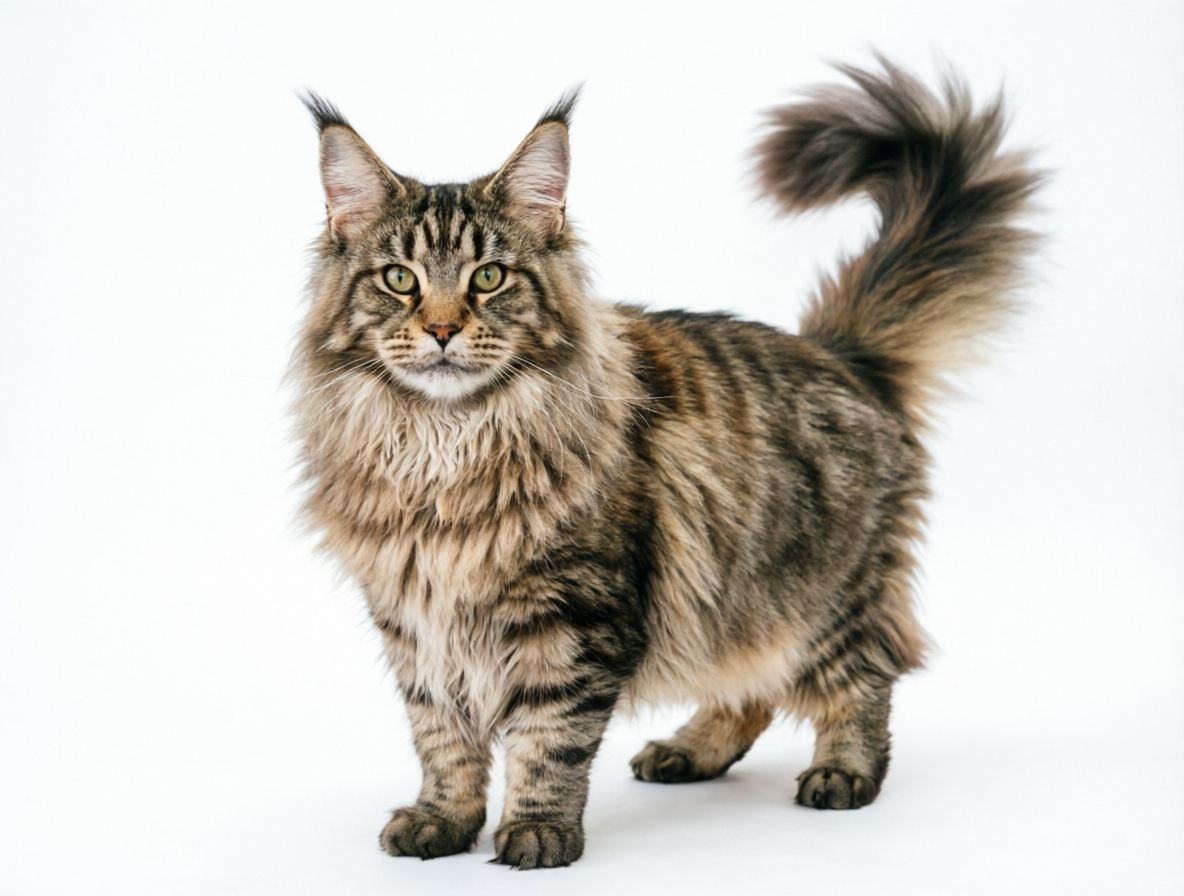
The Maine Coon has a long or medium-length coat that is soft and silky, with texture varying by coat color. The coat features several remarkable adaptations for survival in harsh winter climates: it is dense and water-resistant, longer and shaggier on the underside and rear for extra protection when walking or sitting on wet snow or ice. The length is shorter on the head and shoulders and longer on the stomach and flanks, with some cats having a leonine ruff around their neck.
Fact Number 15: Minimal Grooming Requirements
Despite their long, luxurious coats, Maine Coons require minimal grooming compared to other long-haired breeds. Their double coat is mostly self-maintaining due to a light-density undercoat. The coat is subject to seasonal variation, being thicker in the winter and thinner during the summer. This low-maintenance aspect makes them more practical pets than many other long-haired breeds.
Fact Number 16: The Multi-Purpose Tail
The Maine Coon’s long, bushy, raccoon-like tail serves multiple survival functions in winter weather. It is resistant to sinking in snow and can be curled around their face and shoulders for warmth and protection from wind and blowing snow. Perhaps most impressively, it can be curled around their backside like an insulated seat cushion when sitting down on frozen surfaces, providing natural insulation from the cold.
Fact Number 17: Natural Snowshoe Paws
Maine Coons have large paws that facilitate walking on snow and are often compared to snowshoes. Long tufts of fur grow between their toes, which help keep the toes warm and further aid walking on snow by giving the paws additional structure without significant extra weight. These specialized paws, combined with their large size, distribute their weight more effectively on snowy surfaces.
Fact Number 18: Heavily Tufted Ears
Maine Coons have heavily furred ears with extra-long tufts of fur growing from inside, which help keep them warm more easily in cold climates. These distinctive ear tufts, often called “lynx tips,” are one of the breed’s characteristic features and serve the practical purpose of protecting the ears from frostbite and heat loss in harsh winter conditions.
Fact Number 19: Coat Color Diversity
Maine Coons can have virtually any colors that other cats have, though some breed standards don’t accept colors indicating crossbreeding, such as chocolate, lilac, colorpoint patterns, or certain ticked tabby patterns. However, this varies by registry; for example, the ticked pattern is accepted by both TICA and CFA. The most common pattern seen in the breed is brown tabby. All eye colors are accepted under breed standards, with the exception of blue or odd-eyes in cats possessing coat colors other than white.
Fact Number 20: One of the Largest Domestic Cat Breeds
The Maine Coon is one of the largest breeds of domesticated cats and holds the distinction of being the largest non-hybrid breed. It was once considered the largest breed overall until the introduction of the hybrid Savannah cat (a cross between a serval and a domestic cat) in the mid-1980s. On average, males weigh from 8 to 10 kg (18 to 22 lb), while females weigh from 5 to 7 kg (12 to 15 lb).
Fact Number 21: Impressive Size Dimensions
Adult Maine Coons can vary in height between 25 and 41 cm (10 and 16 in) and can reach a length of up to 97 cm (38 in), including their tail, which alone can reach a length of 36 cm (14 in). The tail is long, tapering, and heavily furred, almost resembling a raccoon’s tail. The body is solid and muscular, which is necessary for supporting their substantial weight, and the chest is broad with a rectangular body shape.
Fact Number 22: Slow Physical Maturation
Maine Coons are remarkably slow to physically mature compared to other cat breeds. Their full size is normally not reached until they are three to five years old, whereas most other cats take about one year to reach their full size. This extended growth period means that Maine Coon kittens and juveniles continue developing and growing for several years before reaching their impressive adult dimensions.
Fact Number 23: Guinness World Record Holder
In 2010, the Guinness World Records accepted a male purebred Maine Coon named “Stewie” as the “Longest Cat,” measuring an astonishing 123 cm (48.5 in) from the tip of his nose to the tip of his tail. Stewie lived in Reno, Nevada, and sadly died on February 4, 2013, from cancer at age 8. As of 2015, the living record-holder for “Longest Cat” was “Ludo” in Wakefield, England, measuring 118 cm (46.59 in). Large Maine Coons can overlap in length with Eurasian lynxes, although with a much lighter build and lower height.
Fact Number 24: Polydactyl Heritage
Many of the original Maine Coon cats that inhabited the New England area possessed a trait known as polydactylism (having one or more extra toes on a paw). With the 1970s revival of interest in the breed, Maine Coons showed an increased incidence of polydactylism compared to other breeds. However, breeders of show-standard cats were advised to regard this variation as undesirable, and it became an automatic disqualifier in show rings, nearly eradicating the trait from the breed. The gene for polydactylism is a simple autosomal dominant gene, and the genetic mutations don’t appear to cause other health problems. Some organizations like TICA now separately certify polydactyl Maine Coons, and the trait is no longer marked down in increasing numbers of cat fancy competitions.
Fact Number 25: Health Considerations and Lifespan
Maine Coons have several health considerations that potential owners should be aware of. Hypertrophic cardiomyopathy (HCM) has been observed in the breed, with a mutation in the MYBPC3 gene associated with the condition; approximately one-third of Maine Coons tested for this mutation test positive, with an HCM prevalence of about 10.1%. Hip dysplasia affects 24.3% of Maine Coons according to OFA data from 1974-2011, with males of this large breed being most commonly affected. The breed is also one of the more commonly affected breeds for spinal muscular atrophy, caused by autosomal recessive mutations in the LIX1 and LNPEP genes. Regarding lifespan, Swedish pet insurance data from 2003-2006 puts the median lifespan at over 12.5 years, with 74% living to 10 years or more and 54% living to 12.5 years or more, though a UK study found a life expectancy of 9.71 years compared to 11.74 years for all cats.
🐾 Maine Coon FAQs
Below are the most frequently searched questions about Maine Coon cats, answered in detail based on breed standards, veterinary guidance, and insights from major cat registries (CFA, TICA, FIFe).
❓ What exactly is a Maine Coon cat?
The Maine Coon is one of the oldest natural breeds of domestic cat in North America, originating in the U.S. state of Maine—where it holds the honor of being the official state cat since 1985. Known as “gentle giants,” they combine impressive size with a sweet, sociable temperament. Unlike many breeds developed through selective crossbreeding, Maine Coons evolved naturally through adaptation to New England’s harsh winters, resulting in distinctive features like a water-resistant double coat, tufted ears, large snowshoe-like paws, and a long, bushy tail. Today, they are pedigreed in all major cat registries worldwide and ranked as the most popular cat breed globally by FIFe (2024) and CFA (2025).
❓ How big do Maine Coons actually get?
Maine Coons are among the largest domesticated cat breeds—and the largest non-hybrid breed. On average:
- Males: 8–10 kg (18–22 lb), though some exceed 11 kg (25 lb)
- Females: 5–7 kg (12–15 lb)
- Length: Up to 97 cm (38 in) from nose to tail tip
- Tail alone: Can reach 36 cm (14 in)
- Height: 25–41 cm (10–16 in) at the shoulder
⚠️ Important: Maine Coons mature slowly. They typically don’t reach their full size until 3–5 years of age, unlike most cats that finish growing by 12–18 months. The Guinness World Record for longest cat was held by a Maine Coon named Stewie, measuring 123 cm (48.5 in).
❓ Are Maine Coons good with children and other pets?
Yes—Maine Coons are renowned for their gentle, patient, and adaptable nature, making them excellent family companions. Key temperament traits include: ✅ Social and affectionate: They enjoy human interaction without being overly demanding
✅ Tolerant of handling: Generally patient with gentle children (supervision always recommended)
✅ Dog-like loyalty: Many follow owners room-to-room, greet visitors, and even play fetch
✅ Compatible with other pets: Usually get along well with cats, cat-friendly dogs, and even small animals when properly introduced
💡 Tip: Early socialization enhances these traits. Always teach children to respect a cat’s boundaries, regardless of breed.
❓ Do Maine Coons shed a lot? How much grooming do they need?
Maine Coons have a semi-long, double-layered coat that is dense and water-resistant—but surprisingly low-maintenance compared to other long-haired breeds.
🔹 Shedding: Moderate to heavy, especially during seasonal changes (spring “blowout” and fall thickening). Regular brushing minimizes loose hair around the home.
🔹 Grooming frequency: 2–3 times per week with a stainless-steel comb or slicker brush is usually sufficient. Daily brushing during shedding seasons helps prevent mats.
🔹 Special attention areas: Check behind ears, under legs, and around the tail base for tangles. Their coat is mostly self-maintaining due to a light-density undercoat.
🔹 Bathing: Rarely needed unless the cat gets dirty; their coat naturally repels dirt and moisture.
✅ Pro tip: Start grooming early to build positive associations. Most Maine Coons tolerate handling well due to their easygoing nature.
❓ Are Maine Coons hypoallergenic?
No, Maine Coons are not hypoallergenic. Like all cats, they produce the Fel d 1 protein—the primary allergen in cat saliva and skin secretions—which triggers reactions in sensitive individuals. While no cat breed is 100% hypoallergenic, some people report milder reactions to certain breeds due to lower Fel d 1 production or coat type. Maine Coons’ dense fur can actually trap more dander, potentially worsening symptoms for allergy sufferers.
✅ If you have allergies:
- Spend time with a Maine Coon before adopting to test your reaction
- Use HEPA air filters and vacuum frequently
- Wash hands after handling and avoid touching your face
- Consult an allergist about management strategies
❓ Do Maine Coons like water?
Many Maine Coons exhibit a notable fascination with water—a trait likely inherited from their working-cat ancestors who lived on ships and farms. Common water-related behaviors include: 💧 Playing with dripping faucets or water bowls
💧 Pawing at water dishes before drinking
💧 Joining owners in the shower or bath (some even enjoy swimming!)
💧 Not avoiding rain or sprinklers like many other cats
⚠️ Safety note: Never force a cat into water. While some Maine Coons enjoy it, individual preferences vary. Always supervise water play and ensure easy exit routes.
❓ What health issues should I watch for in Maine Coons?
While generally robust, Maine Coons are predisposed to several hereditary conditions. Responsible breeders screen for these:
| Condition | Description | Screening/Management |
|---|---|---|
| Hypertrophic Cardiomyopathy (HCM) | Thickening of the heart muscle; leading cause of heart disease in cats | Annual echocardiograms; genetic testing for MYBPC3 mutation (≈10.1% prevalence) |
| Hip Dysplasia | Malformation of the hip joint causing arthritis or lameness | OFA radiograph screening; affects ~24.3% of Maine Coons |
| Spinal Muscular Atrophy (SMA) | Genetic disorder causing muscle weakness and atrophy | DNA test available; autosomal recessive inheritance |
| Polycystic Kidney Disease (PKD) | Fluid-filled cysts in kidneys (less common than in Persians) | Ultrasound screening; genetic testing |
| Dental Disease | Higher risk of gingivitis and tooth resorption | Regular dental checkups; home toothbrushing recommended |
✅ Adoption tip: Always request health clearances for both parents when buying from a breeder. Reputable breeders provide documentation from OFA, PennHIP, or veterinary cardiologists.
❓ How long do Maine Coons live?
With proper care, Maine Coons typically live 12–15 years, though many reach their late teens. Key factors influencing lifespan:
- Genetics: Health-screened breeding stock reduces hereditary disease risk
- Indoor living: Protects from accidents, predators, and infectious diseases
- Nutrition: High-quality, age-appropriate diet supports joint and heart health
- Preventive care: Annual vet exams, vaccinations, dental care, and parasite control
📊 Data insight: Swedish pet insurance records (2003–2006) show 74% of Maine Coons lived to age 10+, and 54% to 12.5+. A UK study noted a slightly lower average (9.71 years), likely reflecting differences in healthcare access or reporting.
❓ How much does a Maine Coon kitten cost?
Prices vary significantly based on source, location, and pedigree:
| Source | Price Range (USD) | What to Expect |
|---|---|---|
| Reputable Breeder | $1,000–$2,500+ | Health-tested parents, registration papers, early socialization, contract, support |
| Pet-Quality (non-show) | $800–$1,500 | Same health standards, but may have minor cosmetic deviations from breed standard |
| Rescue/Shelter | $50–$300 | Adult or young adult cats; often spayed/neutered, vaccinated, microchipped |
| Backyard Breeder/Pet Store | $300–$800 | ⚠️ High risk of health/behavioral issues; avoid due to lack of screening and ethics |
💡 Red flags: Prices that seem “too good to be true,” no health documentation, unwillingness to let you meet the kitten’s parents, or pressure to pay upfront without contracts.
❓ How can I tell if my cat is a purebred Maine Coon?
Without registration papers, it’s impossible to confirm purebred status—but these physical and behavioral traits are strong indicators:
✅ Physical markers:
- Large, rectangular body with broad chest and muscular build
- Long, bushy tail (often as long as the body)
- Tufted ears (“lynx tips”) and large, expressive eyes (green, gold, or copper; blue only in white cats)
- Water-resistant, shaggy coat with ruff around neck and “britches” on hind legs
- Large paws with prominent toe tufts
✅ Behavioral clues:
- Friendly, people-oriented personality
- Vocal with soft chirps, trills, and “chattering” (less meowing)
- Playful into adulthood; may enjoy fetch or leash walks
⚠️ Important: Many domestic longhairs (“moggies”) share Maine Coon-like features due to convergent evolution. Only DNA testing or verified pedigree paperwork can confirm purebred status.
❓ Do Maine Coons meow, or do they make other sounds?
Maine Coons are known for their unique vocalizations—they rarely use a standard “meow.” Instead, expect: 🔊 Chirps and trills: Short, bird-like sounds used to greet people or express curiosity
🔊 Chattering: Rapid jaw movements with soft clicks, often when watching birds
🔊 Purring: Loud, rumbling purrs when content
🔊 Soft mews: Gentle, high-pitched calls for attention
This “talkative but not loud” communication style is part of their dog-like charm. Many owners report their Maine Coons “converse” with them throughout the day.
❓ When do Maine Coons stop growing?
Maine Coons have an exceptionally long growth curve:
- 0–12 months: Rapid kitten growth; reach ~70% of adult size
- 1–3 years: Continued filling out; muscle development, coat thickening, skeletal maturation
- 3–5 years: Reach full physical maturity—height, weight, and coat density stabilize
💡 Practical tip: Feed a high-quality kitten formula until 12–18 months, then transition to adult food formulated for large breeds to support joint health. Avoid overfeeding during growth spurts to prevent obesity.
❓ Are polydactyl Maine Coons rare or special?
Polydactylism (extra toes) was once common in early Maine Coons—up to 40% of the original New England population had this trait. While show standards historically disqualified polydactyls (nearly eradicating the gene from pedigreed lines), the trait is experiencing a revival:
✅ Genetics: Caused by a simple autosomal dominant gene; not linked to health problems
✅ Function: Extra toes may have aided grip on ships or snowy terrain
✅ Recognition: TICA now registers polydactyl Maine Coons separately; many rescues specialize in them
✅ Pop culture: Often called “Hemingway cats” (after the author’s famous polydactyl colony in Key West)
If you adopt a polydactyl Maine Coon, trim nails regularly—extra toes can curl inward if neglected.
❓ What’s the difference between a Maine Coon and a Norwegian Forest Cat?
Though both are large, long-haired breeds adapted to cold climates, key differences exist:
| Feature | Maine Coon | Norwegian Forest Cat |
|---|---|---|
| Origin | United States (Maine) | Norway |
| Head Shape | Square muzzle, high cheekbones | Triangular head, straight profile |
| Ears | Large, wide-set, heavily tufted | Medium, alert, moderately tufted |
| Body | Rectangular, muscular, broad chest | Solid but more elegant; slightly longer back |
| Coat | Uneven length: short on shoulders, long on belly/flanks; silky texture | Even length all over; dense, woolly undercoat |
| Tail | Long, flowing, full-length fur | Long, bushy, but fur length matches body coat |
| Temperament | Outgoing, dog-like, highly social | Independent but affectionate; reserved with strangers |
💡 Fun fact: Their similar appearances result from convergent evolution—not shared ancestry. Genetic studies confirm Maine Coons are closest to UK domestic cats, while Norwegian Forest Cats form a distinct Scandinavian lineage.
❓ Are Maine Coons better as indoor or outdoor cats?
Indoor living is strongly recommended for Maine Coons (and all domestic cats) by veterinarians and animal welfare organizations. Reasons include: 🛡️ Safety: Protection from traffic, predators, toxins, and theft
🛡️ Health: Lower risk of FIV/FeLV, parasites, and injuries
🛡️ Longevity: Indoor cats live significantly longer on average
✅ Enrichment ideas for indoor Maine Coons:
- Cat trees, window perches, and puzzle feeders
- Supervised leash walks or enclosed “catios”
- Interactive play sessions (feather wands, laser pointers)
- Vertical space to satisfy climbing instincts
If you desire outdoor access, a secure, escape-proof catio is the safest compromise.
❓ Where can I responsibly adopt or buy a Maine Coon?
✅ Reputable Breeders:
- Find via CFA (cfa.org), TICA (tica.org), or FIFe breeder directories
- Look for health testing, contracts, lifetime support, and willingness to show facilities
- Expect waitlists—ethical breeders prioritize kitten welfare over volume
✅ Rescue Organizations:
- Breed-specific rescues: Maine Coon Rescue (US), MCRC (UK), Coon Companions
- General shelters: Use Petfinder or Adopt-a-Pet with “Maine Coon” filter
- Benefits: Lower cost, saving a life, often adult cats with known personalities
❌ Avoid: Pet stores, online marketplaces (Craigslist, Facebook), or breeders who:
- Don’t allow home visits or meet-the-parents
- Sell kittens under 12–14 weeks old
- Lack health documentation or contracts
💡 Adoption tip: Adult Maine Coons in rescues often have established personalities and may be already litter-trained and socialized—ideal for first-time owners.
🐾 Final Thought: Maine Coons aren’t just pets—they’re companions with personality, history, and heart. Whether you’re drawn to their majestic appearance, gentle nature, or fascinating heritage, responsible ownership means committing to their health, enrichment, and lifelong well-being. When in doubt, consult your veterinarian or a certified cat behaviorist to ensure your gentle giant thrives.
Sources: Cat Fanciers’ Association (CFA), The International Cat Association (TICA), Fédération Internationale Féline (FIFe), Cornell Feline Health Center, OFA, and peer-reviewed veterinary journals.