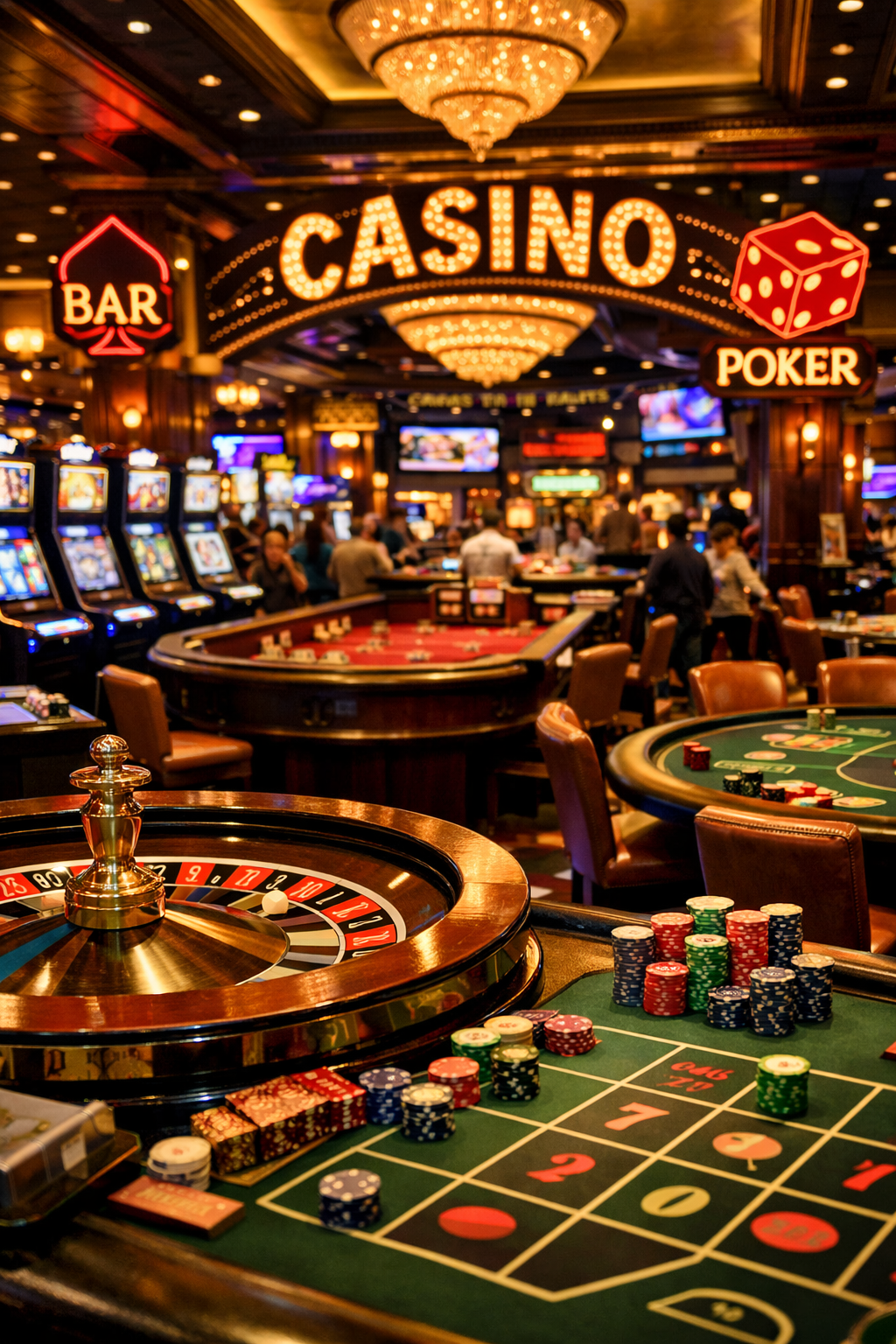
Casino
Casinos are far more than just a dazzling array of flashing lights, ringing bells, and stacked chips; they are masterclasses in human psychology, historical evolution, and ruthless mathematical precision. From their humble origins as 18th-century Italian social villas to the sprawling, multi-billion-dollar mega-resorts of Macau and Las Vegas, these establishments have continually adapted to captivate the human imagination and dominate the global entertainment industry. Behind the glamorous, high-rolling façade lies a meticulously engineered world where every single detail—from the ambient, mood-enhancing scent in the air and the resonant chime of a slot machine to the rapid, scheduled replacement of worn dice—is deliberately designed to keep you playing. Whether you are a seasoned poker player, a curious traveler, or simply fascinated by the hidden mechanics of the gaming world, these 25 captivating facts will pull back the curtain on the “eye in the sky” and reveal the surprising, often counterintuitive truths about how the house always wins.
1. Italian Origins
The word “casino” has undergone a fascinating linguistic evolution. It originates from the Italian word “casa,” meaning “house.” The suffix “-ino” denotes something small, so “casino” originally translated to a “small house.” In 18th- and 19th-century Italy, a casino was not a place for gambling, but rather a small country villa, a garden pavilion, or a social club attached to a larger estate where the aristocracy would gather for music, dancing, and leisurely socializing. It was only later, as these social clubs began to incorporate games of chance as a primary form of entertainment, that the term became inextricably linked with gambling establishments worldwide.
2. First European Gambling House
The Ridotto, opened in Venice, Italy, in 1638, holds the distinction of being the world’s first known government-sanctioned gambling house. Established by the Great Council of Venice, its primary purpose was to provide a controlled, regulated environment for gambling during the chaotic annual carnival season. To maintain an air of exclusivity and order, patrons were required to wear formal attire (including masks and tricorne hats) and pay a substantial entry fee. However, the Ridotto was eventually shut down in 1774 by reformers who argued that the institution was leading to the moral decay and financial ruin of the Venetian nobility.
3. American Saloons
In the 18th and 19th centuries, before the concept of the modern casino existed in the United States, gambling was primarily conducted in frontier saloons. These establishments were the social epicenters of growing cities like New Orleans, St. Louis, Chicago, and San Francisco. While drinking was the main draw, saloons provided a vital communal space where travelers, miners, and merchants could socialize, conduct business, and gamble. Games like faro, poker, and faro were ubiquitous, though the lack of regulation meant that cheating, violence, and swift, unofficial justice were common hazards of the saloon gambling scene.
4. Nevada’s Legalization
The modern American casino industry was born out of economic desperation. In 1931, in the depths of the Great Depression, the state of Nevada was facing severe financial strain and a declining population. In a bold move to stimulate the economy, the state legislature legalized wide-open gambling. This pivotal decision paved the way for the development of Las Vegas. Visionaries and organized crime figures alike saw the potential, leading to the construction of lavish resort-casinos like the Flamingo in 1946, which transformed a dusty Mojave Desert railroad town into the glittering, world-renowned entertainment capital it is today.
5. Atlantic City’s Entry
For decades, Las Vegas held a near-monopoly on legal casino gambling in the United States. That changed in 1976 when New Jersey voters approved a referendum to legalize casino gambling, specifically restricted to the city of Atlantic City. The move was marketed as an urban renewal strategy designed to revitalize the declining seaside resort town, create jobs, and generate tax revenue without raising state income taxes. While it successfully transformed the Atlantic City boardwalk and made it the second-largest gambling hub in the US, the long-term socioeconomic benefits to the broader city remain a subject of intense debate among economists and urban planners.
6. The House Edge
The fundamental business model of every casino in the world is built on a mathematical certainty known as the “house edge.” This is not about rigging individual games, but rather about the built-in statistical advantage encoded into the rules of every game. For example, in American roulette, the presence of the green “0” and “00” means there are 38 possible outcomes, but the payout for a single-number win is only 35 to 1. While a player might win in the short term due to variance, the law of large numbers dictates that over thousands of bets, the casino’s expected value is uniformly positive, while the player’s is uniformly negative, guaranteeing the house a profit over time.
7. Low Winning Rate
The mathematical reality of the house edge is starkly illustrated by empirical data. A comprehensive longitudinal study tracking 4,222 casino gamblers over a two-year period revealed a sobering statistic: only 13.5% of them ended up with a net profit. This finding debunks the “gambler’s fallacy”—the mistaken belief that past losses increase the likelihood of future wins—and highlights that casino gambling is fundamentally a form of paid entertainment, not a viable strategy for generating income. The vast majority of players are mathematically destined to be net losers over an extended period of play.
8. Sound Engineering
Modern casinos are masterclasses in environmental psychology, and sound plays a crucial role. MIT anthropologist Natasha Dow Schüll, in her extensive research on gambling behavior, documented how audio directors at companies like Silicon Gaming meticulously engineer the sounds of slot machines. They design winning chimes, spinning reels, and even “near-miss” sounds to resonate in “the universally pleasant tone of C major.” These carefully sampled, harmonious soundscapes are designed to trigger dopamine releases in the brain, creating a subconscious sense of pleasure and accomplishment that encourages players to keep feeding the machine, even when they are losing money.
9. Scent Marketing
Olfactory marketing is another subtle but highly effective tool in the casino’s psychological arsenal. Research conducted by Dr. Alan Hirsch, a neurological expert in smell and taste, demonstrated that introducing a pleasant, unidentifiable ambient scent (often a subtle blend of floral and citrus notes) into a casino environment can increase slot machine revenue by up to 50%. Hirsch suggested that these pleasing scents act as a mild, subconscious aphrodisiac or mood enhancer. They reduce player fatigue, mask the unpleasant odors of a crowded room, and create a welcoming atmosphere that subtly encourages patrons to stay and gamble longer.
10. Macau’s Dominance
While Las Vegas is the most famous gambling city culturally, Macau is the undisputed financial heavyweight of the global casino industry. A special administrative region of China, Macau surpassed Las Vegas in total gaming revenue in 2006 and has maintained its lead ever since. Unlike Las Vegas, which generates a significant portion of its revenue from mass-market tourism, hotel stays, dining, and entertainment shows, Macau’s economy is overwhelmingly driven by high-stakes baccarat played by wealthy VIPs and “high rollers” from mainland China, facilitated by a network of junket operators.
11. Monte Carlo’s Legacy
The Monte Carlo Casino, located in the Principality of Monaco, opened its doors in 1865. It was originally commissioned by Prince Charles III as a desperate measure to save the tiny, nearly bankrupt principality from financial ruin. The casino was a resounding success, designed with opulent Belle Époque architecture to attract Europe’s wealthiest aristocrats. Over the decades, its strict dress codes, legendary roulette tables, and aura of old-world exclusivity have made it a cultural icon, immortalized in countless novels, songs, and films as the ultimate symbol of high-stakes, glamorous gambling.
12. James Bond Connection
The Monte Carlo Casino’s aura of sophistication is inextricably linked to the James Bond franchise. Author Ian Fleming, who frequently gambled at the Estoril Casino in Portugal (which heavily inspired his writing), used the glamorous setting of Monte Carlo as the backdrop for several of his novels, most notably Casino Royale. This cinematic connection was cemented in the 1962 film Dr. No, where Sean Connery’s Bond delivers the iconic line, “Bond, James Bond,” while playing Chemin de Fer at the Les Ambassadeurs Club in London. The aesthetic of that scene perfectly captured the Monte Carlo vibe, establishing the template for the suave, high-rolling secret agent.
13. Breaking the Bank
In 1891, an English trickster and gambler named Charles Wells achieved the seemingly impossible: he “broke the bank” at the Monte Carlo Casino, meaning he won so much money that the casino’s table ran out of funds to pay him. He reportedly repeated this feat multiple times over a single weekend, winning the equivalent of millions in today’s currency. His exploits inspired the famous 1892 British music hall song “The Man Who Broke the Bank at Monte Carlo.” However, historical investigations later revealed that Wells’s “winning system” was likely a martingale betting strategy funded by a massive fraud or Ponzi scheme, making his legendary win a mix of aggressive betting and illicit financing rather than pure skill.
14. Europe’s Largest Casino
The Casinò di Campione, located in Campione d’Italia, holds the title of the largest casino in Europe. Campione is a unique Italian exclave, meaning it is an Italian territory entirely surrounded by Swiss land. The casino’s massive footprint, covering over 55,000 square meters (590,000 sq ft) in its modern 2007 premises, reflects its strategic position. It serves as a major tax-advantaged entertainment hub, drawing a massive influx of Swiss and broader European tourists who cross the border to enjoy its vast array of slot machines, table games, restaurants, and live entertainment under Italian jurisdiction.
15. World’s Largest Casino
The Venetian Macao, located in the Cotai Strip of Macau, China, is currently the largest casino and one of the largest building complexes in the world. Operated by Las Vegas Sands, it spans over 10.5 million square feet of total space. It is not merely a gambling hall but a colossal, self-contained “city within a city.” The resort features a meticulously crafted replica of Venice, complete with indoor canals, gondola rides, a replica of the Rialto Bridge, and St. Mark’s Campanile, alongside thousands of hotel rooms, massive convention spaces, and a sprawling gaming floor that dwarfs traditional casino resorts.
16. Most Expensive Casino
The Marina Bay Sands in Singapore stands as the second most expensive standalone casino resort in the world, with a staggering construction cost of US$6.8 billion. Designed by renowned architect Moshe Safdie, the resort is famous for its iconic structure: three soaring 55-story hotel towers connected at the top by a massive, ship-like SkyPark that features the world’s largest rooftop infinity pool. The astronomical price tag reflects the sheer ambition of the Singaporean government’s integrated resort model, which was designed to instantly establish the city-state as a premier, ultra-luxury global tourism and business destination.
17. US Casino Count
The United States boasts the largest number of casinos in the world, with over 1,000 licensed gambling establishments spread across 40 different states. This widespread proliferation is the result of decades of state-by-state legislative decisions. As states sought new ways to generate tax revenue without raising income or sales taxes, many turned to gambling. This has created a highly fragmented but massive domestic gambling ecosystem, ranging from massive commercial resort casinos in Nevada and New Jersey to riverboat casinos in the Midwest and racinos (racetracks with slot machines) in various other states.
18. Native American Gaming
A massive shift in the American gambling landscape was driven by the Indian Gaming Regulatory Act (IGRA) of 1988. This federal law formally recognized the right of Native American tribes to operate gaming facilities on their sovereign tribal lands. The stated goal was to promote tribal economic development, self-sufficiency, and strong tribal governments. Since its passage, Native American gaming has exploded, resulting in hundreds of tribal casinos across the country. These establishments have become vital economic engines for many tribes, funding healthcare, education, and infrastructure, while also bringing casino gambling to regions far outside traditional hubs like Las Vegas.
19. Eye in the Sky
Casino security is a highly sophisticated, multi-layered operation, famously anchored by a surveillance system known in the industry as the “eye in the sky.” This system consists of thousands of high-definition, pan-tilt-zoom cameras strategically placed throughout the gaming floor, hallways, and cash handling areas. These feed into a secure, windowless surveillance room manned by trained operators who monitor the floor in real-time. In older or highly secure setups, this is supplemented by physical catwalks hidden above the ceiling tiles, equipped with one-way glass, allowing security personnel to physically observe dealers and players without being seen.
20. The Mirage Innovation
When Steve Wynn opened The Mirage in Las Vegas in 1989, it revolutionized not only casino design (introducing the iconic volcano and the modern resort model) but also casino security. The Mirage was the first major casino to install and utilize video cameras full-time on all table games, not just the high-limit areas. This innovation provided an indisputable visual record of every hand dealt and every chip wagered. It dramatically deterred cheating, protected dealers from false accusations of errors or theft, and set a new, uncompromising industry standard that every major casino operator subsequently adopted.
21. Rapid Card Replacement
In a casino, the integrity of the game is paramount, and even the slightest imperfection in equipment can be exploited. Playing cards are subjected to intense, repetitive use. Microscopic bends, creases, or “crimps” can be felt by skilled card mechanics or used by card counters to track specific high-value cards. To maintain absolute game integrity, casinos rigorously cycle decks out of play every 2 to 4 hours. Once removed, these decks are typically destroyed—often by punching a hole through them or cutting off their corners—to prevent them from re-entering circulation, though some are sold as souvenirs, contributing to industry waste.
22. Frequent Dice Changes
Similar to playing cards, casino dice are precision-machined to exacting standards, featuring perfectly sharp edges and perfectly balanced weight distribution to ensure truly random outcomes. However, the constant, violent rolling of the dice against the felt-covered table and the rubberized back wall takes a physical toll. Over the course of an 8-hour shift, the edges of the dice can become slightly dulled, or microscopic chips can form, which could theoretically alter the physics of a roll and favor certain outcomes. To prevent this, casino protocols mandate that dice be inspected and replaced approximately every 8 hours.
23. Massive Dice Cup Waste
The strict replacement policies for gaming equipment create a staggering environmental footprint. It is estimated that globally, over 500,000 sets of dice cups (the containers used to shake and roll dice in games like craps) are discarded annually. Casinos are responsible for roughly 70% of this waste. While some forward-thinking casinos have begun implementing recycling programs or donating gently used cards to magic shops, schools, or charities, the vast majority of worn dice, shredded cards, and plastic dice cups still end up in landfills, prompting growing calls for more sustainable manufacturing and disposal practices within the gaming industry.
24. Mafia Influence
The early history of major casino hubs is deeply entangled with organized crime. In mid-20th-century Las Vegas, the American Mafia, led by figures like Bugsy Siegel, Meyer Lansky, and Tony Spilotro, provided the illicit capital and muscle necessary to build the city’s early resorts. They famously utilized “the skim”—siphoning untaxed cash directly from the counting rooms before it was officially recorded—to fund mob operations nationwide. Similarly, in Macau, Triad syndicates historically exerted heavy control over the illegal junket system, loan sharking, and casino operations. While stringent modern regulations and corporate oversight have heavily curtailed their overt influence, this criminal legacy remains a defining chapter in casino history.
25. Worker Health Risks
While much attention is paid to the financial risks faced by gamblers, casino employees face significant, documented occupational health hazards. Table game dealers, in particular, are required to stand for long, grueling shifts while performing highly repetitive motions, such as shuffling, dealing, and raking in chips. This leads to high rates of musculoskeletal disorders, including carpal tunnel syndrome, tendonitis, and chronic back pain. Additionally, despite widespread smoking bans in many modern jurisdictions, historical and ongoing exposure to second-hand tobacco smoke in gaming areas remains a severe, documented health risk for casino staff, contributing to higher rates of respiratory issues and certain cancers.
Frequently Asked Questions (FAQs) About Casinos
Casino games are not “rigged” in the sense of being illegally manipulated to cheat you on a specific spin or hand; they are simply governed by strict, unbreakable mathematics. For electronic games like slot machines, outcomes are determined by a Random Number Generator (RNG), a microchip that cycles through millions of number combinations per second, ensuring every spin is entirely independent and random. These RNGs are heavily audited and regulated by state or national gaming commissions. For table games, the “rigging” is built into the rules themselves via the “house edge.” The payouts are always slightly lower than the true odds of winning (like the green 0 and 00 on a roulette wheel). This mathematical guarantee ensures the casino makes a profit over time, making cheating unnecessary and highly risky for the business.
This is one of the most persistent casino myths, popularized by movies like Ocean’s Eleven. The short answer is no. Pumping concentrated oxygen into a public building would be a massive, catastrophic fire hazard, as it would make the environment highly combustible, especially with the presence of cigarettes and electrical equipment. It is also strictly illegal. However, casinos do use environmental psychology to keep you awake and playing. They eliminate clocks and windows to distort your sense of time, keep the lighting bright and stimulating, offer free (often alcoholic) beverages, and, as previously mentioned, pump in subtle, pleasant ambient scents to reduce fatigue and create a welcoming atmosphere.
If your goal is to minimize the house edge and maximize your playing time, you should stick to games that involve an element of skill or have simple, favorable rules. Blackjack is widely considered the best game; if you play using perfect “basic strategy,” the house edge can be reduced to as low as 0.5%. Craps is also excellent, specifically the “Pass Line” or “Don’t Pass” bets, which carry a house edge of around 1.4%, and allow you to take “odds” bets that have a true 0% house edge. Baccarat is another top choice, particularly betting on the “Banker,” which has a house edge of just 1.06%. Conversely, games like Keno, Wheel of Fortune, and certain proprietary table games often have house edges exceeding 10% to 25%.
Using your brain to track the ratio of high to low cards remaining in a deck is not illegal under federal or state law; it is simply a strategy of applying probability. However, casinos are private businesses, and they reserve the right to refuse service to anyone. If a casino’s “eye in the sky” and pit bosses suspect you are counting cards, they will not arrest you, but they will absolutely ask you to leave. They may also “back you off” a specific game, ban you from the property entirely, or implement countermeasures like shuffling the deck after every hand or using Continuous Shuffling Machines (CSMs) to render card counting completely useless.
When you insert a Player’s Club (or loyalty) card into a slot machine or hand it to a blackjack dealer, the casino’s computer system begins tracking your “theoretical loss.” It calculates this based on your average bet size, the speed of your play, and the house edge of the game you are playing. The casino uses this data to determine your “worth” to them. In return, they offer “comps” (complimentary items) like free meals, hotel rooms, or show tickets. This is not out of pure generosity; it is a calculated marketing expense. The casino knows that the mathematical house edge will eventually extract far more money from you than the cost of the free steak dinner or hotel room they provided.
Yes, in most jurisdictions, including the United States, gambling winnings are considered taxable income and must be reported to the government. In the US, casinos are legally required to report your winnings to the IRS if they exceed certain thresholds (e.g., $1,200 or more on a slot machine or bingo game, or $5,000+ on certain table games or poker tournaments), issuing you a W-2G form. However, you are legally responsible for reporting all winnings, regardless of whether you receive a form. The silver lining is that in the US, if you itemize your deductions, you can deduct your gambling losses up to the total amount of your reported winnings, provided you keep meticulous records, receipts, and a gambling diary to prove your losses to the IRS.
Modern casino security is a blend of advanced technology and highly trained human observation. The “eye in the sky” uses high-definition, AI-assisted cameras that can track a specific chip or card across the entire floor. Software can detect betting anomalies or suspicious patterns in real-time. On the floor, pit bosses and dealers are trained to spot physical cheating techniques, such as “past posting” (adding chips to a bet after the outcome is known), “capping” (hiding high-value chips under low-value ones), or using marked cards. Additionally, many casinos now employ facial recognition software linked to databases of known advantage players, card counters, and banned individuals, alerting security the moment a flagged person walks through the doors.